
When you’re shopping for an air conditioner, planning an installation, or preparing for a move, understanding air conditioner weight is essential. The weight of your AC unit affects everything from window frame support requirements to transportation logistics and installation complexity.
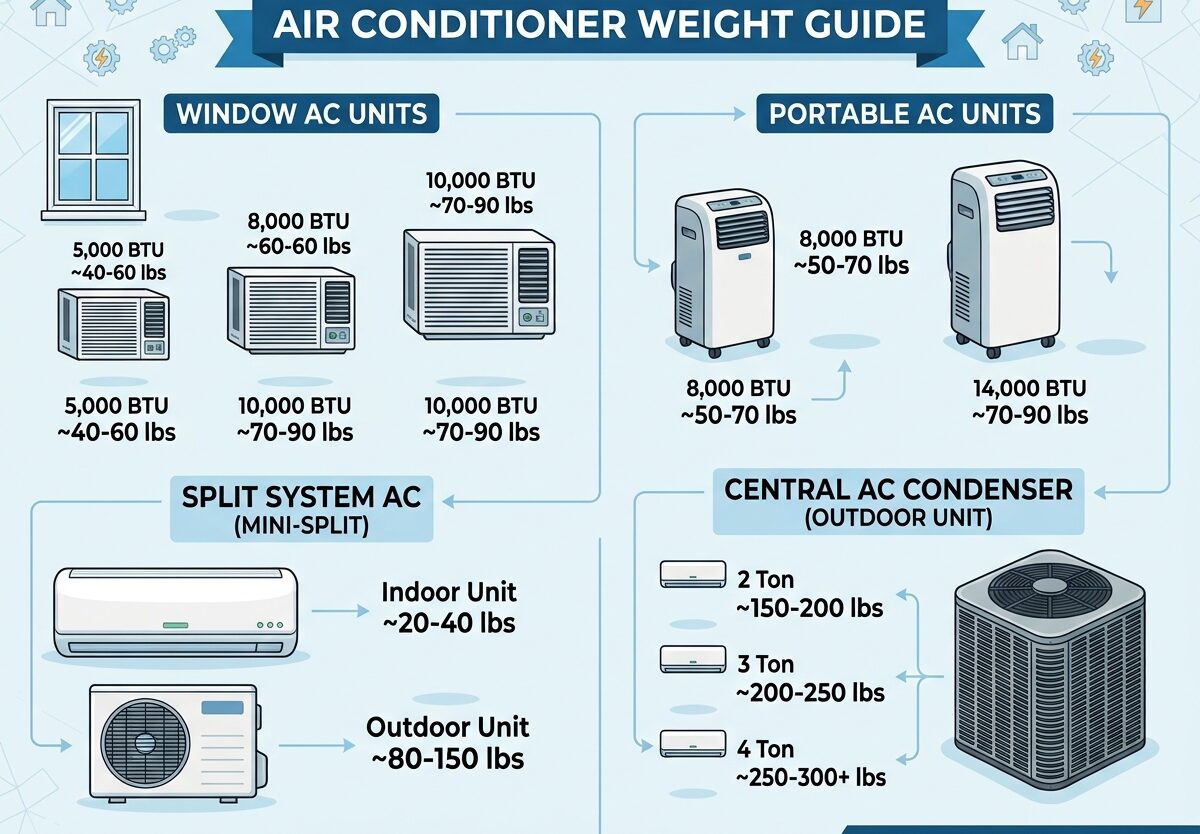
On average, an air conditioner weighs between 60-180 lbs (27-82 kg), with significant variation based on type, capacity, and design. Small window units can weigh as little as 40 lbs (18 kg), while central air conditioning systems can exceed 400 lbs (181 kg) for outdoor condenser units alone.
This comprehensive guide breaks down air conditioner weight by type, BTU capacity, and tonnage, with both pounds and kilogram measurements. We’ll also explain what makes these units heavy and why weight matters for safe installation.
Air Conditioner Weight by Type: Quick Overview
AC unit weights vary dramatically depending on the design and cooling capacity. Here’s what you can expect from each major category:
- Window air conditioners: 40-130 lbs (18-59 kg) – Lightest option, varies by BTU
- Portable air conditioners: 50-80 lbs (23-36 kg) – Self-contained units on wheels
- Ductless mini-split systems: 25-60 lbs indoor (11-27 kg), 80-180 lbs outdoor (36-82 kg)
- Central air conditioners: 150-400+ lbs outdoor unit (68-181+ kg), 50-150 lbs indoor (23-68 kg)
These ranges represent typical residential units. Commercial systems can weigh significantly more, often exceeding 1,000 lbs (454 kg) for large-scale applications.
Window Air Conditioner Weight by BTU
Window air conditioners are the most common type for single-room cooling. Their weight directly correlates with cooling capacity, measured in BTUs (British Thermal Units). Higher BTU ratings require larger compressors, more refrigerant, and bigger coils, all of which add weight.
Window AC Weight Chart by BTU
| BTU Rating | Room Size | Weight Range (lbs) | Weight Range (kg) |
|---|---|---|---|
| 5,000 BTU | 100-150 sq ft | 40-55 lbs | 18-25 kg |
| 6,000 BTU | 150-250 sq ft | 45-60 lbs | 20-27 kg |
| 8,000 BTU | 250-350 sq ft | 50-70 lbs | 23-32 kg |
| 10,000 BTU | 350-450 sq ft | 55-80 lbs | 25-36 kg |
| 12,000 BTU | 450-550 sq ft | 65-90 lbs | 29-41 kg |
| 14,000 BTU | 550-700 sq ft | 75-100 lbs | 34-45 kg |
| 18,000 BTU | 700-1,000 sq ft | 90-120 lbs | 41-54 kg |
| 24,000 BTU | 1,000-1,300 sq ft | 110-130 lbs | 50-59 kg |
As you can see, air conditioner weight increases predictably with BTU capacity. A standard 5,000 BTU window unit weighs around 50 lbs (23 kg), while a powerful 24,000 BTU model can exceed 130 lbs (59 kg). This five-fold increase in cooling capacity roughly triples the weight.
U-Shaped Window AC Considerations
Innovative U-shaped window air conditioners, like those from Midea, redistribute weight differently than traditional window units. These models position most of the weight outside the window frame, reducing stress on your window sill. A typical 12,000 BTU U-shaped window AC weighs approximately 68-75 lbs (31-34 kg), similar to traditional units but with better weight distribution.
Users on home improvement forums frequently report that U-shaped designs feel more secure because the window itself supports less weight. If you’re concerned about window frame integrity, especially with older windows, this design offers advantages despite similar total weight.
Window Weight Limits and Safety
Before installing any window AC, verify your window frame can support the weight. Most modern double-hung windows can safely support 80-100 lbs (36-45 kg) when properly installed in the frame track. Older windows, particularly those with wood frames that may have weakened over time, may have lower limits.
Real user experiences shared on forums like Reddit’s r/HomeImprovement show mixed results with heavy units. Several users report window frame cracking when installing units over 100 lbs (45 kg) without proper support. If your AC exceeds 80 lbs (36 kg), consider using a support bracket that transfers weight to the exterior wall rather than relying solely on the window frame.
Portable Air Conditioner Weight
Portable air conditioners offer flexibility but still pack considerable weight. These self-contained units house all components—compressor, condenser, evaporator, and fans—in a single cabinet on wheels, making them heavier than equivalent window units of the same cooling capacity.
Portable AC Weight by BTU
| BTU Rating | Weight Range (lbs) | Weight Range (kg) |
|---|---|---|
| 8,000 BTU | 50-60 lbs | 23-27 kg |
| 10,000 BTU | 55-65 lbs | 25-29 kg |
| 12,000 BTU | 60-72 lbs | 27-33 kg |
| 14,000 BTU | 65-80 lbs | 29-36 kg |
Despite their portability, these units present lifting challenges. Most portable ACs weigh between 50-80 lbs (23-36 kg), which can be difficult for some users to move up stairs or position near windows. The mobility helps with positioning within a room, but initial placement requires careful planning.
Forum discussions reveal that elderly users and those with mobility issues often struggle with portable AC weight. If you fall into this category, consider recruiting assistance for initial placement or opt for a lighter window unit or professional installation.
Ductless Mini Split Air Conditioner Weight
Ductless mini-split systems distribute weight between indoor and outdoor components, reducing individual unit weight compared to centralized systems. This design makes installation more flexible and reduces structural concerns.
Indoor Unit Weight
Mini-split indoor air handlers typically weigh 25-60 lbs (11-27 kg), depending on capacity and features. Their lightweight design allows mounting on virtually any interior wall without special reinforcement. The slim profile concentrates weight in a small footprint, minimizing stress on mounting brackets.
Outdoor Unit Weight
The outdoor condenser unit bears most of the system’s weight, ranging from 80-180 lbs (36-82 kg) for residential single-zone systems. Despite being heavier than indoor units, ground-level installation on concrete pads eliminates structural concerns.
Multi-Zone Systems
Homes requiring multiple indoor units connect to a single, larger outdoor condenser. These multi-zone outdoor units can weigh 200-300+ lbs (91-136+ kg), necessitating proper pad preparation but still less than equivalent central air systems.
The distributed weight advantage of mini-splits makes them ideal for older homes, retrofits, and situations where window AC installation isn’t feasible. Homeowners particularly appreciate not having to worry about window frame support limits.
Central Air Conditioner Weight by Tonnage
Central air conditioning systems use tonnage rather than BTU to measure capacity. One ton equals 12,000 BTU of cooling capacity. Residential central AC systems typically range from 1.5 to 5 tons, with weight scaling proportionally.
Central AC Weight Chart by Tonnage
th>BTU Equivalent
| System Tonnage | Outdoor Unit Weight (lbs) | Outdoor Unit Weight (kg) | Indoor Unit Weight (lbs) | Indoor Unit Weight (kg) | |
|---|---|---|---|---|---|
| 1.5 ton | 18,000 BTU | 120-150 lbs | 54-68 kg | 40-60 lbs | 18-27 kg |
| 2 ton | 24,000 BTU | 140-170 lbs | 64-77 kg | 50-70 lbs | 23-32 kg |
| 2.5 ton | 30,000 BTU | 160-200 lbs | 73-91 kg | 60-80 lbs | 27-36 kg |
| 3 ton | 36,000 BTU | 180-220 lbs | 82-100 kg | 70-90 lbs | 32-41 kg |
| 3.5 ton | 42,000 BTU | 200-250 lbs | 91-114 kg | 80-100 lbs | 36-45 kg |
| 4 ton | 48,000 BTU | 220-280 lbs | 100-127 kg | 90-110 lbs | 41-50 kg |
| 5 ton | 60,000 BTU | 260-350+ lbs | 118-159+ kg | 100-130 lbs | 45-59 kg |
A typical 3-ton residential central air conditioner—one of the most common sizes—weighs approximately 180-220 lbs (82-100 kg) for the outdoor condenser alone. This substantial weight necessitates professional installation and proper support pads to prevent equipment damage and ensure safe operation.
Attic and Roof Installation Weight
Some central air systems position the indoor air handler in attics or on rooftops, creating additional structural considerations. Attic installations require reinforced flooring or platform supports to safely distribute 70-130+ lbs (32-59+ kg). Roof-mounted systems demand engineering assessment to ensure the structure can support both the unit weight and wind load considerations.
Forum discussions among HVAC professionals and homeowners emphasize that roof installations require careful weight calculation—often 6+ lbs per square foot. Multiple units or large commercial systems may require structural reinforcement before installation.
What Makes Air Conditioners Heavy: Material Composition
Understanding air conditioner weight requires examining what’s inside these units. Several heavy components and materials contribute to the total mass, with some materials being significantly denser than others.
Copper Components
Copper represents one of the heaviest materials in air conditioners. The extensive coil systems—both evaporator coils inside and condenser coils outside—contain substantial copper tubing. Copper weighs approximately 559 lbs per cubic foot (8,960 kg/m³), making it one of the densest materials in your AC unit.
A typical window unit contains 5-15 lbs (2-7 kg) of copper in its coils alone. Central air systems can contain 30-50+ lbs (14-23+ kg) of copper across both indoor and outdoor heat exchangers. This copper content significantly impacts total weight and also explains why AC units are targets for theft—the scrap value of copper makes entire units worth stealing.
Aluminum Heat Transfer Fins
While aluminum is lighter than copper at 168 lbs per cubic foot (2,700 kg/m³), air conditioners use it in large quantities. The thousands of thin fins attached to copper coils dramatically increase surface area for heat transfer. These aluminum fins add considerable weight despite their thin profile.
Steel Housing and Framework
The protective cabinet and internal framework of air conditioners consist primarily of steel. Steel weighs 490 lbs per cubic foot (7,850 kg/m³), and AC units use significant quantities for structural integrity. Window units feature steel chassis and grille work, while central systems have substantial steel enclosures to protect components from weather and debris.
The Compressor
The compressor—the heart of any air conditioning system—is a cast iron or steel component weighing 20-60 lbs (9-27 kg) depending on capacity. This hermetically sealed motor-pump assembly compresses refrigerant and represents one of the heaviest single components in any AC system.
Refrigerant and Oil
While refrigerant itself isn’t extremely heavy, the quantity required adds up. Residential systems contain 3-10 lbs (1-4.5 kg) of refrigerant plus additional compressor oil. Every pound of refrigerant contributes to total weight, though this is minor compared to copper and steel components.
Electric Motor and Fans
Electric motors driving fans and blowers contain substantial copper windings and steel components. The fan assemblies themselves—often made of aluminum or steel—add additional weight. A typical window unit contains two motors, while central systems have multiple motors for fans, blowers, and sometimes the compressor itself.
Why Material Composition Matters
Understanding these materials helps explain why air conditioner weight correlates with quality and efficiency. Higher-quality units often use more copper for better heat transfer, increasing weight. Energy-efficient models may include additional components that add mass. When comparing air conditioner weight, remember that heavier construction often indicates more robust materials and better heat exchange capabilities.
Why Air Conditioner Weight Matters for Installation and Safety
Knowing your air conditioner’s weight isn’t just trivia—it directly impacts installation safety, equipment longevity, and even building structural integrity. Several practical considerations make weight a critical factor before, during, and after installation.
Window Frame Support Limits
Window air conditioners concentrate their entire weight on your window frame and sill. This concentrated load stresses window components, particularly with heavier units exceeding 100 lbs (45 kg). Older windows with degraded wood frames or compromised structural integrity are especially vulnerable.
Installation best practices recommend support brackets for any unit over 80 lbs (36 kg). These brackets transfer weight from the window frame to the exterior wall, distributing the load more safely. Forum users frequently report window frame failure when support brackets weren’t used with heavier units, resulting in costly repairs.
Lifting and Moving Safety
Air conditioners present awkward lifting challenges. Their weight distribution—often heavier toward the back where the compressor sits—creates balance issues during installation. Portable units, despite their mobility, still weigh 50-80 lbs (23-36 kg) and can cause back injuries if lifted improperly.
Safe lifting techniques become essential: lift with your legs, not your back; keep the unit close to your body; and always recruit assistance for units over 50 lbs (23 kg). Central air outdoor units weighing 200+ lbs (91+ kg) absolutely require multiple people or mechanical lifting equipment for safe installation.
Transportation Considerations
Whether you’re moving homes or simply transporting your AC from the store, weight affects vehicle requirements. A 120 lbs (54 kg) window unit exceeds typical passenger vehicle weight capacities for trunk loading. Central air systems may require truck delivery or professional shipping.
Planning for transportation prevents damage to both your vehicle and the AC unit. Secure tie-down points become critical with heavier equipment, and sudden stops can shift heavy units, causing damage or creating safety hazards during transport.
Structural Requirements for Central Systems
Central air outdoor units require proper support pads—typically concrete or heavy-duty plastic—to prevent equipment damage and ensure proper operation. These pads must support the unit’s full weight while providing a level surface for compressor operation and refrigerant flow.
Attic or rooftop installations require professional engineering assessment. The concentrated weight of a 100+ lbs (45+ kg) air handler affects structural load calculations, particularly in older homes not designed for such equipment. Forum discussions among HVAC professionals emphasize that structural reinforcement is often necessary for safe attic installations.
Installation Complexity and Cost
Heavier air conditioners generally require more complex installation. Window units over 80 lbs (36 kg) typically need two people for safe installation. Central air systems require professional installation regardless of weight, but heavier units may need specialized equipment like cranes for rooftop placement.
This installation complexity affects overall cost. Budget-friendly DIY installation is only realistic for lighter window units under 60 lbs (27 kg). As weight increases, professional installation becomes not just recommended but necessary for safety and warranty compliance.
Moving and Transportation Tips for Heavy Air Conditioners
Whether you’re relocating to a new home or simply repositioning your AC unit, safe handling prevents injury and equipment damage. These proven techniques make moving heavy air conditioners manageable.
Preparation Before Moving
Before attempting to move any air conditioner, disconnect power completely and allow the unit to sit upright for at least 24 hours if it has been recently transported or stored on its side. This waiting period allows refrigerant and oil to settle properly, preventing compressor damage.
Clear the transportation path of obstacles and measure doorways and stairways to ensure the unit will fit. There’s nothing worse than discovering your 80 lbs (36 kg) portable AC won’t fit through the doorway after you’ve carried it halfway down the stairs.
Proper Lifting Techniques
Always lift air conditioners with assistance—never attempt to move heavy units alone. Position yourself close to the unit with feet shoulder-width apart for stability. Bend at the knees while keeping your back straight, maintaining the unit’s center of gravity close to your body.
For window units, grip from underneath rather than pulling on side vents or grille work, which can bend or break. If your unit includes carrying handles, use them. Otherwise, support from the bottom provides the most secure grip and prevents damage to the cabinet.
Using Equipment for Heavy Units
For central air outdoor units or extremely heavy window units, consider renting an appliance dolly. These specialized dollies have straps that secure the unit during transport and reduce lifting strain significantly. The investment in proper equipment prevents injury and potential damage to expensive equipment.
When using a dolly, secure the unit with straps before tilting and maintain control of the unit’s weight distribution. Never exceed the dolly’s weight rating—most appliance dollies handle 500-800 lbs (227-363 kg), easily adequate for residential AC units.
Vehicle Transportation
When transporting air conditioners in vehicles, secure units with straps or bungee cords to prevent shifting during transit. Position units upright when possible, and never leave them unsecured in open truck beds where wind could tip them over.
For long-distance transportation, consider professional shipping services experienced with HVAC equipment. Their expertise ensures proper packaging, handling, and insurance coverage for valuable equipment.
Professional Installation for Heaviest Units
Central air systems absolutely require professional installation. The combination of weight, electrical connections, refrigerant handling, and structural requirements makes DIY installation dangerous and potentially illegal due to refrigerant handling regulations.
Even for large window units, professional installation may be worthwhile if you’re uncertain about window frame integrity or proper mounting techniques. The cost of professional installation pales compared to potential damage from improper installation or personal injury from lifting heavy equipment.
Frequently Asked Questions
What is the weight of 1.5 ton AC?
A 1.5 ton central air conditioner outdoor unit typically weighs between 120-150 lbs (54-68 kg). The indoor air handler adds an additional 40-60 lbs (18-27 kg), for a total system weight of 160-210 lbs (73-95 kg) when both components are counted together.
How much does a small 5000 BTU air conditioner weigh?
A 5000 BTU window air conditioner typically weighs between 40-55 lbs (18-25 kg). These compact units represent the lightest category of air conditioners, making them ideal for small rooms and easier installation in standard double-hung windows without additional support brackets.
How much is 1 ton AC weight?
A 1 ton air conditioner (12,000 BTU) weighs approximately 100-130 lbs (45-59 kg) for the outdoor condenser unit in a central system, or 65-80 lbs (29-36 kg) for an equivalent capacity window unit. The weight difference reflects the more robust construction and additional components in central split systems.
How much does an 8000 BTU AC weigh?
An 8000 BTU window air conditioner typically weighs between 50-70 lbs (23-32 kg), while an 8000 BTU portable unit weighs approximately 50-60 lbs (23-27 kg). This mid-range capacity suits medium-sized rooms and remains manageable for most adults to install with proper lifting techniques.
What is the weight of 2.5 ton AC?
A 2.5 ton central air conditioner outdoor unit typically weighs between 160-200 lbs (73-91 kg), with the indoor air handler adding 60-80 lbs (27-36 kg). This represents one of the most common residential sizes, providing adequate cooling for medium-sized homes while requiring professional installation due to the weight and technical complexity.
How heavy is a 24000 BTU air conditioner?
A 24000 BTU (2 ton) window air conditioner weighs between 110-130 lbs (50-59 kg), while a 24000 BTU portable unit weighs approximately 70-80 lbs (32-36 kg). For central systems, the outdoor unit for 2 tons (24,000 BTU) weighs 140-170 lbs (64-77 kg). These heavy-duty units require substantial window support or professional installation.
Conclusion: Understanding Air Conditioner Weight for Safe Installation
Air conditioner weight varies dramatically across types and capacities, from lightweight 40 lbs (18 kg) window units to massive 400+ lbs (181+ kg) central air systems. Understanding your unit’s weight helps ensure safe installation, proper support, and appropriate transportation planning.
For window air conditioners, always verify your window frame can support the weight and consider support brackets for units over 80 lbs (36 kg). Portable units offer mobility but still require careful lifting due to their 50-80 lbs (23-36 kg) weight. Central air systems demand professional installation not just for technical expertise but for safe handling of heavy equipment.
When selecting an air conditioner, balance your cooling needs with practical weight considerations. Higher BTU and tonnage ratings provide more cooling power but come with increased weight that affects installation complexity and support requirements. By understanding air conditioner weight alongside capacity and efficiency ratings, you can choose the right unit for both your cooling needs and your installation constraints.
Whether you’re installing a small window unit or planning a whole-home central air system, weight matters. Plan accordingly, install safely, and enjoy comfortable cooling with confidence in your equipment’s secure installation.





Leave a Comment