
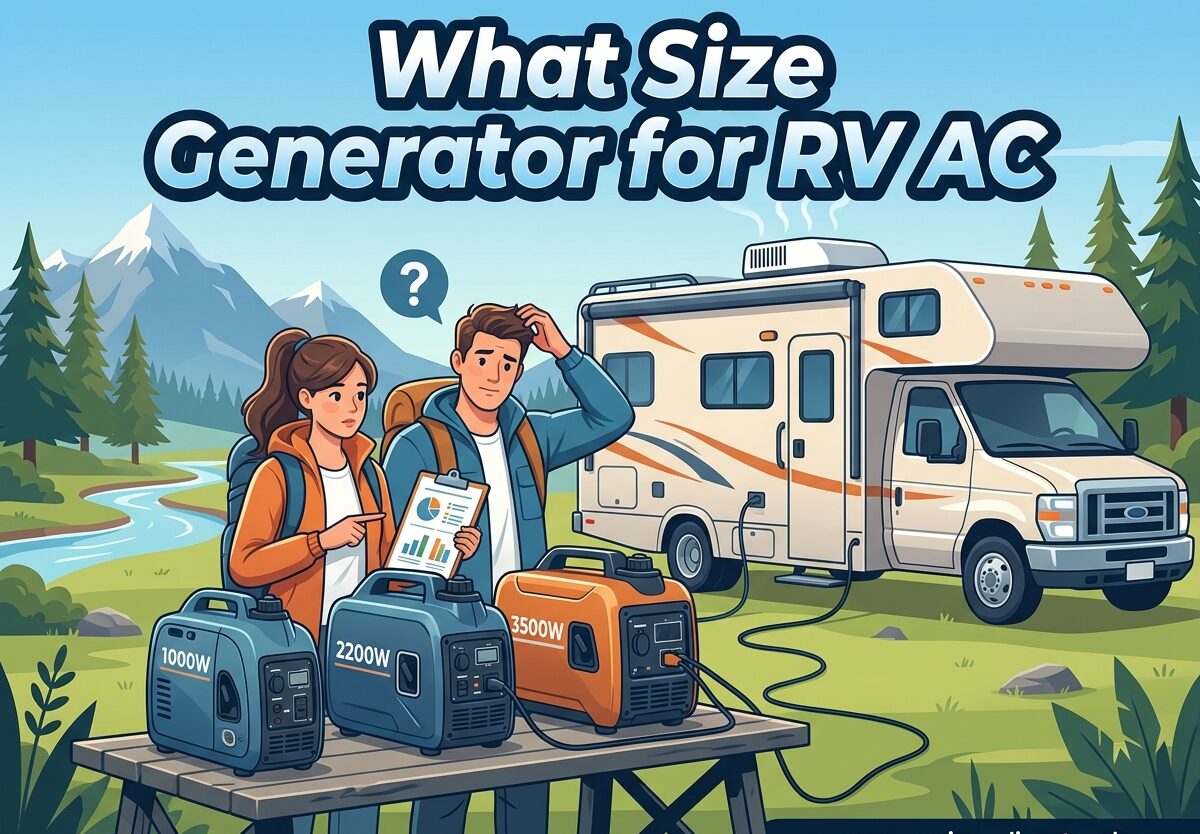
If you’re wondering what size generator for RV AC you’ll need, here’s the quick answer: most RV owners need a 3,000 to 4,000-watt generator to run a single 13,500-15,000 BTU air conditioner. However, the exact size depends on your AC unit’s BTU rating, whether you have a 30-amp or 50-amp RV system, and other factors like elevation and temperature. Using an undersized generator can damage both your AC unit and the generator itself, while oversizing leads to unnecessary fuel consumption and noise.
I’ve spent years researching RV power systems and consulting with full-time RVers about their real-world generator experiences. In this guide, I’ll break down exactly how to calculate your specific needs, explain the critical difference between starting and running watts, and show you how soft start technology can dramatically reduce your generator requirements.
Quick Generator Sizing Reference
Before diving into the details, here’s a quick reference for what size generator for RV AC based on common unit sizes:
- 7,000-10,000 BTU AC unit: 2,000-2,500 watt generator
- 11,000-12,000 BTU AC unit: 2,500-3,000 watt generator
- 13,500 BTU AC unit (most common): 3,000-3,500 watt generator
- 15,000 BTU AC unit: 3,500-4,000 watt generator
- Dual AC units (2x 13.5k or 15k BTU): 5,000-8,000 watt generator
These recommendations include a 20% safety buffer to account for real-world conditions like elevation, heat, and aging equipment. Now let’s understand WHY you need these specific sizes.
Starting Watts vs Running Watts: Why It Matters
The most critical concept in understanding what size generator for RV AC is the difference between starting watts and running watts. This distinction trips up many first-time RV owners, and getting it wrong can mean your generator won’t actually start your AC unit.
Running watts (also called continuous watts or rated watts) are the amount of power your AC unit needs to keep running once it’s already on. For a typical 15,000 BTU RV air conditioner, this is usually around 2,800 watts.
Starting watts (also called surge watts) are the massive spike of power needed to start the compressor. This initial surge can be 2-3 times the running wattage, lasting just a few seconds. That same 15,000 BTU unit might need 5,000-6,000 watts just to start.
Here’s why this matters: if you buy a 3,000-watt generator for your 15,000 BTU AC, it might handle the running wattage fine, but it will never get the compressor started in the first place. Your generator will overload and shut down as soon as you try to turn on the AC.
I’ve seen this frustration countless times on RV forums. A RVer buys a 2,800-watt generator thinking it’s enough for their 15,000 BTU AC, only to find it trips the breaker every time. The generator isn’t defective—it’s just not sized for the STARTING watts, not the running watts.
BTU to Wattage Conversion: Understanding Your AC
BTU stands for British Thermal Unit, and it measures cooling capacity. The higher the BTU rating, the more cooling power your AC has. However, BTU alone doesn’t tell you the wattage—you need to understand how these relate.
As a general rule of thumb, you can estimate wattage from BTU using this simple formula:
Running Watts = BTU ÷ 4
So a 13,500 BTU AC would need roughly 3,375 watts to run. But remember, this is just the running wattage. You need to multiply this by 2.5-3x to get the starting wattage requirement.
However, this is just an estimate. Different AC units have different efficiencies, measured by EER (Energy Efficiency Ratio). A unit with higher EER will use fewer watts for the same cooling capacity. Always check your specific AC unit’s specifications for exact running and starting wattage requirements.
You can usually find this information on a sticker inside your AC unit’s air intake cover, in your RV owner’s manual, or by contacting the manufacturer with your model number.
What Size Generator for RV AC by Unit Size
Now let’s get specific about what size generator you need for your particular AC unit. This comprehensive table covers the most common RV air conditioner sizes and their power requirements.
| AC Unit Size | Running Watts | Starting Watts | Minimum Generator Size | Recommended Generator Size |
|---|---|---|---|---|
| 7,000 BTU | 600-800W | 1,500-2,000W | 2,000W | 2,500W |
| 9,000 BTU | 800-1,000W | 2,000-2,500W | 2,500W | 3,000W |
| 10,000 BTU | 900-1,200W | 2,200-2,800W | 2,800W | 3,000W |
| 11,000 BTU | 1,000-1,300W | 2,500-3,000W | 3,000W | 3,200W |
| 13,500 BTU (Most Common) | 1,200-1,600W | 2,800-3,500W | 3,500W | 3,700W |
| 15,000 BTU | 1,400-1,800W | 3,200-4,500W | 4,000W | 4,200W |
| Dual 13.5k BTU | 2,400-3,200W | 5,600-7,000W | 7,000W | 7,500W |
| Dual 15k BTU | 2,800-3,600W | 6,400-9,000W | 9,000W | 9,500W |
Why the recommended size is higher than the minimum: I always recommend a 10-20% buffer above the absolute minimum. This accounts for real-world conditions like high temperatures, high elevation, older equipment, and simultaneous use of other appliances like your refrigerator or TV.
Trust me, you don’t want to be that person at the campsite whose generator trips every time someone turns on a light. That extra buffer ensures reliable operation.
30-Amp vs 50-Amp RV Systems: What You Need to Know
Your RV’s electrical system plays a major role in determining what size generator for RV AC you need. Understanding the difference between 30-amp and 50-amp systems can save you from costly mistakes.
30-Amp RV Systems: These can handle up to 3,600 watts total (30 amps x 120 volts). If you have a 30-amp RV with a single 13,500 BTU AC, a 3,000-3,500 watt generator is typically sufficient. However, you’ll need to be careful about running other appliances simultaneously with the AC.
50-Amp RV Systems: These can handle up to 12,000 watts total (50 amps x 240 volts, split into two 120-volt legs). If you have a 50-amp RV, you might have dual AC units. In that case, you’ll need a larger generator in the 5,000-8,000 watt range, depending on whether you plan to run both ACs at once.
Here’s the thing: even if you have a 50-amp RV system, you don’t necessarily NEED a 50-amp rated generator if you only plan to run one AC unit at a time. A 3,500-4,000 watt generator can handle one 15,000 BTU AC just fine. You’ll just need to manage your power usage and avoid running both ACs simultaneously.
I’ve seen many RVers make the mistake of buying a massive 8,000-watt generator for their 50-amp RV when they only ever run one AC unit. That’s overkill that leads to unnecessary fuel consumption and noise.
Soft Start Technology: Game-Changer for Generator Sizing
If you’re struggling with what size generator for RV AC because you want to downsize your generator or you’re having trouble starting your AC with your current generator, soft start technology might be the solution.
A soft starter (like the popular MicroAir EasyStart) is a device that reduces the massive starting current surge of your AC compressor. Instead of drawing 3-4 times the running watts to start, a soft starter can reduce this to just 1.5-2 times the running watts.
The impact is dramatic. I’ve seen RVers report that after installing a soft starter, their 15,000 BTU AC that previously required a 4,000-watt generator could now start and run on a 2,200-watt generator. That’s nearly a 50% reduction in required generator size.
Here’s a real example from RV forums: “After installing MicroAir EasyStart, the AC runs on a 15amp household outlet. Before the installation, it would trip the breaker every time.”
Soft start technology is particularly valuable if you:
- Already own a smaller generator and don’t want to upgrade
- Want to reduce generator noise and fuel consumption
- Camp in high-elevation areas where generator output is reduced
- Have limited budget for a large generator
The cost of a soft starter ($200-300) is significantly less than upgrading from a 2,000-watt to a 4,000-watt generator ($800-1,500 difference). For many RVers, it’s a no-brainer investment.
Generator Types for RV AC: Pros and Cons
When choosing what size generator for RV AC, you’ll also need to decide on the TYPE of generator. Different fuel sources and technologies each have their advantages and disadvantages for RV use.
Conventional Gasoline Generators: These are the most affordable and powerful option. A 4,000-watt conventional generator typically costs $400-600. However, they’re loud (often 70-80 dB) and the power can be “dirty” with voltage fluctuations that might damage sensitive electronics over time.
Inverter Generators: These are the gold standard for RV use. They produce clean, stable power that’s safe for electronics, and they’re much quieter (50-60 dB). They’re also more fuel-efficient, especially at lower loads. The downside is cost—expect to pay $800-1,500 for a quality 3,000-4,000 watt inverter generator. Popular options include the Honda EU series and Predator inverter generators.
Dual-Fuel Generators: These can run on either gasoline or propane. Propane is cleaner-burning and stores indefinitely, making it great for emergency preparedness. However, generators typically produce 10-15% less power on propane than gasoline. So if you’re looking at a 3,500-watt dual-fuel generator, expect only about 3,000 watts when running on propane.
Solar Generators: These are battery-based systems that can be charged by solar panels. They’re silent and emission-free, but current technology limits them to about 2,000-3,000 watts of continuous output. This makes them suitable for smaller AC units (up to 11,000 BTU) but inadequate for larger units without substantial battery banks and multiple solar panels. Expect to pay $2,000-5,000 for a solar setup capable of running even a small AC for a few hours.
For most RVers with a 13,500-15,000 BTU AC, an inverter generator in the 3,500-4,000 watt range offers the best balance of power, quiet operation, and clean power for electronics.
How Elevation and Heat Affect Generator Performance
One factor that many RVers overlook when deciding what size generator for RV AC is the impact of elevation and temperature on generator output. This is a critical consideration that can mean the difference between a generator that works and one that doesn’t.
Generators lose power as elevation increases because there’s less oxygen available for combustion. As a general rule, generators lose 3-4% of their rated output for every 1,000 feet above sea level.
Here’s a practical example: if you have a 3,500-watt generator and you’re camping at 5,000 feet elevation (common in many western US camping areas), your generator will only produce about 2,800-3,000 watts of actual power. That might not be enough to start your 15,000 BTU AC.
Similarly, high temperatures reduce generator efficiency. At temperatures above 85°F, generators can lose an additional 5-10% of their output. Combine high elevation with hot summer weather, and your 3,500-watt generator might only deliver 2,500-2,700 watts when you need it most.
This is why I always recommend a buffer in your generator sizing. If you camp at high elevations or in hot climates, consider sizing up by 500-1,000 watts beyond the minimum recommendation. That extra capacity will ensure reliable operation when conditions are less than ideal.
How to Calculate Your Exact Generator Needs
Now that you understand all the factors, here’s a step-by-step process to calculate exactly what size generator for RV AC you need:
Step 1: Find Your AC’s BTU Rating
Check your AC unit’s specifications. This is usually printed on a sticker inside the air intake cover or in your RV owner’s manual. Common sizes are 11,000, 13,500, and 15,000 BTU.
Step 2: Determine Running Watts
If your specs list wattage, use that. If not, divide BTU by 4 for a rough estimate. For a 13,500 BTU unit: 13,500 ÷ 4 = 3,375 watts running.
Step 3: Calculate Starting Watts
Multiply running watts by 2.5-3x. Using our example: 3,375 x 2.5 = 8,438 watts starting (this is why you need to check actual specs—real 13.5k BTU units typically need 2,800-3,500 starting watts, not 8,438).
Step 4: Add 20% Safety Buffer
If starting watts are 3,500: 3,500 x 1.2 = 4,200 watts recommended.
Step 5: Account for Elevation (if applicable)
If camping above 2,000 feet, add 3-4% per 1,000 feet. At 5,000 feet: 4,200 x 1.15 = 4,830 watts.
Step 6: Consider Other Appliances
What else will run simultaneously? Fridge (150-300W), TV (100-200W), microwave (800-1,200W). Add these to your total.
Step 7: Round Up to Available Generator Sizes
Generators typically come in standard sizes: 2,000W, 2,500W, 3,000W, 3,500W, 4,000W, 5,000W, etc. Always round up to the next size.
Frequently Asked Questions
Will a 2200 watt generator run an RV air conditioner?
A 2,200 watt generator can run smaller RV AC units (7,000-9,000 BTU) but will struggle with typical 13,500-15,000 BTU units. The starting wattage requirement alone exceeds 2,200W for larger ACs. However, if you install a soft start device on your AC, you might be able to run a 13,500 BTU unit on a 2,200W generator—though it’s not recommended for reliable operation.
How big of a generator do I need to run RV AC?
For a single 13,500-15,000 BTU RV air conditioner, you need a 3,500-4,000 watt generator. This size provides enough starting watts (3,000-4,500W) to kickstart the compressor and sufficient running watts (1,200-1,800W) to keep it running. If you have dual AC units or plan to run multiple appliances simultaneously, you’ll need 5,000-8,000 watts. Always check your specific AC unit’s starting and running wattage requirements before purchasing.
How many watts do you need to run an AC in an RV?
RV air conditioners typically need 1,200-1,800 running watts and 2,800-4,500 starting watts, depending on the BTU rating. A 13,500 BTU unit (most common) uses about 1,400-1,600 running watts but needs 2,800-3,500 starting watts. A 15,000 BTU unit requires 1,600-1,800 running watts and 3,200-4,500 starting watts. Always size your generator based on STARTING watts, not running watts—this is the most common mistake RVers make.
Will a 3000 watt generator run an RV AC?
A 3,000 watt generator can run many 13,500 BTU RV air conditioners, but it might be marginal for 15,000 BTU units or in high-elevation areas. The 3,000W output is just enough for the starting surge of most 13.5k BTU ACs (2,800-3,500 starting watts). However, you’ll have little headroom for other appliances. For reliable operation, especially in hot weather or at altitude, I recommend stepping up to 3,500-4,000 watts. Many RVers report that 3,000W works but sometimes struggles on the hottest days.
Can I run my RV AC on a 2000 watt generator?
A 2,000 watt generator can only run smaller RV AC units (7,000-10,000 BTU) and will NOT handle typical 13,500-15,000 BTU units. The starting wattage alone exceeds 2,000W for larger ACs. However, if you install a soft start device (like MicroAir EasyStart), you can reduce starting current by 50-70%, potentially allowing a 13,500 BTU AC to run on 2,000W. This setup works for many RVers but isn’t recommended for full-time use or in extreme conditions. For reliable operation, size up to at least 3,000W.
What size generator do I need for a 50-amp RV with 2 AC units?
For a 50-amp RV with dual air conditioners (typically two 13,500 or 15,000 BTU units), you need a 7,000-9,000 watt generator if you plan to run both ACs simultaneously. Each 13,500 BTU unit needs 2,800-3,500 starting watts, so dual units require 5,600-7,000 starting watts minimum. If you only run one AC at a time, a 3,500-4,000 watt generator is sufficient. Many 50-amp RV owners use a smaller generator and manage power usage by running ACs sequentially rather than simultaneously.
Do I need an inverter generator for my RV AC?
You don’t strictly NEED an inverter generator to run your RV AC—conventional generators work fine. However, inverter generators offer significant advantages: they’re much quieter (50-60 dB vs 70-80 dB), produce cleaner power safe for electronics, and are more fuel-efficient, especially at partial loads. For RV camping where noise matters, an inverter generator is worth the extra cost. Many campgrounds have noise restrictions that conventional generators violate. If budget allows, choose an inverter generator for a better camping experience.
Conclusion
Choosing what size generator for RV AC doesn’t have to be complicated. For most RVers with a single 13,500-15,000 BTU air conditioner, a 3,500-4,000 watt generator will provide reliable operation in most conditions. The key is to size based on STARTING watts, not running watts, and to include a 20% buffer for elevation, heat, and aging equipment.
Remember that soft start technology can be a game-changer, potentially reducing your generator size requirements by 50% while also protecting your AC unit from electrical stress. For RVers who already own a smaller generator or who want to minimize noise and fuel consumption, a soft starter is often more cost-effective than upgrading to a larger generator.
Before making your final decision, always check your specific AC unit’s documentation for exact wattage requirements, consider where and when you’ll be camping (elevation and temperature affect generator performance), and think about what other appliances you’ll want to run simultaneously. With the right generator size, you’ll stay cool and comfortable no matter where your RV adventures take you in 2026.

Leave a Comment