
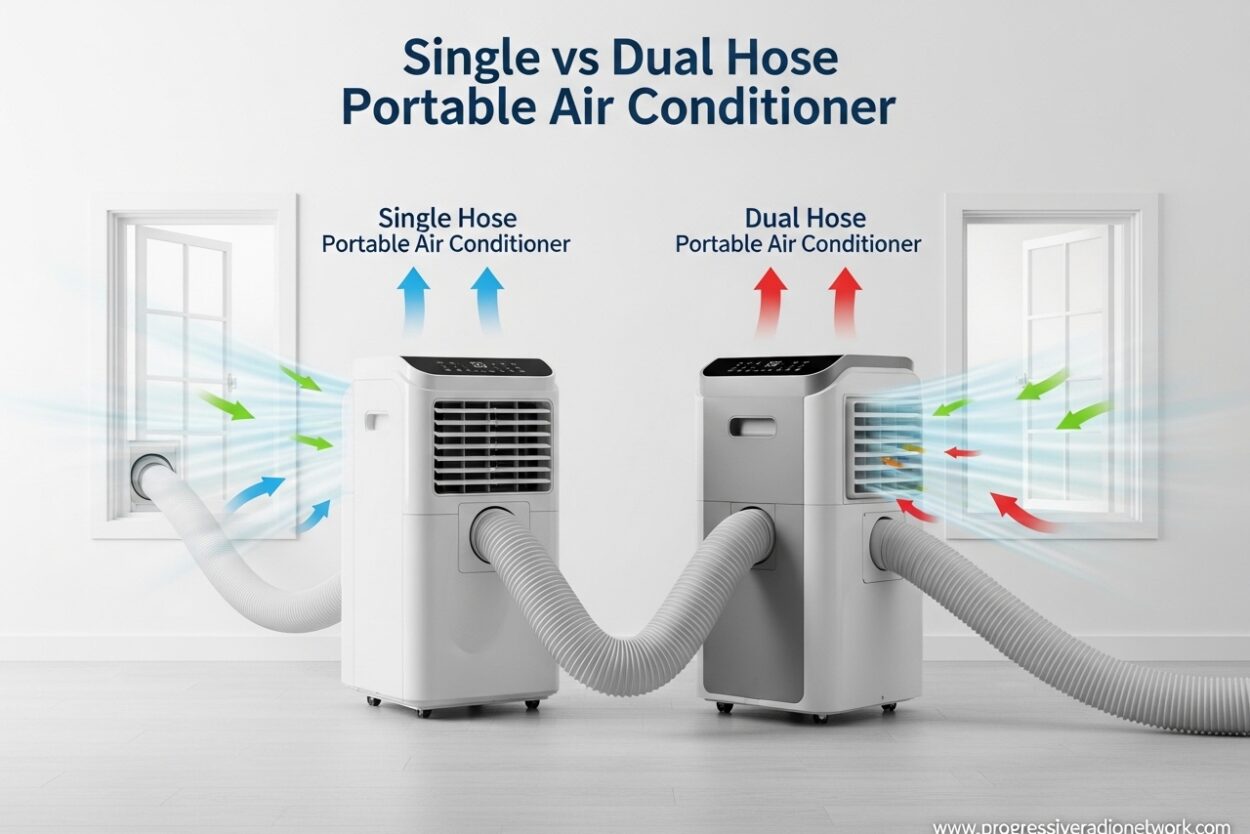
Dual hose portable air conditioners are generally more efficient and provide better cooling performance than single hose models. The two-hose design prevents negative pressure issues that plague single-hose units, resulting in 20-30% better cooling efficiency. However, single hose portable ACs cost less and work adequately for smaller spaces.
When shopping for a portable air conditioner, you’ll notice two main designs: single vs dual hose portable air conditioner models. This difference isn’t just about appearance – it fundamentally affects how the unit cools your room and how efficiently it operates. After researching dozens of units and analyzing real user experiences, I’ll break down exactly what you need to know to make the right choice.
Understanding this distinction matters because the wrong choice means wasting money on electricity and never getting the cooling relief you need. Let me explain how each system works and which one fits your situation.
How Dual-Hose Portable Air Conditioners Work
Dual hose portable air conditioners use two separate hoses to manage airflow more efficiently. One hose draws in outside air to cool the condenser coils, while the second hose exhausts the hot air outside. This design creates a closed system that doesn’t interfere with the air already inside your room.
Here’s what happens: The unit takes room air, cools it, and sends it back into your space. Meanwhile, it pulls fresh outdoor air through the intake hose to cool down the hot condenser. This heated outdoor air then exits through the exhaust hose, never mixing with your conditioned indoor air.
The key advantage is that dual hose units don’t create negative pressure. Your room stays sealed, and the AC doesn’t have to work harder to cool air that’s constantly leaking in from outside. HVAC professionals consistently recommend dual hose designs for this reason.
Reddit users in HVAC forums overwhelmingly agree that dual hose is always better than single hose for portable AC units. The efficiency gains are real, especially in larger rooms or hot climates.
How Single-Hose Portable Air Conditioners Work
Single hose portable air conditioners rely on just one hose to vent hot air outside. This might seem simpler, but it creates a fundamental problem called negative pressure. Here’s why: as the single-hose unit blows hot air out through the exhaust, it’s also removing air from your room.
Nature abhors a vacuum, so warm air from outside gets pulled back in through every crack, gap, and opening it can find. Your window, door frames, and electrical outlets become pathways for hot air to enter. The single-hose portable AC ends up cooling this replacement air instead of maintaining the temperature you want.
This negative pressure issue means single-hose units work harder and use more energy. They’re essentially fighting against themselves – cooling air that immediately leaks out and gets replaced by more hot air. The problem gets worse in well-sealed rooms where replacement air has to force its in more dramatically.
Despite this drawback, single hose models remain popular because they’re cheaper and easier to set up. For small rooms or occasional use, the efficiency loss might not matter much to you.
Single vs Dual Hose Portable Air Conditioner: Key Differences
The main difference comes down to efficiency and cooling performance. Dual hose units maintain your room’s air balance while single hose models constantly disrupt it. This seemingly small design difference affects everything from energy consumption to how quickly a room cools down.
Cooling capacity is another major distinction. A 14,000 BTU dual hose unit will outperform a 14,000 BTU single hose model in the same room. The dual hose system delivers more of its rated cooling power where you actually need it – your living space rather than fighting negative pressure effects.
Setup complexity differs too. Single hose units have one window connection and take about 5-10 minutes to install. Dual hose models require two window openings or a specialized dual-hose window kit, adding 5-10 minutes to setup time. The extra hose also means more to manage and store.
Noise levels are similar between types when comparing units of similar quality. Both designs produce compressor noise and fan sounds. However, dual hose units might run less frequently to maintain temperature, potentially reducing total noise over time.
Pros and Cons: Single Hose vs Dual Hose
Dual-Hose Portable AC Pros
More efficient cooling performance – dual hose units deliver 20-30% better efficiency because they don’t create negative pressure. Your room stays cooler, faster.
Better for larger rooms – spaces over 500 square feet need the extra cooling power that dual hose designs provide. The negative pressure issue in single hose units becomes more pronounced as room size increases.
Lower energy consumption – since the unit isn’t constantly fighting replacement air, dual hose portable ACs use less electricity to maintain your desired temperature. Over a hot summer, this can mean significant savings.
Consistent temperature maintenance – dual hose systems maintain stable temperatures because they’re not battling air leaks. Your room stays at the set temperature without fluctuations.
Handles heat waves better – in extreme heat (90+ degrees), dual hose portable ACs maintain their cooling capacity while single hose models struggle as the negative pressure effect intensifies.
Dual-Hose Portable AC Cons
Higher upfront cost – dual hose models typically cost $100-300 more than comparable single hose units. You’re paying for the additional hose assembly and more complex internal design.
More complex setup – you need to install two hoses through your window, which means either a specialized window kit or modifying the included adapter. Not all windows accommodate dual hose setups easily.
More hoses to manage – having two hoses means more to route around furniture and more to store during the off-season. If you’re moving the unit between rooms, it’s more hassle.
Larger footprint – dual hose units are often slightly larger and heavier due to the additional air handling components. Consider this if space is tight in your room.
Single-Hose Portable AC Pros
Lower purchase price – single hose portable ACs cost significantly less upfront. If budget is your main concern, single hose units provide adequate cooling for less money.
Simpler installation – one hose means one window connection. Most people can set up a single hose unit in under 10 minutes with minimal hassle.
More compact design – without the second air intake system, single hose models are often smaller and lighter. This matters if you need to move the unit between rooms or store it in a small closet.
Works adequately for small spaces – rooms under 400 square feet don’t suffer as much from the negative pressure effect. A single hose unit can cool a small bedroom or home office sufficiently.
Single-Hose Portable AC Cons
Less efficient cooling – the negative pressure problem means single hose units work harder and use more energy. You’re basically paying to cool the neighborhood, not just your room.
Struggles in large rooms – spaces over 500 square feet overwhelm single hose portable ACs. The unit runs constantly without reaching your desired temperature.
Higher energy bills – because the unit compensates for air leakage, single hose models consume more electricity over time. What you save upfront, you pay later in energy costs.
Poor performance in heat waves – when outdoor temperatures soar above 90 degrees, single hose units lose efficiency rapidly. The temperature difference between inside and outside air makes the negative pressure effect worse.
Which Should You Choose: Single or Dual Hose?
Choose a dual hose portable air conditioner if you’re cooling a large room (500+ square feet), live in a hot climate where summer temperatures regularly exceed 90 degrees, or plan to use the unit frequently throughout the season. The efficiency gains and better performance make the extra upfront cost worth it in these situations.
Choose a single hose portable air conditioner if you’re cooling a small room (under 400 square feet), only need occasional cooling, or budget is your primary concern. Single hose models work fine for bedrooms, home offices, or supplemental cooling in spaces that already have some air conditioning.
Consider your climate too. In dry heat, single hose units perform better than in humid conditions. Humid air carries more heat energy, making the negative pressure problem worse. If you live in a humid region like the Southeast, dual hose becomes more important.
Think about BTU rating regardless of hose design. Most rooms need about 20 BTU per square foot for adequate cooling. A 12,000 BTU unit handles around 600 square feet under ideal conditions. However, single hose models need oversized BTU ratings to compensate for their inefficiency.
Newer SACC ratings (Seasonally Adjusted Cooling Capacity) provide more accurate real-world performance numbers than traditional BTU ratings. This DOE standard accounts for the negative pressure effect in single hose units. When comparing models, look for SACC ratings – a high-SACC single hose unit might outperform a low-SACC dual hose model.
Frequently Asked Questions
Is it better to have dual hose portable air conditioner?
Yes, dual hose portable air conditioners are better for most situations. They’re 20-30% more efficient because they don’t create negative pressure, cool larger spaces more effectively, and maintain consistent temperatures better. The only reason to choose single hose is budget constraints or very small rooms under 400 square feet.
Why do some portable air conditioners have two hoses and some have one?
The difference comes down to airflow design. Single hose units use one exhaust hose to vent hot air outside, which creates negative pressure that pulls warm air back into your room. Dual hose units add a second intake hose that brings in outside air to cool the condenser, preventing negative pressure and improving efficiency.
What is the disadvantage of dual inverter AC?
The main disadvantages of dual hose portable ACs are higher upfront cost ($100-300 more), more complex installation requiring two window connections, and more hoses to manage and store. They’re also typically larger and heavier than single hose models. However, these drawbacks are outweighed by better efficiency and cooling performance for most users.
Do dual hose portable AC units cool better?
Yes, dual hose portable AC units cool better than single hose models with equivalent BTU ratings. Because they don’t create negative pressure, all their cooling power goes into your room rather than fighting replacement air. In real-world testing, dual hose units cool rooms faster and maintain lower temperatures more consistently.
Can I use a single hose portable AC in a large room?
You can use a single hose portable AC in a large room, but it will struggle. For rooms over 500 square feet, single hose units run constantly without reaching desired temperature. You’ll need an oversized BTU rating to compensate, which increases energy consumption. A dual hose model is a better investment for larger spaces.
What is negative pressure in portable AC?
Negative pressure happens when a single hose portable AC blows air out of your room faster than replacement air can enter naturally. This creates a vacuum effect that pulls warm outdoor air through cracks around windows, doors, and outlets. The unit then has to cool this hot replacement air, making it work harder and use more energy.
Conclusion
The choice between single vs dual hose portable air conditioner comes down to your specific needs. Dual hose units are technically superior and provide better cooling efficiency, especially for larger rooms and hot climates. The negative pressure problem with single hose designs isn’t just marketing hype – it’s real physics that affects performance.
However, single hose portable ACs have their place. If you’re cooling a small bedroom, only need occasional cooling, or working with a tight budget, a single hose model will serve you adequately. Just understand its limitations and don’t expect it to handle large spaces or extreme heat effectively.
For most people serious about cooling their space, dual hose is the better investment. The energy savings over time can offset the higher purchase price, and you’ll get more reliable cooling when you need it most. Consider your room size, climate, and usage patterns before making your decision.
Remember that portable ACs of any type are less efficient than window units or split systems. If you have the option, a window air conditioner will always cool more efficiently than any portable model. But when portable is your only choice, understanding the single vs dual hose portable air conditioner difference helps you get the most cooling for your money.
Leave a Comment