
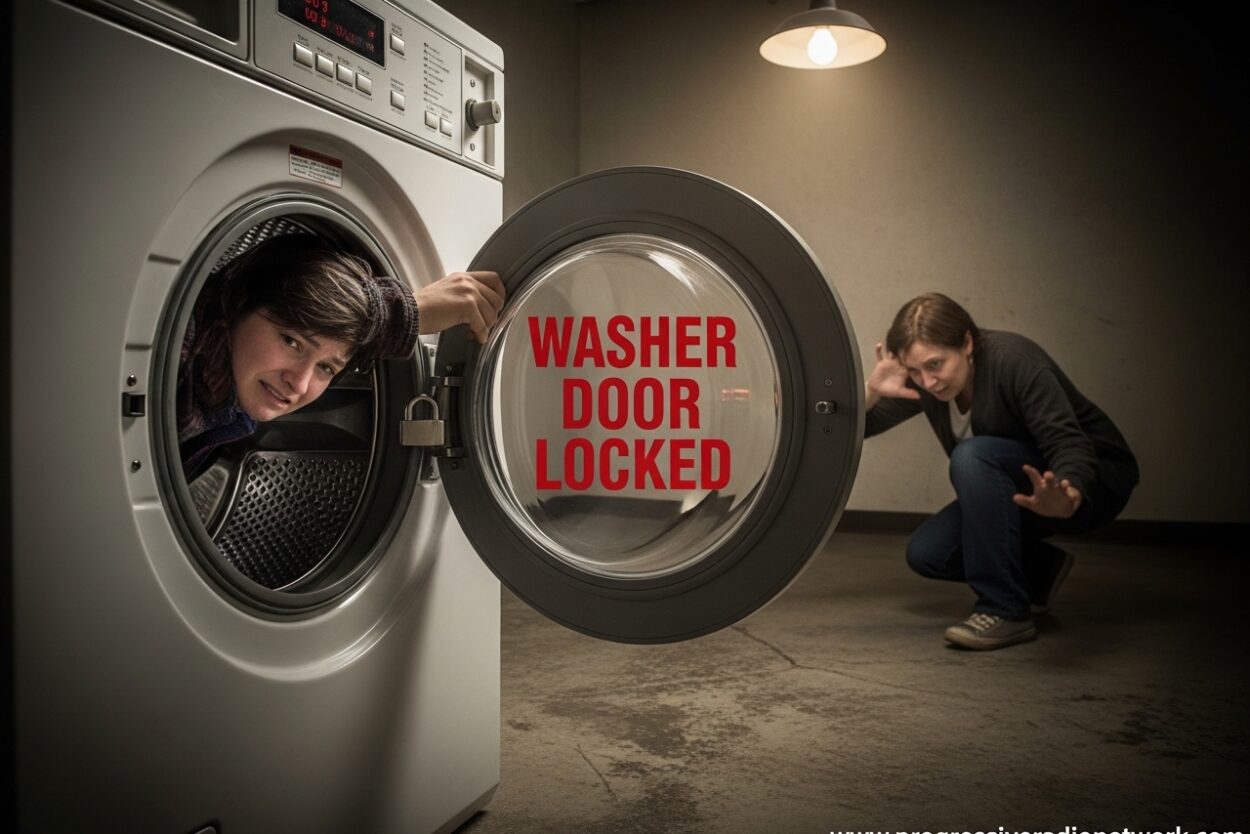
That sinking feeling when your washer door won’t open is something every laundry owner dreads. Your clothes are trapped inside, possibly soaking wet, and the machine seems determined to keep them hostage. I’ve been there, and I understand the frustration. A washer door locked situation happens to almost everyone at some point, and the good news is that most cases resolve quickly with the right approach.
Modern washing machines have door locks as safety features to prevent water from flooding your laundry room during cycles. Front-load washers especially need this protection because water could pour out if the door opened mid-cycle. Most of the time, your door will unlock automatically within 2-5 minutes after the cycle ends. When it doesn’t, you need to know why and what steps to take next.
Why Your Washer Door Locked: 6 Common Causes
Understanding why your washing machine door won’t open is the first step toward solving the problem. Based on service technician reports and user forums, these six causes cover the majority of washer door locked situations.
Water remaining in the drum is the most common reason washers refuse to unlock. The machine’s safety sensor detects water level and won’t release the door until the drum drains below a safe threshold. This can happen if the drain filter is clogged, the drain hose is blocked, or the pump has failed. Some users report their washer door locked with water inside after a cancelled cycle or power interruption.
Thermal lock activation affects many European washers and some newer models. These machines use a wax motor or thermal device that requires time to cool before releasing. If your washer door locked after a hot cycle, you might need to wait 3-5 minutes for the mechanism to cool down. I’ve seen cases where impatient users forced the door during this period and damaged the lock assembly.
Child lock engagement catches many people off guard. Most modern washers have a child safety feature that locks all controls, including the door. You might accidentally activate it by pressing certain button combinations. The indicator usually displays a key icon or “CL” on the control panel. A common scenario: kids play with the buttons, or you lean against the control panel while loading laundry.
Mid-cycle pause or power outage can leave your washer in a locked state. When the power goes out during a cycle, or you pause it mid-wash, the machine may keep the door locked as a safety precaution. The washer essentially “remembers” it was running and keeps everything secured. This is especially common during thunderstorm season in areas with unstable power.
Control board glitch causes frustrating intermittent lock issues. The electronic control board manages the door lock mechanism, and sometimes it gets confused. Unplugging the washer for 5-10 minutes often resets the board and resolves the problem. I’ve helped multiple people on forums who thought their washer was broken, only to need a simple hard reset.
Broken door latch assembly is the worst-case scenario. If the physical locking mechanism is jammed or broken, the door won’t release even when the machine sends the unlock signal. This typically happens after years of use or if someone forced the door previously. The door lock light might blink continuously, or you might hear clicking without the latch releasing.
Quick Fixes to Try First
Before attempting manual release methods or calling a technician, try these quick fixes in order. I’ve organized them from easiest to more involved, based on what appliance repair technicians recommend first.
Step 1: Unplug the washer for a full 10 minutes. This is the most common solution and works about 60% of the time. The hard reset allows the electronic control board to fully discharge and reset. Don’t just turn it off at the panel—actually unplug it from the wall outlet. I’ve seen countless forum posts where users said they “tried everything” but only unplugged for 30 seconds. Give it the full 10 minutes.
Step 2: Run a drain and spin cycle if water remains visible in the drum. Select the “Drain & Spin” or “Spin Only” setting and let it complete. This tells the washer to actively pump out remaining water, which should trigger the door unlock once the water level drops. If this cycle won’t start, move to the next step.
Step 3: Check for child lock activation by looking at your display panel. Most washers show a key icon, padlock symbol, or “CL” when child lock is on. To deactivate, press and hold the child lock button (usually two buttons simultaneously) for 3-5 seconds. Check your manual for the specific combination, as it varies by brand. Samsung typically uses “Temp” and “Signal” buttons, while LG often uses “Rinse” and “Spin.”
Step 4: Wait for the thermal lock to cool if you just finished a hot cycle. Give it 5 minutes before attempting anything else. Listen for a clicking sound, which indicates the thermal mechanism releasing. European washers with thermal locks are particularly sensitive to this timing. I’ve helped users who waited just 2 minutes and thought something was wrong, when 3 more minutes would have solved it.
Step 5: Check the door lock indicator light if your model has one. A solid light means the door is properly locked. A blinking light usually indicates a problem with the lock mechanism or that the machine is trying to lock but can’t engage properly. If it’s blinking rapidly after the reset attempts, you may have a hardware issue requiring service.
How to Manually Release a Locked Washer Door
When the quick fixes don’t work, you’ll need to manually release the door. These methods vary by washer type, so identify whether you have a front-load or top-load model before proceeding. Always practice safety—unplug the machine before attempting any manual release.
Emergency Release Tab (Front-Load Washers)
Most front-load washers have an emergency release mechanism designed exactly for this situation. The location varies by brand, but it’s typically accessible without major disassembly.
For most models: Look at the bottom front panel of your washer. You’ll find a small access panel or kick plate that pops off. Behind it, you’ll see either a pull tab or a small ring. Pull this tab downward firmly but gently to manually release the door lock. Some users report success using a bent coat hanger to reach the tab if their fingers can’t access it.
Samsung and LG front-loaders: The emergency release is often behind the small circular panel on the front bottom right. Use a flathead screwdriver to gently pry it open. Pull the emergency drain hose out first to drain remaining water into a shallow pan, then pull the release tab. I’ve personally done this on a Samsung washer, and it took about 3 minutes once I found the right spot.
Whirlpool, Maytag, and Kenmore: Look for the emergency release behind the bottom access panel. On some models, you’ll need to remove three screws securing the panel first. The release is usually a plastic pull tab or a string loop. Pull it straight down, not at an angle, to avoid breaking it.
String Method for Stuck Latch
This trick works when the door lock mechanism is stuck but not broken. It’s especially useful if the emergency pull tab is broken or missing.
Take a strong nylon string or thin cord (dental floss works in a pinch) and loop it around the door latch hook where it catches the door frame. Gently pull the string upward and toward you at a 45-degree angle while simultaneously pulling the door handle. The string applies direct pressure to the release mechanism that your hand can’t reach. This method has saved multiple Reddit users from waiting days for a technician.
Credit Card Technique
Similar to unlocking a locked interior door, this method can work on some washer models with flexible rubber seals.
Slide a stiff plastic card (credit card, ID card, or similar) between the door and frame near the latch location. Work it in about 1-2 inches while gently wiggling the door handle. The card pushes back the rubber seal enough to release the latch mechanism. Be careful not to damage the seal—this method works best on older models with more flexible gaskets.
Top-Load Washer Lid Release
Top-load washers with lid locks can be released differently depending on the model.
Standard top-loaders: Unplug the washer and wait 60 seconds. The lock should release automatically. If not, look under the lid near the front edge—some models have a small manual release tab you can push with a screwdriver.
Top-load impeller models (no agitator): These often have the lock mechanism under the washer’s top panel. You’ll need to unplug the machine, then use a putty knife to release the two spring clips holding the top panel (they’re located under the front edge, about 3 inches from each side). Lift the panel, and you’ll see the lid lock assembly. Look for a manual release ring or tab on the mechanism itself.
Brand-Specific Troubleshooting Tips
Different washer brands have unique features and reset procedures. Here are the most effective brand-specific solutions based on official support documentation and technician experiences.
Samsung Washer Door Locked
Samsung washers have a few quirks that can cause persistent door lock issues. The child lock feature engages easily—simultaneously press and hold the “Temp” and “Signal” buttons (or “Rinse” and “Spin” on newer models) for 3-5 seconds to deactivate it.
For Samsung front-loaders that won’t unlock, run the “Spin Only” cycle first to drain any remaining water. If that doesn’t work, unplug for 10 minutes, then plug back in and immediately press the “Power” button followed by “Spin Only.” The door should unlock after 2-3 minutes. Samsung’s emergency release is behind the small circular access panel on the front bottom right corner.
LG Washer Door Locked
LG washers are known for thermal lock mechanisms that require patience. If your LG washer door is locked after a cycle, wait 5 full minutes before attempting anything. The thermal wax motor needs time to cool and contract.
LG’s child lock deactivation requires holding the “Rinse” and “Spin” buttons simultaneously for 3 seconds. For manual release, LG emergency pull tabs are typically red or orange and located behind the bottom access panel. Some LG models also have a small emergency drain hose that must be used before the door will unlock—pull it out, drain the water into a shallow container, remove the plug, and then pull the emergency release tab.
GE Washer Door Locked
GE washers sometimes experience control board glitches that keep the door locked. The most effective reset for GE models is unplugging for a FULL 15 minutes—not the standard 5-10. GE’s electronic boards seem to need longer discharge time.
For GE front-loaders, the emergency release is typically behind the bottom kick plate. Look for a pull ring or tab. GE top-loaders with lid locks may require removing the washer’s top panel to access the manual release on the lock mechanism itself. If your GE washer displays an error code along with the locked door, note the code—F28 and F29 specifically indicate door lock assembly problems.
Whirlpool Washer Door Locked
Whirlpool washers (including Maytag and Kenmore models made by Whirlpool) have straightforward emergency releases. For front-loaders, remove the bottom panel by either popping it off or removing the retaining screws. The emergency pull tab is usually a red or yellow plastic tab directly connected to the door lock mechanism.
Whirlpool top-loaders with lid locks can sometimes be reset by unplugging and immediately lifting the lid—some models release the lock as soon as power is cut. If not, you’ll need to access the lock from under the washer’s top panel. Whirlpool’s diagnostic mode can also help: rotate the cycle knob to any position except “Off,” press and hold the “Start” button, then simultaneously press and hold the “Cycle Signal” button for 3 seconds to enter diagnostic mode, which sometimes resets the lock.
5 Warning Signs Your Door Lock Needs Replacement
Identifying a failing door lock early can save you from the frustrating situation of being locked out completely. Based on technician reports, these warning signs typically appear weeks or months before complete failure.
Door lock light blinking continuously indicates the machine can’t properly engage or disengage the lock. The blinking is an error code telling you the control board isn’t receiving the correct signal from the lock assembly. I’ve seen this progress from intermittent blinking to complete failure within 2-3 weeks.
Door won’t lock even when empty suggests the latch mechanism is physically failing. If the door won’t catch when there’s no load inside, the problem isn’t weight or alignment—it’s the lock itself. This is especially common on washers over 5 years old.
Cycle won’t start with door closed means the machine isn’t detecting that the door is locked. The door strike (the metal hook on the door) might be worn, or the switch inside the lock mechanism may be failing. The washer thinks the door is open and refuses to start as a safety measure.
Burning smell during operation around the door area is a serious warning sign. This typically indicates the door lock motor or solenoid is overheating and failing. If you smell burning plastic or electrical odor, stop using the washer and check the door lock mechanism immediately.
Clicking sound without engaging when you start a cycle means the lock is trying to engage but can’t complete the action. This clicking often progresses to no sound at all when the mechanism finally fails completely. A technician can typically diagnose this from the specific pattern of clicking sounds.
When to Call a Professional Technician
Some washer door locked situations require professional expertise. Knowing when to call a technician can save you time, money, and potentially prevent further damage to your machine.
Call a professional if you’ve attempted all the quick fixes and manual release methods without success, especially if the washer displays an error code. Error codes like F28 (GE), dE (Samsung and LG), or F21 (Whirlpool) specifically point to door lock assembly failures that typically require replacement parts.
If you’re uncomfortable removing panels or accessing internal components, don’t force it. A technician can manually release your door and diagnose the problem within an hour. The average service call costs $100-150, while door lock assembly replacement runs $150-250 including parts and labor.
Control board symptoms warrant professional service. If your washer displays random error codes, cycles stop unexpectedly, or buttons don’t respond consistently, the issue may be the electronic control board rather than the door lock itself. Board repair or replacement requires technical expertise and proper diagnostic tools.
If your washer is still under warranty, always use authorized service providers. DIY repairs can void your warranty, and door lock assemblies are often covered under manufacturer warranties for the first 1-2 years.
Prevention Tips: How to Avoid Future Door Lock Problems
Regular maintenance prevents most washer door locked situations. These simple habits can significantly extend the life of your door lock mechanism.
Clean the door seal and drain filter monthly. Built-up debris and detergent residue can interfere with proper door alignment and latch engagement. Wipe the rubber seal with a damp cloth and remove the drain filter (usually behind a small access panel at the front bottom) to clean out lint, coins, and other debris.
Don’t overload your washer. Excessive weight strains the door lock mechanism and can cause misalignment over time. Heavy bedding and large loads should be washed in smaller batches or at a laundromat with commercial machines.
Use the correct amount of HE detergent. Too much detergent creates excessive suds that can confuse the pressure sensor and affect the door lock operation. Follow the manufacturer’s guidelines and use only high-efficiency detergent in front-load washers.
Leave the door ajar between cycles. This prevents mold growth in the seal and allows the lock mechanism to dry completely, reducing corrosion and wear. A slightly open door also prevents that musty washer smell many owners complain about.
Avoid pausing mid-cycle when possible. If you must pause, try to do it during the wash portion rather than the rinse or spin cycles, and always allow the cycle to complete the drain portion before canceling. This prevents water from remaining in the drum, which is the most common cause of persistent door lock issues.
Frequently Asked Questions
How do I get my washing machine out of lock mode?
Unplug the washer for 10 full minutes to reset the control board. Check if child lock is engaged (look for a key icon or CL on the display) and deactivate by holding the appropriate buttons for 3-5 seconds. If water remains in the drum, run a drain and spin cycle before attempting to open the door.
How do you unlock your washing machine door?
Start with basic troubleshooting: unplug for 10 minutes, run drain/spin cycle, check child lock. For manual release, locate the emergency pull tab behind the bottom access panel on front-loaders or under the top panel on top-loaders. Pull the tab downward firmly to release the door. As a last resort, some models respond to the string method around the door latch.
What to do when the washing machine says the door is locked?
First, determine if this is a normal operation message or an error. If the cycle just finished, wait 3-5 minutes for the thermal lock to release. If the door remains locked after 10 minutes, unplug the washer for a full 10-minute hard reset. Run a drain cycle if water is visible. Check the door lock indicator light—blinking usually indicates a problem with the lock mechanism requiring service.
How do I get my GE washing machine out of lock mode?
GE washers often need longer to reset than other brands—unplug for 15 full minutes, not just 5-10. Check for error codes like F28 or F29, which indicate door lock assembly problems. To deactivate child lock on GE models, press and hold the Lock button for 3-5 seconds. The emergency release on GE front-loaders is behind the bottom kick plate as a pull ring.
Is it safe to force open a locked washer door?
No, never force a locked washer door. The lock mechanism is designed to prevent opening when it’s unsafe to do so. Forcing can break the door latch assembly, damage the door seal, or cause water flooding if the drum contains water. Use the emergency release tab instead, or wait for a technician. Breaking the lock typically costs $150-250 to repair.
Conclusion
Dealing with a washer door locked situation is frustrating, but most cases resolve quickly with the right approach. Start with the basics: unplug for 10 minutes, check child lock, run a drain cycle, and wait for thermal locks to cool. For stubborn cases, use the emergency release tab located behind the bottom access panel on most front-load models. Brand-specific procedures vary slightly, with Samsung, LG, GE, and Whirlpool each having unique reset methods.
Recognizing warning signs early—blinking lock lights, clicking without engaging, or burning smells—can help you address door lock problems before complete failure. Regular maintenance like cleaning seals, using proper detergent amounts, and avoiding mid-cycle pauses prevents most issues. When DIY methods don’t work after multiple attempts, or if error codes appear, calling a professional technician is the safest and most cost-effective choice.
Have you successfully unlocked your washer door using these methods? Share your experience in the comments to help others facing the same washer door locked problem.


Leave a Comment