
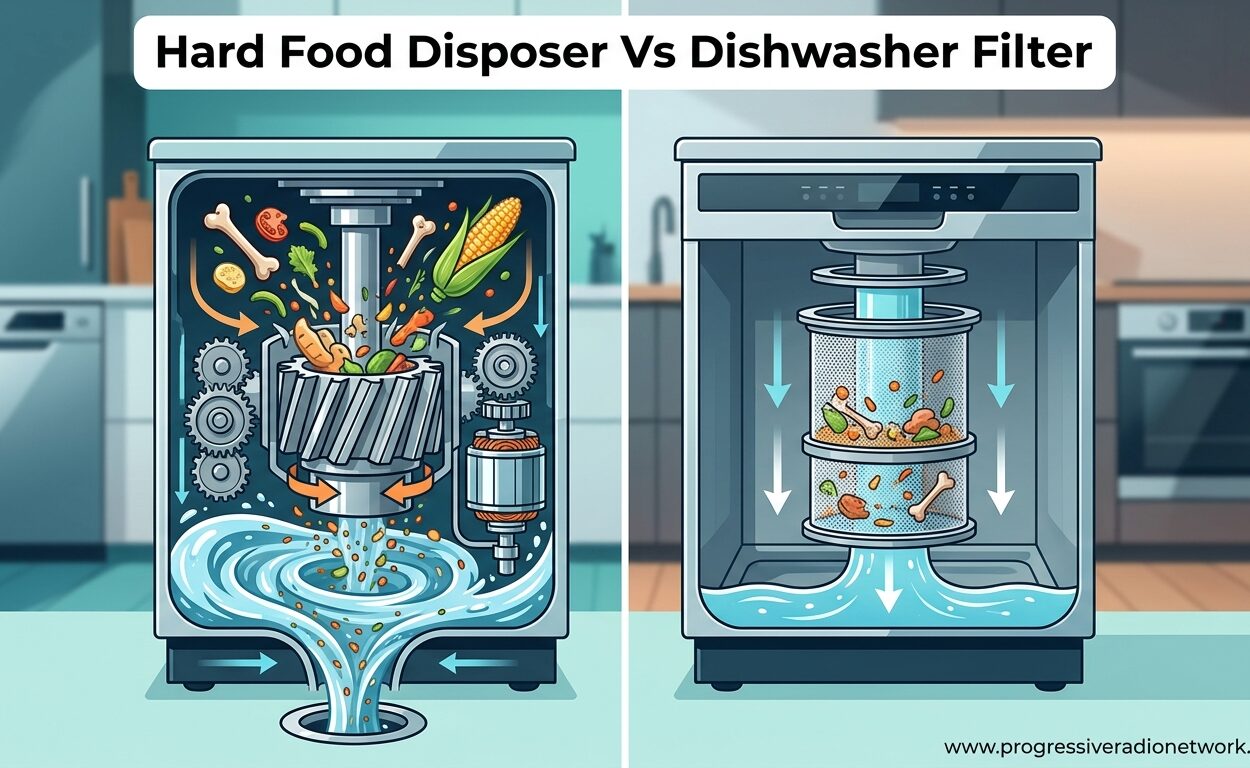
When shopping for a new dishwasher, you’ll inevitably encounter the debate between hard food disposers and filtration systems. This choice affects everything from noise levels to maintenance routines, and getting it wrong means dealing with smelly filters or noisy cycles for years. I’ve spent years researching dishwasher technology and testing both systems firsthand, and I’ll break down exactly what each system does so you can make the right choice for your kitchen.
What is a Hard Food Disposer – Definition and How It Works
A hard food disposer is a built-in grinding mechanism located at the bottom of your dishwasher that pulverizes food particles into tiny pieces. This system uses a stainless steel chopper blade, often spinning at high RPMs, to disintegrate food scraps before they can clog spray arms or redeposit onto your clean dishes.
The process works like this: as food washes off your dishes, it falls into the disposer chamber where the blade grinds it into a pulp. This pulped material then mixes with water and flushes safely down the drain without any manual intervention required. Think of it as a mini garbage disposal specifically designed for your dishwasher.
Major brands like Maytag, KitchenAid, and some GE and LG models have long relied on hard food disposers as their primary food management system. These disposers are typically paired with stainless steel tubs and powerful motors to handle everything from soft vegetables to harder food scraps.
What is a Dishwasher Filtration System – Definition and How It Works
A dishwasher filtration system works differently by trapping food particles in a removable filter rather than grinding them up. This system uses one or more layers of ultra-mesh filtration to catch food debris as water circulates through the dishwasher during the cleaning cycle.
Here’s the filtration process in action: as water and food particles settle at the bottom of the tub, they pass through the filter mesh which captures everything from large chunks to microscopic particles. The cleaned water then recirculates back through the spray arms to continue washing your dishes. This continuous filtration cycle repeats throughout the wash.
The key difference is that you must manually remove and clean the filter periodically to prevent odors and maintain performance. Premium European brands like Bosch, Miele, and most modern Samsung models have adopted filtration systems because they enable significantly quieter operation without the noise of grinding blades.
Hard Food Disposer Vs Dishwasher Filter: Key Differences
The fundamental difference comes down to how each system handles food particles: one grinds while the other traps. This core difference cascades into several practical implications that affect your daily dishwasher experience in 2026.
| Feature | Hard Food Disposer | Filtration System |
|---|---|---|
| Noise Level | Louder (grinding sounds during cycle) | Quieter operation |
| Maintenance | Maintenance-free | Manual filter cleaning required |
| Food Handling | Pulverizes particles for drain flush | Traps particles in mesh filter |
| Odor Risk | Lower (food flushed away) | Higher if filter neglected |
| Energy Use | Slightly higher (motor power) | Lower energy consumption |
| Common Brands | Maytag, KitchenAid, older GE | Bosch, Miele, Samsung, modern LG |
The most noticeable difference for most homeowners is noise. Hard food disposers create grinding sounds throughout the wash cycle, while filtration systems operate almost silently. This explains why Bosch, famous for their quiet dishwashers, exclusively uses filtration technology.
Pros and Cons: Hard Food Disposer
Understanding the advantages and drawbacks of each system will help you decide which trade-offs you’re willing to accept in your kitchen.
Pros:
- Completely maintenance-free operation with no manual cleaning required
- Food particles are eliminated from the dishwasher completely
- Lower risk of odors developing from trapped food debris
- No need to remember filter cleaning schedules
- Better for households that frequently wash dishes with heavy food residue
Cons:
- Significantly louder operation due to grinding mechanism
- Higher energy consumption from the additional motor
- More moving parts means potential for mechanical failures
- Can be more expensive to repair if the disposer breaks
- Limited availability in newer premium models focused on quiet operation
Forum users consistently praise the convenience of hard food disposers, with many reporting they’ve gone years without any maintenance. However, noise complaints are equally common, especially from owners whose kitchens are open to living areas.
Pros and Cons: Dishwasher Filtration System
Filtration systems have gained popularity in recent years, particularly among premium manufacturers prioritizing quiet performance.
Pros:
- Much quieter operation without grinding sounds
- Lower energy consumption with fewer moving parts
- Less complex mechanism with fewer failure points
- Better water efficiency in many models
- More widely available in modern premium dishwashers
Cons:
- Requires manual filter cleaning to prevent odors and maintain performance
- Forgetting to clean the filter leads to smelly dishwasher
- Food particles accumulate and can attract pests if neglected
- Some filters are difficult to access and remove
- Cleaning frequency varies based on usage patterns
Real-world users on forums frequently report that once they establish a cleaning routine, filtration systems work flawlessly. The biggest challenge is simply remembering to perform the maintenance, especially for households new to this technology.
Maintenance Requirements Deep Dive
The maintenance difference is perhaps the most practical consideration when choosing between these systems. Hard food disposers truly are set-and-forget, requiring no attention beyond normal dishwasher care like running occasional cleaning cycles with dishwasher cleaner.
Filtration systems demand a more hands-on approach. Most manufacturers recommend cleaning the filter every 2-4 weeks depending on usage. The process involves removing the bottom rack, twisting out the filter, rinsing it under running water, and sometimes scrubbing stubborn particles with a brush.
Technicians recommend using dishwasher cleaner every two weeks for filters that are hard to access. Users who cook frequently or wash dishes with heavy food soil may need to clean weekly, while lighter users can stretch to monthly cleaning.
Signs your filter needs cleaning include unpleasant odors, visible debris on dishes after cycles, and slower drainage. Establishing a routine schedule based on your household’s usage patterns prevents these issues before they start.
Brand Availability Overview
The dishwasher market has clearly divided along these technological lines, making brand choice an important factor in your decision. Maytag and KitchenAid have traditionally championed hard food disposers across most of their model lines, emphasizing the maintenance-free aspect in their marketing.
Bosch, the leader in quiet dishwashers, abandoned hard food disposers years ago in favor of advanced filtration systems. Their entire lineup uses various filtration technologies including multi-layer systems and even self-cleaning filters in premium models.
Samsung and LG have shifted toward filtration systems in recent generations as they compete on noise performance. However, some LG models still offer hard food disposers in specific lines, giving consumers options. GE has also transitioned most newer models to filtration while keeping disposers in select budget-friendly options.
Miele exclusively uses filtration technology, pairing it with their famous cutlery trays and advanced sensor systems. Whirlpool, parent company to KitchenAid and Maytag, offers both systems across different product lines at different price points.
Which Option is Right for You
Your choice between hard food disposer vs dishwasher filter ultimately depends on your household priorities and lifestyle. If you value convenience above all else and don’t mind some additional noise during cycles, a hard food disposer delivers true maintenance-free operation that handles whatever food scraps you throw at it.
Choose a filtration system if quiet operation is your priority and you’re willing to commit to a simple cleaning routine. Modern filters have become easier to remove and clean, with many models featuring indicator lights that remind you when maintenance is due.
Large families who run multiple cycles daily often prefer disposers to avoid constant filter cleaning. Apartment dwellers and those with open-concept kitchens typically benefit from the whisper-quiet operation of filtration systems. Eco-conscious buyers might lean toward filters for their lower energy consumption.
Frequently Asked Questions
What is the difference between a hard food disposer and filtration in dishwashers?
A hard food disposer grinds food particles into pulp that flushes down the drain, while a filtration system traps particles in a removable mesh filter that requires manual cleaning. The main difference is automatic grinding versus manual trapping and cleaning.
What does ‘hard food disposer’ mean on a dishwasher?
A hard food disposer is a built-in grinding mechanism with a stainless steel chopper blade that pulverizes food particles during the wash cycle. This eliminates the need for manual filter cleaning and prevents food from recirculating onto clean dishes.
How often should I clean my dishwasher filter?
Clean your dishwasher filter every 2-4 weeks depending on usage. Heavy users who cook frequently may need weekly cleaning, while lighter users can stretch to monthly. Look for signs like odors, debris on dishes, or slow drainage indicating it’s time to clean.
Is it better to drain a dishwasher through a garbage disposal?
Draining through a garbage disposal can help prevent clogs by further grinding any particles that pass through your dishwasher system. However, it’s not strictly necessary if your dishwasher has an effective hard food disposer or well-maintained filtration system.
Why are dishwashers with filters quieter?
Dishwashers with filtration systems are quieter because they lack the grinding mechanism found in hard food disposers. Without a chopper blade spinning at high RPMs to pulverize food, filtration models can operate at significantly lower decibel levels, often below 45 dBA.
Conclusion
The hard food disposer vs dishwasher filter debate ultimately comes down to prioritizing either convenience or quiet operation. Both systems effectively clean your dishes when working properly, but they require different commitments from you as the owner. Hard food disposers offer truly maintenance-free performance at the cost of some additional noise, while filtration systems deliver whisper-quiet operation in exchange for regular filter cleaning. By understanding your household’s priorities and willingness to perform maintenance, you can choose the system that will serve you best for years to come.



Leave a Comment