
When shopping for a new washing machine, one of the biggest decisions you’ll face is choosing between an agitator vs impeller washer. Both designs have their strengths, and the right choice depends on your laundry habits, the types of clothes you wash, and what matters most to you: cleaning power or fabric care. In this guide, I’ll break down exactly how these two washing machine types work, their pros and cons, and help you decide which is better for your home.
Agitator vs Impeller Washer: What’s the Difference?
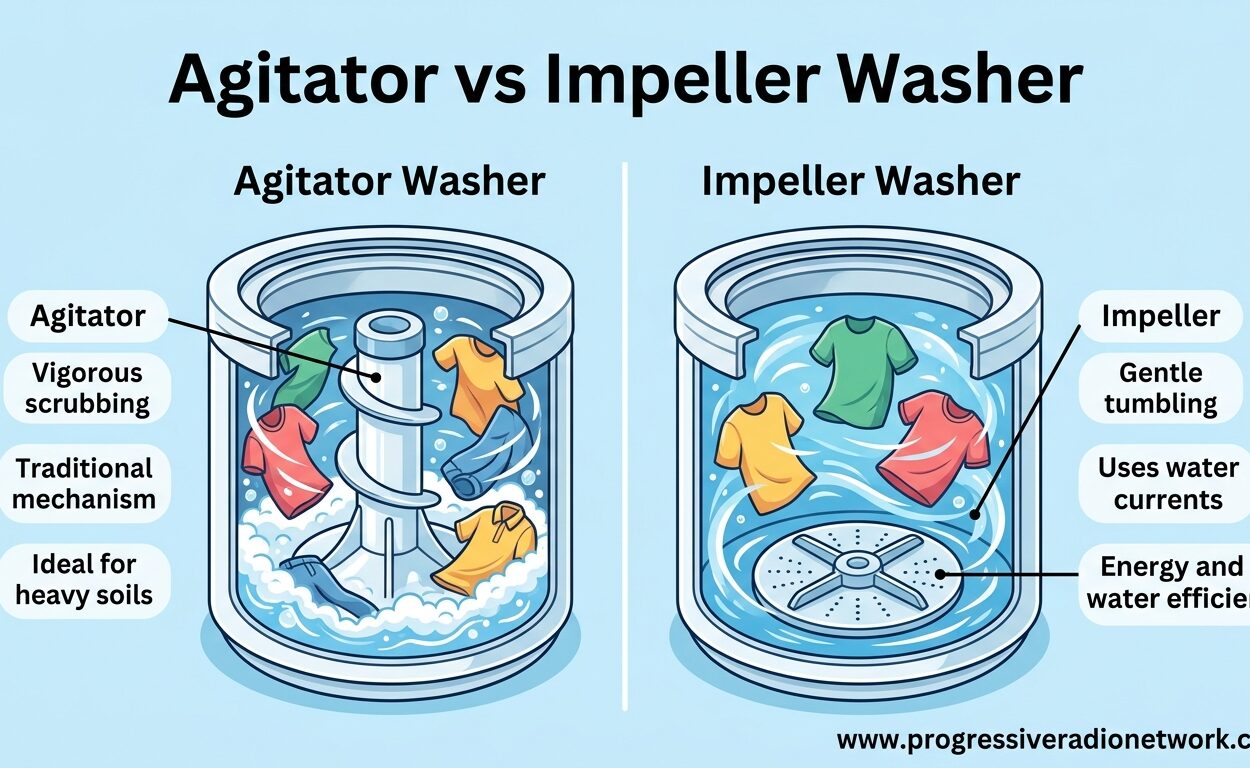
The fundamental difference between these two washer types comes down to how they move your clothes during the wash cycle. An agitator washer uses a tall central post that twists back and forth, rubbing clothes against the post and drum to remove dirt. An impeller washer uses a low-profile disc or plate at the bottom of the drum that spins to create turbulence, moving clothes around so they rub against each other for cleaning.
This mechanical difference affects everything from cleaning performance to fabric gentleness, water usage, and even how much laundry you can fit in a single load. Let me dive deeper into each type.
What is an Agitator Washer?
An agitator washer is the traditional top-load washing machine design that many of us grew up with. At the center of the wash basket, you’ll find a tall post (the agitator) with fins or ridges that twist and turn during the wash cycle. This post moves back and forth in a rhythmic motion, creating a strong mechanical washing action.
The agitator’s twisting motion rubs your clothes against the post and against each other, which is excellent for breaking down dirt and stains. This robust cleaning action has made agitator washers popular for decades, especially in households with heavily soiled work clothes, uniforms, or active families.
Traditional agitator washers typically use more water than newer high-efficiency models, as they need enough water to fully cover the agitator and allow clothes to move freely. The drum fills higher, which means these machines generally have longer wash and rinse cycles but use that extra water and mechanical action to deliver thorough cleaning.
Most agitator models offer multiple wash settings and cycle options, allowing you to adjust the agitation intensity based on fabric type. Many also feature a “deep fill” option that lets you add even more water for extra-large or heavily soiled loads.
What is an Impeller Washer?
An impeller washer represents the newer high-efficiency (HE) top-load design. Instead of a tall central post, these washers feature a low-profile disc, cone, or plate at the bottom of the wash basket. During the wash cycle, this impeller spins to create currents and turbulence within the drum.
The spinning action of the impeller moves clothes in a 360-degree motion, causing them to rub against each other rather than against a central post. This friction between garments is what helps lift dirt and stains. Because there’s no tall agitator post taking up space in the center of the drum, impeller washers offer more usable capacity for bulky items like comforters, pillows, and large loads.
Impeller washers are designed as high-efficiency machines, meaning they use less water and energy than traditional agitator models. The wash basket doesn’t fill as completely; instead, the impeller creates a concentrated wash action using a smaller amount of water. This makes impeller washers more eco-friendly and can lead to savings on your utility bills over time.
Modern impeller washers often feature advanced wash plate designs, multiple wash motions, and smart technology that senses load size and soil level to optimize water usage and cycle time. Brands market these under various names like “Power Impeller,” “wash plate,” or “impeller action,” but they all work on the same principle of friction-based cleaning without a central post.
How Agitator vs Impeller Washers Work
Understanding the mechanical difference between these washer types helps explain their performance characteristics. Let me break down exactly how each one cleans your clothes.
Agitator Washers: The central agitator post twists in one direction, then reverses and twists the other way. This back-and-forth motion creates a strong mechanical washing action that rubs clothes against the agitator fins and the drum walls. The vigorous movement is particularly effective at breaking apart ground-in dirt and tough stains. The higher water level helps suspend soils so they can be flushed away during the drain and spin cycles.
Impeller Washers: The impeller disc spins at the bottom of the drum, creating currents and turbulence that move clothes in a circular motion. As clothes are pushed toward the center and then pulled back out, they rub against each other. This friction is what provides the cleaning action. The lower water level means clothes are more concentrated, which enhances the friction cleaning. Modern impeller washers may also use multiple wash motions like tumbling, rolling, and scrubbing for enhanced cleaning performance.
The key difference is the source of friction: agitator washers rely on clothes rubbing against the agitator post and drum, while impeller washers rely on clothes rubbing against each other. This fundamental difference explains why agitators typically provide stronger stain removal while impellers are gentler on fabrics.
Agitator vs Impeller Washer: Benefits Comparison
Both washer types have distinct advantages. Here’s a comprehensive comparison to help you understand the strengths of each design.
Agitator Washer Benefits:
- Superior Stain Removal: The robust mechanical action excels at breaking down tough stains, ground-in dirt, and heavy soils. Work clothes, sports uniforms, and heavily soiled items come out cleaner.
- Shorter Wash Cycles: Because agitator washers use more water and stronger mechanical action, they often complete cycles faster than impeller models. Quick wash options can handle lightly soiled loads in under 30 minutes.
- Reliable Performance: This is a proven technology that has been refined over decades. Many users find agitator washers consistently deliver thorough cleaning without needing to pretreat stains.
- Familiar Design: If you’ve used traditional top-load washers before, you already know how to use an agitator model. There’s no learning curve for loading or maintenance.
- Deep Water Option: Many agitator models offer a deep fill feature that lets you add extra water for large or heavily soiled loads, giving you more control over the wash.
Agitator Washer Drawbacks:
- Harsher on Fabrics: The vigorous rubbing action can be rough on delicate items, causing more wear and tear over time. Delicates may fray or pill faster.
- Less Usable Capacity: The central agitator post takes up space in the drum, reducing the effective capacity. You won’t be able to fit as many bulky items like comforters.
- Higher Water and Energy Use: Traditional agitator washers aren’t high-efficiency models, so they use more water and energy per load. This means higher utility costs.
- Noisier Operation: The mechanical action of the agitator creates more noise during the wash cycle compared to impeller models.
Impeller Washer Benefits:
- Gentler on Clothes: Without a central post rubbing against fabrics, impeller washers are much gentler. Your clothes experience less wear and tear, helping them last longer.
- More Usable Capacity: The absence of a tall agitator means more interior space. You can fit larger loads, bulky items like comforters and pillows, and more laundry per cycle.
- Water and Energy Efficient: As high-efficiency models, impeller washers use significantly less water and energy. Over the life of the machine, this can save you money on utilities.
- Better for Delicates: The gentler wash action makes impeller washers ideal for delicate fabrics, hand-wash items, and clothing you want to preserve.
- Quieter Operation: Without the mechanical action of an agitator post, these washers run more quietly during the wash cycle.
- Modern Features: Impeller washers often come with the latest technology, including smart sensors, multiple wash motions, and advanced cycle options.
Impeller Washer Drawbacks:
- Less Effective on Heavy Stains: The gentler action may struggle with heavily soiled items or tough stains without pretreatment or longer cycles.
- Longer Cycle Times: High-efficiency cycles often take longer to compensate for using less water. You may wait 50-70 minutes for a normal wash.
- Learning Curve for Loading: Proper loading technique matters more with impeller washers. Overloading can reduce cleaning effectiveness as clothes need room to move and rub against each other.
- Potential for Tangling: The spinning motion can cause clothes to tangle, especially with larger loads or items like sheets and bedding.
- Less Deep Water: HE models use less water, which can be a downside if you prefer lots of water for rinsing or heavily soiled loads.
Which Washer is Right for You?
Choosing between an agitator vs impeller washer ultimately comes down to your specific laundry needs. Here’s my straightforward guidance based on common household situations.
Choose an Agitator Washer If:
- You have heavily soiled loads from work, sports, or outdoor activities
- You prioritize stain removal and cleaning power over fabric gentleness
- You want shorter wash cycles and don’t mind higher water usage
- You wash lots of durable fabrics like cotton work clothes, denim, and uniforms
- You prefer a familiar, proven design with straightforward operation
- You’re on a tighter budget and traditional agitator models fit your price range
Choose an Impeller Washer If:
- You wash lots of delicate fabrics, synthetic athletic wear, or clothing you want to preserve
- You want to save on water and energy costs over time
- You need to wash bulky items like comforters, pillows, and large blankets
- You want a quieter washing machine
- You’re willing to adjust your loading technique for optimal performance
- You prefer modern features and smart technology
- You want more capacity in the same footprint
Agitator vs Impeller Washer for Pet Hair
Pet owners have specific laundry needs, and both washer types can handle pet hair with the right approach. Here’s what you need to know.
Agitator washers can be effective at removing pet hair due to their vigorous mechanical action. The rubbing motion helps loosen and flush away pet hair from fabrics. Many pet owners find that agitator models handle pet bedding and blankets well, especially when using a high water level setting.
Impeller washers can also work well for pet hair removal, but they may require more attention to loading. The key is not to overload the machine so clothes can move freely. Some pet owners report that impeller washers work great for everyday pet hair on clothes, while very hairy items may need an extra rinse cycle or pretreatment.
Some manufacturers offer specialized pet hair features. Maytag’s Pet Pro system includes a specialized lint trap and a dedicated cycle for removing pet hair. Whether you choose an agitator or impeller, look for models with extra rinse options and consider using a lint roller on heavily hairy items before washing.
Water and Energy Efficiency Comparison
If environmental impact and utility costs are important to you, the efficiency difference between agitator and impeller washers is significant.
Impeller washers are high-efficiency machines designed to use less water and energy. They typically use 15-30 gallons of water per cycle compared to 30-45 gallons for traditional agitator models. Over the course of a year, this can save thousands of gallons of water. The lower water usage also means less energy needed to heat water for warm or hot wash cycles.
Many impeller washers qualify for ENERGY STAR certification, meaning they meet strict efficiency guidelines set by the EPA. These models can save you $30-50 per year on utilities compared to traditional agitator washers, depending on your usage patterns and local utility rates.
Agitator washers use more water and energy because they rely on higher water levels for their cleaning action. However, some newer agitator models are being designed with efficiency features that reduce water usage while maintaining cleaning performance. If you prefer an agitator but want to minimize environmental impact, look for models with cycle options that let you adjust water level settings based on load size.
Detergent usage is another consideration. Impeller washers require high-efficiency (HE) detergent, which is formulated to produce fewer suds and work with less water. Using regular detergent in an HE washer can cause oversudsing and reduce cleaning effectiveness. Agitator washers can use either regular or HE detergent, though using HE detergent in any washer is generally more economical and environmentally friendly.
Hybrid Solutions: 2-in-1 Removable Agitator
If you’re struggling to decide between an agitator and impeller washer, you’re not alone. Manufacturers have recognized this dilemma and developed hybrid solutions that offer the best of both worlds. Whirlpool’s 2-in-1 Removable Agitator is one such innovation that I’ve found particularly interesting.
This design features a removable agitator post that you can take out when you want the benefits of an impeller washer (more capacity, gentler cleaning) and insert when you need the power of an agitator (tough stain removal, shorter cycles). In one load, you could use the agitator for heavily soiled work clothes, then remove it for a load of delicates.
Other brands offer similar flexibility through different approaches. Some models have wash plates that can be adjusted, while others offer cycle options that mimic agitator-style cleaning even without a physical agitator post. These hybrid solutions are worth considering if you want maximum flexibility and can’t commit to just one style.
When evaluating hybrid models, consider the ease of removing and reinstalling the agitator, whether you need to store the agitator elsewhere when not in use, and how the machine performs in both configurations. Read reviews from users who have tested both modes to get a realistic sense of real-world performance.
Frequently Asked Questions
Which is better agitator or impeller washer?
Neither is universally better – it depends on your needs. Choose an agitator for superior stain removal and shorter cycles. Choose an impeller for gentler fabric care, more capacity, and water/energy efficiency. Most households find either type works well for everyday laundry.
What brand of washer has the least problems with top load?
Based on reliability data, brands like Speed Queen, Whirlpool, and Maytag consistently rank well for top-load washers. Consumer Reports and owner surveys show these brands have lower repair rates and longer lifespans. However, reliability can vary by specific model, so always check recent reviews for the exact washer you’re considering.
Is it better to get a washer with or without an agitator?
Get a washer with an agitator if you need strong cleaning power for heavily soiled loads. Get a washer without an agitator (impeller) if you want gentler fabric care, more capacity, and better efficiency. For mixed laundry needs, consider a hybrid 2-in-1 model with a removable agitator that gives you both options.
What are the disadvantages of an agitator washing machine?
The main disadvantages of agitator washers are: harsher on fabrics causing more wear and tear, less usable capacity due to the central post, higher water and energy consumption, and noisier operation. They may also tangle delicate items more easily. However, they excel at stain removal and typically have shorter cycle times.
Conclusion
After evaluating both washer types, you can see that the agitator vs impeller washer debate doesn’t have a one-size-fits-all answer. Both designs deliver clean laundry through different approaches, and both have loyal users who swear by their choice.
If you’re still undecided, consider this: most modern households do fine with either type. Everyday laundry like t-shirts, jeans, and towels comes out clean in both agitator and impeller washers. The decision matters most when you have specific needs like heavily soiled work clothes (favoring agitators) or lots of delicates and bulky items (favoring impellers).
Before making your final decision, visit a local appliance store to see both types in person. Open the lids, look at the drum capacity, and imagine loading your typical laundry. If possible, read recent user reviews for specific models you’re considering, paying attention to experiences from people with similar laundry habits to yours.
Remember that whichever type you choose, proper maintenance, correct detergent use, and appropriate loading technique will have a bigger impact on your laundry results than the agitator vs impeller distinction. Both types can deliver excellent results when used correctly.



Leave a Comment