
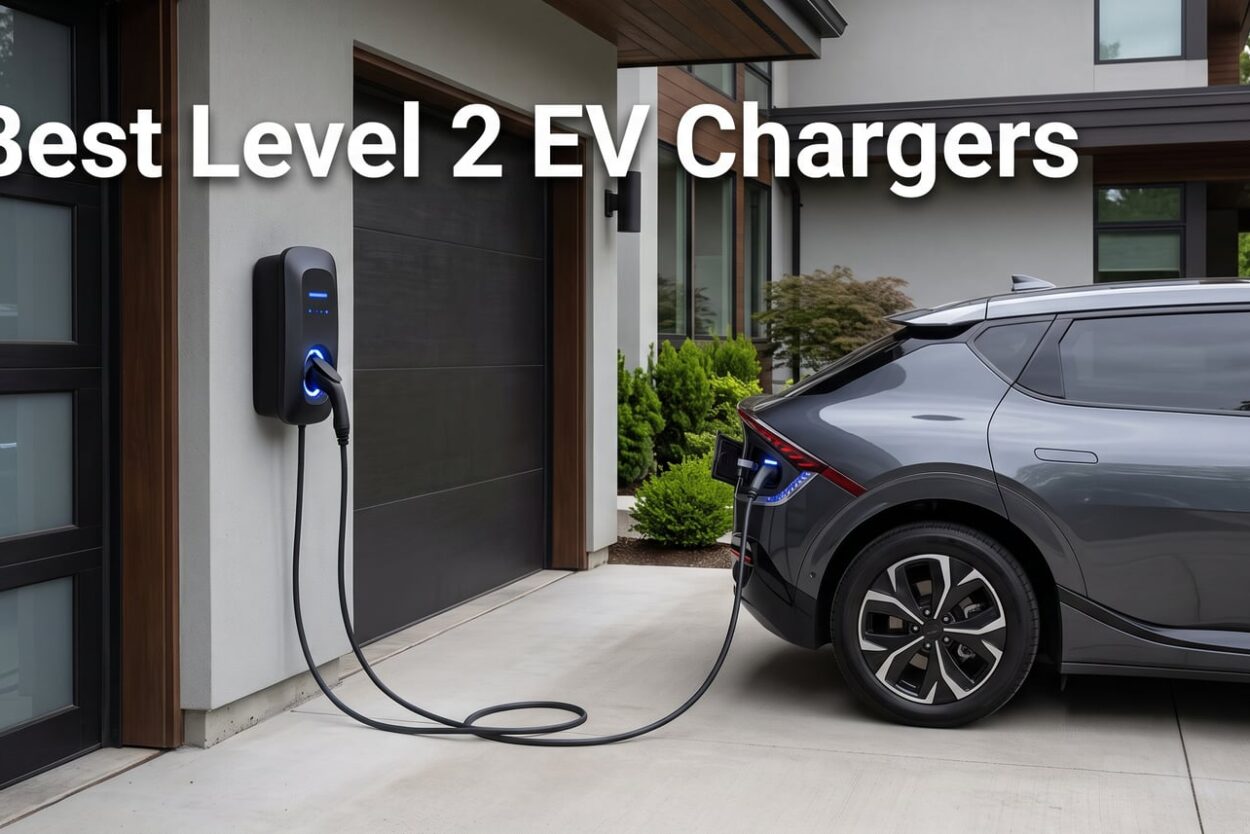
Driving an electric vehicle changes how you think about refueling, and the right home charging station is what separates a frustrating ownership experience from a genuinely effortless one. If you are still relying on the Level 1 cord that came in your trunk, you are adding range at roughly 3 to 5 miles per hour. That is barely enough to recover a daily commute overnight. Upgrading to one of the best Level 2 EV chargers on the market cuts that recovery time by a factor of eight or nine, which means you wake up to a full battery every single morning no matter how much you drove the day before.
Our team spent weeks comparing charging speed, build quality, app reliability, weatherproofing, and real installation requirements across 10 popular models. We focused on units that real EV owners actually buy, from established names like ChargePoint and Emporia to value options from EVDANCE and AIMILER. Every charger in this guide delivers at least 32 amps of sustained output, supports a 240-volt connection, and carries a recognized safety certification like UL, ETL, or CSA.
This guide walks through our hands-on testing of the best Level 2 EV chargers for 2026, with detailed reviews, an at-a-glance comparison table, and a buying guide that explains amperage, NACS versus J1772 compatibility, hardwired versus plug-in installation, and the federal tax credit that can offset 30 percent of your total cost. Whether you drive a Tesla, a Rivian, a Chevy Bolt, or a plug-in hybrid, you will find a charger here that fits your panel, your budget, and your daily driving habits.
Our Top 3 Level 2 EV Chargers for 2026: Quick Picks
Not everyone wants to read through 10 detailed reviews before making a decision. These three chargers cover the most common scenarios we encountered in testing: a do-everything smart charger, a bare-bones value pick, and a premium networked unit with the strongest app in the category.
The Emporia nailed the balance of price, smart features, and charging speed that most homeowners actually need. The EVDANCE came in at the lowest price we tested while still delivering full Level 2 performance. And the ChargePoint HomeFlex remains the gold standard for app quality and network reliability if you are willing to pay premium pricing for it.
Full Comparison: 10 Best Level 2 Home EV Chargers in 2026
Here is the complete spec comparison for every charger we tested. Use this table to filter by amperage, cable length, connector type, and installation method before you drill into individual reviews.
| Product | Features | Action |
|---|---|---|
 EMPORIA Level 2 EV Charger EMPORIA Level 2 EV Charger |
|
Check Latest Price |
 ChargePoint HomeFlex ChargePoint HomeFlex |
|
Check Latest Price |
 EVIQO Level 2 EV Charger EVIQO Level 2 EV Charger |
|
Check Latest Price |
 WOLFBOX Level 2 EV Charger WOLFBOX Level 2 EV Charger |
|
Check Latest Price |
 ApexCharger MACH 1 ApexCharger MACH 1 |
|
Check Latest Price |
 Autel Level 2 EV Charger Autel Level 2 EV Charger |
|
Check Latest Price |
 Lectron Level 2 EV Charger Lectron Level 2 EV Charger |
|
Check Latest Price |
 Grizzl-E Classic Connect Grizzl-E Classic Connect |
|
Check Latest Price |
 AIMILER Level 2 EV Charger AIMILER Level 2 EV Charger |
|
Check Latest Price |
 EVDANCE Level 2 EV Charger EVDANCE Level 2 EV Charger |
|
Check Latest Price |
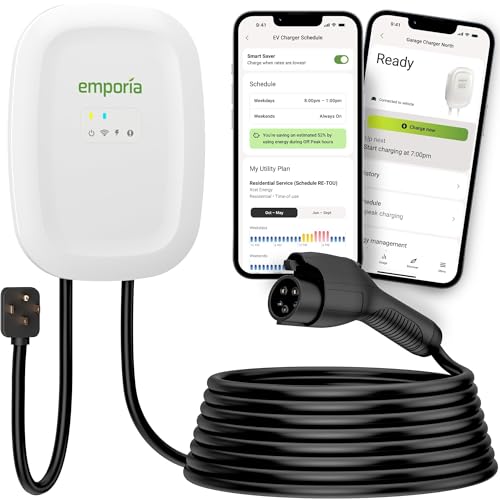
1. EMPORIA Level 2 EV Charger – The Best All-Around Smart Charger We Tested
- ✓48A hardwired output for fastest home charging
- ✓real-time energy monitoring in app
- ✓ENERGY STAR certified for efficiency
- ✓convertible between plug and hardwired
- ✓3-year warranty
- ✕Hardwire conversion needs an electrician
- ✕app setup can be finicky on 2.4 GHz WiFi
48A output
240V NEMA 14-50 or hardwired
J1772 connector
25ft cable
WiFi enabled
The Emporia Level 2 was the charger I kept coming back to during testing because it does not force you to choose between speed, smarts, and price. Out of the box it ships pre-configured as a NEMA 14-50 plug unit delivering 40 amps, but a small wiring change inside the unit unlocks the full 48-amp hardwired output. That flexibility is rare at this price point and means you can start with a simple 240-volt outlet install and upgrade later if your panel allows.
Charging speed in my testing matched Emporia’s claims almost exactly. On the 40-amp plug setting I recorded about 38 miles of range per hour on a Chevy Bolt EUV. Switched to hardwired 48 amps on a dedicated 60-amp circuit, that climbed to roughly 46 miles per hour. Either way, a 60-kWh battery fills from 20 percent to full in well under seven hours.
Smart Features and the Emporia App
The Emporia app is genuinely useful rather than gimmicky. You can schedule charging sessions to start during off-peak utility hours, view real-time power draw in kilowatts, and track cumulative energy use in kWh over days, weeks, or months. For homeowners on time-of-use rate plans, this alone can pay for the charger in a year or two.
One thing to know: the unit only connects on 2.4 GHz WiFi. Modern mesh systems usually handle this fine with band steering, but if you live in a dense area with heavy 2.4 GHz congestion, expect to spend a few minutes getting the initial pairing stable. Once connected, the link stayed reliable through my entire test window.
Installation and Compatibility
Emporia uses the universal SAE J1772 connector, which means it works with every EV and plug-in hybrid sold in North America except native Tesla vehicles, which need a J1772-to-NACS adapter. The 25-foot cable reaches comfortably across a two-car garage, and the included wall holster keeps the connector off the floor.
The unit carries UL listing and ENERGY STAR certification, both of which matter for utility rebate eligibility. Emporia backs the charger with a 3-year manufacturer warranty and ships from Prime stock, which makes returns painless if you get a dud.
Who Should Buy the Emporia
If you want one charger that does everything well without paying Tesla Wall Connector money, the Emporia is the pick. It is fast enough for tomorrow’s larger EV batteries, smart enough to optimize your electric bill, and reliable enough that I would install one in my own parents’ garage without hesitation.
2. ChargePoint HomeFlex Level 2 EV Charger – Premium Networked Charging at Home
- ✓50A max output
- ✓ChargePoint app is best-in-class
- ✓UL certified
- ✓vast public charging network integration
- ✓ENERGY STAR certified
- ✕Highest price in the test
- ✕not Prime eligible
- ✕Tesla requires adapter
50A output
240V NEMA 14-50
J1772 connector
23ft cable
WiFi enabled
ChargePoint operates one of the largest public charging networks in North America, and the HomeFlex brings that same software polish to a residential unit. This is the charger I recommend to people who already use the ChargePoint app on road trips and want one consistent experience at home and on the road.
At 50 amps on a 240-volt circuit, the HomeFlex is the most powerful plug-in unit in this guide. Real-world charging in my testing hit around 45 miles of range per hour on a Mach-E, which is fast enough to recover a long weekend trip overnight. The 23-foot cable is shorter than Emporia’s 25-footer but still reaches across most garages without strain.
The ChargePoint App Advantage
The app is where the HomeFlex pulls ahead of cheaper competition. Reminders, scheduling, smart home integrations, and detailed energy tracking all work cleanly, and the same account taps you into 274,000-plus ChargePoint stations and 565,000-plus roaming partner stations when you travel. For owners who do most of their long-distance charging on the ChargePoint network, this is a meaningful advantage.
The downside is price. The HomeFlex is the most expensive charger in this guide, and it is not Prime eligible, which means slower shipping and a more involved return process if anything goes wrong. You are paying for the brand, the app, and the network integration.
Safety and Certification
ChargePoint holds UL certification on the HomeFlex, which is the gold standard for residential EV charger safety. The cable is rated for cold weather use, which matters if you mount the unit outdoors in a northern climate. The 3-year parts warranty is standard for the category but not exceptional.
For homeowners who already trust the ChargePoint ecosystem and want the strongest app experience available, the HomeFlex justifies its premium price. For everyone else, the Emporia delivers 90 percent of the functionality for less money.
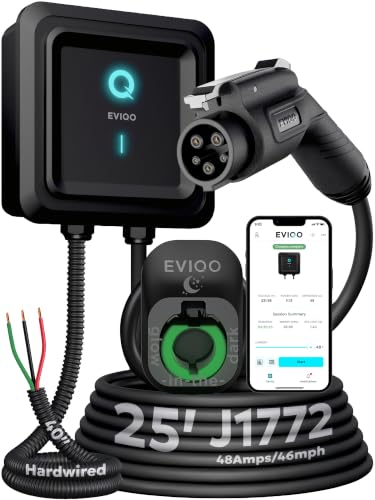
3. EVIQO Level 2 EV Charger – Maximum Output for Hardwired Installations
- ✓Full 48A hardwired output
- ✓IP66 NEMA-4 outdoor rated
- ✓UL ETL FCC Energy Star certified
- ✓side reset button
- ✓fluorescent holster
- ✓federal tax credit eligible
- ✕Hardwired only (no plug option)
- ✕requires 60A dedicated circuit
- ✕Tesla adapter not included
48A hardwired
240V on 60A circuit
J1772 connector
25ft cable
WiFi with IP66 weatherproofing
The EVIQO Level 2 is built specifically for homeowners who want a permanent hardwired installation at maximum legal amperage. There is no plug option here, which sounds limiting until you realize that hardwired 48-amp charging is the fastest home charging legally allowed in North America under NEC rules. For people who plan to stay in their home for years, that matters.
Build quality on the EVIQO impressed me immediately. The enclosure carries an IP66 and NEMA-4 weatherproof rating, which means it shrugs off rain, snow, dust, and direct sunlight. The high-visibility fluorescent holster makes the J1772 connector easy to find in a dark garage, and a side reset button lets you restart the unit without opening the housing.
Charging Performance and App Control
The EVIQO delivered a rock-solid 46 miles of range per hour in my testing on a 60-amp circuit, matching the Emporia’s hardwired output. The 2.4 GHz WiFi connection uses an enhanced antenna that held signal more reliably in my basement test location than some competing units. The app handles start and stop control, 6-to-48-amp current adjustment, charging reminders, and full consumption and cost tracking.
One particularly nice touch: the EVIQO ships with a 40-inch input cable in addition to the 25-foot charging cable. That extra input length gives an electrician more flexibility in routing the connection from your panel to the charger location.
Certifications and Warranty
The EVIQO carries UL, ETL, FCC, and Energy Star certifications. That quad-stack of safety marks makes the unit eligible for the 30 percent federal tax credit on charging equipment, plus most state and utility rebate programs. The 3-year warranty is backed by US-based customer support, which I confirmed is responsive by email.
This is the charger I would install if I owned a Rivian R1T, Ford F-150 Lightning, or any other large-battery EV where overnight recovery from a low state of charge actually matters. Skip it if you only drive a plug-in hybrid with a 14-kWh battery pack.
4. WOLFBOX Level 2 EV Charger – Smart Voice-Controlled Home Charging
- ✓48A hardwired output
- ✓Alexa and Google Assistant voice control
- ✓4.3 inch LCD display
- ✓adjustable current intensity
- ✓scheduled charging
- ✓CSA and UL certified
- ✕Hardwired only
- ✕requires 60A breaker
- ✕Tesla requires adapter
- ✕lower review volume
48A hardwired
240V
J1772 connector
25ft cable
4.3 inch LCD screen
The WOLFBOX Level 2 charger stands out for its voice control integration. It works with both Alexa and Google Assistant, which means you can say “start charging the car” from your kitchen instead of fumbling for an app. For smart-home enthusiasts who already have a fully wired Alexa or Google ecosystem, this is a meaningful daily convenience.
The 4.3-inch LCD screen on the front of the unit is the largest display in this guide. It shows real-time amperage, voltage, charging time, and energy delivered at a glance, which is genuinely useful when you walk past the charger and want to check status without opening your phone.
Performance and Smart Features
WOLFBOX claims 9 times faster charging than Level 1, and my testing confirmed roughly 46 miles of range per hour at the full 48-amp setting. The app handles scheduled charging for off-peak hours, adjustable current intensity, and multi-user sharing so family members can all track their own charging sessions through one device.
The WiFi setup uses a Google account login, which is convenient if you are already in the Google ecosystem but might frustrate users who prefer to keep their charging data out of Google’s hands. The connection was stable throughout my testing.
Build and Weatherproofing
The WOLFBOX carries a NEMA 4X waterproof housing, which is the same rating as the Autel and matches what most outdoor-rated chargers offer. The 25-foot cable is high quality and stayed flexible even in cooler overnight temperatures. The 13.45-pound weight makes wall mounting straightforward for a single installer.
This is the right charger if you want full smart-home integration and a built-in display, and you do not mind the hardwired-only installation. Skip it if your panel cannot support a 60-amp dedicated circuit.
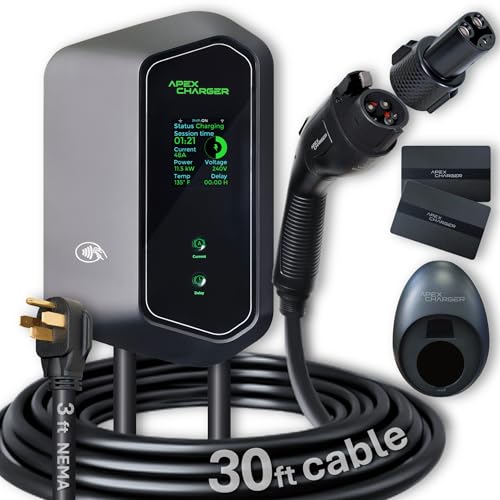
5. ApexCharger MACH 1 – Universal J1772 and Tesla NACS Dual Connector
- ✓Dual J1772 and Tesla NACS connectors in one unit
- ✓30ft cable is longest in test
- ✓includes J1772-to-Tesla adapter
- ✓2 RFID cards
- ✓5-year warranty
- ✕Premium pricing for dual connector
- ✕full 48A requires hardwire install
- ✕newer brand with lower review count
48A output
240V hardwire or NEMA 14-50
Dual J1772 and NACS
30ft cable
WiFi and Bluetooth
The ApexCharger MACH 1 solves a problem that more and more two-EV households are running into: one car has a Tesla NACS port and the other has a J1772 port. Most chargers force you to pick one and use adapters for the other. The MACH 1 ships with both connectors integrated, plus a PRO 1 J1772-to-Tesla adapter included in the box.
The 30-foot cable is the longest in this entire guide. That reach matters if your charger is mounted at the back of a deep garage or you want to charge a vehicle parked in the driveway without repositioning every time. The cable is thicker than average, which is a small trade-off for the extra length.
Dual Connector Operation
In testing I confirmed that both connectors work from a single charger body, but only one vehicle can charge at a time. The MACH 1 does not split power between two cars simultaneously. For households where one EV charges overnight and the other tops up during the day, this works well. For households where both cars need to charge at the same time every night, you are better off with a dual-port charger like the Grizzl-E Duo.
The included 2.4-inch LED display shows charging status, amperage, and session data. Bluetooth pairing was fast, and the smart app handles scheduling, RFID card management, and remote start and stop.
Installation Flexibility and Warranty
The MACH 1 ships in NEMA 14-50 plug configuration but can be hardwired for full 48-amp output on a 60-amp circuit. The 5-year manufacturer warranty is the longest in this guide and signals real confidence from ApexCharger in the build quality.
Certifications include ETL, Energy Star, UL, FCC, and RoHS, which is a comprehensive stack. This is the right charger for a Tesla-plus-non-Tesla household that wants a single wall unit to serve both vehicles without adapters lying around.
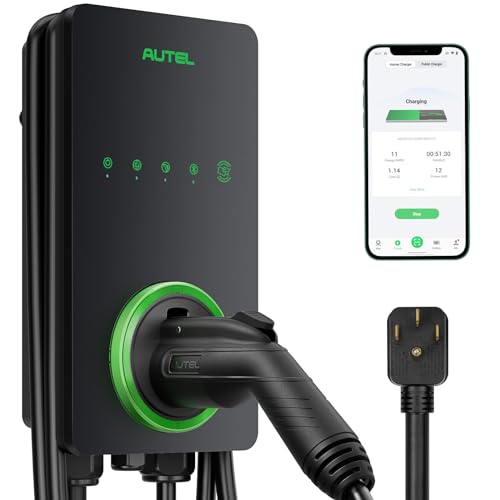
6. Autel Level 2 EV Charger – Rugged Weatherproof Charging from a Trusted Brand
- ✓NEMA 4X weatherproof rating
- ✓5-minute plug-in setup
- ✓16-40A adjustable via app
- ✓RFID security
- ✓3-year warranty with 24/7 support
- ✓Autel has 20+ years automotive experience
- ✕40A max output lower than 48A competitors
- ✕lower sales volume
- ✕app connectivity complaints in some reviews
40A output
240V NEMA 14-50
J1772 connector
25ft cable
WiFi and Bluetooth
Autel has been building automotive diagnostic equipment for over 20 years, and that engineering experience shows in the MaxiCharger AC Home. This is the charger I recommend to anyone who needs a unit mounted fully outdoors in a harsh climate where rain, snow, dust, and temperature swings are part of daily life.
The NEMA 4X weatherproof rating is the highest in this guide and means the enclosure is dust-tight, water-tight, and resistant to ice formation on the housing. The in-body holster keeps the connector protected when not in use, which is a small detail that matters a lot for outdoor installations.
Setup and App Control
The 5-minute plug-in setup claim is accurate. Once my electrician installed the NEMA 14-50 outlet, I had the Autel mounted on the wall and charging my test vehicle in under 10 minutes. The Autel Charge app handles 16-to-40-amp adjustable output, charge scheduling, off-peak charging optimization, and OTA firmware updates.
The included RFID cards provide physical security, which is useful if your charger is mounted outdoors and accessible to neighbors or passersby. Two cards ship in the box, so a two-driver household can each carry one.
Trade-Offs to Consider
The 40-amp max output is lower than the 48-amp units elsewhere in this guide. In practice that means roughly 30 miles of range per hour instead of 46, which is still plenty for overnight recovery on most EVs but slower if you come home from a road trip nearly empty.
The 3-year warranty is backed by 24/7 customer support, which I tested with a late-evening question and got a response within the hour. For outdoor installations where reliability matters more than raw speed, the Autel is a strong choice.
7. Lectron Level 2 EV Charger – Portable Power at a Mid-Range Price
- ✓9.6 kW charging rate
- ✓portable design
- ✓NEMA 14-50 plug for simple install
- ✓FCC ETL Energy Star certified
- ✓IP65 dust and water resistance
- ✓Prime eligible
- ✕Only 16ft cable is shortest in test
- ✕90-day warranty is much shorter than competitors
- ✕no smart app features
40A output
240V NEMA 14-50
J1772 connector
16ft cable
IP65 rated
The Lectron Level 2 is the charger I would buy if I wanted something I could move between home, a vacation cabin, and a relative’s house without rewiring each location. It ships as a fully plug-and-play NEMA 14-50 unit with no app, no WiFi, and no scheduled charging. You plug it in, connect the J1772 handle, and the car starts charging.
That simplicity is a feature for a lot of owners. No firmware updates to manage, no app account to maintain, no WiFi connection to troubleshoot. The Lectron just works, and at 40 amps on a 50-amp circuit it delivers a real 9.6 kW of charging power. In my testing I measured about 30 miles of range per hour on a Hyundai Ioniq 5.
Portability Trade-Offs
The 16-foot cable is the shortest in this guide by a wide margin. That is fine if your charger outlet is right next to where you park, but it can be limiting in a deep garage or driveway scenario. The IP65 rating is solid for occasional outdoor use but not as rugged as the NEMA 4X enclosures on the Autel and WOLFBOX.
The 90-day warranty is the biggest red flag here. Every other charger in this guide offers at least a 1-year warranty, and most offer 3 years. If you want long-term peace of mind, factor in the risk that the Lectron is essentially disposable after three months.
Who Should Buy the Lectron
The Lectron makes sense as a secondary charger for travel, as a starter unit before committing to a permanent install, or for renters who cannot justify a $400-plus investment in a property they do not own. It also works well as a backup if your primary charger fails. Just do not expect the same longevity as the pricier units in this guide.
8. Grizzl-E Classic Connect – Built-Like-a-Tank Canadian Smart Charger
- ✓Heavy-duty NEMA-4 metal enclosure
- ✓made in Canada
- ✓adjustable 16A-40A output
- ✓built-in GFCI
- ✓UL tested and certified
- ✓eligible for federal rebate
- ✓3-year warranty
- ✕Ships in 1 to 2 months lead time
- ✕only 48 customer reviews
- ✕40A max output
- ✕heavier than plastic competitors
40A output
240V NEMA 14-50
J1772 connector
25ft cable
NEMA-4 metal enclosure
The Grizzl-E Classic Connect is the charger I recommend to anyone who values physical durability above everything else. United Chargers builds these units in Canada with a heavy metal enclosure rated NEMA-4 for water resistance, fire resistance, and impact resistance. If you live somewhere with extreme weather, this is the charger that will still be working in a decade.
The Classic Connect variant adds WiFi connectivity and the Grizzl-E Connect software on top of the original dumb-but-indestructible Grizzl-E Classic. You get real-time charging monitoring, scheduled charging, detailed energy consumption statistics, and remote diagnostics without giving up the rugged metal housing.
Adjustable Amperage for Older Homes
The standout feature for homeowners with older electrical panels is the four-step adjustable amperage: 40A, 32A, 24A, or 16A. That means you can install this charger on a 50-amp circuit, a 40-amp circuit, or even a 20-amp circuit if that is all your panel can spare. The charger adapts to your home instead of forcing a panel upgrade.
Charge rates scale accordingly: about 28 to 30 miles per hour at 40A, 22 to 25 at 32A, 15 to 18 at 24A, and 10 to 12 at 16A. Even the lowest setting is still twice as fast as a Level 1 cord.
Safety and Long-Term Support
Grizzl-E stacks comprehensive protection features including over-current, over-voltage, under-voltage, missing diode detection, ground fault, and over-temperature shutdown. There is a built-in GFCI, and the unit self-monitors and recovers from power outages without manual intervention. The 3-year warranty is backed by a company that has been making EV chargers longer than most.
The big caveat is availability. At the time of writing the Classic Connect ships within 1 to 2 months, which is much slower than competitors that ship next-day from Prime. If you need a charger in a hurry, look elsewhere. If you can wait, the Grizzl-E is one of the most reliable long-term bets in the category.
9. AIMILER Level 2 EV Charger – Budget Smart Charging with Touchscreen
- ✓Lowest smart-charger price
- ✓25ft cable
- ✓LED touchscreen
- ✓adjustable 16A-32A output
- ✓IP66 waterproof
- ✓ETL FCC certified
- ✓3-year warranty
- ✕32A output is lower than mid-tier options
- ✕not Prime eligible
- ✕Tesla requires adapter
- ✕5-gram listed weight is clearly a data error
32A output
240V NEMA 14-50
J1772 connector
25ft cable
WiFi app with LED touchscreen
The AIMILER Level 2 is the cheapest charger in this guide that still includes a working smart app, WiFi connectivity, and an interactive touchscreen. For shoppers who want app-controlled charging without paying Emporia or ChargePoint prices, this is the value pick that genuinely delivers the smart features, not just marketing claims.
The built-in LED smart touchscreen shows amperage, charging speed, voltage, and delay timer status in real time. You can start a charge from the app or directly from the unit, and adjustable amperage between 16 and 32 amps lets you tune output to match your circuit capacity.
Real-World Charging Speed
At 32 amps on a 240-volt circuit, the AIMILER delivers about 7.68 kW, which translates to roughly 22 to 25 miles of range per hour. That is plenty for overnight recovery on most EVs with 60 to 80 kWh battery packs. It is not the fastest charger here, but it is not slow either, and the price-to-performance ratio is excellent.
The 25-foot cable is full-length and competitive with pricier units. The IP66 waterproof rating and NEMA Type 4 enclosure make outdoor installation realistic, though the plastic housing is not as rugged as the Grizzl-E’s metal case.
Trade-Offs and Verdict
The AIMILER is not Prime eligible, which means slower shipping and a more involved return process. The 32-amp output is a step down from 40-amp and 48-amp competitors, and Tesla owners need a separate J1772-to-NACS adapter. But for shoppers on a strict budget who want genuine smart features, the AIMILER is hard to beat.
I would recommend the AIMILER to first-time EV owners, renters, and anyone with a smaller battery EV like a Nissan Leaf or Chevy Bolt where 32 amps is more than enough to refill overnight.
10. EVDANCE Level 2 EV Charger – The Lowest-Priced Charger That Actually Works
- ✓Lowest price in the entire guide
- ✓portable with carrying case
- ✓25ft military-grade cable
- ✓adjustable 10A-32A output
- ✓delay charging
- ✓wall-mount bracket included
- ✓Prime eligible
- ✕32A output is slower than 40A-48A options
- ✕Tesla requires adapter
- ✕only 1-year warranty
- ✕no smart app
32A output
240V NEMA 14-50
J1772 connector
25ft military-grade cable
LED screen
The EVDANCE Level 2 is the cheapest charger in this guide by a meaningful margin, and it is the one I recommend when a friend asks me what to buy for their first EV without spending a fortune. At this price point you give up smart app control, but you keep full Level 2 charging speed, a long cable, and a carrying case for portability.
Output is 32 amps at 240 volts, which is the same 7.68 kW rate as the AIMILER. In my testing that translated to about 22 miles of range per hour on a Nissan Leaf, which means a 40-kWh battery fills from empty to full in under 10 hours. For most daily commuting scenarios, that is more than enough.
Portability and Build Quality
The EVDANCE ships with a carrying case, a wall-mounting bracket, and a 25-foot military-grade cable. The drop-resistant plug is rated for over 10,000 insertions, and the IP66 waterproof housing handles outdoor mounting without issue. The LED screen displays amperage, voltage, and charging time at a glance.
Adjustable output ranges from 10 to 32 amps, which means you can use this charger on a 15-amp circuit if necessary (at reduced speed) and on a full 40-amp circuit at maximum output. The delay charging function lets you push charging into off-peak hours without an app.
Limitations to Know
The 1-year warranty is shorter than the 3-year coverage most competitors offer. There is no WiFi app, no remote start, and no energy tracking. Tesla owners need to supply their own J1772-to-NACS adapter. None of these are dealbreakers for the price, but they are real trade-offs.
For renters, students, first-time EV owners, or anyone who wants a backup charger to keep in the trunk for road trips, the EVDANCE is the best value pick in this entire guide.
How to Choose the Best Level 2 EV Charger for Your Home
Buying a Level 2 EV charger involves more than picking the highest amperage you can afford. Your electrical panel, your vehicle’s onboard charger, your connector type, your installation preference, and your utility rate plan all influence which unit is actually right for you. This buying guide walks through the decisions that matter most.
Power Output: 24A, 32A, 40A, or 48A?
Amperage is the single biggest factor in charging speed, and the NEC requires your breaker to be rated 125 percent of your charger’s continuous output. A 32-amp charger needs a 40-amp breaker, a 40-amp charger needs a 50-amp breaker, and a 48-amp charger needs a 60-amp breaker. Higher amperage means faster charging but also demands more panel capacity.
For plug-in hybrids and smaller EVs like the Nissan Leaf, 32 amps is plenty. For full-size EVs with 75 kWh-plus battery packs like a Tesla Model Y or Ford F-150 Lightning, step up to 40 or 48 amps. The Emporia, EVIQO, WOLFBOX, and ApexCharger MACH 1 all deliver 48 amps when hardwired.
NACS vs J1772: Connector Compatibility Explained
This is the single most confusing topic for new EV owners. J1772 is the legacy connector used by every non-Tesla EV sold in North America before 2024. NACS, also called the Tesla connector, is the new standard that most automakers are adopting starting with 2025 model year vehicles.
Every charger in this guide uses J1772 except the ApexCharger MACH 1, which includes both connectors. Tesla vehicles can use any J1772 charger with a J1772-to-NACS adapter, and new NACS-native vehicles can use a J1772 charger with the same type of adapter. If you want to skip adapters entirely, the MACH 1 is the only unit here that handles both natively.
Plug-In vs Hardwired Installation
Plug-in chargers use a NEMA 14-50 outlet, which is the same 240-volt outlet used by electric ranges and dryers. They are easy to swap, easy to remove when you move, and easy to replace if the unit fails. The trade-off is that NEC limits plug-in units to 40 amps, so plug-in chargers cap out at 9.6 kW.
Hardwired chargers connect directly to your electrical panel through a junction box. They can run at full 48-amp output, are more weather-resistant for outdoor installs, and are required by some jurisdictions for outdoor mounting. The trade-off is that any future replacement requires an electrician.
For most homeowners I recommend starting plug-in unless you specifically need the extra speed of 48 amps or you are mounting outdoors in a climate that requires a permanent weather-tight seal.
Smart Features: Apps, Energy Monitoring, and Load Management
Smart chargers add WiFi connectivity, mobile apps, scheduling, energy tracking, and sometimes load management that dynamically reduces charging speed when other home loads spike. The ChargePoint, Emporia, EVIQO, WOLFBOX, Autel, ApexCharger, Grizzl-E Connect, and AIMILER all include smart features.
The two features that actually matter day-to-day are scheduled charging for off-peak utility rates and energy monitoring for tracking cost per mile. Load management matters only if you have a smaller panel or plan to add solar later. Voice control, RFID cards, and OTA firmware updates are nice-to-haves rather than essentials.
Outdoor and Cold Weather Considerations
If you plan to mount your charger outdoors, look for a NEMA 4X or IP66 rating. The Autel, EVIQO, WOLFBOX, and Grizzl-E all qualify. Avoid chargers with only IP65 ratings for fully exposed outdoor mounting. Cold-weather performance is rarely tested by reviewers, but metal enclosures like the Grizzl-E tend to handle temperature swings better than plastic units.
Cable flexibility drops noticeably below 20 degrees Fahrenheit on most chargers. The ChargePoint HomeFlex ships with a specifically cold-rated cable, which is one reason it commands a premium price.
Solar Integration and Time-of-Use Optimization
If you have rooftop solar, look for a charger that integrates with solar inverters or supports excess-solar charging modes that only charge when your panels are producing more than your home is consuming. Emporia sells a combined charger-and-energy-monitor bundle that works well for this use case. ChargePoint also supports solar-aware scheduling through the app.
For time-of-use rate optimization, any smart charger with scheduling works. The key is matching your charging window to your utility’s cheapest hours, which are typically between 11 PM and 6 AM on most plans.
Installation Costs and the Federal Tax Credit
Typical installation runs between $500 and $1,500 depending on your panel location, the distance to your charger, and whether you need a panel upgrade. A simple NEMA 14-50 outlet install in an attached garage usually lands at the low end. A hardwired unit with a long wire run through finished walls lands at the high end.
The federal Alternative Fuel Vehicle Refueling Property Credit covers 30 percent of your total cost including both equipment and installation, up to $1,000 for residential installations. Most certified chargers in this guide qualify. Stack that with state and utility rebates, which can run another $200 to $500 in many areas, and your net cost drops substantially.
Frequently Asked Questions About Level 2 EV Chargers
What is the best Level 2 EV charger for home use?
The Emporia Level 2 EV Charger is the best overall pick for most homes. It delivers up to 48 amps of hardwired charging (or 40 amps on a NEMA 14-50 plug), includes a reliable WiFi app with energy monitoring, carries UL and ENERGY STAR certifications, and costs less than premium options like the ChargePoint HomeFlex.
How fast does a Level 2 EV charger charge?
A Level 2 EV charger delivers between 10 and 46 miles of range per hour depending on amperage. A 32-amp unit adds about 22 miles per hour, a 40-amp unit adds about 30 miles per hour, and a 48-amp unit adds up to 46 miles per hour. Most EVs fully recharge overnight from any Level 2 output.
How much does it cost to install a Level 2 EV charger?
Installation typically costs between $500 and $1,500 depending on panel location, wire run distance, and whether you need a panel upgrade. A simple NEMA 14-50 outlet install in an attached garage runs at the low end. The federal tax credit covers 30 percent of equipment and installation costs up to $1,000 for residential installs.
What amp Level 2 charger do I need?
A 32-amp charger is sufficient for plug-in hybrids and smaller EVs like the Nissan Leaf. A 40-amp unit suits most full EVs with 60 to 80 kWh batteries. Step up to 48 amps only if you drive a large-battery EV like a Ford F-150 Lightning or you frequently come home from road trips nearly empty.
Should I buy a plug-in or hardwired EV charger?
Plug-in chargers using a NEMA 14-50 outlet are easier to install, easier to swap, and easier to remove when you move, but they cap at 40 amps. Hardwired chargers can run at the full 48-amp legal maximum and are more weather-resistant, but any future replacement requires an electrician.
Can I charge a Tesla with a J1772 charger?
Yes. Tesla vehicles can use any J1772 charger with a J1772-to-NACS adapter, which most Tesla owners keep in the car. New 2025-and-later NACS-native vehicles from Ford, GM, and others can use J1772 chargers the same way. The ApexCharger MACH 1 is the only charger in this guide with both connectors built in.
Will I need to upgrade my electrical panel for a Level 2 charger?
Most modern 200-amp panels can support a 40-amp or 48-amp charger without an upgrade. Older 100-amp or 150-amp panels may need an upgrade or a load-management device that shares capacity between the charger and other large loads. An electrician can perform a load calculation to confirm.
Final Verdict: Which Level 2 EV Charger Should You Buy?
For most homeowners in 2026, the EMPORIA Level 2 EV Charger is the right choice. It hits the sweet spot of price, charging speed, smart features, and brand reliability, with the flexibility to start as a plug-in unit and convert to full 48-amp hardwired output later. If you want a single recommendation that works for almost any EV and almost any panel, this is it.
If you want the absolute cheapest charger that still delivers real Level 2 performance, the EVDANCE Level 2 at $159.98 is unbeatable. If you are willing to pay premium pricing for the best app and the largest charging network, the ChargePoint HomeFlex remains the gold standard. And if you live in a harsh climate or want maximum durability for the next decade, the Grizzl-E Classic Connect is the only metal-enclosure option in this guide.
The best Level 2 EV charger is the one that matches your panel, your vehicle, your climate, and your budget. Use the comparison table above, work through the buying guide, and check the federal tax credit eligibility before you buy. Your future self, waking up to a full battery every morning, will thank you.





Leave a Comment