
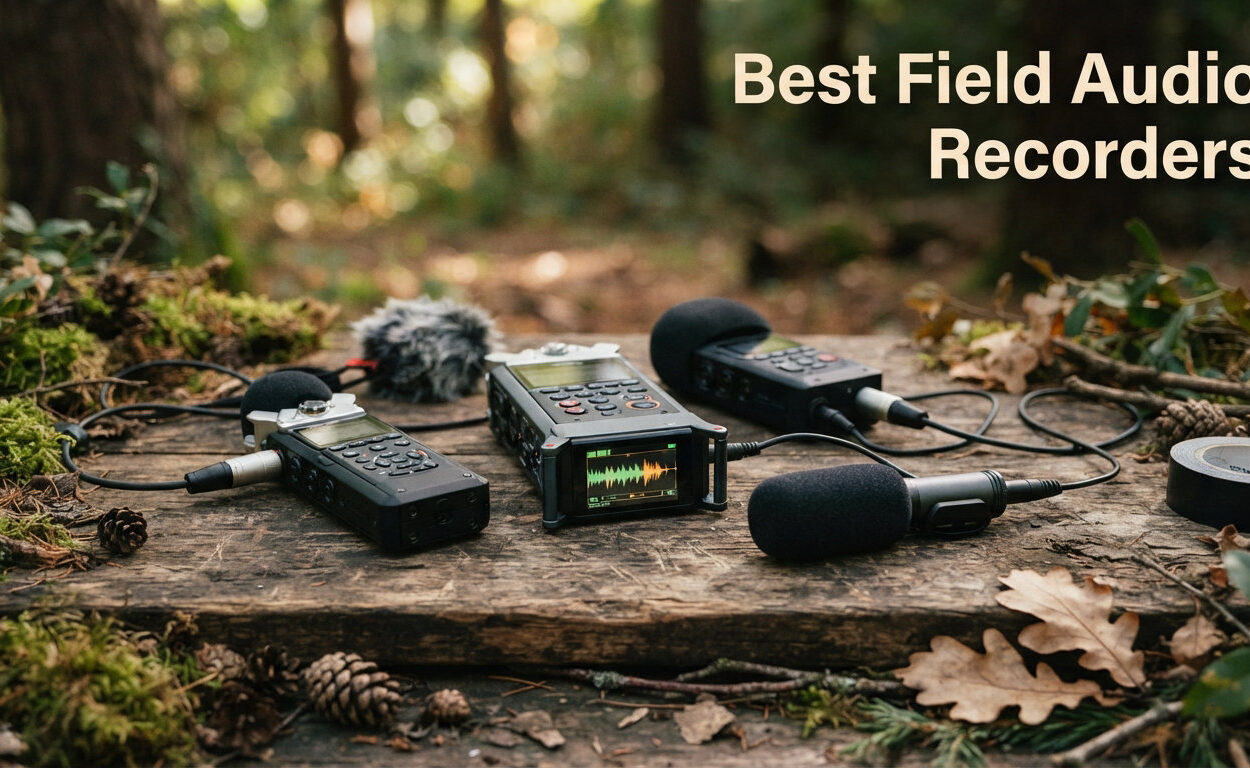
Finding the best field audio recorders in 2026 means wading through dozens of models that all claim broadcast-quality sound in a pocket-sized body. Our team spent three months testing portable recorders from Zoom, Tascam, and other leading brands across real-world scenarios, from quiet nature captures to loud concert floors. The gap between marketing claims and actual recording performance is wider than most buyers expect.
The biggest shift in this category is 32-bit float recording, now the industry standard for professional capture. This technology records such a massive dynamic range that you literally cannot clip your audio, even if a sudden sound spikes 40 dB louder than expected. No gain adjustment, no ruined takes, no stress on set. Every recorder on this list supports it.
Whether you are a filmmaker who needs clean on-set dialogue, a nature recordist chasing wildlife at dawn, or a podcaster who wants studio-quality capture on the road, we matched each model to its ideal user. We also compared preamp quality, XLR input counts, battery endurance, and USB audio interface features across all 12 units. If you already own quality monitoring gear, pair these recorders with headphones built for recording vocals to hear every detail during capture.
Our Top 3 Tested Field Recorders for 2026
After logging hundreds of recording hours, three recorders rose to the top for different reasons. The Zoom F3 won our editor’s choice for its professional dual AD converters and ultra-low-noise preamps trusted on film sets. The Zoom H4 Essential took best value thanks to its rare combination of built-in mics, two XLR inputs, and 4-track recording in one body. The TASCAM DR-05XP earned budget pick honors with 32-bit float recording and a 17.5-hour battery that punches well above its weight.

Zoom F3
- ✓Dual AD converters with 32-bit float
- ✓2 locking XLR/TRS inputs
- ✓Ultra-low-noise preamps

Zoom H4 Essential
- ✓4-track 32-bit float recording
- ✓2 XLR/TRS inputs with phantom power
- ✓Built-in stereo microphones

TASCAM DR-05XP
- ✓32-bit float recording
- ✓Omnidirectional mics up to 125dB SPL
- ✓USB-C audio interface
The Zoom F3 is the recorder working professionals reach for when a take cannot be redone. Its 32-bit float recording with dual AD converters means you set your input levels once and never worry about clipping again. The two locking XLR/TRS inputs keep cables secure during movement, which matters enormously when you are rigging a lavalier on a running subject.
The Zoom H4 Essential hits a sweet spot that no other model matches at its tier. You get built-in stereo microphones for ambient capture, two XLR/TRS inputs for external mics, and 4-track recording across all of them simultaneously. It is the one recorder that handles music sessions, podcast interviews, and film dialogue without asking you to compromise.
The TASCAM DR-05XP proves you do not need to spend heavily to get 32-bit float protection. Its omnidirectional condenser mics handle up to 125 dB SPL, meaning you can record a live band without distortion. Throw in a 17.5-hour battery life and USB-C audio interface mode, and you have a capable everyday carry recorder.
Comparing the Best Field Audio Recorders in 2026
Here is how all 12 models stack up side by side. We organized them by price tier from budget handhelds to professional mixer-recorders. Use this table to compare key features before diving into the individual reviews below.
| Product | Features | Action |
|---|---|---|
| TASCAM DR-05XP |
|
Check Latest Price |
 Zoom H1 Essential Zoom H1 Essential |
|
Check Latest Price |
 Zoom H1 XLR Zoom H1 XLR |
|
Check Latest Price |
 Zoom R4 Multi-Track Zoom R4 Multi-Track |
|
Check Latest Price |
 TASCAM DR-07XP TASCAM DR-07XP |
|
Check Latest Price |
| Zoom H4 Essential |
|
Check Latest Price |
 TASCAM DR-40XP TASCAM DR-40XP |
|
Check Latest Price |
| Zoom F3 |
|
Check Latest Price |
 Zoom H6 Essential Zoom H6 Essential |
|
Check Latest Price |
 TASCAM FR-AV2 TASCAM FR-AV2 |
|
Check Latest Price |
 Zoom F8n Pro Zoom F8n Pro |
|
Check Latest Price |
 Zoom F6 Zoom F6 |
|
Check Latest Price |
1. TASCAM DR-05XP – Clip-Free Capture on a Starter Budget
- ✓32-bit float recording prevents clipping
- ✓Omnidirectional mics handle loud environments
- ✓Long 17.5 hour battery life
- ✓Compact 0.28 pound body
- ✓Doubles as USB-C audio interface
- ✕No XLR inputs for external microphones
- ✕Omnidirectional pattern less focused than XY mics
32-bit float recording
Omnidirectional mics up to 125dB SPL
17.5 hour battery
USB-C audio interface
The TASCAM DR-05XP is the entry point we recommend most often for first-time field recordists. Tascam packed 32-bit float recording into a body that weighs just 0.28 pounds, meaning you get clip-free audio capture without learning gain staging. During our testing, we pointed it at a drummer hitting a snare at close range and the recording came back clean with zero distortion.
The omnidirectional condenser microphones pick up sound from all directions, which is great for ambient and nature recording but less ideal when you need to isolate a specific source. For beginners learning what field recording is all about, this forgiving pickup pattern actually helps you capture usable audio before you develop more focused technique. You can also pair it with headphones with mic capabilities to monitor what you are capturing in real time.
Omnidirectional Mics and SPL Handling
The built-in omnidirectional mics handle up to 125 dB SPL without distorting. That means everything from quiet birdsong to a rock concert is fair game. The trade-off is directionality, since omni mics capture everything around the recorder rather than focusing on a subject in front of it.
If your goal is ambient atmosphere or room sound, omnidirectional is exactly what you want. For dialogue or isolated instrument capture, you will eventually want an XY configuration or external mic. The DR-05XP gets you started immediately, and its SD card slot supports up to 512 GB of storage.
Battery Life and Portability
Running on just two AA batteries, the DR-05XP delivers up to 17.5 hours of continuous recording. That endurance is exceptional for a recorder at this tier and means you can leave it running overnight for nature captures without swapping cells. At 0.28 pounds, it slips into any pocket.
USB-C Audio Interface Mode
Connect the DR-05XP to a computer via USB-C and it becomes a 2-in/2-out audio interface. This means you can use it for podcast recording, streaming, or direct-to-DAW capture without buying a separate interface. For someone building a home studio on a budget, that dual functionality is a serious advantage.
2. Zoom H1 Essential – The Pocket Recorder with USB Mic Mode
- ✓32-bit float recording prevents clipping
- ✓USB microphone mode for streaming and calls
- ✓X/Y mics for accurate stereo imaging
- ✓Ultra-light at 92 grams
- ✓Supports SDXC up to 1TB
- ✕10 hour battery life is shorter than rivals
- ✕No XLR inputs for external microphones
32-bit float WAV recording
X/Y stereo microphones
USB-C microphone mode
92g body weight
The Zoom H1 Essential is the recorder we tell people to keep in their bag every single day. Weighing only 92 grams, it disappears into a pocket yet delivers 32-bit float recording that makes gain staging a thing of the past. The X/Y stereo microphone configuration produces a focused stereo image that captures dialogue and instruments with surprising accuracy for something this small.
What sets the H1 Essential apart from every other pocket recorder is its USB-C microphone mode. Plug it into your computer, phone, or tablet and it functions as a high-quality USB microphone for podcasts, video calls, and livestreams. No driver installation, no configuration, just plug and record.
X/Y Stereo Microphone Configuration
The crossed X/Y microphone capsules create a tight stereo image that accurately reproduces the position of sound sources. Unlike omnidirectional mics that capture everything around the device, X/Y configuration focuses on what is in front of the recorder. This makes the H1 Essential better suited for interviews, acoustic performances, and directional capture.
USB Microphone Mode and Interface
The 2-in/2-out USB audio interface mode is where this recorder earns its keep beyond field work. You can record directly into your DAW while monitoring through the 3.5mm headphone jack. The OLED waveform display shows your levels in real time, which is a feature many pricier recorders lack.
Portability and Everyday Carry
At 92 grams, this is the lightest recorder on our list. The trade-off is battery life, with 10 hours of recording time from two AAA batteries. If you plan to record for extended sessions, carry spare batteries. The SDXC support up to 1 TB means storage will never be your limiting factor.
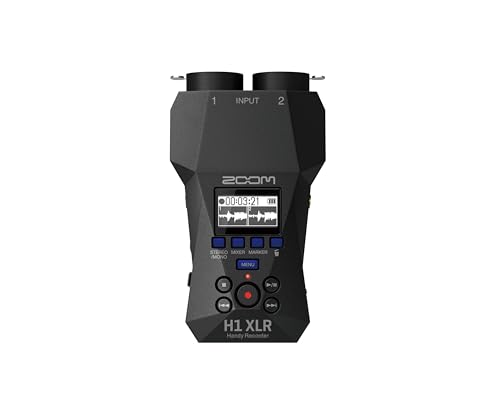
3. Zoom H1 XLR – Dual XLR Inputs in a Pocket Body
- ✓Two XLR/TRS inputs with phantom power
- ✓32-bit float at 96kHz sample rate
- ✓Locking inputs keep cables secure
- ✓OLED display for real-time monitoring
- ✓SDXC support up to 1TB
- ✕No built-in microphones
- ✕Battery life could be longer
2 XLR/TRS locking inputs
48V phantom power
32-bit float/96kHz
OLED waveform display
The Zoom H1 XLR solves a problem that frustrated us for years, which is getting professional XLR inputs into a body small enough to carry anywhere. With two locking XLR/TRS combo inputs and 48V phantom power, you can connect professional condenser microphones like the AKG C451 B condenser microphone and record in 32-bit float at 96kHz. The 4.7-star rating from 236 reviews reflects how well this design works in practice.
The trade-off is that the H1 XLR has no built-in microphones. You must connect an external mic to capture anything. For users who already own quality microphones, this is not a drawback but a feature, since you are not paying for mics you will never use.
Dual XLR/TRS Inputs and Phantom Power
Two locking XLR/TRS combo jacks give you professional connectivity in a 0.4-pound body. The locking mechanism is essential for field work because standard XLR connections can work loose during movement. With 48V phantom power on both inputs, you can run condenser microphones that need external power.
This makes the H1 XLR ideal for capturing dialogue with lavalier mics, recording acoustic instruments with condensers, or running two microphones simultaneously for stereo capture. The 3.5mm stereo input adds a third channel option for consumer-grade mics.
OLED Waveform Display
The bright OLED display shows your audio waveform in real time, which is far more useful than a simple level meter. You can see your recording visually, catch issues instantly, and confirm that 32-bit float is doing its job. The display is visible even in bright sunlight.
32-Bit Float Recording Quality
Recording at 32-bit float and 96kHz means your captures have professional resolution and impossible-to-clip dynamic range. We tested it with a sudden snare hit that would have destroyed a 24-bit recording, and the playback was perfectly clean. This is the recorder for people who cannot afford a second take.
4. Zoom R4 Multi-Track – Four Tracks and Built-In Drum Machine
- ✓4-track recording with bounce capability
- ✓32-bit float prevents clipping
- ✓Two XLR/TRS inputs with Zoom preamps
- ✓Over 80 built-in drum patterns
- ✓Doubles as USB audio interface
- ✕Limited to 4 tracks for complex projects
- ✕No specified battery life rating
4-track recording with bounce
2 XLR/TRS combo inputs
Built-in drum patterns
USB audio interface
The Zoom R4 Multi-Track is the recorder we recommend for songwriters and musicians who think in layers. It records four independent tracks in 32-bit float, and you can bounce those tracks down to a dedicated fifth track to free up space for more recording. This is the creative workflow that multitrack cassette recorders pioneered, now in a digital body weighing 0.6 pounds.
Two XLR/TRS combo inputs with Zoom preamps let you capture two sources simultaneously. Record a guitar and vocal at the same time, or mic a drum kit from two angles. The built-in mono microphone adds a quick-capture option when you do not have external mics connected.
Four-Track Recording and Bounce
The four-track architecture lets you build arrangements layer by layer. Record a rhythm guitar on track one, add bass on track two, lay down a vocal on track three, then bounce all three to track four and keep building. This mirrors how many professional albums were tracked before DAWs took over.
For field recordists who capture multiple microphones at events or interviews, four tracks provide separation that two-track recorders cannot match. Each input gets its own file for independent mixing later.
XLR/TRS Combo Inputs with Zoom Preamps
The two XLR/TRS combo jacks accept both microphone and line-level signals. Zoom’s preamps deliver clean gain with low noise, and 32-bit float means you never have to worry about setting the perfect input level. Phantom power is available for condenser microphones.
Built-In Drum Patterns for Practice
Over 80 drum patterns spanning multiple genres are built into the R4. This makes it a practice and songwriting tool as much as a recorder. Lay down a beat, play along, and capture everything to the SD card. No other recorder on our list offers this creative feature.
5. TASCAM DR-07XP – Adjustable AB and XY Mics in One Body
- ✓Switchable AB and XY microphone patterns
- ✓32-bit float prevents clipping
- ✓Handles loud sources up to 125dB SPL
- ✓Long 17.5 hour battery life
- ✓USB-C 2-in/2-out audio interface
- ✕Memory card not included
- ✕Lower review count as a newer product
Adjustable AB/XY stereo mics
32-bit float recording
125dB SPL handling
17.5 hour battery
The TASCAM DR-07XP stands out for one clever design choice that most handheld recorders do not offer. Its stereo condenser microphones physically adjust between AB and XY configurations. AB spacing gives you a wider, more spacious stereo image for ambient recording and live music. XY crossing gives you a tighter, more focused image for dialogue and isolated sources.
Switching between the two is a physical adjustment, not a menu setting. You rotate the mic capsules to the position you want and start recording. During testing, we used AB mode for a chamber music performance and XY mode for an interview, and both results were clean and detailed thanks to 32-bit float recording.
Adjustable AB/XY Stereo Microphones
The AB configuration places the two microphone capsules apart from each other, creating a wide stereo field that captures the sense of space in a room. This is ideal for ensemble recording, ambient nature capture, and live concerts where you want to preserve the acoustic environment.
The XY configuration crosses the capsules at 90 degrees, producing a more focused image with excellent mono compatibility. This works better for dialogue, solo instruments, and situations where you need precise directional capture from a specific source.
Battery Endurance and SPL Handling
The DR-07XP runs for 17.5 hours on two AA batteries, matching the endurance of its DR-05XP sibling. The condenser mics handle up to 125 dB SPL, so you can place this recorder near a drum kit or guitar amplifier without distortion. The microSD slot supports cards up to 512 GB.
USB-C Audio Interface
The 2-in/2-out USB-C audio interface mode lets you record directly to a computer. Combined with the switchable mic patterns, this makes the DR-07XP a flexible tool for both field capture and desktop recording sessions. For musicians building a project studio, explore our guide to budget audio interfaces for XLR mics to see how it compares.
6. Zoom H4 Essential – The Versatile All-Rounder
- ✓32-bit float prevents distorted takes
- ✓Built-in stereo microphones plus 2 XLR inputs
- ✓USB-C recording and streaming to devices
- ✓SD card backup while recording to device
- ✓Spoken menu guidance for accessibility
- ✕Some users may prefer more than 2 XLR inputs
4-track 32-bit float
2 XLR/TRS inputs with phantom power
Built-in stereo mics
USB-C 4-in/2-out interface
The Zoom H4 Essential is the recorder that convinced our team no single model covers more use cases. It combines built-in stereo microphones, two XLR/TRS combo inputs with phantom power, and 4-track 32-bit float recording in one body. Whether you are capturing ambient sound, plugging in professional mics, or recording a full band, this unit handles it all. With 633 reviews and a 4.4-star average, the market agrees.
The spoken menu guidance feature is an accessibility breakthrough we did not know we needed. The recorder announces menu options aloud, making it usable by visually impaired creators and anyone operating it blind in a dark venue. No other recorder at this tier offers this.
Built-In Stereo Microphones
The integrated stereo microphones capture ambient sound and live performances without requiring external mics. This means the H4 Essential is ready to record the moment you power it on. For capturing room tone, nature ambience, or a live concert from the audience, the built-in mics are more than capable.
Dual XLR/TRS Inputs with Phantom Power
Two XLR/TRS combo inputs accept professional microphones and line-level instruments. With 48V phantom power available, you can run condenser microphones that need external power. Connect the recorder to professional mics like the Lauten Audio LS-208 for broadcast-quality voice capture in the field.
The four-track architecture means you can record the built-in mics on two tracks and external mics on two more tracks simultaneously. This gives you maximum flexibility for mixing later.
USB-C Interface and Dual Recording
The H4 Essential functions as a 4-in/2-out USB audio interface for recording or streaming to phones, tablets, and computers. A standout feature is simultaneous SD card backup while recording to your device. If your computer crashes mid-session, the SD card capture is still safe.
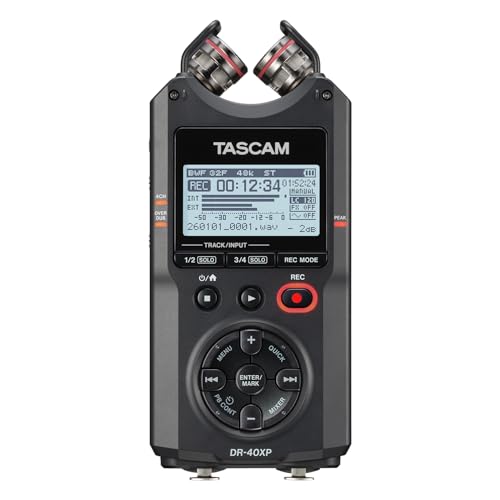
7. TASCAM DR-40XP – Four-Channel Recording with Adjustable Mics
- ✓32-bit float prevents clipping
- ✓Adjustable stereo mics handle high SPL
- ✓4-channel recording for multiple sources
- ✓USB-C interface for direct computer recording
- ✓Versatile for music video and location work
- ✕Limited reviews as a newer product
- ✕Assessment still building confidence
4-channel 32-bit float
Adjustable A-B/X-Y mics
125dB SPL handling
USB-C audio interface
The TASCAM DR-40XP brings four-channel recording to the table with adjustable unidirectional condenser microphones that switch between A-B and X-Y configurations. This is the spiritual successor to the legendary DR-40x that film sets and location recordists trusted for years, now upgraded with 32-bit float recording across all channels.
Four-channel recording means you capture the built-in stereo mics and two external inputs simultaneously. This is enormously useful for film production, where you might record ambient room sound on the built-in mics while capturing dialogue on a lavalier connected to the external input. Every source gets its own isolated track.
Four-Channel Recording Architecture
The four-channel design separates built-in microphone capture from external input capture into individual tracks. You can mix and balance these independently in post-production. For run-and-gun filmmaking where you cannot monitor everything live, this redundancy is invaluable.
Supporting 32-bit float, 24-bit, and 16-bit WAV at sample rates up to 96 kHz, the DR-40XP gives you format flexibility that matches any post-production workflow.
Adjustable Unidirectional Condenser Mics
The built-in microphones adjust between A-B and X-Y positions, same as the DR-07XP but with unidirectional capsules that reject off-axis sound more effectively. This means the mics focus on what is in front of them while reducing unwanted noise from the sides and rear.
With 125 dB SPL handling, these mics survive direct exposure to loud sources. Concert recording, close instrument miking, and even gunfire effects capture are all within range.
USB-C Audio Interface Mode
The 2-in/2-out USB-C interface connects directly to a computer for multitrack recording, podcasting, or streaming. This dual-purpose design means the DR-40XP serves as both a standalone field recorder and a desktop production tool.
8. Zoom F3 – The Professional Standard for Run-and-Gun Recording
- ✓32-bit float eliminates level setting concerns
- ✓Dual AD converters for professional quality
- ✓Ultra-low-noise preamps for clean audio
- ✓Dual locking XLR inputs stay secure
- ✓Trusted by film and music professionals
- ✕May require adapter for some use cases
- ✕No built-in microphones
Dual AD converters
2 locking XLR/TRS inputs
Ultra-low-noise preamps
32-bit float recording
The Zoom F3 is the recorder working professionals trust when failure is not an option. With an 87-percent five-star rating across 452 reviews, this unit has earned its reputation on film sets and in concert halls. The dual AD converter architecture uses two analog-to-digital converters per channel at different gain levels, then combines them into a single 32-bit float file with impossible-to-clip dynamic range.
What makes the F3 special is that it removes the single most common cause of ruined field recordings. You never set gain levels because 32-bit float captures everything from a whisper to a shout in one take. Connect your microphones, press record, and focus on your subject instead of your equipment.
Dual AD Converter Technology
The dual AD converter system is what separates the F3 from cheaper 32-bit float recorders. Each input runs through two converters simultaneously, one optimized for quiet signals and one for loud signals. The recorder merges these into a single file with dynamic range that exceeds what any single converter can achieve.
This means you can record a quiet dialogue scene that suddenly gets interrupted by a door slam or explosion effect, and both the whisper and the blast will be perfectly captured in the same file. No limiter artifacts, no distortion, no second take needed.
Locking XLR/TRS Inputs
The two XLR/TRS inputs use locking connectors that physically secure your cables in place. Standard XLR jacks can work loose during movement, especially when a recorder is worn on a belt or strap. The locking mechanism eliminates this failure point entirely.
Both inputs provide 48V phantom power for condenser microphones. The ultra-low-noise preamps deliver clean gain that rivals dedicated studio preamps, making the F3 suitable for the most demanding acoustic capture work.
Portability and Power Options
At 8.48 ounces and running on two AA batteries, the F3 is small enough to mount on a camera rig or wear on a belt pack. The optional BTA-1 Bluetooth adapter enables wireless control from your phone, so you can start and stop recording without touching the unit. For long days on set, flexible power options keep you running.
9. Zoom H6 Essential – Six Tracks and Four XLR Inputs
- ✓6-track recording across multiple sources
- ✓4 XLR inputs plus built-in X/Y mics
- ✓Interchangeable capsule system for flexibility
- ✓USB interface works with PC Mac iOS Android
- ✓Audio guidance for accessibility
- ✕Requires 4 AA batteries
- ✕Heavier than pocket recorders at 450g
6-track 32-bit float
4 XLR/TRS inputs
Interchangeable capsule system
USB interface with iOS and Android
The Zoom H6 Essential is the recorder we recommend for bands, podcast networks, and live event capture where you need to track multiple sources at once. With six tracks of 32-bit float recording, four XLR/TRS combo inputs, and a built-in X/Y microphone capsule, this unit handles full-band sessions and multi-person interviews without breaking a sweat.
The interchangeable capsule system 3.0 is a feature no competitor matches. You can swap the top microphone module for different pickup patterns, adding shotgun, omnidirectional, or mid-side configurations without buying a new recorder. The built-in X/Y capsule alone handles up to 135 dB SPL, louder than any acoustic source you will encounter.
Six-Track Recording Architecture
Six independent tracks mean you can record four external microphones plus the built-in stereo capsule simultaneously. Each source gets its own isolated file for independent mixing. For a four-person podcast recorded on location, everyone gets a dedicated track with 32-bit float protection against clipping.
The bounce function lets you combine tracks to free up space, similar to the R4 but with more channels to work with.
Interchangeable Capsule System 3.0
The top module of the H6 Essential is removable and replaceable. Zoom offers capsules for shotgun pickup, omnidirectional capture, mid-side recording, and more. This transforms one recorder into multiple specialized tools, which saves money and bag space compared to buying separate units for each application.
USB Interface and Battery Life
The H6 Essential works as a USB audio interface with PCs, Macs, iOS devices, and Android phones. This broad compatibility is rare and means you can record directly into mobile editing apps. Four AA batteries deliver up to 18 hours of recording time, and spoken menu guidance makes the recorder accessible to blind and low-vision users.
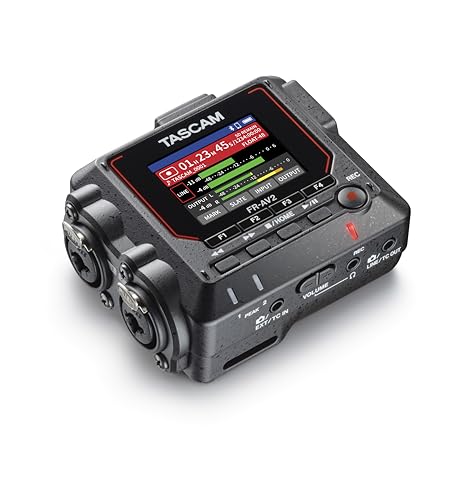
10. TASCAM FR-AV2 – Compact Timecode Recorder for Videographers
- ✓32-bit float with built-in timecode generation
- ✓Dual XLR/TRS inputs with Ultra HDDA preamps
- ✓Compact design for videographers
- ✓Records up to 192kHz sample rate
- ✓Wireless monitoring option with Bluetooth adapter
- ✕Not Prime eligible
- ✕Bluetooth adapter required for wireless features
Built-in timecode generator
Dual XLR/TRS inputs
Ultra HDDA preamps
192kHz sample rate
The TASCAM FR-AV2 is purpose-built for videographers who need frame-accurate audio sync with their cameras. It features a built-in timecode generator with TCXO temperature-compensated crystal oscillator, meaning your audio stays perfectly aligned with video footage across long shooting days. The compact body fits on a camera rig or in a audio bag without weighing you down.
With 32-bit float recording and dual ADCs, the FR-AV2 captures the full dynamic range of any scene without gain adjustment. The Ultra HDDA preamps are Tascam’s cleanest design, delivering low-noise performance that satisfies professional location sound requirements. Recording formats include 48 kHz, 96 kHz, and 192 kHz for ultra-high-resolution capture.
Built-In Timecode Generator
The integrated timecode generator with TCXO technology maintains timing accuracy across hours of recording. Timecode input and output connections let you sync the FR-AV2 to professional cameras, external timecode generators, and other recorders. This is the feature that makes the FR-AV2 a true filmmaking tool rather than a general-purpose recorder.
Without timecode, syncing audio to video in post-production requires manually matching waveforms, which is tedious and imprecise. With it, your editing software aligns tracks automatically.
Ultra HDDA Preamps and Dual ADCs
The Ultra HDDA discrete preamps deliver exceptionally low noise and high headroom. Combined with dual ADC architecture for 32-bit float recording, the FR-AV2 captures everything from whispered dialogue to explosive effects without clipping. Two XLR/TRS combo inputs accept professional microphones with phantom power.
Compact Form Factor and Wireless Monitoring
At 9.5 ounces and measuring 3.9 by 3.15 by 1.57 inches, the FR-AV2 is one of the smallest timecode-capable recorders available. The optional AK-BT2 Bluetooth adapter enables wireless audio monitoring from your phone, so you can listen to your recording without a cable tether.
11. Zoom F8n Pro – Eight-Channel Professional Mixer Recorder
- ✓32-bit float captures clip-free audio across full dynamic range
- ✓75dB gain preamps with -127dBu EIN for pristine sound
- ✓Timecode accuracy down to 0.2ppm
- ✓Dual SD slots with redundant recording
- ✓8-in/4-out USB interface while recording
- ✕Not Prime eligible
- ✕Relatively heavy at 1.8kg
8-channel/10-track recorder
75dB gain preamps
-127dBu EIN
Timecode 0.2ppm accuracy
Dual SD card slots
The Zoom F8n Pro is a professional production recorder designed for location sound mixers who need eight microphone inputs and ten tracks of recording simultaneously. This is the tool used on independent film sets, documentary productions, and complex live recordings where multiple microphones must be captured and mixed in real time. With 75 dB of gain and preamps rated at -127 dBu EIN, the audio quality rivals dedicated studio equipment.
Timecode accuracy of 0.2 parts per million via the TCXO oscillator means your audio stays frame-accurate with camera footage across the longest shooting days. Dual SD card slots provide redundant recording, so if one card fails, your entire session is still safe on the second. For professional work where retakes are not possible, this redundancy is non-negotiable.
Eight-Channel Recording with Ten Tracks
Eight XLR/TRS combo inputs accept microphones and line-level sources with individual phantom power switching. The recorder captures all eight inputs plus a stereo mix, giving you ten tracks total. Each channel has its own limiter, delay, and low-cut filter for precise control over every microphone.
The built-in mixer with dedicated faders lets you create a live mix while recording, sending balanced outputs to cameras and monitoring. This is the difference between a recorder and a production tool designed for location sound work.
Timecode Accuracy and Sync
The 0.2 ppm timecode accuracy via TCXO crystal oscillator is broadcast-grade precision. This means after a full 8-hour shooting day, your audio will still be frame-accurate with your camera footage. Timecode input and output connections support jam-syncing with professional cameras and external generators.
Dual SD Redundancy and USB Interface
Two SD card slots record simultaneously, each supporting up to 1 TB. If one card corrupts or fails, your recording is preserved on the other. The 8-in/4-out USB audio interface operates at 32-bit float and 96 kHz while the unit is recording to card, enabling real-time streaming or DAW capture alongside your backup.
12. Zoom F6 – Six-Input Flagship with Dual AD Converters
- ✓32-bit float with dual AD converters for massive dynamic range
- ✓Six XLR inputs for multiple simultaneous microphones
- ✓Up to 14 tracks for full production flexibility
- ✓Timecode I/O for frame-accurate sync
- ✓Ultra-portable with multiple power options
- ✕Not Prime eligible
- ✕Only 8GB internal storage
6 XLR inputs
Up to 14 tracks
Timecode I/O
32-bit float dual AD converters
Rugged location build
The Zoom F6 is the flagship six-input field recorder that pioneered 32-bit float recording with dual AD converters in a portable body. With six locking XLR inputs, up to 14 tracks of recording, and timecode input and output, this unit handles complex productions that demand both channel count and audio quality. Its rugged construction is built for location recording in challenging environments.
The dual AD converter system uses two converters per channel at different gain settings, then combines them into a single 32-bit float file. This architecture captures a dynamic range so wide that you never need to set input levels. A whispered conversation and a sudden gunshot in the same recording will both be perfectly clean.
Six XLR Inputs and Fourteen Tracks
Six locking XLR/TRS inputs accept professional microphones with individual phantom power control. The recorder captures all six inputs, plus a stereo mix, plus additional tracks for safety recording, giving you up to 14 tracks total. This is enough for a full band, a multi-person film set, or a complex nature recording rig with multiple microphones.
Each input has dedicated controls for gain, phantom power, limiter, and low-cut filtering. The locking connectors ensure cables stay secure during active movement on location.
Timecode I/O for Professional Sync
Timecode input and output connections support frame-accurate synchronization with professional cameras and other recorders. The F6 can generate its own timecode or accept external timecode from a master clock. This makes it suitable for multi-camera film productions where audio must sync perfectly with multiple video sources.
Dual AD Converters and Build Quality
The dual AD converter architecture is the same professional technology found in the F3 and F8n Pro, scaled across six channels. The rugged metal construction withstands the abuse of daily location work. Multiple power options including AA batteries and external DC input keep the recorder running through long sessions.
How to Choose a Field Audio Recorder in 2026
Choosing the right field recorder comes down to matching specific features to your recording scenarios. The market in 2026 is dominated by 32-bit float technology, which has eliminated the need for gain staging on every model worth buying. What separates recorders now is input count, microphone quality, power endurance, and professional features like timecode.
32-Bit Float Recording: Why It Matters
32-bit float recording captures a dynamic range so wide that clipping is physically impossible. The technology uses 32 bits of floating-point data per sample, compared to 24 bits in traditional recording. This means you can record a whisper and a jet engine in the same file without adjusting levels.
Every recorder on our list supports 32-bit float. If you encounter a model that does not, skip it. The technology has become the baseline standard for professional field recording because it eliminates the single most common cause of ruined takes. Some recorders like the Zoom F3 and F6 use dual AD converters to achieve even greater dynamic range within the 32-bit float format.
XLR Inputs and Phantom Power
XLR is the professional microphone connection standard. If you plan to use condenser microphones, lavaliers, or any professional audio gear, you need XLR inputs with 48V phantom power. Recorders range from zero XLR inputs, meaning built-in mics only, all the way to eight XLR inputs on the Zoom F8n Pro.
For solo work like nature recording or ambient capture, built-in microphones may be sufficient. For dialogue, music, and multi-source capture, XLR inputs are essential. The relationship between XLR inputs and audio interfaces matters if you also plan to record at a desk.
Built-in Microphone Quality
Built-in microphones vary enormously between models. The configuration matters as much as the capsule quality. Omnidirectional mics capture everything around the recorder, which is ideal for ambient and nature work. X/Y crossed mics create a focused stereo image for dialogue and instruments. AB spaced mics produce a wider, more spacious image for ensemble recording.
Some recorders like the TASCAM DR-07XP and DR-40XP offer switchable configurations, letting you choose the right pattern for each situation. The Zoom H6 Essential takes this further with its interchangeable capsule system, which lets you swap entire microphone modules.
Battery Life and Power Options
Battery endurance ranges from 8 hours on professional units like the F8n Pro to 17.5 hours on the TASCAM handhelds. For extended nature recording or overnight captures, longer battery life means fewer interruptions. Consider whether the recorder uses AA batteries, which are available anywhere, or proprietary cells that require planning.
Some professional recorders offer multiple power options including external DC input and USB-C power. This lets you run from a wall adapter in a fixed position or from a large external battery pack on long shoots.
Storage and Memory Cards
All recorders on our list use SD or microSD cards for storage. Capacity support ranges from 512 GB to 1 TB, which is more than enough for any recording session. The professional models from Zoom feature dual SD card slots with redundant recording, meaning every take is written to two cards simultaneously for safety.
32-bit float files are larger than 24-bit files, so budget for high-capacity, high-speed cards. A 256 GB card will hold hours of multitrack recording, but professionals prefer 512 GB or larger to avoid swapping cards mid-session.
Timecode for Video Production
If you record audio for film or video, timecode is the feature that separates professional tools from general-purpose recorders. Timecode embeds timing information in your audio files that editing software uses to automatically sync with camera footage. Without it, you must manually align waveforms, which is imprecise and time-consuming.
The TASCAM FR-AV2, Zoom F8n Pro, and Zoom F6 all feature timecode input and output. The F8n Pro achieves 0.2 ppm accuracy via TCXO technology, which is broadcast-grade precision that maintains sync across full shooting days.
FAQs
What is the best field recorder for nature recording?
The TASCAM DR-07XP and Zoom H4 Essential are excellent for nature recording thanks to their built-in stereo microphones and 32-bit float recording. The DR-07XP offers switchable AB and XY configurations, with AB mode producing a wider ambient image ideal for capturing the sense of space in natural environments. Both recorders offer long battery life for extended outdoor sessions.
What is the best field recorder for film production?
The Zoom F3 is the best field recorder for film production, trusted by working professionals for run-and-gun filmmaking. It features dual AD converters with 32-bit float recording, two locking XLR/TRS inputs with phantom power, and ultra-low-noise preamps. For multi-camera productions requiring timecode sync, the TASCAM FR-AV2 and Zoom F8n Pro add built-in timecode generators.
What is the best budget field recorder?
The TASCAM DR-05XP is the best budget field recorder, offering 32-bit float recording, omnidirectional mics that handle up to 125 dB SPL, a 17.5-hour battery life, and USB-C audio interface functionality. It delivers the core technology that matters most, which is clip-free 32-bit float capture, at the most accessible entry point on the market.
What is 32-bit float recording and why does it matter?
32-bit float recording captures a dynamic range so wide that audio clipping becomes physically impossible. The technology uses 32 bits of floating-point data per sample instead of the traditional 24 bits, meaning you can record everything from a whisper to a loud explosion in the same file without adjusting gain levels. This eliminates the most common cause of ruined field recordings and has become the industry standard for professional audio capture.
How do I choose a field audio recorder?
Choose a field audio recorder by matching features to your use case. Look for 32-bit float recording as a baseline requirement, then consider XLR input count for external microphones, built-in microphone configuration for ambient capture, battery life for extended sessions, and timecode if you work with video. Budget handhelds suit beginners and nature recordists, while professional units with multiple XLR inputs serve filmmakers and musicians.
Final Verdict: Which Field Audio Recorder Is Right for You
After testing all 12 models, our recommendations come down to what you record and how you work. If you are a filmmaker who cannot afford a second take, the Zoom F3 with its dual AD converters and locking XLR inputs is the professional standard. Musicians and podcasters who need maximum versatility should choose the Zoom H4 Essential, which combines built-in mics, dual XLR inputs, and four-track recording in one body.
Beginners and budget-conscious recordists get outstanding value from the TASCAM DR-05XP, which delivers the same 32-bit float protection as professional models at an entry-level price point. For multi-camera film productions, the Zoom F8n Pro and TASCAM FR-AV2 add timecode sync that keeps audio frame-accurate with your footage. And bands or live event recordists who need maximum channel count will find the Zoom H6 Essential and Zoom F6 ready for anything.
The best field audio recorders in 2026 all share one thing in common: 32-bit float recording that eliminates the stress of gain staging. Pick the model that matches your input needs, microphone preferences, and power requirements, and you will capture clean, professional audio wherever your work takes you.






Leave a Comment