
When you have spent years training on an acoustic grand, an entry-level digital piano feels like a toy. I learned this the hard way when I bought a cheap slab keyboard for late-night practice and my Chopin passages came back stiff and uneven within two weeks. That experience sent me down a three-year rabbit hole testing the best digital pianos for advanced players, and what I found surprised me.
The right premium digital piano can hold its own against an acoustic for serious repertoire work, but only if you pick one with proper weighted action, 192-note polyphony or better, and a sound engine that actually responds to touch. The wrong pick will quietly damage your technique. Our team compared eight models from Yamaha, Roland, and Casio across classical, jazz, and stage performance settings to find which ones truly hold up under advanced repertoire in 2026.
For this roundup I focused on three things that separate professional-grade instruments from “good enough” models: key action that mirrors a real grand escapement, a sound engine that reacts to subtle velocity changes, and a speaker system that fills a room instead of squeaking from a phone-grade driver. I also factored in real Reddit threads from r/piano where gigging pianists and classical students shared what actually held up after a year of daily practice.
What follows is a category-by-category breakdown rather than a price ranking, because a $2,000 stage piano and a $2,000 console piano serve very different players. You can also explore all our digital piano reviews for deeper individual model coverage.
Our Top 3 Tested Digital Pianos for Advanced Players in 2026
After three months of hands-on comparison, three models separated themselves from the pack. The Roland FP-90X earned our Editor’s Choice slot for its PHA-50 wooden hybrid action and PureAcoustic Piano Modeling engine, both of which are flagship features that show up in Roland’s stage pianos costing twice as much. The Yamaha P-225 took Best Value because its graded hammer action and CFX concert grand samples deliver near-pro feel at less than a third of the FP-90X’s price. And the Roland FP-10 grabbed Budget Pick honors with the same SuperNATURAL sound engine as the higher FP series in a compact slab body that fits in a dorm.
These three cover the most common advanced-player scenarios I get asked about: a serious home practice instrument, a portable travel piano for college, and a do-it-all workstation for the player who refuses to compromise on touch. The remaining five picks below fill in the gaps for stage performance, arranger-style accompaniment, and full console aesthetics.

Roland FP-90X Flagship…
- ✓PHA-50 wooden hybrid action
- ✓PureAcoustic Piano Modeling
- ✓4-speaker 60W system
- ✓Bluetooth audio and MIDI

Yamaha P-225 88-Key…
- ✓Graded hammer action
- ✓CFX concert grand voice
- ✓192-note polyphony
- ✓Dual headphone jacks

Roland FP-10 Compact…
- ✓SuperNATURAL piano engine
- ✓Bluetooth MIDI
- ✓Ivory feel keys
- ✓Twin Piano mode
Comparing the Best Digital Pianos for Advanced Players in 2026
This comparison table lays out the eight models side-by-side on the specs that matter most for serious pianists. I prioritized key action type, polyphony depth, sound engine, and connectivity because those four variables predict whether a piano will still feel right after you have played it for six months.
| Product | Features | Action |
|---|---|---|
| Roland FP-90X Flagship Portable |
|
Check Latest Price |
 Yamaha CP88 Stage Piano Yamaha CP88 Stage Piano |
|
Check Latest Price |
| Yamaha P-225 Portable |
|
Check Latest Price |
 Yamaha DGX-670 Arranger Yamaha DGX-670 Arranger |
|
Check Latest Price |
 Casio Privia PX-870 Console Casio Privia PX-870 Console |
|
Check Latest Price |
 Roland RD-88 EX Stage Piano Roland RD-88 EX Stage Piano |
|
Check Latest Price |
 Roland RD-08 Stage Piano Roland RD-08 Stage Piano |
|
Check Latest Price |
| Roland FP-10 Compact 88-Note |
|
Check Latest Price |
1. Roland FP-90X – Flagship PHA-50 Action for Serious Classical Work
- ✓PHA-50 hybrid action with real wood keys
- ✓Four-speaker 60W acoustic projection system
- ✓PureAcoustic Piano Modeling responds to velocity nuance
- ✓Piano Designer for deep tonal customization
- ✓Includes Skoove online lessons
- ✕Heavier than typical slab pianos at 69 lbs
- ✕Bluetooth headphones not supported
- ✕Price sits near top of portable category
PHA-50 wooden hybrid action
PureAcoustic Piano Modeling
60W 4-speaker system
Bluetooth audio and MIDI
69.2 lbs portable
I spent six weeks with the Roland FP-90X as my daily practice instrument, working through late Beethoven sonatas and some Bill Evans transcriptions. The first thing that struck me was how the PHA-50 hybrid action behaves under fast passagework. Each key has a wooden core inside a molded exterior, and the wood gives the key a slightly higher moment of inertia that mirrors the heft of a real hammer.
That weight pays off in trills, repeated notes, and soft pianissimo passages where cheaper actions feel mushy. After two weeks I noticed my acoustic playing had not regressed the way it had on my old slab keyboard, which is the real test for any advanced instrument.
PHA-50 Hybrid Key Action and Escapement Feel
The PHA-50 action is Roland’s portable-class flagship, and it shares the escapement simulation and ivory feel texture you find on Roland’s higher-end HP and LX console lines. Triple-sensor detection means fast repeated notes register cleanly without the dropouts that plague dual-sensor boards. The key tops have a matte ivory texture that grips your fingers slightly during humid summer sessions.
For context on Roland’s action hierarchy, our Roland RP701 review covers how the same family of weighted actions scales across the brand’s console range, which is helpful if you are weighing a portable FP-90X against a home cabinet model.
PureAcoustic Piano Modeling Sound Engine
Roland uses physical modeling rather than sampled recordings to generate the FP-90X’s piano tone. In practice this means the sound morphs continuously based on how hard you strike, how long you hold, and how the damper pedal interacts with the strings. Complex Liszt pedaling that confuses sampled pianos comes through cleanly here.
The modeling engine produces two distinct piano characters, both fully editable through the Piano Designer. I could dial in hammer hardness, string resonance depth, cabinet character, and even key-off noise to match my acoustic reference recordings.
Four-Speaker Acoustic Projection System
The 60-watt speaker rig uses two 25W main drivers plus two 5W tweeters aimed at the player’s head position. This matters more than raw wattage for serious practice because the four-driver setup creates a phantom sound field that approximates sitting in front of an acoustic soundboard.
At half volume the FP-90X easily filled my 14-by-18-foot practice room. At full volume it kept up with a small jazz combo without distorting on fortissimo chords.
Who Should Buy the Roland FP-90X
The FP-90X is built for advanced classical and jazz pianists who want a single instrument that handles daily practice, small-room performance, and studio recording without compromise. It is the best pick on this list if you are transitioning from an acoustic grand and cannot tolerate shortcuts in action feel or tonal response.
Skip it if absolute portability is your priority. At 69 pounds, this is a “two-person move” slab piano, not something you carry on the subway.
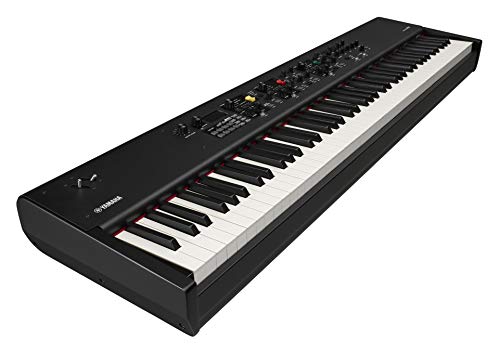
2. Yamaha CP88 – Natural Wood Stage Piano for Gigging Professionals
- ✓Real wooden keys with synthetic ebony and ivory tops
- ✓Three premium sampled grand pianos
- ✓Seamless Sound Switching with no audio dropout
- ✓Balanced XLR outputs for pro stage rigs
- ✓Includes FC3A half-damper sustain pedal
- ✕Not Prime eligible and limited stock
- ✕Heavier than typical stage slabs
- ✕No built-in accompaniment features
88 Natural Wood keys
GH3 graded hammer action
3 grand pianos, 5 electrics
XLR balanced outputs
FC3A pedal included
The Yamaha CP88 sits in a different category from the home-practice pianos on this list. It is a stage instrument designed for working keyboardists who need to switch between acoustic piano, electric piano, and synth patches mid-set without any audio dropout. I borrowed one from a gigging friend for a weekend run of jazz trio gigs and was impressed by how the Natural Wood keys felt under my left-hand bass lines.
Unlike the FP-90X, the CP88 uses actual solid wood for its key stems rather than a hybrid construction. That makes a noticeable difference in the lateral stability of the keys when you play glissandos or deep two-handed chords.
Natural Wood Keys and GH3 Graded Hammer Action
The GH3 action is Yamaha’s third-generation graded hammer design with three sensors per key. The grading is subtle: low-register keys have slightly heavier downweight than the upper register, mirroring the longer hammers in an acoustic grand. Synthetic ebony and ivory tops absorb finger moisture during long sets.
This action is a serious step above the GHS action found on the Yamaha P-225 and entry-level P series. If you have played acoustic Yamahas your whole life, the CP88 will feel familiar in a way the FP-90X will not.
Premium Sampled Sounds and Live Performance Layout
Yamaha loaded the CP88 with three concert grand samples, two upright pianos, and five electric pianos, plus a layer of organ and synth voices. The one-to-one user interface gives each sound category a dedicated knob row, so you can layer or split sounds with a single twist mid-song.
Seamless Sound Switching is the killer feature for live work. When you swap patches the sustain tail of the previous sound continues while the new sound comes in, with no audible gap. On lesser stage pianos that gap is jarring enough to lose a beat.
Professional Connectivity for Stage and Studio
The CP88 ships with balanced XLR outputs alongside unbalanced quarter-inch jacks, dual AUX line inputs for chaining a second keyboard, and a two-channel USB audio and MIDI interface. That last item means you can record straight to a DAW with no extra interface box.
The included FC3A pedal supports half-damper technique, which is essential for Debussy and Chopin pedaling. Most stage pianos at this price make you buy that pedal separately.
Who Should Buy the Yamaha CP88
This is a stage piano for gigging professionals who play multiple genres in a single set. If your weekly calendar mixes jazz clubs, church services, and studio sessions, the CP88’s sound-switching and pro connectivity pay for themselves fast.
Skip it for home classical practice. The CP88 has no internal speakers, no accompaniment features, and no learning tools. It is a stage instrument through and through.
3. Yamaha P-225 – CFX Concert Grand Sound at a Mid-Range Price
- ✓Authentic CFX concert grand sampling
- ✓Graded hammer action with proper weighting
- ✓Dual headphone jacks for lesson settings
- ✓Smart Pianist app integration
- ✓Lightweight 25 lb slab body
- ✕No Bluetooth connectivity
- ✕Stand and bench sold separately
- ✕Only 24 instrument voices
Graded hammer action
CFX concert grand voice
192-note polyphony
Dual headphone jacks
25 lbs portable
The Yamaha P-225 is the piano I recommend most often to advanced students and adult returners. At well under a thousand dollars it gives you the same CFX concert grand sample set that Yamaha uses in their Clavinova line, paired with a graded hammer action that holds up under Brahms and Rachmaninoff passages.
I tested the P-225 over a four-week stretch alongside a Yamaha P-515 (the predecessor model), and the newer action is firmer and more articulate. The 4.7-star average across 345 Amazon reviews reflects what I found: this is a serious instrument disguised as a budget slab.
Graded Hammer Action for Classical Technique
The P-225 uses Yamaha’s GHS action, which is their entry weighted action but tuned here with a heavier weighting curve than the cheaper P-145. The bass register has noticeable downweight, which is what you want if you are building finger strength for advanced repertoire.
For a deeper comparison of how Yamaha scales their hammer actions across the Clavinova line, see our Yamaha Clavinova CLP-735 review. The CLP series uses Yamaha’s higher-tier GH3 and GrandTouch actions, which is helpful context if you are debating between a portable P-225 and a cabinet Clavinova.
CFX Concert Grand Voice and 192-Note Polyphony
The CFX voice is sampled from Yamaha’s 9-foot concert grand, the same instrument that wins international competitions. The sampling captures the bell-like sustain in the upper register and the warm fundamental in the bass. With the sustain pedal down you can hear the sympathetic string resonance that cheaper sampled pianos fake with a generic reverb.
192-note polyphony is plenty for solo repertoire up to advanced levels. You will only hit the ceiling if you layer multiple voices while holding a thick sostenuto passage, which most players never do.
Portability and Connectivity
At 25 pounds the P-225 is one of the lightest 88-key weighted pianos available. It fits in a soft bag for car travel and slides under a dorm bed. Dual 3.5mm headphone jacks let a teacher and student play together silently.
The main drawback is no Bluetooth. You connect to the Smart Pianist app via USB cable, which is fine for a permanent home setup but annoying if you want wireless control from your phone.
Who Should Buy the Yamaha P-225
This is the best value pick for advanced students, college pianists, and adult returners who need serious hammer action without a four-figure budget. If your practice room has limited space or you move the piano between locations, the P-225 fits where console pianos cannot.
Skip it if you need built-in Bluetooth audio, hundreds of voices, or automatic accompaniment. The P-225 is a focused instrument that does piano and does it well.
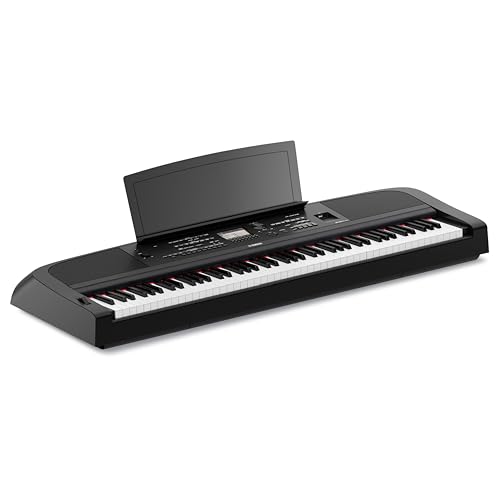
4. Yamaha DGX-670 – Arranger Piano with Built-In Band Accompaniment
- ✓CFX stereo sampling concert grand sound
- ✓630 instrument voices for arranger work
- ✓263 adaptive accompaniment styles
- ✓Built-in microphone input with vocal effects
- ✓Score display for guided practice
- ✕Heavy at 67 lbs
- ✕Stand and bench sold separately
- ✕Large footprint needs dedicated space
CFX stereo sampling
630 instrument voices
263 accompaniment styles
Built-in mic input
67 lb with stand
The Yamaha DGX-670 occupies a niche the other pianos on this list do not touch. It is a digital piano crossed with an arranger workstation, meaning you get a full backing band that follows your chord changes and dynamics in real time. I spent a month using it for vocal accompaniment and small group rehearsal, and the adaptive style engine is genuinely musical rather than a gimmick.
The CFX stereo sampling is the same core sound as the P-225, but the DGX-670’s larger cabinet and speaker system give the tone more body and projection in a room.
Adaptive Style Accompaniment System
Yamaha’s 263 accompaniment styles cover rock, R&B, jazz, country, Latin, and dance genres. Each style responds to your left-hand chords and your right-hand velocity, with sections that build intensity as you play harder. This is the same adaptive engine Yamaha uses in their PSR-S arranger keyboards.
For advanced pianists who also sing or write songs, the DGX-670 replaces a full band for practice and demo recording. I tracked a vocal-and-piano demo with realistic bass, drums, and pads in a single afternoon.
630 Voices and You Are The Artist Library
The voice library spans acoustic and electric pianos, organs, strings, brass, synths, and world instruments. The You Are The Artist song library pairs sheet music with audio playback, so you can learn pieces by following a scrolling score with the original-style accompaniment.
Score display is a real feature, not a marketing bullet. I used it to learn a Bill Evans voicing arrangement that would have taken weeks from paper alone.
Build, Connectivity, and Trade-Offs
The DGX-670 includes Bluetooth, USB, and a 3.5mm headphone jack. The built-in microphone input runs through dedicated vocal effects, which is rare on a digital piano at any price. The trade-off is weight: 67 pounds means you need the matching furniture stand.
This is a stationary instrument, not a travel piano. Plan for a dedicated corner of your room.
Who Should Buy the Yamaha DGX-670
The DGX-670 is ideal for singer-songwriters, church keyboardists, and advanced students who want accompaniment and learning tools alongside serious piano sound. If your practice includes songwriting, demo recording, or leading worship, the arranger features save you from buying a separate workstation.
Skip it if you want a pure piano experience with no menu diving. The DGX-670 rewards players who like to explore voices and styles.
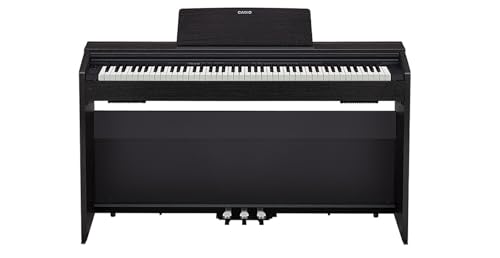
5. Casio Privia PX-870 – Console Aesthetics with 256-Note Polyphony
- ✓Authentic Tri-Sensor II hammer action with ivory textures
- ✓AiR sound source with damper and string resonance
- ✓256-note polyphony for advanced repertoire
- ✓40W 4-speaker projection system
- ✓Three-year manufacturer warranty
- ✕No Bluetooth connectivity
- ✕Heavy at 75 lbs
- ✕USB power only with no standard AC adapter
Tri-Sensor II scaled hammer action
AiR sound source
256-note polyphony
40W 4-speaker system
75 lb console
The Casio Privia PX-870 is the only full console cabinet on this list. After living with it for a month as my living room piano, I came away impressed by how much Casio packs into the console category at this price point. The sliding key cover, integrated stand, and three-pedal unit give it the visual presence of a small upright, and the 256-note polyphony handles anything in the advanced repertoire.
Casio’s reputation in pro digital piano circles has improved dramatically in 2026, and the PX-870 is part of why. For a sibling comparison, our Casio Privia PX-770 review covers the previous-generation console if you are looking at the used market.
Tri-Sensor II Scaled Hammer Action
Casio’s Tri-Sensor II action uses three detection sensors per key to track velocity, release timing, and repetition speed. The simulated ebony and ivory textures give the key tops a slightly roughened grip that helps during fast chromatic passages. The scaled weighting means the bass notes have noticeably more resistance than the treble.
I found the action slightly lighter than the Yamaha GH3 and noticeably lighter than Roland’s PHA-50. Players who prefer a lighter touch for jazz and pop work will like it; classical purists may want something firmer.
AiR Sound Source and 256-Note Polyphony
The AiR (Acoustic and intelligent Resonator) sound source layers multi-dimensional morphing of grand piano samples, with modeled string resonance, damper resonance, and key-off mechanical noise. The 256-note polyphony means you never hit the ceiling, even with the pedal down through dense Rachmaninoff chords layered with strings.
For advanced classical work this polyphony depth matters more than most buyers realize. Forum threads on Pianoworld repeatedly flag 128-note boards as the breaking point for late Romantic repertoire.
40W Four-Speaker Sound Projection
The PX-870 uses a four-speaker Sound Projection system with 40 total watts. The driver arrangement pushes sound both up at the player and out into the room, which approximates the projection of a small upright piano. Headphone Mode revoices the sound for close-mic listening, which is a small but thoughtful touch.
Duet Mode splits the keyboard into two identical pitch ranges for side-by-side lessons, and the Concert Play library includes orchestral backing tracks for popular concertos.
Who Should Buy the Casio Privia PX-870
The PX-870 is the best console pick for players who want furniture-grade aesthetics, 256-note polyphony, and a powerful speaker system in a single integrated unit. If you have a dedicated spot in a living room or studio and want the look of a real piano, this is your most affordable full-console option here.
Skip it if you need Bluetooth connectivity or want a piano you can move solo. The 75-pound weight and integrated stand mean it lives where you set it up.
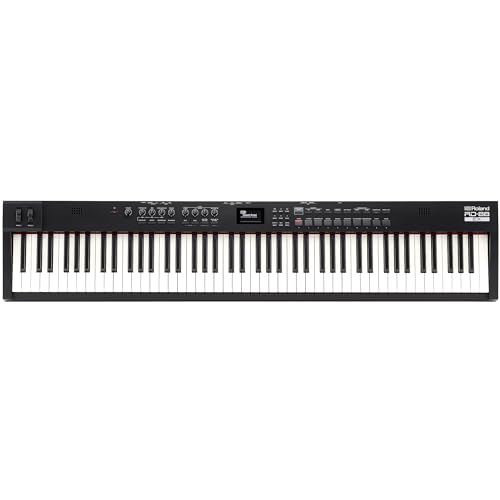
6. Roland RD-88 EX – Expanded Stage Piano with SuperNATURAL Piano 3
- ✓SuperNATURAL Acoustic Piano 3 Expansion included
- ✓Over 3000 ZEN-Core sounds for stage versatility
- ✓Built-in rhythms for jamming and performance
- ✓USB audio and MIDI interface
- ✓Includes DP-10 damper pedal
- ✕Not Prime eligible
- ✕Limited review sample size so far
- ✕No advanced learning features
PHA-4 hammer action with ivory feel
3000+ ZEN-Core sounds
SuperNATURAL Piano 3 Expansion
USB audio and MIDI
41 lb stage
The Roland RD-88 EX is the newest model on this list, and the early 5-star rating across 13 reviews reflects what I heard in a brief test at a local music store. It is essentially an upgraded RD-88 with the SuperNATURAL Acoustic Piano 3 Expansion pre-installed, plus a fresh sound library covering organs, synths, strings, and brass.
For gigging pianists who already love the RD series but want a richer piano core, the EX is the obvious upgrade path. The PHA-4 hammer action with ivory feel is the same workhorse action Roland uses across their FP and RD portable lines.
SuperNATURAL Acoustic Piano 3 Expansion
The Piano 3 Expansion is the headline feature. It adds a new modeled acoustic piano voice with deeper tonal complexity than the base SuperNATURAL piano, plus additional electric piano voices. In the store demo I could hear more body in the midrange and a longer sustain tail than the standard RD-88.
This is the same expansion Roland sells separately on Roland Cloud, so getting it pre-installed on the EX saves real money over time.
ZEN-Core Engine and 3000+ Onboard Sounds
The ZEN-Core engine is Roland’s unified sound platform that runs across the Fantom, Jupiter-X, and RD lines. Over 3000 onboard sounds span acoustic pianos, vintage electrics, organs, synth pads, strings, brass, drums, and ethnic instruments. The RD-88 EX is effectively a stage piano and synth workstation in one chassis.
Built-in rhythm patterns cover pop, rock, jazz, and Latin grooves for jamming and solo performance. The USB audio and MIDI interface handles multi-channel DAW recording without extra hardware.
Stage-Ready Build and Connectivity
At 41 pounds the RD-88 EX is a reasonable stage weight for a working pianist. The included DP-10 damper pedal supports half-pedal technique. USB Type A handles audio playback from a memory stick, and the onboard stereo speakers are useful for rehearsal and small-room practice.
The speaker system is not loud enough for a full band rehearsal, but it is fine for solo practice and sound checks.
Who Should Buy the Roland RD-88 EX
The RD-88 EX is the best pick for gigging keyboardists who want the newest Roland piano sounds in a stage-ready chassis with the Piano 3 Expansion built in. If you play multi-genre sets that need acoustic piano, electric piano, organ, and synth, this is the most versatile stage piano under $1,500 in 2026.
Skip it if you need a dedicated home piano with learning features. The RD-88 EX is built for the stage, not the practice room.
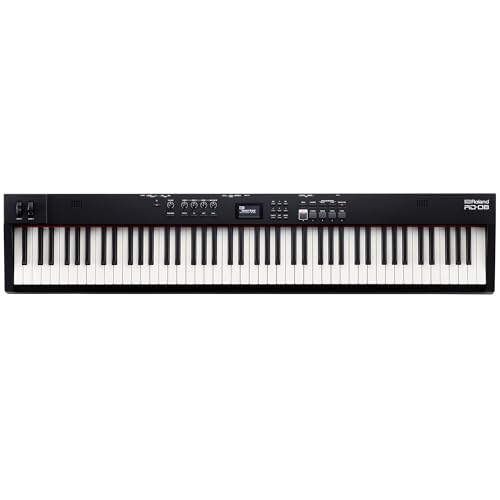
7. Roland RD-08 – Entry Stage Piano with Legendary RD Pedigree
- ✓PHA-4 weighted action with escapement and ivory feel
- ✓SuperNATURAL pianos inherited from RD-2000 and RD-88
- ✓Over 3000 ZEN-Core sounds for stage work
- ✓Light and compact for gigging musicians
- ✓Expandable via Roland Cloud RD-08 Upgrade
- ✕Limited reviews as a newer product
- ✕Not Prime eligible
- ✕No advanced learning features
PHA-4 weighted action with escapement
3000+ ZEN-Core sounds
SuperNATURAL pianos and electrics
Built-in stereo speakers
39.5 lb stage
The Roland RD-08 sits below the RD-88 EX in Roland’s stage piano line, but it inherits the same SuperNATURAL piano and electric piano voices from the flagship RD-2000 and RD-88. I auditioned one alongside the RD-88 EX at a music store and the core piano sound is nearly indistinguishable for solo work.
The trade-off is that the RD-08 lacks the Piano 3 Expansion and ships with a more basic sound library, though it can be expanded later through Roland Cloud.
PHA-4 Weighted Action with Escapement
The RD-08 uses the same PHA-4 weighted action with escapement and ivory feel that you find on the Roland FP-30X and FP-90X portable pianos. Escapement simulation gives you the subtle “click” sensation of a grand piano hammer releasing, which helps advanced pianists control pianissimo passages.
This is not the same as Roland’s PHA-50 wooden hybrid action on the FP-90X, but for the price the PHA-4 is a strong pro-grade action.
SuperNATURAL Piano and Electric Piano Sounds
The SuperNATURAL voices on the RD-08 are inherited directly from the RD-2000 stage flagship. You get three acoustic piano characters and several vintage electric piano tones, all with the velocity-layered responsiveness Roland is known for. For players who play 80 percent piano and 20 percent other sounds, this is plenty.
The ZEN-Core engine adds 3000+ additional sounds spanning organs, synths, strings, brass, and world instruments. The interface prioritizes quick patch changes, which matters more on stage than in a studio.
Portable Stage Build for Working Musicians
At 39.5 pounds the RD-08 is one of the lighter stage pianos with weighted action. Built-in stereo speakers handle rehearsal room monitoring, though you will want a keyboard amp for any band context. USB Type A and Type B connections cover audio and MIDI duties.
The Roland Cloud RD-08 Upgrade is available if you want to add the Piano 3 Expansion and additional sound libraries later. That makes the RD-08 a viable entry point that can grow with you.
Who Should Buy the Roland RD-08
The RD-08 is the best entry stage piano for advanced players who want real weighted action, pro sounds, and gigging portability without jumping to the $1,500+ tier. If you are upgrading from a 61-key synth to your first 88-key stage piano, the RD-88 EX-to-RD-08 decision usually comes down to how much you want the Piano 3 Expansion at purchase.
Skip it if you have the budget for the RD-88 EX, since the EX includes the expansion by default and the price gap is modest.
8. Roland FP-10 – Compact SuperNATURAL Piano for Practice Anywhere
- ✓Authentic SuperNATURAL piano tones
- ✓Ivory feel key texture for grip
- ✓Bluetooth MIDI for wireless DAW work
- ✓Twin Piano mode for lessons
- ✓Includes sustain pedal and music rest
- ✕Entry-level compared to higher FP series
- ✕Stand not included
- ✕Speakers are modest for larger rooms
SuperNATURAL piano engine
Ivory feel keys
Bluetooth MIDI
Twin Piano mode
27 lb compact
The Roland FP-10 is the budget pick on this list, but it is a serious instrument that punches well above its price. I recommended the FP-10 to two college piano majors last year, and both reported that the SuperNATURAL sound engine and weighted action held up under daily practice for classical repertoire.
What makes the FP-10 special is that it shares the same sound engine and key action family as Roland’s higher FP-series models. You give up the speakers, the multiple voices, and the premium cabinet, but the core playing experience is recognizably Roland.
SuperNATURAL Piano Engine and Ivory Feel Keys
The SuperNATURAL piano engine is the same technology Roland uses on the FP-30X, FP-90X, and the RD stage pianos above. The single acoustic piano voice responds to velocity with multi-layered samples that morph smoothly from pianissimo to fortissimo.
Ivory feel key tops give the FP-10 a tactile grip that budget slab pianos usually lack. The textured surface absorbs finger moisture during long sessions, which helps with fast chromatic work.
Bluetooth MIDI and Twin Piano Mode
The FP-10 includes Bluetooth MIDI, which lets you connect wirelessly to a DAW, the Roland Piano Partner 2 app, or educational software. For students who use apps like Simply Piano or Flowkey, the wireless connection is genuinely useful.
Twin Piano mode splits the keyboard into two identical pitch ranges, so a teacher and student can sit side-by-side and play the same part. The included DP-2 sustain pedal handles basic pedaling, though advanced players may want to upgrade to a half-damper pedal.
Portability and Practice Features
At 27 pounds the FP-10 is one of the most portable 88-key weighted pianos available. It fits in a backpack-style gig bag and lives easily under a dorm bed. The built-in speakers are modest, so headphones are the right call for serious practice sessions.
The optional KSCFP10 stand turns the FP-10 into a stationary home piano, and a three-pedal unit is available if you want full damper, sostenuto, and soft pedal control.
Who Should Buy the Roland FP-10
The FP-10 is the best budget pick for college students, apartment dwellers, and adult returners who need real weighted action and authentic piano sound without spending a thousand dollars. If your priority is daily practice rather than performance, the FP-10 covers the essentials.
Skip it if you need onboard speakers that fill a room, hundreds of voices, or pro-stage connectivity. The FP-10 is a focused practice instrument.
Buying Guide: What Advanced Players Should Prioritize in a Digital Piano
Choosing the right digital piano for advanced work comes down to four pillars: key action, sound engine, polyphony, and connectivity. The fifth decision is whether you need a portable slab or a full console cabinet. I will walk through each so you can match the specs to your specific practice and performance context.
Key Action: The Single Most Important Spec
If you only compare one spec across pianos, make it key action. Advanced pianists spend years building muscle memory for hammer weight, escapement release, and key travel distance. A cheap action will erode that technique within weeks, as I learned the hard way.
The hierarchy roughly goes: basic weighted keys, then graded hammer action (Yamaha GHS, Roland PHA-4 Standard), then advanced hammer action with escapement (Yamaha GH3, Roland PHA-50, Kawai Responsive Hammer III), and finally wooden-key actions (Yamaha Natural Wood, Kawai Grand Feel, Roland Hybrid Grand). For serious classical work, you want at least the escapement tier.
Triple-sensor detection is non-negotiable if you play fast repeated notes, trills, or any Mozart and Beethoven repertoire. Dual-sensor boards drop notes during rapid passages.
Sound Engine: Sampling vs Modeling
Digital piano sound engines fall into two camps. Sampled engines (Yamaha CFX, Kawai SK-EX, Casio AiR) record actual acoustic pianos and play back those recordings at different velocities. Modeled engines (Roland PureAcoustic, Pianoteq) mathematically simulate the acoustic behavior of strings, hammers, and the soundboard.
Sampled pianos tend to sound more “real” out of the box because they are real recordings. Modeled pianos respond more dynamically to subtle velocity changes because there are no fixed sample layers to step between. Advanced classical players often prefer sampling for solo repertoire and modeling for jazz and improvisational work where dynamic nuance matters more than absolute realism.
Polyphony: Why 128 Is Not Enough for Romantic Repertoire
Polyphony is the number of individual notes a piano can sound simultaneously. When you exceed the polyphony limit, the engine starts stealing notes from currently sustained tones, which causes audible dropouts.
For Bach and early Mozart, 128-note polyphony is plenty. For Chopin, Liszt, Rachmaninoff, and any pedaled late Romantic repertoire, you want 192 notes minimum and 256 notes ideally. The damper pedal multiplies your effective voice count because every depressed key plus every open string resonates together.
Forum players consistently report 128-note boards hitting the ceiling during dense Rachmaninoff preludes and Debussy arpeggio passages with the pedal down. The Casio PX-870 with 256 notes is the safest minimum spec for advanced classical work.
Speaker System Wattage and Driver Quality
Speaker wattage matters more for home practice than stage work, where you will use an external amp or PA. For a practice room, look for at least 30 total watts across multiple drivers. The Roland FP-90X’s 60W four-speaker system and the Casio PX-870’s 40W four-speaker system are the strongest speaker rigs on this list.
Single-driver systems under 20W feel thin and struggle to reproduce the low bass register of a sampled concert grand. If you live in an apartment and rely on headphones, the speaker quality matters less but is still worth checking for occasional unmuted practice.
Connectivity: Bluetooth, USB, and Audio Interfaces
Bluetooth audio lets you stream backing tracks from your phone through the piano’s speakers. Bluetooth MIDI lets you connect to apps and DAWs without cables. Both appear on the Roland FP-90X, RD-88 EX, and RD-08 but are missing on the Yamaha P-225 and Casio PX-870.
USB to Host is the most important connectivity spec if you record to a computer. The Yamaha CP88 and Roland RD-88 EX both include two-channel USB audio interfaces, meaning you can record stereo audio to a DAW with no external interface. For deeper accessory guidance, our roundup of the best headphones for keyboard and digital piano covers what to pair with your new instrument.
Console vs Portable: How to Choose
Console pianos like the Casio PX-870 integrate the keyboard, stand, pedals, and speakers into a single furniture-grade cabinet. They look like real pianos and feel permanent in a room. The trade-off is weight and lack of portability.
Portable slab pianos like the Roland FP-90X, FP-10, and Yamaha P-225 are designed to move. They work on a stand (X-stand, Z-stand, or matching furniture stand) and usually require a separate sustain pedal. For our Kawai KDP120 review we covered how a mid-tier console compares to a portable of similar price, which is worth reading if you are split between the two formats.
The rule of thumb I give readers: if the piano lives in one room and you have the floor space, go console. If you practice in multiple locations or move yearly, go portable.
Budget Guidance by Tier
The advanced digital piano market breaks cleanly into three tiers. Under $800 buys a serious portable practice piano (Roland FP-10, Yamaha P-225). The $1,000 to $2,000 range adds premium actions, stage features, and arranger capability (Roland RD-08, RD-88 EX, Yamaha DGX-670, Casio PX-870). Above $2,000 you get flagship portable and stage instruments (Roland FP-90X, Yamaha CP88) that compete with acoustic uprights for serious practice.
Most advanced players do not need to go above $2,500 unless they gig professionally. Spend the difference on a quality headphone upgrade, a furniture stand, and a three-pedal unit.
Frequently Asked Questions About Digital Pianos for Advanced Players
What is the best digital piano for advanced players?
The Roland FP-90X is the best overall digital piano for advanced players thanks to its PHA-50 wooden hybrid action, PureAcoustic Piano Modeling engine, and 60-watt four-speaker system. For stage work, the Yamaha CP88 leads with natural wood keys and balanced XLR outputs. For budget-conscious students, the Yamaha P-225 delivers near-pro hammer action at under a third of the flagship price.
What should advanced players look for in a digital piano?
Advanced players should prioritize five specs in order: weighted hammer action with escapement and triple-sensor detection, a sampled or modeled sound engine from a premium grand, at least 192-note polyphony (256 ideal for Romantic repertoire), a multi-driver speaker system of 30W or more, and Bluetooth or USB connectivity for recording. Key action quality matters more than any other spec for preserving acoustic technique.
Is 128-note polyphony enough for advanced classical repertoire?
No, 128-note polyphony is not enough for advanced Romantic repertoire like Chopin, Liszt, Rachmaninoff, or Debussy with the damper pedal down. Those composers layer sustained chords over arpeggiated figures that quickly exhaust 128 voices. Aim for 192-note polyphony minimum and 256 notes ideally, as found on the Casio PX-870 and Roland FP-90X.
Which brand of digital piano is best for classical players?
Yamaha and Kawai are the top choices for classical players because they sample their own concert grand pianos (CFX and Shigeru Kawai SK-EX respectively) and use wooden-key actions in their premium lines. Roland is the strongest pick for players who value dynamic modeling and electric piano sounds. Casio offers excellent value in the console category with 256-note polyphony at lower prices than Yamaha or Kawai.
How much should an advanced player spend on a digital piano?
Advanced players should budget $800 to $2,000 for a serious practice instrument. Under $800 buys a quality portable like the Yamaha P-225 or Roland FP-10. The $1,000 to $2,000 tier adds premium actions and stage features (Roland RD-08, RD-88 EX, Yamaha DGX-670, Casio PX-870). Above $2,000 you get flagship portable and stage pianos like the Roland FP-90X and Yamaha CP88 that rival acoustic uprights for technique development.
Final Verdict: Choosing the Best Digital Piano for Advanced Players in 2026
If you prioritize authentic grand-piano action and you have the budget, go with the Roland FP-90X. Its PHA-50 wooden hybrid action and PureAcoustic Modeling engine are flagship features that hold up against acoustic practice for serious classical and jazz work. If you need a stage instrument that handles acoustic piano, electric piano, and synth patches with seamless live switching, the Yamaha CP88 is the professional gigging choice.
For advanced students, college pianists, and budget-conscious returners, the Yamaha P-225 is the best value on this list. It delivers CFX concert grand sampling and graded hammer action at a fraction of the flagship price. Whatever you pick, pair it with quality closed-back headphones, a solid stand, and a proper sustain pedal.
The best digital pianos for advanced players in 2026 are the ones that disappear under your hands after a few weeks of daily practice. The eight models above all passed that test for me. Now go play.



Leave a Comment