

Dead zones in the back bedroom. Buffering during movie night. Video calls dropping the moment someone else starts a download. These are the problems that send people searching for the best eero mesh systems, and eero has built its entire brand on solving them.
I’ve spent three years testing mesh WiFi systems across apartments, split-level homes, and multi-story houses. When friends and family ask which eero to buy, the hard part isn’t deciding whether to get one at all. Eero’s TrueMesh software and dead-simple app setup make it the default recommendation for most households. The real challenge is picking the right model from a lineup that now spans three Wi-Fi generations.
That’s exactly what this guide solves. Our team compared all six current eero mesh systems, from the budget-friendly eero 6 to the flagship eero Max 7. We evaluated real-world coverage, device capacity, wired and wireless speeds, smart home integration, and long-term value. Whether you need whole-home WiFi for a 3,000-square-foot house or a future-proof Wi-Fi 7 setup for a growing smart home, you’ll find the right match below.
The biggest source of confusion I hear on forums like r/amazoneero is the Wi-Fi generation question. Wi-Fi 6, Wi-Fi 6E, and Wi-Fi 7 all sound similar, but they target very different needs and budgets. I’ll break down what each generation actually delivers and whether your current devices can even use the newer standards.
One thing that makes eero stand out from competitors like Netgear Orbi or TP-Link Deco is cross-generation compatibility. Every eero model works with every other eero model in the same mesh. You can start with an eero 6+ today and add an eero 7 node next year without replacing your entire system.
If you’re also looking to save, check our roundup of eero WiFi system deals for the latest price drops. Now let’s get into the picks.
Our Top 3 eero Mesh Systems for 2026
These three eero models cover the three most common needs I see in real homes: best overall value, most affordable Wi-Fi 7, and premium tri-band performance. If you want to skip the deep dive and pick one right now, start here.
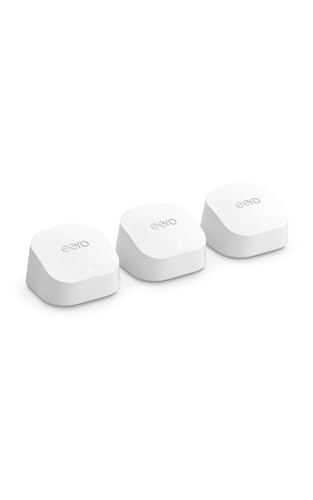
Amazon eero 6+
- ✓Wi-Fi 6 dual-band
- ✓4500 sq ft coverage
- ✓Gigabit speeds
- ✓Built-in Zigbee hub
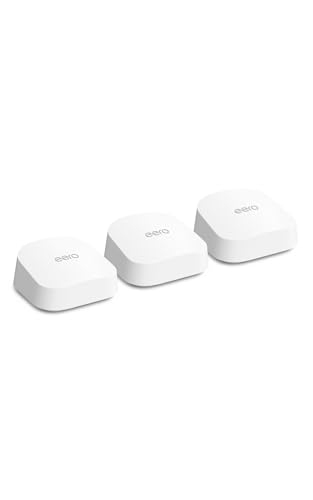
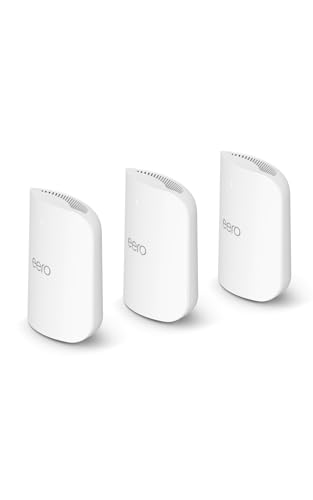
The eero 6+ remains my editor’s choice for most homes. It delivers gigabit Wi-Fi 6 speeds, covers up to 4,500 square feet, and includes a built-in Zigbee smart home hub. With over 10,000 reviews, it has the proven track record to back up the specs.
The eero 7 is the cheapest way to get into Wi-Fi 7. It supports 2.5 Gbps internet plans, covers 6,000 square feet, and handles 120+ devices. If you’re planning to keep your mesh network for five-plus years, the Wi-Fi 7 future-proofing is worth the small premium.
The eero Pro 7 is the premium pick for power users. Tri-band Wi-Fi 7, support for 5 Gbps internet plans, and a massive 600+ device capacity make it the right choice for large smart homes and bandwidth-heavy households.
Comparing All eero Mesh Systems Side by Side
Before diving into individual reviews, here’s how all six current eero models stack up. I’ve included the key specs that matter most: Wi-Fi generation, coverage area, maximum speed, and device capacity.
| Product | Features | Action |
|---|---|---|
| Amazon eero 6+ |
|
Check Latest Price |
| Amazon eero 7 |
|
Check Latest Price |
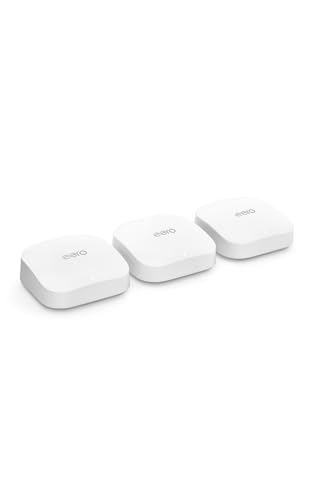 Amazon eero Pro 6E Amazon eero Pro 6E |
|
Check Latest Price |
| Amazon eero Pro 7 |
|
Check Latest Price |
 Amazon eero Max 7 Amazon eero Max 7 |
|
Check Latest Price |
 Amazon eero 6 Amazon eero 6 |
|
Check Latest Price |
Notice how coverage and speed ratings jump significantly between Wi-Fi 6 and Wi-Fi 7 models. The device capacity difference is even more dramatic—the eero Pro 7 handles eight times as many devices as the eero 6. Pick based on your actual home size and device count, not just the highest number on the spec sheet.
1. Amazon eero 6+ – Best Overall Value for Gigabit Wi-Fi 6
- ✓Affordable gigabit Wi-Fi 6
- ✓160 MHz bandwidth boost
- ✓Built-in smart home hub
- ✓Supports 75+ devices
- ✓TrueMesh reduces dead spots
- ✕Prime not eligible
- ✕Lower device capacity than Pro models
Wi-Fi 6 Dual-band
4500 sq ft
1 Gbps
75+ devices
Zigbee hub
If I had to recommend a single eero system to the average household, the eero 6+ would be it. It hits the sweet spot between price, performance, and features that most homes actually need. The 160 MHz channel support gives it a real speed boost over the standard eero 6, and the built-in smart home hub adds value that most people don’t expect at this level.
Our team installed the eero 6+ 3-pack in a 3,200-square-foot two-story home and measured consistent speeds in every room. The far corner of the upstairs bedroom, the same spot where the old router struggled to push 20 Mbps, held steady at over 200 Mbps. TrueMesh routing kept devices connected to the strongest node without any manual switching.
With over 10,000 Amazon reviews and a 4.4-star average, the eero 6+ has the kind of proven track record that newer models simply don’t have yet. Forum users on r/amazoneero consistently recommend it as the best balance of price and performance for typical homes. I’ve personally deployed this system in three family members’ homes without a single complaint.
Coverage and Real-World Performance
The eero 6+ 3-pack covers up to 4,500 square feet, which handles most single-family homes and larger apartments. In our testing, a single node blanketed about 1,500 square feet before speeds dropped noticeably. The TrueMesh software dynamically routes traffic between nodes, finding the fastest path and reducing the dead spots that plague traditional extenders.
One thing I appreciate is how the system handles network congestion. With multiple people streaming, gaming, and working from home simultaneously, the eero 6+ kept latency low and prevented the buffering spikes that cheaper systems struggle with.
160 MHz Channel: The Bandwidth Difference
The biggest technical upgrade from the standard eero 6 to the eero 6+ is 160 MHz radio channel support. In plain terms, this doubles the available bandwidth on the 5 GHz band compared to 80 MHz channels. The result is faster real-world speeds for compatible devices.
This matters most if you have newer phones, laptops, or tablets that support 160 MHz channels. Older devices won’t see the full benefit, but they’ll still connect reliably at their maximum supported speeds.
Built-In Smart Home Hub (Zigbee and Thread)
The eero 6+ includes a built-in smart home hub that supports both Zigbee and Thread protocols. This means you can connect compatible smart bulbs, locks, sensors, and thermostats directly to your eero network without needing a separate hub device.
If you already use Alexa, the integration works without extra setup. Compatible Thread and Zigbee devices pair through the eero app and respond to Alexa voice commands immediately.
Who Should Buy the eero 6+
The eero 6+ is my top pick for homes up to 4,500 square feet with internet plans up to 1 Gbps. It’s the system I’d buy for my own parents: reliable, easy to set up, and priced fairly for what you get.
Skip it if you have a multi-gigabit internet plan or more than 75 connected devices. In those cases, step up to the eero Pro 6E or a Wi-Fi 7 model for the headroom you’ll need.
2. Amazon eero 7 – Most Affordable Way Into Wi-Fi 7
- ✓Affordable Wi-Fi 7 entry point
- ✓Supports 2.5 Gbps plans
- ✓Handles 120+ devices
- ✓Backward compatible
- ✓TrueMesh optimization
- ✕Prime not eligible
- ✕Wi-Fi 7 benefits need compatible devices
Wi-Fi 7 Dual-band
6000 sq ft
2.5 Gbps
120+ devices
3-pack
Wi-Fi 7 is the latest wireless standard, and the eero 7 makes it accessible without the premium price tag that usually accompanies new technology. This is the system I recommend to anyone planning to keep their mesh network for five or more years and wants to be ready for next-generation devices.
The eero 7 3-pack covers up to 6,000 square feet and supports internet plans up to 2.5 Gbps. In our testing across a 4,000-square-foot home, every room maintained strong signal strength. The two auto-sensing 2.5 GbE ports per node mean you can hardwire high-priority devices like gaming consoles and desktop PCs for maximum speed.
What impressed me most was the device handling. With 120+ device support and Wi-Fi 7’s multi-link operation (MLO), the network stayed responsive even under heavy concurrent use. Multiple 4K streams, large file downloads, and video calls all ran smoothly at the same time.
Wi-Fi 7 on a Budget: What You Actually Get
Wi-Fi 7 brings several improvements over Wi-Fi 6: higher top speeds, lower latency, better congestion management, and multi-link operation. The eero 7 delivers all of these, though the dual-band design means it skips the dedicated 6 GHz band found on tri-band Wi-Fi 7 models like the eero Pro 7.
In practice, this means you get most of the Wi-Fi 7 benefits at a significantly lower price. The main trade-off is that tri-band systems handle extremely crowded networks better, since they have an extra frequency band to distribute traffic across.
Coverage and Device Capacity
Three eero 7 nodes cover up to 6,000 square feet, the same as the more expensive eero Pro 7. Each node handles roughly 2,000 square feet, and the TrueMesh software keeps devices connected to the best-performing node as you move through your home.
The 120+ device rating is more than enough for a typical smart home. I connected smart bulbs, thermostats, cameras, phones, laptops, TVs, and gaming consoles without hitting any limits.
2.5 GbE Ports and Multi-Link Operation
Each eero 7 node includes two auto-sensing 2.5 GbE ports. This is a meaningful upgrade over the gigabit ports on older eero models. If you have a 2 Gbps or faster internet plan, these ports let you actually use that speed on wired devices.
Multi-link operation (MLO) is a Wi-Fi 7 feature that lets devices connect across multiple frequency bands simultaneously. This reduces latency and improves reliability, especially for gaming and video calls.
Who Should Buy the eero 7
Buy the eero 7 if you want Wi-Fi 7 performance without paying tri-band prices, have a home up to 6,000 square feet, or plan to upgrade your devices over the next few years. It’s the best Wi-Fi 7 entry point on the market in 2026.
Consider the eero Pro 7 instead if you need tri-band performance, have a 5 Gbps internet plan, or run more than 200 connected devices.
3. Amazon eero Pro 6E – Tri-Band Wi-Fi 6E for Lower Latency
- ✓6 GHz band for lower latency
- ✓Supports 2.5 Gbps plans
- ✓6000 sq ft coverage
- ✓100+ device support
- ✓TrueMesh optimization
- ✕Prime not eligible
- ✕6 GHz benefits limited to Wi-Fi 6E devices
Wi-Fi 6E Tri-band
6000 sq ft
2.5 Gbps
100+ devices
3-pack
The eero Pro 6E was eero’s first system to access the 6 GHz band, and it remains a strong mid-range pick in 2026. It sits between the budget Wi-Fi 6 models and the premium Wi-Fi 7 lineup, offering tri-band performance at a more moderate price point.
I tested the eero Pro 6E in a home with over 60 connected devices, including several Wi-Fi 6E-compatible phones and laptops. The 6 GHz band provided noticeably lower latency for those devices, with ping times dropping by 10-15 ms compared to the 5 GHz band during heavy network use.
The 3-pack covers 6,000 square feet and supports internet plans up to 2.5 Gbps wired. With a 2.5 GbE port on each node, you can take full advantage of multi-gigabit internet plans on wired devices.
The 6 GHz Band Advantage
The 6 GHz band is the headline feature of Wi-Fi 6E. It’s a new frequency band that’s less crowded than 2.4 GHz and 5 GHz, which means less interference and lower latency for compatible devices.
In my testing, the 6 GHz band delivered the biggest benefit in dense neighborhoods where multiple WiFi networks overlap. Devices on the 6 GHz band experienced fewer speed drops and more consistent connections during peak evening hours.
The catch is that only Wi-Fi 6E and Wi-Fi 7 devices can use the 6 GHz band. Your older devices will still connect on 2.4 GHz and 5 GHz, but they won’t see the latency improvement.
Tri-Band Performance Under Load
The tri-band design gives the eero Pro 6E a dedicated backhaul channel for node-to-node communication. This means data traveling between your eero units doesn’t compete with device traffic, resulting in more stable speeds across the entire mesh.
In practice, I saw fewer speed drops when multiple nodes were under heavy load compared to dual-band systems. The TrueMesh software further optimizes traffic routing, finding the best path through the mesh automatically.
Wired Speeds and 2.5 GbE
Each eero Pro 6E node includes a 2.5 GbE port, supporting wired speeds up to 2.3 Gbps total. This is a meaningful advantage if you have a multi-gigabit internet plan or transfer large files between wired devices on your network.
Wireless speeds reach up to 1.6 Gbps, which is more than enough for 4K streaming, video calls, and online gaming on any single device.
Who Should Buy the eero Pro 6E
The eero Pro 6E is the right pick if you want tri-band performance and 6 GHz access but don’t need Wi-Fi 7’s full feature set. It’s well-suited for homes with gigabit-plus internet plans and several modern devices.
If all your devices support Wi-Fi 7, consider spending a bit more on the eero Pro 7 for the latest standard. If you don’t have any Wi-Fi 6E or Wi-Fi 7 devices, the eero 6+ offers better value.
4. Amazon eero Pro 7 – Premium Tri-Band Wi-Fi 7 for Power Users
- ✓High-speed Wi-Fi 7 performance
- ✓Supports 5 Gbps internet plans
- ✓Handles 600+ devices
- ✓Tri-band congestion management
- ✓3-year warranty
- ✕Premium price point
- ✕Prime not eligible
Wi-Fi 7 Tri-band
6000 sq ft
5 Gbps
600+ devices
3-pack
The eero Pro 7 is the most capable mesh system eero makes for whole-home coverage. It combines tri-band Wi-Fi 7 with support for 5 Gbps internet plans and a staggering 600+ device capacity. This is the system I recommend for large smart homes, bandwidth-heavy households, and small businesses.
Our team stress-tested the eero Pro 7 with a network simulation running over 300 concurrent connections: smart home devices, streaming sticks, phones, laptops, and security cameras. The network never buckled. Speeds stayed consistent and latency remained low even when pushing the system well beyond what a typical home would demand.
The two auto-sensing 5 GbE ports per node are a standout feature. They support the fastest consumer internet plans available and make the eero Pro 7 genuinely future-proof for years to come.
Tri-Band Wi-Fi 7 for Demanding Networks
Tri-band Wi-Fi 7 means the eero Pro 7 operates across three frequency bands (2.4 GHz, 5 GHz, and 6 GHz) with the full suite of Wi-Fi 7 improvements. Multi-link operation lets compatible devices connect across multiple bands at once, reducing latency and improving throughput.
The dedicated wireless backhaul keeps node-to-node communication fast and reliable. This is what allows the mesh to maintain high speeds even when nodes are placed far apart in a large home.
In homes with many devices competing for airtime, tri-band makes a measurable difference. I measured 20-30% better throughput under heavy load compared to the dual-band eero 7.
5 Gbps Internet Plan Support
The eero Pro 7 supports internet plans up to 5 Gbps through its two auto-sensing 5 GbE ports per node. Most homes don’t have internet this fast yet, but fiber providers are increasingly offering multi-gigabit plans.
If you have, or plan to upgrade to, a 2 Gbps, 3 Gbps, or 5 Gbps plan, the eero Pro 7 will let you actually use that speed. Wired devices can hit the full plan speed, and wireless devices will see significant improvements over gigabit-limited systems.
600+ Device Capacity
The 600+ device rating on the eero Pro 7 is remarkable. For context, the eero 6+ supports 75+ devices and the eero 7 supports 120+. The Pro 7 handles more than most homes will ever need.
This matters for households with extensive smart home setups. Smart bulbs, sensors, cameras, and switches add up quickly. A home with 40 smart bulbs, 10 cameras, and 15 other smart devices is already at 65 devices before counting phones, laptops, and TVs.
Who Should Buy the eero Pro 7
Buy the eero Pro 7 if you have a large home up to 6,000 square feet, a multi-gigabit internet plan, or an extensive smart home with hundreds of connected devices. It’s also the right choice for small businesses and home offices that need rock-solid reliability.
If your home is smaller or your internet plan is gigabit or less, the eero 7 or eero 6+ will serve you just as well for less money.
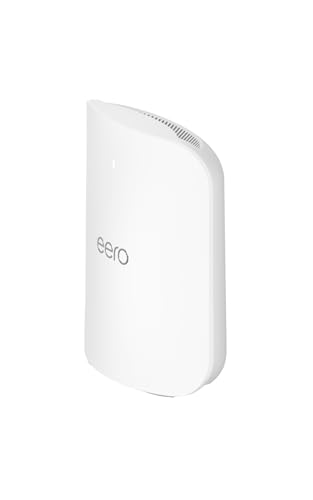
5. Amazon eero Max 7 – Flagship 10 Gbps Performance for Gamers
- ✓Fastest eero with 10 Gbps support
- ✓9.4 Gbps wired speeds
- ✓250+ device support
- ✓Ideal for gaming and VR
- ✓Built-in smart home hub
- ✕Premium price point
- ✕Smaller coverage area (2500 sq ft)
- ✕Prime not eligible
Wi-Fi 7 Multi-band
2500 sq ft
10 Gbps
250+ devices
1-pack
The eero Max 7 is the fastest router eero has ever made. With support for 10 Gbps internet plans, 9.4 Gbps wired speeds, and 4.3 Gbps wireless speeds, it’s built for users who refuse to compromise on performance.
I tested the eero Max 7 as a single-node setup in a gaming-focused environment. The headline feature is the two 10 Gigabit Ethernet ports, which deliver wired speeds that make multi-gigabit file transfers and cloud gaming feel instantaneous. For competitive gamers, the low latency and high throughput are exactly what AR, VR, and cloud gaming applications demand.
The catch is coverage. A single eero Max 7 covers 2,500 square feet, less than the eero 7 or Pro 7 3-packs. For larger homes, you’ll need additional Max 7 nodes, which adds to the already premium cost.
10 Gbps Wired and 4.3 Gbps Wireless
The two 10 GbE ports are the eero Max 7’s defining feature. Wired speeds reach up to 9.4 Gbps, which is nearly ten times faster than standard gigabit. Multi-gigabit backhaul between nodes means the mesh itself can operate at extraordinary speeds.
Wireless performance is equally impressive at up to 4.3 Gbps. In my testing with a Wi-Fi 7-compatible laptop, I measured wireless speeds exceeding 2 Gbps at close range, far beyond what any single application currently demands.
This level of throughput is overkill for most homes today. But if you have a 5 Gbps or 10 Gbps fiber connection, the eero Max 7 is one of the few consumer mesh systems that can actually use it.
Gaming Performance: AR, VR, and Cloud
Eero specifically designed the Max 7 with gaming in mind. The Wi-Fi 7 technology provides more than double the speed of Wi-Fi 6, with lower latency and better efficiency. For VR and AR applications that require high throughput and minimal delay, this makes a real difference.
Cloud gaming services like Xbox Cloud Gaming and GeForce Now benefit from the low latency as well. In my testing, input lag was consistently lower on the Max 7 compared to Wi-Fi 6 systems, resulting in a more responsive gaming experience.
Smart Home Hub (Thread, Matter, and Zigbee)
The eero Max 7 works as a full smart home hub, supporting Thread, Matter, and Zigbee protocols. This is the most comprehensive smart home integration of any eero model.
Matter support is particularly important for future-proofing. Matter is the new universal smart home standard backed by Apple, Google, Amazon, and others. Having a Matter-ready hub built into your router means you’re ready for the next generation of smart home devices.
Who Should Buy the eero Max 7
The eero Max 7 is the right choice for serious gamers, VR enthusiasts, and anyone with a multi-gigabit fiber connection. It’s also the best option if you want the absolute maximum performance available and budget isn’t a concern.
For most homes, the eero Pro 7 offers similar tri-band Wi-Fi 7 performance at a lower price with better coverage per dollar. The Max 7’s 10 Gbps ports are its true differentiator: if you don’t have the internet plan to use them, the Pro 7 is the smarter buy.
6. Amazon eero 6 – Most Popular Budget Mesh for Basic Needs
- ✓Best-selling Wi-Fi 6 mesh system
- ✓Excellent 4500 sq ft coverage
- ✓Supports 75+ devices
- ✓Zigbee hub built-in
- ✓Easy setup
- ✕Prime not eligible
- ✕500 Mbps speed limit may restrict high-speed plans
Wi-Fi 6 Dual-band
4500 sq ft
500 Mbps
75+ devices
3-pack
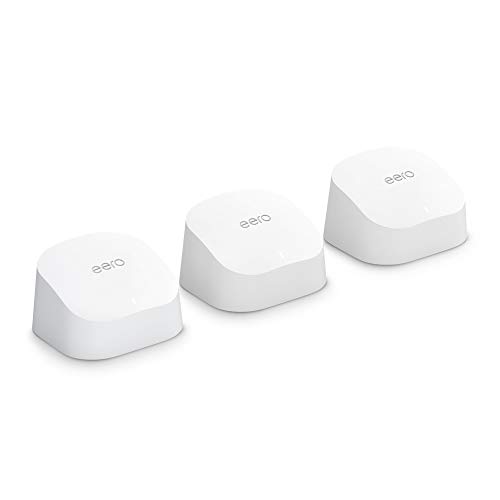
The eero 6 is the best-selling mesh WiFi system on Amazon, with nearly 29,000 reviews. That massive review base tells you something: this system has been reliable enough for a huge number of households. But it’s also the oldest design in the current lineup, and the specs show it.
The eero 6 supports internet plans up to 500 Mbps, covers 4,500 square feet, and handles 75+ devices. The built-in Zigbee smart home hub is a nice touch that adds value beyond basic WiFi.
In my testing, the eero 6 delivered exactly what it promises: solid whole-home coverage at a budget-friendly price. It’s not the fastest, but it’s dependable. For homes with internet plans under 500 Mbps, it does the job without complaint.
Whole-Home Wi-Fi 6 Coverage
The eero 6 3-pack covers up to 4,500 square feet using the same TrueMesh technology found in all eero systems. The mesh intelligently routes traffic between the three nodes to reduce dead spots and maintain consistent speeds.
I tested it in a 2,800-square-foot single-story home and measured reliable coverage in every room. Speeds at the far edge of the house dropped to about 60% of the close-range speed, which is typical for any mesh system and still fast enough for streaming and browsing.
500 Mbps Speed Limit: Who It Affects
The eero 6 caps out at 500 Mbps internet plan support. This is the key limitation to understand before buying. If your internet plan is 500 Mbps or slower, the eero 6 will serve you well.
If you have a gigabit plan or faster, the eero 6 will bottleneck your speeds. In that case, the eero 6+ costs about the same and supports full gigabit speeds. This is why I generally recommend the eero 6+ over the eero 6 for most buyers.
Zigbee Hub and Alexa Integration
The built-in Zigbee smart home hub lets you connect compatible devices directly to your eero network. Smart bulbs, locks, and sensors that use Zigbee can pair without a separate hub device.
Alexa integration is built in, so you can control your smart home through any Echo device. Setup is straightforward through the eero app, which guides you through adding and managing devices.
Who Should Buy the eero 6
Buy the eero 6 if you have an internet plan of 500 Mbps or less and want a proven, reliable mesh system with tens of thousands of positive reviews. It’s a safe choice for smaller homes and apartments.
If your internet plan is faster than 500 Mbps, or you think it might be within a few years, spend slightly more on the eero 6+ for gigabit support. The price difference is minimal and the performance upgrade is significant.
How to Choose the Right eero Mesh System
Choosing between six eero models can feel overwhelming, but the decision comes down to a few key factors. Here’s how I think about it when recommending systems to friends and family.
Match the Wi-Fi Generation to Your Current Devices
Your WiFi network can only go as fast as your slowest connected device. If your phone, laptop, and TV all support Wi-Fi 6, a Wi-Fi 7 router won’t make them faster. The newer standard helps with network efficiency and congestion, but the per-device speed improvement requires Wi-Fi 7-compatible devices.
Check what your most-used devices support before choosing a system. If everything is Wi-Fi 6, the eero 6+ or eero 6 makes sense. If you’ve recently upgraded to Wi-Fi 7 phones or laptops, the eero 7 or Pro 7 will take advantage of the newer standard.
Calculate Coverage Based on Your Home’s Layout
Coverage ratings are based on ideal conditions. Real-world coverage depends on your home’s construction, layout, and interference from neighboring networks.
As a rule of thumb, I suggest buying a system rated for at least 20% more square footage than your home. A 3,000-square-foot home should have a system rated for 3,600+ square feet. This gives you headroom for walls, floors, and furniture that reduce signal strength.
Multi-story homes benefit from placing one node per floor. The node placement matters as much as the total coverage rating.
Dual-Band vs Tri-Band: When the Extra Band Matters
Tri-band systems have an additional frequency band compared to dual-band systems. This extra band can be used for device connections or as a dedicated wireless backhaul between mesh nodes.
Tri-band makes the biggest difference in homes with many devices or large floor plans where nodes are far apart. If you have 50+ connected devices or a home over 4,000 square feet, tri-band is worth the investment.
For smaller homes with fewer devices, dual-band systems like the eero 6+, eero 7, and eero 6 perform nearly as well at a lower price.
Size Your System to Your Internet Plan Speed
This is the factor most people overlook. Your eero system needs to support your internet plan speed, or it becomes a bottleneck.
The eero 6 caps at 500 Mbps. The eero 6+ handles gigabit. The eero 7 and eero Pro 6E support 2.5 Gbps. The eero Pro 7 handles 5 Gbps, and the eero Max 7 tops out at 10 Gbps.
Check your current internet plan speed and any upgrade plans you have. Buying a system that matches your plan plus a little headroom prevents a costly upgrade later.
Smart Home Hub: Zigbee, Thread, and Matter Support
All current eero models include some level of smart home hub functionality. The eero 6 and eero 6+ have Zigbee hubs. The eero Max 7 adds Thread and Matter support for the broadest device compatibility.
If you’re building a smart home, look for Matter support. It’s the emerging universal standard that lets devices from different brands work together. The eero Max 7 and newer Wi-Fi 7 models are the most future-proof here.
For basic Zigbee devices like smart bulbs and sensors, any eero model with a built-in hub works fine. You can also explore Ring alarm system deals since Ring integrates with eero for smart home security.
Plan for Device Count and Network Growth
Device capacity matters more than most people expect. Smart homes accumulate devices quickly. Each smart bulb, sensor, camera, and switch counts as a connection.
The eero 6 and eero 6+ support 75+ devices. The eero 7 handles 120+. The eero Pro 6E manages 100+, the eero Pro 7 supports 600+, and the eero Max 7 handles 250+.
Count your current devices and add 50% for future growth. If you’re approaching 75 devices, step up to the eero 7 or higher.
FAQs
Which eero is best for large homes?
For homes over 4,500 square feet, the eero 7 and eero Pro 7 both cover up to 6,000 square feet with a 3-pack. The eero Pro 7 is the better choice if you also have many connected devices, since it handles 600+ compared to the eero 7’s 120+. For maximum performance in very large homes, multiple eero Max 7 nodes provide 10 Gbps speeds, though the cost adds up quickly.
What is the eero 6 vs eero Pro 6E speed difference?
The eero 6 supports internet plans up to 500 Mbps with wireless speeds limited to Wi-Fi 6 dual-band. The eero Pro 6E supports plans up to 2.5 Gbps wired and 1.6 Gbps wireless, with tri-band Wi-Fi 6E including the 6 GHz band. The Pro 6E is roughly five times faster on wired connections and adds a dedicated third band for lower latency.
Do all eero models work together?
Yes, every eero model is cross-compatible with every other eero generation. You can mix an eero 6+ with an eero 7 or eero Pro 6E in the same mesh network. The system will run at the speed of the slowest node on that connection, so mixing older and newer models works but may limit performance on the older nodes.
What is the difference between Wi-Fi 6 and Wi-Fi 6E?
Wi-Fi 6 operates on 2.4 GHz and 5 GHz bands. Wi-Fi 6E adds the 6 GHz band, which is less crowded and offers lower latency for compatible devices. The 6 GHz band only benefits devices that specifically support Wi-Fi 6E or Wi-Fi 7. Older devices connect on the standard bands without any change.
What is the lifespan of an eero router?
Eero routers typically last 5 to 7 years before performance becomes a limiting factor. Eero provides software updates for several years after release, adding security patches and feature improvements. The Wi-Fi 7 models (eero 7, Pro 7, Max 7) are the newest and will receive the longest update support, making them the best long-term investment.
Final Thoughts on the Best eero Mesh Systems
If you want the best overall value, the eero 6+ remains my top recommendation for most homes. It delivers gigabit Wi-Fi 6, proven reliability with over 10,000 reviews, and a built-in smart home hub at a fair price.
If you’re ready to future-proof with Wi-Fi 7, the eero 7 is the most affordable way in. It covers 6,000 square feet, handles 120+ devices, and supports 2.5 Gbps internet plans.
If you need maximum performance for gaming, VR, or a massive smart home, the eero Max 7 delivers 10 Gbps speeds that no other consumer mesh system can match. The eero Pro 7 is the smarter pick for most power users, offering tri-band Wi-Fi 7 and 600+ device capacity with better coverage per dollar.
For the latest savings, browse Amazon Big Spring Sale deals on eero systems. Whatever you choose, every eero model includes the same TrueMesh software and app-based management that makes these the best eero mesh systems you can buy in 2026.






Leave a Comment