

The best earbud hearing aids in 2026 combine discretion with functionality, offering FDA-approved OTC devices that look like modern Bluetooth earbuds while providing clinically effective amplification for mild to moderate hearing loss.
Earbud-style hearing aids have revolutionized the market by eliminating the stigma of traditional medical devices, making hearing assistance as socially acceptable as wearing professional audio headphones. According to FDA regulations, these OTC devices are intended for adults 18+ with mild to moderate hearing loss, offering self-fitting capabilities without requiring audiologist visits.
Unlike traditional behind-the-ear hearing aids, earbud-style devices sit in the ear canal like wireless earbuds you’d already see people wearing at the gym or office. This crossover category includes true wireless earbuds with hearing features (like AirPods Pro), dedicated OTC hearing aids with earbud designs (from brands like Audien and ELEHEAR), and premium prescription devices that prioritize cosmetic discretion (like Eargo). The market has exploded since late 2022 when FDA OTC regulations took effect, creating options from under $100 to over $2,000.
Quick Comparison: Best Earbud Hearing Aids
| Product | Type | Bluetooth | Battery Life | Water Resistance |
|---|---|---|---|---|
| Audien Atom One | Basic OTC | None | 24 hours | Not specified |
| Karthus Rechargeable | Basic OTC | None | 80+ hours with case | No (issues reported) |
| Audien Atom X | Mid-range OTC | Yes (universal) | 48+ hours | IPX4 (estimated) |
| ELEHEAR Beyond | Mid-range OTC | Bluetooth 5.3 | 100+ hours | Not specified |
| ELEHEAR Beyond Pro | Premium OTC | Bluetooth streaming | 80+ hours | Not specified |
| Sennheiser All-Day Clear | Premium OTC | Yes (hands-free) | 24 hours | Not specified |
| EARGO 8 | Prescription-grade | App control only | 224 hours with charger | IP68 (highest) |
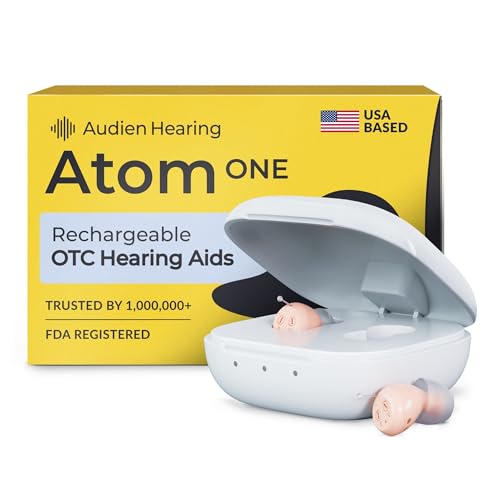
Audien Atom One: Best Budget Entry Point
The Audien Atom One represents the most affordable entry point into FDA-registered OTC hearing aids, offering basic amplification at a price point that won’t break the bank. At under $150, this device provides crystal clear sound quality without the tinny distortion common in cheaper personal sound amplification products (PSAPs). The ultra-small discreet design barely shows when worn, making it an excellent option for first-time hearing aid users who want to test the waters without investing thousands.
This device prioritizes simplicity over advanced features. There’s no Bluetooth for phone calls or music streaming, and no smartphone app for customization. What you get instead is straightforward amplification with an adjustable frequency system that allows basic personalization. The 24-hour battery life exceeds many competitors in the budget category, and the convenient charging dock makes recharging simple.
Audien designed the Atom One with audiologist input, resulting in multiple ear dome sizes included for a custom fit. The device is easy to insert and remove, which is crucial for seniors or anyone new to hearing aids. Customer service is proactive, with follow-up calls to ensure you’re satisfied with your purchase—a level of support uncommon at this price point.
However, the Atom One has limitations. Some users report one unit malfunctioning after a few days, and replacement processing can take 2-3 weeks. The amplification is basic and won’t satisfy those with moderate hearing loss. There’s no tinnitus masking, and frequency adjustments are limited compared to premium models.
Key Features:
- FDA-registered medical-grade technology
- Up to 24 hours battery life on single charge
- Adjustable frequency system for basic personalization
- Multiple ear dome sizes included
- Rechargeable with USB-C charging dock
- Ultra-small discreet design
- Designed by audiologists
Pros:
- Excellent value for budget-conscious buyers
- Clear sound quality without tinny distortion
- Comfortable all-day wear
- Long battery life for the price
- Easy setup and use
- Great customer service and support
- Good for mild hearing loss
- Discreet design
- Great option to try hearing aids without large investment
- Upgrade program available to Atom X with Bluetooth
Cons:
- No Bluetooth capability for phone calls/music
- No smartphone app for advanced controls
- One unit may malfunction after a few days
- Customer service replacement can take 2-3 weeks
- Not suitable for severe hearing loss
- Limited to basic amplification
- No tinnitus masking features
- Basic frequency adjustments only
Best For: First-time hearing aid users, budget-conscious buyers with mild hearing loss, anyone wanting to test OTC devices without significant investment, seniors needing simple operation.
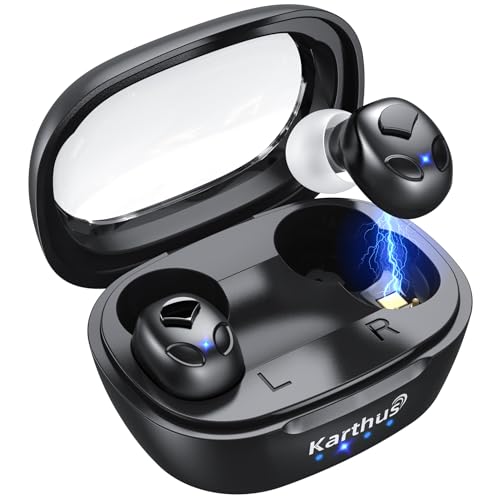
Karthus Rechargeable: Incredible Battery Life on a Budget
The Karthus Rechargeable hearing aid stands out in the budget category with exceptional battery life—80+ hours total with the charging case. At under $130, this device offers clear sound quality with smart chip technology that automatically eliminates whistling and feedback. The deep in-ear design makes it virtually invisible when worn, appealing to users prioritizing discretion above all else.
Smart chip technology powers automatic feedback cancellation, addressing one of the most common complaints with budget hearing aids. The device offers two listening modes (Quiet Mode and Noise-Canceling Mode) for different environments. A 2-hour charging time provides 24 hours of device use, and the portable charging case holds multiple full charges for extended use.
Operation is intentionally simple, with no apps or complicated controls to navigate. This simplicity makes the Karthus ideal for seniors or anyone who wants a set-it-and-forget-it device. The lightweight design ensures comfort during all-day wear, and the deep canal design provides significant cosmetic discretion.
However, critical limitations exist. The device is NOT waterproof, and multiple customer reports indicate failures when exposed to rain or humidity. Customer service tends to blame “improper use” for water damage, and repair costs nearly equal the price of a new device. There’s no Bluetooth streaming capability or app customization, limiting functionality to basic amplification.
Key Features:
- 24 hours device + 80 hours with charging case
- Smart chip with automatic feedback cancellation
- 2 listening modes (Quiet, Noise-Canceling)
- Deep in-ear canal design for invisibility
- 2-hour quick charging time
- Lightweight at 5.61 ounces
- FDA OTC approved
Pros:
- Incredible battery life—80+ hours total with charging case
- Very affordable at under $130
- Smart chip eliminates whistling and feedback
- Clear sound quality with noise reduction
- Deep in-ear design is very discreet and invisible
- Comfortable for all-day wear
- Simple operation—no apps or complicated controls
- Quick 2-hour charging time
- Lightweight and portable
- Great for seniors—simple to use
Cons:
- NOT waterproof—failures reported in rain/humidity
- Poor customer service for water damage claims
- No Bluetooth streaming capability
- No app for customization
- Repair costs almost as much as buying new
- Can be too loud in cars/restaurants (picks up all sounds)
- Not suitable for severe hearing loss
- Limited to 2 listening modes
Best For: Budget-conscious users needing exceptional battery life, those wanting maximum discretion, seniors preferring simple operation without apps, users in dry climates (critical due to water sensitivity).
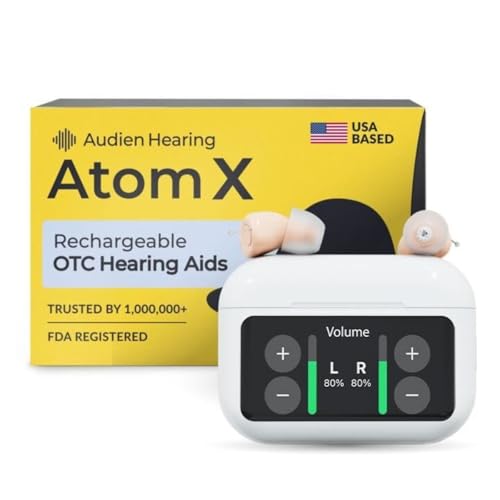
Audien Atom X: Best Mid-Range with Bluetooth
The Audien Atom X elevates the mid-range category by adding Bluetooth connectivity while maintaining an accessible price point under $500. What sets this device apart is the large clear touchscreen control on the charging case—making it exceptionally easy for seniors to adjust settings without struggling with smartphone apps. The 48+ hour total battery life with the charging case provides extended use between charges.
Universal Bluetooth connectivity allows streaming music and phone calls directly to the hearing aids, functioning as both medical devices and true wireless earbuds. The A2 TM Max processing chip powers background noise reduction, automatically blocking loud sudden sounds for comfort. Multiple listening modes are accessible via the intuitive touchscreen, eliminating the need for app navigation.
No app is required for operation—everything controls through the touchscreen case. This design choice significantly reduces the technology barrier for seniors or anyone preferring physical controls. The device maintains a discreet low-profile in-ear design that doesn’t draw attention. Quick noise cancellation activates instantly when loud sounds occur.
User feedback indicates excellent sound clarity for conversations and TV watching. The #1 Best Seller status in Hearing Amplifiers reflects strong market acceptance, with over 2000 units purchased monthly. Bluetooth connects to any device universally without requiring specific app compatibility checks.
Drawbacks include potential discomfort for very small ear canals, as even the smallest ear domes may feel painful. Proper ear dome selection is critical to prevent feedback and whistling. The device isn’t suitable for severe hearing loss, and some users report a 2-3 week adjustment period before achieving optimal results.
Key Features:
- 48+ hours total battery with charging case
- Universal Bluetooth connectivity
- No app required—touchscreen control on case
- A2 TM Max processing with background noise reduction
- Multiple listening modes via touchscreen
- In-ear earbud style, discreet low-profile
- 6 pairs of ear domes included
- Quick noise cancellation for loud sounds
- FDA OTC approved
Pros:
- Large clear touchscreen control—very easy for seniors
- Excellent battery life (48+ hours total with case)
- No app required—everything via touchscreen
- Bluetooth streaming for music and phone calls
- Significantly more affordable than prescription alternatives
- Quick noise cancellation—blocks loud sudden sounds
- Comfortable and discreet design
- Universal Bluetooth connects to any device
- #1 Best Seller in Hearing Amplifiers
- 2000+ bought in past month—very popular
Cons:
- Small ear canals may find smallest ear domes painful
- Requires proper ear dome selection to prevent feedback
- Not suitable for severe hearing loss (mild to moderate only)
- Adjustment period of several weeks needed
- Ear domes must be cleaned regularly to prevent feedback
- May feel unnatural until brain adjusts
Best For: Mid-range buyers wanting Bluetooth streaming without apps, seniors needing simple touchscreen controls, users struggling with small smartphone app interfaces, anyone wanting hearing aids that double as wireless earbuds.
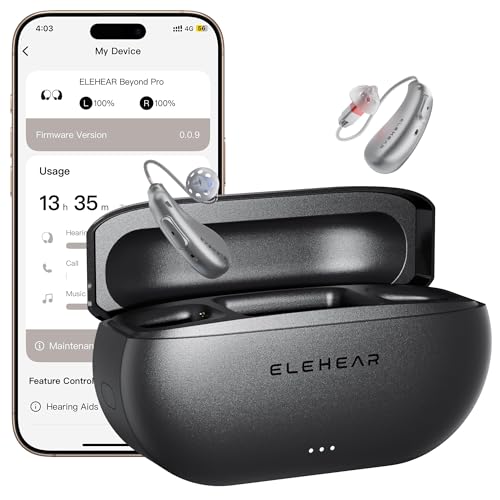
ELEHEAR Beyond: Best Mid-Range Performance
The ELEHEAR Beyond delivers premium features at a mid-range price point, powered by VocClear AI Technology for superior sound clarity. Maximum gain up to 50dB accommodates moderate hearing loss better than many competitors. Bluetooth 5.3 enables phone calls and audio streaming, while 24dB noise attenuation effectively reduces background noise in challenging environments.
The smart app provides extensive customization with 20 sound levels—far more than the typical 3 found on cheaper models. Tinnitus masking comes built-in, a valuable feature for the significant percentage of hearing loss sufferers who also experience tinnitus. AI translation capability for real-time conversation translation in multiple languages sets this device apart from competitors.
Environment presets (general, TV, restaurant) allow quick adaptation to different acoustic situations. The 100-hour total battery life (20 hours device + 4 charges from case) ranks among the best in the mid-range category. Fast and easy Bluetooth switching between devices makes transitioning from phone to TV to tablet seamless.
Receiver-in-canal (RIC) design with a stay-in-ear wire provides excellent fit stability during active use. The device automatically powers on when removed from the case and off when returned—eliminating battery drain from forgetting to power down. No whistling or feedback issues reported by users, thanks to advanced feedback cancellation.
Limitations include the higher price point at $399 and faster battery drain when streaming audio. Regular cleaning is required to prevent wax buildup from muffled sound. The app may have a learning curve for some seniors, and initial setup requires downloading the app.
Key Features:
- VocClear AI Technology for sound clarity
- Up to 50dB maximum gain for moderate loss
- 24dB noise attenuation reduces background noise
- Bluetooth 5.3 for calls and audio streaming
- Smart app with 20 sound levels
- Tinnitus masking feature built-in
- AI translation capability
- Environment presets (general, TV, restaurant)
- 100+ hours total battery life
- Receiver-in-canal design
- FDA OTC approved
Pros:
- VocClear AI Technology for superior sound clarity
- Maximum gain up to 50dB for moderate hearing loss
- 24dB noise attenuation reduces background noise effectively
- Bluetooth 5.3 for phone calls and audio streaming
- Smart app with extensive customization (20 sound levels)
- Tinnitus masking feature built-in
- AI translation capability
- Environment presets (general, TV, restaurant)
- Exceptional 100-hour total battery life
- Fast and easy Bluetooth switching between devices
- No whistling or feedback issues
- Stay-in-ear design with receiver wire
- Automatic on/off when removed from case
- FSA/HSA eligible
- Audiologist remote care service available
Cons:
- Higher price point at $399
- Streaming drains battery faster
- Wax buildup requires regular cleaning
- May not fit severe hearing loss needs
- Initial setup requires app download
- Some users experienced ear fit issues initially
- Must use provided charging cable (not all USB-C work)
- App learning curve for advanced features
Best For: Mid-range buyers wanting maximum customization, users needing tinnitus masking, those requiring higher gain for moderate loss, anyone wanting AI translation features, active users needing secure fit.

ELEHEAR Beyond Pro: Premium Features Without Prescription Pricing
The ELEHEAR Beyond Pro represents the pinnacle of OTC hearing aid technology, featuring VocClear 2.0 algorithm that delivers 30% clearer speech than standard processing. Real-time AI translation for 11 languages provides a unique feature unmatched by competitors—invaluable for travel or multilingual environments. The 15-minute fast charge provides 6 hours of use, eliminating battery anxiety.
This device excels in music performance with a dedicated Music Mode that delivers rich audio streaming quality rivaling premium studio monitor headphones. The enhanced app interface includes audiologist review service, allowing remote professional tuning without clinic visits. Tinnitus masking features 20 immersive soundscapes (rain, breeze, forest, etc.) for relief options.
The featherlight receiver-in-canal design ensures comfort even during extended wear. Multiple ear dome types are included (closed, open, power, tulip) to ensure optimal fit for various ear canal shapes. Frequency response extends to 8500Hz with only 8ms latency—critical for natural sound perception and lip-reading synchronization.
Battery life is exceptional at 80+ hours total (20 hours device + 4 additional charges from case). The app provides comprehensive controls with multiple listening modes for restaurants, TV, noisy crowds, and one-on-one conversations. Customer service includes proactive check-in calls to ensure satisfaction.
Drawbacks include the premium $599 price point, which may challenge budget-conscious buyers. The device is larger than some OTC options, though still discreet. The extensive app features require a learning curve, and sound quality may require audiologist tuning for optimal results.
Key Features:
- VocClear 2.0 with 30% clearer speech
- Real-time AI translation for 11 languages
- 15-minute fast charge for 6 hours use
- 80+ hours total battery life
- Tinnitus masking with 20 soundscapes
- Music mode for rich audio streaming
- Featherlight RIC design
- Multiple ear dome types included
- Frequency response to 8500Hz with 8ms latency
- Enhanced app with audiologist tuning
- Bluetooth streaming for calls and music
- FDA OTC approved
Pros:
- #5 Best Seller in Hearing Aids—extremely popular
- VocClear 2.0 delivers 30% clearer speech
- Real-time AI translation in 11 languages (unique feature!)
- Excellent app with audiologist review service included
- 15-minute fast charging gives 6 hours use
- Incredible battery life (80+ hours total)
- Tinnitus masking with 20 soundscapes (rain, breeze, etc.)
- Music mode for rich audio streaming
- Very comfortable RIC design—forget you’re wearing them
- Outstanding customer service (proactive check-in calls)
- Multiple ear dome types included for best fit
- Frequency response up to 8500Hz with only 8ms latency
- Custom audiologist tuning available via app
Cons:
- Premium price at $599
- Larger than some other OTC options
- Learning curve for all app features
- May have to try multiple dome types to find best fit
- Sound quality may not be best out of box—requires app tuning
Best For: Users wanting premium OTC performance, travelers needing translation features, tinnitus sufferers requiring masking options, musicians wanting excellent music quality, anyone wanting remote audiologist tuning.
Sennheiser All-Day Clear: Premium Audio Heritage
The Sennheiser All-Day Clear leverages seven decades of audio expertise to deliver exceptional sound quality in an OTC hearing aid. The self-fitting process uses an intuitive app that guides users through customization in three simple steps—no audiologist required. Bluetooth streaming enables hands-free phone calls and music listening, with automatic environment adjustment adapting to acoustic conditions in real-time.
Sennheiser’s audio heritage is evident in the app equalizer, allowing bass, mid, and treble adjustments for personalized sound profiles. Wind noise reduction activates when needed for outdoor use. The device offers two primary sound profiles: Automatic for everyday situations and Live Music for concert and performance environments.
The 24-hour continuous battery life provides all-day use on a single charge. Rechargeable via the charging case, which must be plugged in (unlike portable battery cases on some competitors). The design is discreet and comfortable, using the receiver-in-canal style that’s become standard for modern hearing aids.
Professional endorsement from hearing care professionals adds credibility. FSA/HSA eligibility makes the device purchasable with pre-tax health dollars. The 30-day risk-free trial allows thorough evaluation before commitment.
However, significant concerns exist. The premium price of $799.95 (discounted from $999.95) is the highest among true OTC options. Critical long-term reliability issues have emerged, with multiple users reporting units failing shortly after the one-year warranty expires. Perhaps most problematic: replacement ear tips/domes are not available for purchase, rendering devices unusable when tips wear out.
Customer support cannot recommend repair services, and single-unit replacement isn’t available—users must buy a new pair at a $200 discount when one fails. The limited sound profile options (only Automatic and Live Music) disappoint users wanting more customization. Phone auto-switching to hearing aids cannot be disabled, interrupting normal phone use.
Key Features:
- Exceptional Sennheiser sound quality
- Self-fitting with intuitive app
- Bluetooth streaming for calls and music
- Hands-free calling capability
- App equalizer (bass, mid, treble)
- Wind noise reduction
- Automatic environment adjustment
- 24-hour continuous battery life
- FDA cleared OTC hearing aid
- Sound profiles: Automatic and Live Music
- Receiver-in-canal design
Pros:
- Exceptional sound quality from Sennheiser audio expertise
- Self-fitting process with intuitive app
- Bluetooth streaming for phone calls and music
- Hands-free calling capability
- App equalizer (bass, mid, treble adjustments)
- Wind noise reduction feature
- Automatic environment adjustment
- FSA/HSA eligible
- Endorsed by hearing care professionals
- 30-day risk-free trial
- Rechargeable with all-day battery life
- Discreet and comfortable design
- Sound profiles: Automatic and Live Music
- Comparable to prescription hearing aids costing $1500+
Cons:
- Highest price point at $799.95 (was $999.95)
- Poor long-term reliability (units fail after warranty)
- No spare parts or single unit replacement available
- Critical issue: No replacement ear tips available
- Cannot upload custom audiologist hearing profile
- Only 2 sound profiles available
- No custom profile creation in app
- Charging case must be plugged in (no portable battery)
- Higher dome causes occlusion effect for some users
- Limited advanced settings compared to prescription models
- Support cannot recommend repair services
- Phone automatically switches audio output to hearing aids
- Limited to 3 dome sizes
Best For: Brand-conscious buyers prioritizing audio quality, users wanting simple self-fitting with app controls, those valuing professional endorsement, anyone wanting hands-free calling with music streaming.

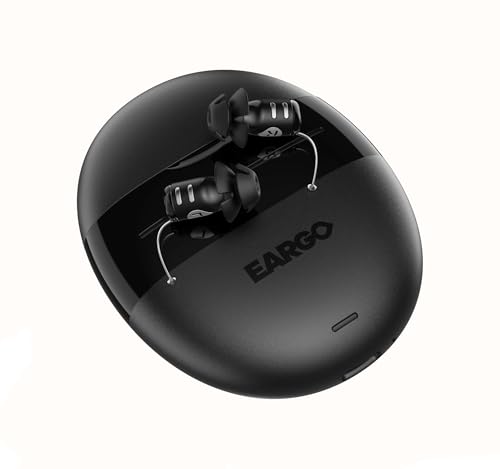
EARGO 8: Ultra-Premium Discretion with FDA Clearance
The EARGO 8 represents the highest tier of OTC hearing aids with FDA clearance (the most stringent standard—not just registration). The completely-in-canal design makes these devices virtually invisible when worn, addressing cosmetic concerns as a primary feature. IP68 rating provides the highest level of water, dust, and sweat resistance in the category—critical for active users.
Smart Sound Adjust technology automatically adapts to your acoustic environment without manual intervention. Device Scan monitors device health automatically, alerting you to maintenance needs before problems occur. Lifetime customer support from US-based experts provides ongoing assistance throughout the product lifespan.
The 2-year warranty includes unlimited repairs plus loss/damage coverage—exceptional for the hearing aid industry. Self-fitting uses Sound Match technology for remote customization without clinic visits. The 16-hour device battery combines with a charger holding 14 full recharges for 224 total hours of portable power.
Completely-in-canal design means no behind-ear component—ideal for glasses wearers or anyone不喜欢 objects visible behind the ear. Multiple eartip sizes ensure optimal fit, and the design is award-winning for aesthetic innovation. Sound quality is superior with best-in-class noise reduction.
However, the $2,699 price places these in prescription hearing aid territory. NO Bluetooth audio streaming means you can’t listen to music or take phone calls through the devices—Bluetooth only connects for app control. Completely-in-canal insertion requires precise technique, and feedback occurs if not inserted correctly.
The adjustment period lasts 2-3 weeks, with some users initially experiencing a metallic sound quality or “garbage can” effect as the brain adapts. Tapping the ear to change presets often doesn’t work reliably, requiring app use instead. At this price point, the lack of streaming capabilities disappoints users expecting premium features.
Key Features:
- FDA-cleared (highest standard)
- Completely-in-canal design—virtually invisible
- IP68 rated (highest water/dust/sweat resistance)
- Smart Sound Adjust automatic adaptation
- Device Scan health monitoring
- Lifetime US-based customer support
- Self-fitting with Sound Match technology
- 16-hour device + 14 full recharges from charger (224 hours total)
- 2-year warranty with unlimited repairs + loss/damage coverage
- No in-office visits required
- 4 preset programs + app customization
Pros:
- FDA-cleared (highest standard—not just registered)
- Completely-in-canal design is virtually invisible
- IP68 rating—highest water/dust/sweat resistance
- Smart Sound Adjust automatically adapts to environment
- Device Scan monitors device health automatically
- Lifetime customer support from US-based experts
- Self-fitting with Sound Match technology
- 16-hour battery with charger holding 14 recharges
- 2-year warranty with unlimited repairs + loss/damage coverage
- Award-winning design from established hearing aid brand
- Excellent sound quality with best-in-class noise reduction
- No in-office visits required—fully remote support
- Multiple eartip sizes included for custom fit
Cons:
- Very expensive at $2,699
- NO Bluetooth audio streaming (music/calls)
- Completely-in-canal design can be tricky to insert
- Feedback if not inserted in very specific way
- Adjustment period of 2-3 weeks required
- Sound can feel metallic initially
- Tapping ear to change presets often doesn’t work
- Premium price may not be justifiable for all users
- Metallic sound quality for some users
Best For: Users prioritizing maximum discretion above all else, active users needing IP68 water/sweat resistance, those wanting lifetime professional support, buyers preferring FDA-cleared devices, anyone wanting comprehensive warranty with loss/damage coverage.
Buying Guide: How to Choose the Right Earbud Hearing Aid
OTC vs Prescription: What’s the Difference?
OTC hearing aids became available in late 2022 following FDA regulation, creating a new category for adults 18+ with mild to moderate hearing loss. These devices cost significantly less ($99-$1,000 vs $3,000-$6,000 for prescription) and don’t require audiologist visits. Prescription hearing aids serve severe hearing loss, are professionally fitted, and offer more advanced processing—but cost significantly more and require clinic visits.
The key limitation: OTC devices only work for mild to moderate hearing loss. If you have severe loss or conductive hearing loss (physical ear damage), you need prescription devices and professional medical care. Always consult an audiologist if you’re unsure about your hearing loss severity.
iOS vs Android Compatibility Matters
Platform compatibility varies significantly across earbud hearing aids. Apple AirPods Pro provide optimized hearing aid features for iPhone users but offer limited functionality for Android. Universal Bluetooth devices like Audien Atom X work equally well with both platforms but lack platform-specific optimization.
Dedicated apps (ELEHEAR, Sennheiser) typically support both iOS and Android with similar feature sets. However, hands-free calling quality varies—some devices optimize for iPhone protocols, others for Android. Check manufacturer specifications if you primarily use one platform.
Essential Features to Prioritize
Battery Life: Consider your daily usage patterns. If you stream music or take calls frequently, look for 20+ hours device battery. If you use hearing aids intermittently, 12-16 hours may suffice. Charging case capacity determines total portable power—80+ hours is excellent for travel.
Bluetooth Streaming: Decide if you want hands-free calling and music streaming. Budget models skip Bluetooth to keep prices low. Mid-range and premium devices include streaming, but quality varies—Sennheiser leverages audio heritage, while ELEHEAR adds AI translation features.
App Customization: More expensive devices offer smartphone apps with extensive controls (20+ sound levels, equalizers, environment presets). Budget devices use simple controls or no app at all. Consider technical comfort—some seniors struggle with small app interfaces.
Water Resistance: Active users should prioritize IP ratings. IP68 (Eargo 8) provides complete dust protection and water immersion—ideal for sports and humid climates. Lower IP ratings or unspecified resistance means avoiding sweat and rain.
Understanding Price Tiers
Under $150 (Budget): Basic amplification without Bluetooth or apps. Suitable for mild hearing loss and first-time users wanting to test OTC devices without significant investment. Examples: Audien Atom One, Karthus.
$300-$500 (Mid-range): Bluetooth streaming, app controls, better noise reduction. Best value for most users with mild to moderate loss. Examples: Audien Atom X, ELEHEAR Beyond.
$500-$1,000 (Premium OTC): Advanced processing, AI features, excellent build quality. Ideal for discerning users wanting near-prescription performance. Examples: ELEHEAR Beyond Pro, Sennheiser All-Day Clear.
$2,000+ (Ultra-Premium): Prescription-grade quality, FDA clearance, lifetime support. For maximum discretion, active lifestyles, and users wanting comprehensive warranties. Example: EARGO 8.
Return Policies and Trial Periods
Most OTC hearing aids offer 30-day return windows—sufficient for the typical 2-3 week adjustment period. Premium brands like Eargo extend trial periods to 45+ days. Check if return shipping is covered and whether full refunds are provided vs. store credit.
Consider warranty coverage beyond the return period. One year is standard, but Eargo offers two years with unlimited repairs. Factor in replacement part availability—Sennheiser’s lack of replacement ear tips creates long-term usability issues.
FAQ: Common Questions About Earbud Hearing Aids
Are earbud hearing aids as good as traditional hearing aids?
For mild to moderate hearing loss, modern OTC earbud hearing aids deliver comparable performance to traditional prescription devices for a fraction of the cost. HearAdvisor lab testing shows some OTC models scoring 4.3/5 for speech-in-quiet performance—rivaling prescription alternatives. However, traditional hearing aids remain superior for severe loss, conductive hearing loss, and complex processing needs. Many users end up owning both—OTC devices for casual use and prescription aids for challenging listening environments.
Can I use AirPods Pro as hearing aids?
Yes, AirPods Pro 2 and 3 include FDA-cleared hearing aid features accessible through the Health app on iPhone. The Hearing Test feature creates a personalized audiogram, and the Hearing Assist mode amplifies specific frequencies based on your results. However, AirPods work best for calls and streaming—they’re not designed for all-day hearing aid use. Most users find dedicated hearing aids more comfortable for extended wear, while using AirPods for specific situations like phone calls or TV watching.
How long does the adjustment period take?
Expect 2-3 weeks for your brain to adjust to new hearing aids. Initially, sounds may seem metallic, too loud, or unnatural—this is normal. Start by wearing devices 1-2 hours daily in quiet environments, gradually increasing duration and moving to noisier settings. Some users experience the “garbage can” effect where everything sounds like you’re in a metal container—this typically resolves within two weeks as your brain adapts. If issues persist beyond 3-4 weeks, consult an audiologist.
Will hearing aids cure my tinnitus?
Hearing aids don’t cure tinnitus, but many devices include tinnitus masking features that provide relief. ELEHEAR devices offer 20 soundscapes (rain, breeze, forest) that distract from tinnitus sounds. Improved hearing from amplification can also reduce tinnitus perception by enhancing environmental sounds that mask internal ringing. For severe tinnitus, combination treatment using hearing aids plus sound therapy from an audiologist works best.
What’s the 60-60 rule for hearing protection?
The 60-60 rule prevents noise-induced hearing loss: listen to audio at no more than 60% of maximum volume for no longer than 60 minutes at a time. This guideline from audiology experts applies whether you’re using musical audio equipment, headphones, or hearing aids with streaming features. Taking regular breaks gives your ears recovery time and prevents permanent damage from prolonged exposure—even at moderate volumes.
Do I need an audiologist for OTC hearing aids?
OTC hearing aids are designed for self-fitting without professional assistance. Most include apps with hearing tests that automatically configure amplification based on your responses. However, consulting an audiologist is recommended if: you’re unsure about your hearing loss severity, you experience sudden hearing loss, you have ear pain or drainage, or OTC devices don’t provide sufficient improvement. Audiologists can also identify medical conditions requiring treatment rather than amplification.
How long do hearing aid batteries last?
Rechargeable OTC hearing aids typically provide 16-24 hours of device battery life, with charging cases holding 3-14 additional charges for 80-224 total hours of portable power. Budget devices like Audien Atom One offer 24 hours on a single charge. Premium models like Eargo 8 provide 224 total hours through a charging case. Daily charging is required for all rechargeable models—overnight charging ensures full battery for the next day. Expect 2-3 years of battery life before replacement becomes necessary.
Medical Disclaimer: This content is for informational purposes only and does not constitute medical advice. Consult with a licensed audiologist or healthcare provider for diagnosis and treatment of hearing loss. OTC hearing aids are intended for adults 18+ with mild to moderate hearing loss per FDA regulations.
Conclusion: Which Earbud Hearing Aid is Right for You?
The best earbud hearing aid depends on your budget, hearing loss severity, and feature priorities. For budget-conscious buyers with mild loss, the Audien Atom One provides an excellent entry point under $150. Mid-range buyers wanting Bluetooth streaming should choose between the Audien Atom X (touchscreen controls, ideal for seniors) and ELEHEAR Beyond (app customization, tinnitus masking). Premium seekers will find the ELEHEAR Beyond Pro offers the best value with AI translation and audiologist tuning at $599.
Maximum discretion seekers should consider the EARGO 8 despite the premium price—FDA clearance, IP68 rating, and lifetime support justify the investment for active users. Brand-conscious buyers prioritizing audio quality may choose Sennheiser All-Day Clear, but be aware of long-term reliability concerns and lack of replacement parts.
Start by determining your hearing loss severity (professional testing recommended), then set a realistic budget. Prioritize features matching your lifestyle—Bluetooth for phone calls, water resistance for sports, long battery for travel. Take advantage of 30-day trial periods to test comfort and sound quality before committing. With the right choice, modern earbud hearing aids provide life-changing improvement while looking as natural as wearing wireless earbuds.




Leave a Comment