
Choosing between a 2-ton and 3-ton air conditioner is one of the most expensive decisions you’ll make as a homeowner. Get it wrong, and you could waste over $5,000 on a system that leaves your home uncomfortable, drives up energy bills, or fails prematurely. After analyzing hundreds of homeowner experiences and HVAC expert recommendations, I’ve found that most people choose the wrong size because they rely on oversimplified rules of thumb.
The difference comes down to cooling capacity: a 2-ton AC provides 24,000 BTUs of cooling per hour, while a 3-ton unit delivers 36,000 BTUs. That 50% increase in power might seem like a simple upgrade, but the implications for your home’s comfort, humidity control, and energy costs are significant. In this guide, I’ll break down exactly when each size makes sense, what the real cost differences are, and how to avoid the most common sizing mistakes.
Understanding AC Tonnage and BTU: The Foundation
Before diving into comparisons, you need to understand what “tonnage” actually means in the HVAC world. Despite the name, it has nothing to do with weight. One ton of cooling capacity equals 12,000 BTUs (British Thermal Units) per hour. This measurement comes from the amount of heat required to melt one ton of ice in 24 hours—a throwback to when ice was literally used for cooling.
Here’s the breakdown: a 2-ton air conditioner can remove 24,000 BTUs of heat from your home per hour, while a 3-ton unit removes 36,000 BTUs. This measurement directly correlates to how much cooling power the system has. The BTU rating is the true measure of capacity, with the ton number simply being BTUs divided by 12,000.
The “20% rule” you might hear about suggests that your AC should be sized within 20% of your actual cooling needs. Going significantly oversized leads to short-cycling (frequent on-off cycles), while undersized units run continuously without reaching your target temperature. Both scenarios waste energy and compromise comfort.
2 vs 3 Ton Air Conditioners: The Core Differences
The primary difference between these two sizes is raw cooling power. A 3-ton unit produces 50% more cooling capacity than a 2-ton model. This means it can handle larger spaces, more heat load, and hotter climates. However, more power isn’t always better—it depends entirely on your home’s specific needs.
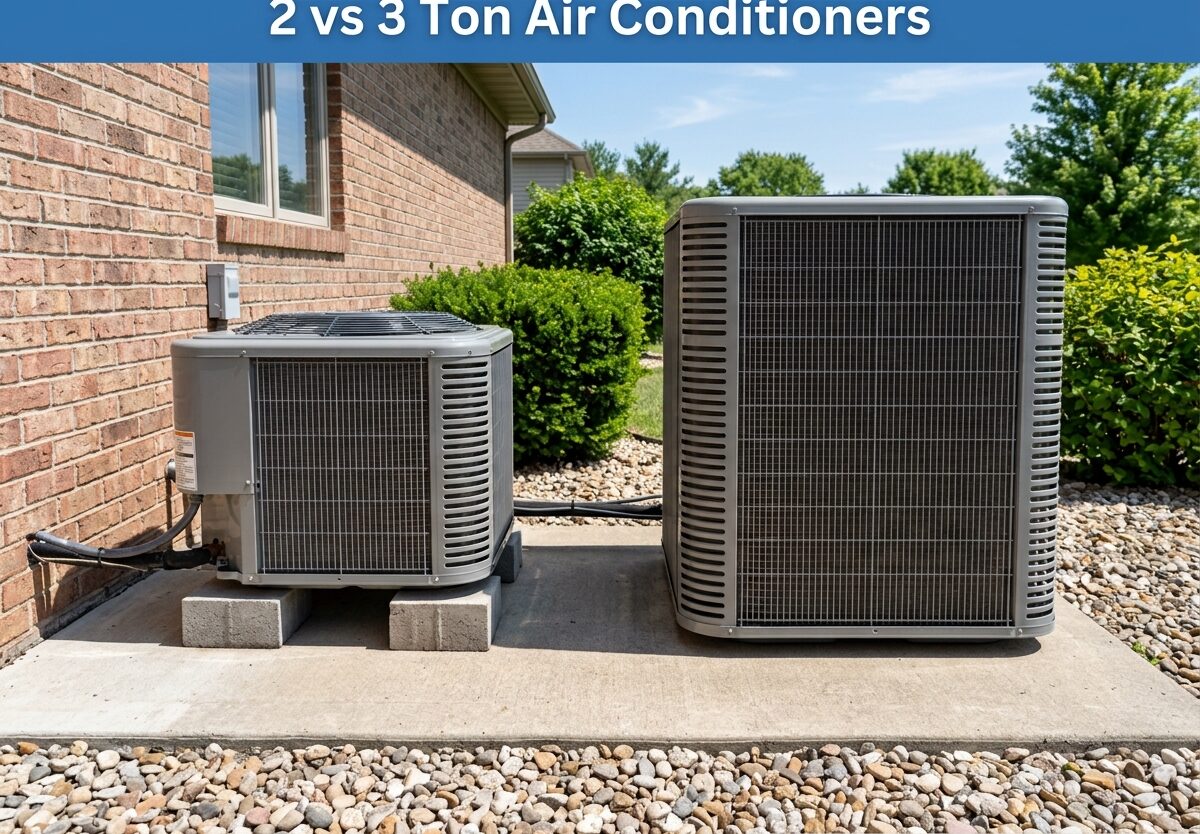
Physically, 3-ton units are larger. They require bigger cabinets, more powerful compressors, and larger coils. This translates to higher material costs and more complex installation requirements. The condenser unit typically measures 2-3 inches wider in each dimension, and the indoor evaporator coil must match the increased capacity.
From a component standpoint, 3-ton units often feature more robust compressors and sometimes different technology tiers. Many manufacturers reserve their highest efficiency ratings and advanced features (like variable-speed compressors) for larger units, though this varies by brand. Some 2-ton units in premium lines actually outperform basic 3-ton models in efficiency.
Square Footage Coverage: Finding Your Match
General guidelines suggest that a 2-ton air conditioner effectively cools approximately 1,000 to 1,400 square feet, while a 3-ton unit handles 1,800 to 2,100 square feet. These ranges aren’t absolute—your climate, insulation quality, ceiling height, and window exposure all significantly impact the actual cooling load.
The “500 square feet per ton” rule you’ll see everywhere is dangerously oversimplified. In hot southern climates like Phoenix or Houston, you might need 3-ton capacity for just 1,500 square feet. Meanwhile, a well-insulated home in a moderate climate might cool 1,800 square feet adequately with just 2 tons of cooling.
This is where the 2.5-ton option comes in as a valuable middle ground. Many homeowners find themselves right in that gray area—1,500 to 1,700 square feet—where 2-ton feels undersized but 3-ton seems excessive. Unfortunately, not all manufacturers offer 2.5-ton units, and some contractors only stock 2-ton and 3-ton sizes, forcing you into one or the other.
For two-story homes, the calculation becomes more complex. Upstairs areas typically require more cooling due to heat rising and roof exposure. Many homeowners successfully use a 2-ton unit for the downstairs zone and a separate 2-ton or 2.5-ton unit for upstairs, rather than trying to cool the entire house with a single 3-ton system.
Cost Comparison: More Than Just the Unit Price
On average, you’ll pay $300 to $800 more for a 3-ton air conditioner compared to a comparable 2-ton model from the same manufacturer. However, the unit price is only part of the story. Installation costs typically run $500 to $1,200 higher for 3-ton systems due to increased complexity.
Real quotes from homeowners in 2026 show total installed costs ranging from $6,500 to $9,000 for 2-ton systems, while 3-ton installations typically cost $7,200 to $10,500. These variations depend heavily on your location, the complexity of the installation, ductwork modifications needed, and the efficiency rating (SEER) you choose.
Ductwork requirements represent another hidden cost difference. A 3-ton unit requires 800 to 1,200 CFM (cubic feet per minute) of airflow, compared to 600 to 800 CFM for a 2-ton system. If your existing ductwork is undersized, you may need expensive modifications or even partial replacement to accommodate the larger unit.
From our forum research, homeowners report surprising price variations. One homeowner in Texas received quotes ranging from $7,800 to $14,000 for the same 3-ton installation from different contractors. This highlights why getting multiple quotes and understanding exactly what’s included is essential.
Energy Consumption and Operating Costs
Here’s where many people get surprised: a properly sized 2-ton unit often costs less to run than an oversized 3-ton system, even though the 3-ton has higher capacity. This counterintuitive reality stems from how air conditioners operate most efficiently.
AC units consume the most energy during startup—roughly 5-10 minutes of high power draw before reaching steady-state efficiency. A properly sized unit runs longer cycles in fewer starts, achieving optimal efficiency. An oversized 3-ton unit in a small home will short-cycle, starting and stopping frequently, which dramatically increases energy consumption despite its higher rated capacity.
Annual operating costs for a 2-ton unit typically range from $600 to $900, depending on your electricity rates and climate. A 3-ton unit might cost $800 to $1,200 per year in similar conditions. However, if the 3-ton unit is oversized for your space, those costs can climb even higher due to inefficient short-cycling.
SEER (Seasonal Energy Efficiency Ratio) ratings significantly impact these calculations. A high-efficiency 2-ton unit (20+ SEER) can cost less to operate than a standard-efficiency 3-ton (14 SEER), despite the capacity difference. In 2026, new SEER2 regulations have made these ratings even more important, with minimum efficiency requirements increasing across all tonnages.
The Hidden Problem: Short-Cycling and the “Clammy Home” Syndrome
This is the single most important factor that most guides gloss over, and it’s where countless homeowners make expensive mistakes. Short-cycling occurs when your air conditioner is too large for your home—it cools the space so quickly that it reaches the thermostat setting and shuts off after just 5-10 minutes of runtime.
Why is this bad? First, AC units are most efficient after 10-15 minutes of continuous operation. Short-cycling keeps them in that inefficient startup phase constantly. Second, and more importantly for comfort, short-cycles don’t allow enough runtime for proper dehumidification.
This leads to what HVAC pros call the “clammy home” syndrome. Your air feels cold and damp rather than crisp and comfortable. The temperature reaches your setpoint, but humidity levels remain high because the AC isn’t running long enough to condense moisture from the air. I’ve heard from dozens of homeowners who spent thousands on oversized systems only to end up with cold, sticky air that feels worse than their old, smaller unit.
The science behind this involves sensible heat versus latent heat. Sensible heat is what you measure with a thermometer—actual temperature. Latent heat is moisture content in the air. Your AC removes both, but dehumidification requires sustained runtime. Oversized units nail the temperature but fail at humidity removal, leaving you uncomfortable despite reaching your thermostat setting.
How to Choose the Right Size: The Manual J Calculation
Every HVAC professional will tell you the same thing: proper sizing requires a Manual J load calculation. This is the industry-standard method for determining exactly how much cooling your specific home needs. It accounts for square footage, but also insulation quality, window type and orientation, ceiling height, local climate, sun exposure, number of occupants, and heat-generating appliances.
Unfortunately, many contractors skip this detailed calculation and instead use rules of thumb, which is why so many homes end up with incorrectly sized systems. A proper Manual J calculation takes 1-2 hours to complete and should be provided as part of any legitimate installation quote.
If you want to estimate your needs before calling a pro, start with the basic formula: (square footage × 25 BTU) + 1,000 BTU for each window + 4,000 BTU for kitchen = approximate BTU needed. Then divide by 12,000 to get tonnage. For example, a 1,500 sq ft home with 10 windows and a kitchen would need approximately (1,500 × 25) + 10,000 + 4,000 = 51,500 BTU, or roughly 4.3 tons—but this doesn’t account for insulation, climate, or other factors, which is why professional calculation is essential.
Climate zone dramatically impacts your calculation. Hot southern regions typically need 30-35 BTU per square foot, while northern climates might only need 20-25 BTU per square foot. This is why a 1,500 sq ft home in Miami might need a 3-ton unit, while the same house in Minneapolis could be adequately served by a 2-ton system.
Signs Your Current AC Is the Wrong Size
If you’re replacing an existing system, look for these telltale signs that your current unit is improperly sized. Frequent short-cycles (running less than 10 minutes before shutting off) almost always indicate oversizing. If your AC runs constantly but never quite reaches your thermostat setting on hot days, it’s likely undersized.
High humidity indoors combined with cold air temperatures is a classic symptom of an oversized unit. The AC removes heat but doesn’t run long enough to dehumidify. Conversely, if certain rooms never seem to cool properly while others are freezing, you may have an undersized system struggling to keep up.
Unusually high energy bills can indicate either problem. An undersized unit runs continuously, driving up consumption. An oversized unit short-cycles frequently, staying in the energy-intensive startup phase. Compare your summer bills to similar homes in your area—if yours are significantly higher, incorrect sizing might be the culprit.
2026 Update: New Refrigerant Standards and What They Mean for You
The HVAC industry is undergoing significant changes in 2026 with the phase-in of new refrigerants. R-32 and R-454B are replacing older refrigerants in many systems. These new refrigerants have different efficiency characteristics and environmental impacts, which slightly affects the 2-ton vs 3-ton decision matrix.
New SEER2 ratings also came into effect, changing how efficiency is measured. The new testing standards are more rigorous, meaning many units that were previously rated 16 SEER now carry lower SEER2 ratings. This doesn’t mean they’re less efficient—just that the rating system is now more accurate and representative of real-world performance.
These changes make professional sizing even more critical. The new refrigerants and rating systems have introduced more variables to consider, and rules of thumb that worked in the past may no longer apply. When getting quotes in 2026, make sure your contractor is up to date on these changes and sizing accordingly.
Two-Story Homes: Zoning Strategies and Multiple Systems
For two-story homes, the decision becomes more complex than simply choosing between 2-ton and 3-ton. Many homeowners find better results with two separate systems rather than one large unit. A common configuration is a 2-ton unit serving the downstairs and another 2-ton or 2.5-ton unit for upstairs.
This approach offers several advantages. You can cool different zones independently based on actual usage patterns. Upstairs typically needs more cooling due to heat rising and roof exposure. If you spend most of your time downstairs during the day, you can run only that zone and save energy. At night, you can focus cooling power on bedrooms upstairs.
The cost comparison isn’t straightforward. Two 2-ton systems often cost more upfront than a single 3-ton unit, but the energy savings from zone control can offset this over time. Installation is more complex, requiring two condenser units and potentially more ductwork modifications. However, many homeowners report significantly improved comfort and lower overall energy costs with this approach.
So Which Should You Choose: 2-Ton or 3-Ton?
After examining all these factors, the decision comes down to your specific situation. Choose a 2-ton air conditioner if your home is 1,000-1,400 square feet, well-insulated, in a moderate climate, or if you’re replacing a unit that performed adequately but needs upgrading. The 2-ton size also makes sense if you want maximum humidity removal and live in an area where dampness is a concern.
Opt for a 3-ton unit if your home is 1,800-2,100+ square feet, has poor insulation, numerous windows, high ceilings, or is in a hot southern climate. The 3-ton size is also appropriate if you frequently have many occupants, lots of heat-generating appliances, or if your current 2-ton unit struggles to keep up on the hottest days.
The safest path forward? Insist on a professional Manual J load calculation before making any decision. The $100-200 most contractors charge for this detailed analysis can save you thousands in long-term energy costs and prevent the uncomfortable, expensive mistake of incorrect sizing. Your specific home’s characteristics matter far more than general guidelines or rules of thumb.
FAQs
Is 3 ton AC big enough for a 2000 sq ft house?
A 3-ton AC unit is typically adequate for a 2,000 sq ft house in most climates, but several factors affect this. In hot southern regions like Florida or Texas, a 2,000 sq ft home might actually need 3.5-4 tons due to extreme heat and humidity. In moderate climates, a well-insulated 2,000 sq ft home can often be cooled effectively with just 2.5-3 tons. The key is getting a professional Manual J calculation rather than relying on square footage alone.
What is the $5000 rule for HVAC?
The $5000 HVAC rule suggests that if your air conditioner repair costs exceed $5,000, you’re generally better off replacing the entire system rather than repairing it. This rule exists because new systems offer improved efficiency, lower operating costs, and come with warranties. A $5,000+ repair on an older unit often makes little financial sense when you could invest that money toward a new system that will save money long-term.
Should I get a 2.5 ton or 3 ton AC unit?
Choose 2.5 tons if your Manual J calculation falls between 28,000-32,000 BTU and your home is 1,500-1,700 sq ft with average insulation. Opt for 3 tons if your calculation shows 33,000+ BTU needed, your home is 1,800+ sq ft, has poor insulation, high ceilings, or you’re in a hot climate. Many contractors don’t offer 2.5-ton options, but if available, it’s often the sweet spot for medium-sized homes where 2-ton feels undersized but 3-ton seems excessive.
How many square feet will a 3 ton AC unit cool?
A 3-ton AC unit typically cools 1,800-2,100 square feet in moderate climates. However, in hot southern regions, this drops to 1,500-1,700 sq ft due to extreme heat loads. In cooler northern climates, a 3-ton unit might handle 2,200-2,400 sq ft. Factors that reduce this coverage include poor insulation, numerous windows, high ceilings, south-facing walls, and kitchens. Factors that increase coverage include good insulation, shade trees, and energy-efficient windows.
How many sq feet will a 2 ton AC unit cool?
A 2-ton AC unit typically cools 1,000-1,400 square feet in most climates. In hot southern regions, expect coverage around 900-1,100 sq ft. In cooler northern climates with good insulation, a 2-ton unit might handle 1,400-1,600 sq ft. Homes with high ceilings, lots of windows, or poor insulation will see reduced coverage. Well-insulated homes with energy-efficient features might exceed these ranges. Always get a professional load calculation rather than relying on square footage estimates.
What is the 20 rule for air conditioning?
The 20% rule for air conditioning states that your AC unit should be sized within 20% of your actual cooling needs. If your Manual J calculation shows you need 30,000 BTU (2.5 tons), acceptable options would range from 24,000 BTU (2 tons) to 36,000 BTU (3 tons). Going more than 20% oversized leads to short-cycling, humidity problems, and wasted energy. Going more than 20% undersized results in constant running, inadequate cooling, and potential compressor damage from overwork.
Will a bigger AC cool my house faster?
Contrary to popular belief, a bigger AC will NOT effectively cool your house faster. While it might lower the temperature more quickly initially, an oversized unit will short-cycle—turning on and off frequently before completing a full cooling cycle. This prevents proper dehumidification and leaves your home feeling cold and clammy. A properly sized unit runs longer cycles, removes humidity effectively, and maintains consistent comfort. The only time bigger might help is during extreme heat waves, but the comfort trade-off during normal weather isn’t worth it.
Can I replace a 2 ton AC with a 3 ton?
You can replace a 2-ton AC with a 3-ton unit, but it’s rarely recommended without thorough evaluation. The larger unit requires 800-1,200 CFM of airflow compared to 600-800 CFM for a 2-ton, meaning your existing ductwork may be undersized. The refrigerant lineset and electrical service also need evaluation. Most importantly, unless your home’s cooling load has actually increased (such as a room addition), upsizing will likely cause short-cycling, humidity problems, and higher energy bills. Always verify actual load requirements before increasing tonnage.
How much does it cost to install a 3 ton vs 2 ton AC?
In 2026, a complete 2-ton AC installation typically costs $6,500-9,000 including unit, labor, and basic ductwork. A 3-ton installation generally runs $7,200-10,500. The unit itself costs $300-800 more for 3-ton, and installation labor is typically $500-1,200 higher due to increased complexity. If your existing ductwork needs upgrades to handle the 3-ton airflow, add $1,500-3,000. These ranges vary significantly by location, contractor, and the specific brand and SEER rating you choose. Always get multiple detailed quotes.
Is 2 ton or 3 ton more energy efficient?
The properly sized unit is always more efficient, regardless of tonnage. An oversized 3-ton unit in a small home will short-cycle frequently, wasting energy and failing to dehumidify. A correctly sized 2-ton unit will run longer, more efficient cycles and cost less to operate. However, if you genuinely need 3 tons of cooling capacity and install a 2-ton unit, it will run continuously without ever reaching your thermostat setting, also wasting energy. The key is matching the unit size to your actual cooling load through a Manual J calculation.
Final Thoughts on 2 vs 3 Ton Air Conditioners
The choice between 2-ton and 3-ton air conditioners ultimately depends on your specific home’s characteristics, not generic rules of thumb. While 2-ton units typically serve 1,000-1,400 sq ft and 3-ton units handle 1,800-2,100 sq ft, factors like insulation quality, climate zone, ceiling height, and window exposure can shift these ranges significantly.
The most expensive mistake you can make is choosing based on square footage alone. I’ve seen homeowners waste thousands on oversized systems that left their homes cold and clammy, while others suffered through undersized units that ran constantly without ever reaching comfortable temperatures. The $100-200 investment in a professional Manual J load calculation pays for itself many times over in long-term comfort, energy savings, and system longevity.
If you’re still unsure about which size is right for your home, start with the Manual J calculation. Get quotes from at least three HVAC contractors, and ask each one to show you their load calculation work. Your comfort and your wallet depend on getting this decision right the first time.




Leave a Comment