
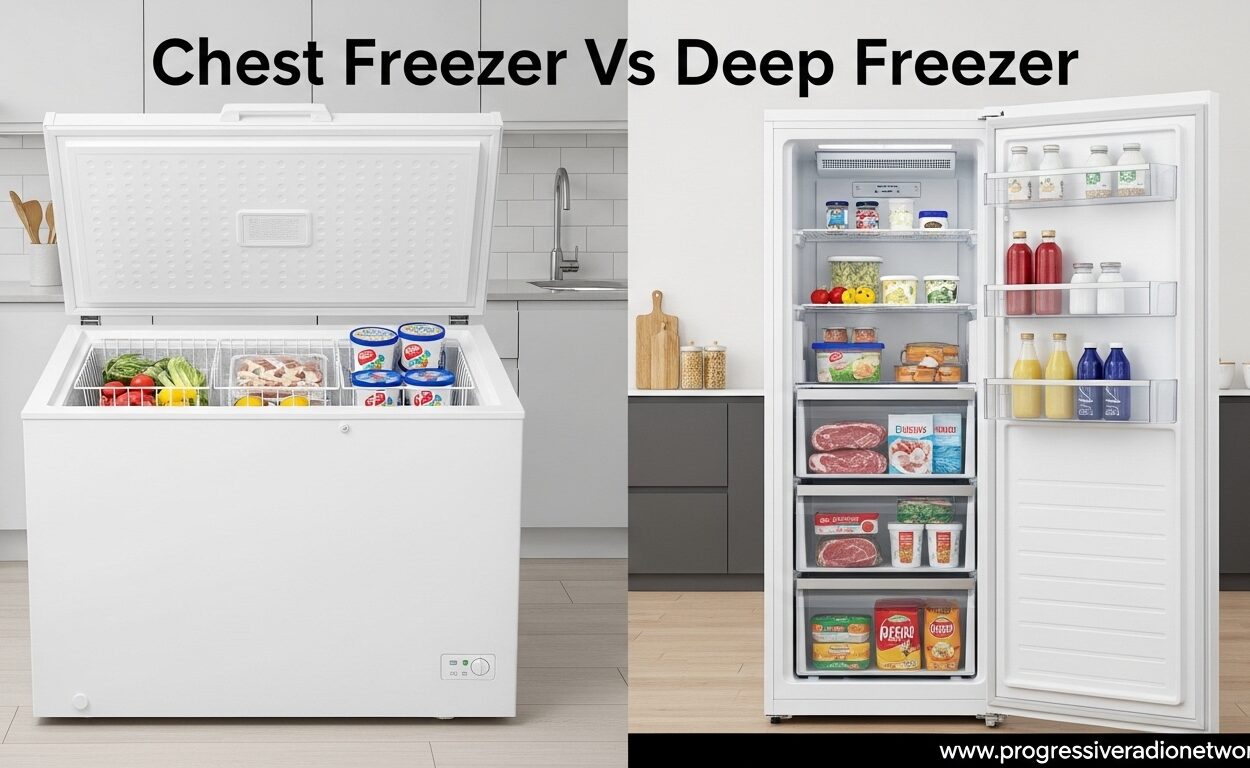
If you’ve been shopping for extra frozen food storage, you’ve probably encountered confusing terminology. Some retailers call them “chest freezers,” others say “deep freezers,” and still others use “upright freezers.” What’s the actual difference, and more importantly, which one belongs in your home? After researching freezer specifications and analyzing real user experiences, I’ll break down everything you need to know about the chest freezer vs deep freezer decision.
Understanding the Terminology: Chest Freezer vs Deep Freezer
Before diving into comparisons, let’s clear up the confusion. A chest freezer is a specific type of freezer—it’s horizontal, opens from the top with a lid, and looks like a low chest or box. The term “deep freezer” is actually an umbrella category that includes BOTH chest freezers AND upright freezers. Essentially, any standalone freezer with more capacity than your refrigerator’s freezer compartment qualifies as a deep freezer.
So when you see “chest freezer vs deep freezer,” what most people are really asking about is the comparison between chest freezers (top-loading) and upright freezers (front-loading, often called upright deep freezers). This distinction matters because the design differences significantly affect energy efficiency, organization, and how well your food stays frozen during power outages.
What is a Chest Freezer?
A chest freezer is a horizontal freezer unit that opens from the top with a hinged lid. They’re typically rectangular or box-shaped, ranging from compact 5-cubic-foot models perfect for apartments to massive 25-cubic-foot units designed for serious bulk storage. The interior is essentially one open space, though most models include removable storage baskets that hang from the rim.
The design is brilliantly simple. Because cold air is denser than warm air, it naturally sinks to the bottom of the unit. When you open the top lid, very little cold air escapes since it’s trapped at the bottom. This physics principle makes chest freezers exceptionally energy efficient and gives them superior temperature stability.
Chest freezers excel at long-term storage for bulk purchases, hunting meat, garden harvests, or emergency preparedness. They’re the go-to choice for homesteaders, large families who buy in bulk, and anyone prioritizing maximum energy efficiency over convenient access.
What is a Deep Freezer?
Here’s where terminology gets tricky. “Deep freezer” doesn’t refer to a specific design—it’s a category that encompasses any standalone freezer with greater capacity and colder temperatures than a standard refrigerator freezer compartment. Both chest freezers AND upright freezers qualify as deep freezers.
Historically, the term “deep freezer” referred to freezers capable of reaching temperatures below 0°F (-18°C) for long-term food preservation. Today, it’s commonly used as a catch-all term for any standalone freezer, whether it’s a chest-style unit or an upright model with shelves and a front-opening door.
When shopping, you’ll see both terms used interchangeably. A retailer might list a product as a “15 cubic foot deep freezer” when it’s actually a chest-style unit, or call an upright model a “deep freezer” to distinguish it from a refrigerator freezer. The key is looking at the physical design rather than relying on terminology.
Understanding Upright Freezers (Often Called Deep Freezers)
Upright freezers look like refrigerators—they’re vertical units with a front-opening door and multiple shelves inside. This design makes them familiar and intuitive to use. You can see everything at a glance, and items are organized on shelves rather than stacked on top of each other.
The interior typically includes glass or wire shelves, door bins for smaller items, and sometimes drawers or baskets. Organization is straightforward, similar to how you’d arrange a refrigerator. This visibility and accessibility is the upright freezer’s biggest advantage.
However, that front-opening door comes with a significant drawback. Every time you open the door, cold air pours out onto the floor (since cold air is denser and sinks). The upright freezer then has to work harder to bring the temperature back down, which is why upright models use considerably more electricity than chest freezers.
Chest Freezer vs Deep Freezer: Energy Efficiency Comparison
Energy efficiency is where chest freezers clearly dominate. According to ENERGY STAR data, a typical 15-cubic-foot chest freezer uses approximately 215-330 kWh per year, while a similarly sized upright freezer consumes 395-500+ kWh annually. That’s roughly 50% more electricity for the upright model.
Translated to actual costs, you’re looking at about $30-40 per year to run a chest freezer versus $50-70+ for an upright, depending on your local electricity rates. Over a 15-year lifespan, that’s a difference of $300-600 or more in operating costs alone.
The efficiency advantage comes down to physics. Cold air sinks, so when you open a chest freezer’s top lid, minimal cold escapes. The frozen food at the bottom stays cold, and the unit doesn’t have to work hard to recover its temperature. With an upright freezer, opening the door causes massive cold air loss—the entire interior volume is exposed, and cold air literally pours out onto the floor.
If energy efficiency and low operating costs are priorities, a chest freezer is the clear winner. The savings add up significantly over time, especially with rising electricity rates.
Storage Capacity and Usable Space Comparison
Here’s something most people don’t consider: chest freezers actually use their claimed capacity more efficiently. A 15-cubic-foot chest freezer provides nearly 15 cubic feet of usable storage space because it’s essentially one open cavity. You can pack it full without worrying about shelf configurations.
An upright freezer with the same 15-cubic-foot rating might only offer 12-13 cubic feet of actual usable space. Shelves, especially fixed glass ones, reduce usable volume and limit what you can store. You can’t easily slide in a large roast or bulky items if they don’t fit between shelf levels.
However, upright freezers make better use of vertical space. If floor space is limited in your garage or basement, going vertical with an upright model might make more sense. A chest freezer requires a larger footprint since it’s low and wide—you need enough clearance to open the lid fully and access the interior.
For pure bulk storage capacity where every cubic foot counts, chest freezers win. They’re also better for odd-shaped items like whole turkeys, bulk meat packages, or sheet pans. But if you’re working with limited floor area, an upright’s vertical design might be the practical choice.
Organization and Accessibility Differences
This is where upright freezers shine. With shelves, door bins, and clear visibility, finding specific items is straightforward. You can see everything at a glance, and similar items stay together. No digging required.
Chest freezers require more organization strategy. Without shelves, items naturally stack on top of each other. That package of frozen berries you bought three months ago? It’s probably buried at the bottom under everything else. Many chest freezer users develop systems—using milk crates, dividers, or numbered zones—to keep track of what’s where.
Most chest freezers come with one or two hanging baskets that help somewhat. You can keep frequently-used items in the baskets for easy access. But anything placed directly in the bottom becomes difficult to retrieve without unloading the upper layers first.
There’s also the physical factor. Accessing a chest freezer requires bending, reaching, and sometimes leaning in quite far. For anyone with mobility issues, back problems, or difficulty with deep bending, an upright freezer at counter height is significantly more ergonomic. You simply open the door and grab what you need without contortions.
Power Outage Performance: Which Keeps Food Frozen Longer?
Power outage performance is a critical consideration that many buyers overlook, and chest freezers have a substantial advantage here. During a power outage, a chest freezer will keep food frozen for 2-4 days, depending on how full it is and how often you open it. An upright freezer typically maintains safe temperatures for only 1-2 days.
Why such a difference? That same physics principle that makes chest freezers energy efficient also helps during outages. The small lid opening minimizes cold air loss, and the deep column of cold air at the bottom stays cold much longer. Plus, chest freezers are typically better insulated overall.
Here’s a practical tip many experienced freezer users swear by: keep a frozen cup of water with a penny on top in your freezer. If you experience a power outage while away, check the penny’s position. If it’s still on top of the ice, your food stayed frozen. If it has sunk into the ice (meaning the water thawed and refroze), you’ll know that food safety may have been compromised.
For anyone in an area with unreliable power, or for emergency preparedness, a chest freezer is the safer bet. That extra day or two of frozen storage can mean the difference between saving your food supply and having to discard everything.
Manual Defrost vs Auto-Defrost: Maintenance Differences
Most chest freezers are manual defrost, while many upright freezers offer auto-defrost (also called frost-free) options. This distinction affects both convenience and food quality.
Manual defrost freezers require defrosting whenever ice buildup reaches 1/4 inch thick—typically once or twice a year. The process involves emptying the freezer, turning it off, placing towels to catch water, and waiting for the ice to melt (or speeding things up with bowls of hot water). It’s a bit of a project that takes several hours.
Auto-defrost upright freezers cycle on heating coils periodically to melt ice buildup, so you never have to manually defrost. Convenient, yes, but there’s a trade-off. The defrost cycle causes temperature fluctuations that can contribute to freezer burn over time. Manual defrost freezers maintain more consistent temperatures, which many users report results in better long-term food quality.
Manual defrost units are also simpler with fewer components that can fail. Auto-defrost systems add complexity and potential repair issues. Many chest freezer owners actually prefer manual defrost once they establish a routine—the food quality and reliability benefits outweigh the inconvenience of occasional defrosting.
Purchase Price and Long-Term Value
Initial purchase prices vary significantly by size and features, but generally speaking, chest freezers cost less upfront. You’ll find chest freezers in the $500-$1,500 range, while upright models typically run $700-$2,500 for similar capacities. The simpler design of chest freezers translates to lower manufacturing costs.
However, long-term value involves more than just the sticker price. When you factor in operating costs over 10-15 years (the typical lifespan of a well-maintained freezer), chest freezers often come out ahead. Their energy efficiency saves hundreds of dollars over time, potentially offsetting a higher initial purchase price if you’re comparing premium models.
Repair frequency also affects long-term value. Chest freezers, with their simpler design and manual defrost systems, tend to have fewer mechanical issues. Auto-defrost uprights have more components that can fail—heating elements, sensors, defrost timers—and repairs can be costly. Many users report chest freezers running reliably for 15-20 years with minimal maintenance.
Quick Comparison: Chest Freezer vs Upright Deep Freezer
| Feature | Chest Freezer | Upright Deep Freezer |
|---|---|---|
| Energy Use | 215-330 kWh/year (~$30-40/year) | 395-500+ kWh/year (~$50-70/year) |
| Usable Space | ~90% of rated capacity | ~75-85% of rated capacity |
| Organization | Challenging; items get buried | Excellent; shelves provide clear visibility |
| Accessibility | Requires bending/reaching; difficult for some users | Easy; counter height, open-and-grab |
| Power Outage Performance | 2-4 days food stays frozen | 1-2 days food stays frozen |
| Defrost Type | Manual defrost (1-2x/year) | Auto-defrost available |
| Initial Price Range | $500-$1,500 | $700-$2,500 |
| Typical Lifespan | 15-20 years with maintenance | 10-15 years with maintenance |
Which Freezer Type is Best for Your Situation?
The “right” choice depends entirely on your specific needs and circumstances. Let me break down the best use cases for each type:
Choose a Chest Freezer If: You’re buying in bulk from warehouse clubs, hunting or processing large quantities of meat, preserving garden harvests, preparing for emergency situations, or prioritizing energy efficiency and lowest operating costs. Chest freezers are also ideal for garages or unheated spaces because they handle temperature fluctuations better and maintain food safety during power outages.
Choose an Upright Freezer If: You’ll access your frozen foods frequently (daily or several times per week), have limited floor space, prefer easy organization and visibility, have mobility concerns that make bending difficult, or simply want the convenience of a refrigerator-style layout. Uprights work well for supplemental kitchen storage or as a second freezer in a mudroom or utility area.
For Specific Scenarios: Breast milk storage typically works better in upright freezers where you can organize bags by date and access them easily without disturbing other items. Serious meal preppers often prefer uprights for the same reason—easy access to multiple pre-portioned meals. Homesteaders and preppers almost universally choose chest freezers for maximum capacity and energy efficiency.
Family Size Guidelines: A family of four typically needs 12-16 cubic feet of freezer space for bulk storage. Singles or couples usually manage well with 5-9 cubic feet. Large families (6+ or those who buy half/whole beef) should consider 18+ cubic feet regardless of type.
Frequently Asked Questions
Which is better: chest freezer or deep freezer?
Neither is universally better—it depends on your priorities. Chest freezers win on energy efficiency (using about 50% less electricity), lower operating costs, longer power outage performance, and better long-term food quality. Upright freezers (also called deep freezers) excel at organization, accessibility, and convenience. If you prioritize savings and bulk storage, choose a chest freezer. If you prioritize easy access and organization, an upright is better.
What are the disadvantages of a chest freezer?
The main disadvantages are poor organization—items get buried at the bottom and become difficult to find; physical accessibility requires bending, reaching, and sometimes climbing in; manual defrosting is required 1-2 times per year; they take up more floor space; and they’re not ideal for frequent access since digging through layers is inconvenient. Anyone with back problems or mobility issues may find chest freezers challenging to use.
Why put a penny in the freezer?
The penny trick is a power outage monitoring method. Freeze a cup of water, place a penny on top of the ice, and leave it in your freezer. If you return after a power outage and the penny is still on top of the ice, your food stayed frozen and is safe. If the penny has sunk into the ice (meaning the water thawed and refroze), your food thawed and refroze, which may compromise food safety. It’s especially useful for those who leave freezers in vacation homes or unattended spaces.
Which type of freezer is best?
The best freezer type depends on your specific situation. For energy efficiency, lowest operating costs, bulk storage, and power outage protection, chest freezers are superior. For convenience, organization, frequent access, and ease of use, upright freezers win. Consider how often you’ll access the freezer, your physical limitations, available space, and whether energy savings or convenience matters more for your household. Many serious food storage enthusiasts actually own both—a chest for long-term bulk storage and an upright for frequently-used items.
How long does a chest freezer keep food frozen during power outage?
A well-stocked chest freezer will keep food frozen for 2-4 days during a power outage, depending on ambient temperature and how often you open it. The superior insulation and top-opening design minimize cold air loss. A full freezer holds temperature longer than a partially filled one, so keeping your freezer well-stocked actually provides better protection. For comparison, upright freezers typically maintain safe temperatures for only 1-2 days during the same conditions.
Do chest freezers use less electricity than upright?
Yes, significantly less. Chest freezers typically use 215-330 kWh per year, while upright freezers consume 395-500+ kWh annually for the same capacity. That’s roughly 50% more electricity for upright models. Translated to dollars, expect to pay about $30-40 per year to run a chest freezer versus $50-70+ for an upright, depending on your local electricity rates. Over a 15-year lifespan, that’s $300-600+ in savings.
Can a freezer be kept in an unheated garage?
Yes, but with caveats. Chest freezers generally handle garage temperatures better than uprights. Many models are specifically rated ‘garage-ready’ and can operate in temperatures from 0°F to 110°F. However, extreme cold can affect compressor operation in some models. Check the manufacturer’s specifications before placing any freezer in an unheated space. Also be aware that very humid garages may cause more frost buildup on manual defrost units, requiring more frequent defrosting.
What size freezer do I need for a family of 4?
A family of four typically needs 12-16 cubic feet of freezer space for bulk storage, assuming you also use your refrigerator’s freezer compartment. If you buy meat in bulk, shop at warehouse clubs, or prepare meals in advance, lean toward the larger end of that range. If you’re only storing occasional extras and backup items, 12-14 cubic feet should suffice. For whole or half beef purchases, you’ll want at least 18-20 cubic feet regardless of family size.
Conclusion: Making Your Chest Freezer vs Deep Freezer Decision
After analyzing energy data, user experiences, and practical considerations, the chest freezer vs deep freezer decision ultimately comes down to your priorities. Chest freezers offer superior energy efficiency, lower operating costs, better power outage performance, and longer lifespan. They’re the practical choice for anyone serious about bulk food storage, emergency preparedness, or long-term savings.
Upright freezers trade efficiency and performance for convenience and organization. If you’ll access frozen foods daily, have mobility concerns, or simply value easy visibility over everything else, the upright design makes sense—despite the higher energy bills. Many households actually benefit from having both: a chest freezer in the garage for bulk storage and an upright in the house for frequently-used items.
Consider your specific situation honestly. How often will you access it? Do you have mobility limitations? Is energy efficiency a priority? How often do power outages occur in your area? Answer these questions, and the right choice for your chest freezer vs deep freezer decision becomes clear.

Leave a Comment