
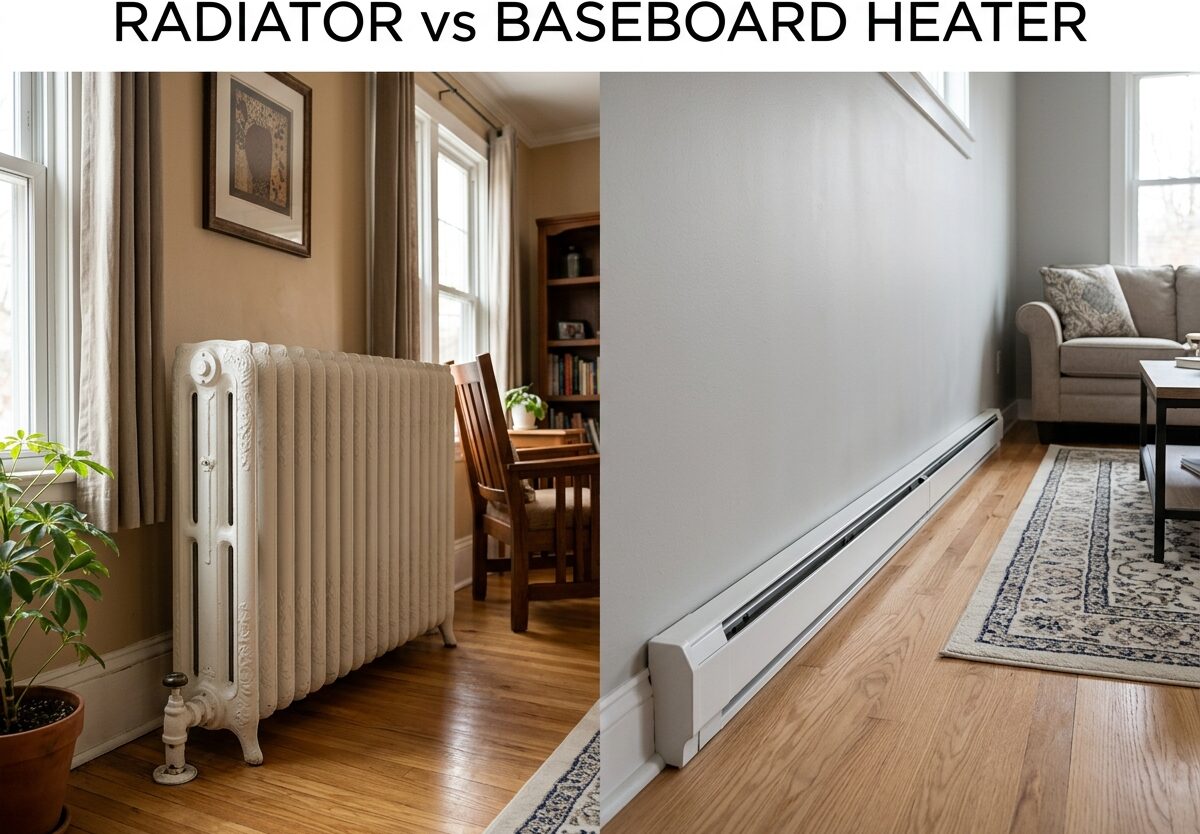
Choosing the right heating system for your home is a decision that impacts comfort, energy bills, and property value for decades. When exploring radiator vs baseboard heater options, homeowners often find themselves weighing tradition against modern convenience, efficiency against aesthetics, and upfront costs against long-term savings.
This comprehensive comparison breaks down exactly how these two hydronic heating systems work, their real-world performance differences, and which one makes sense for your specific situation. I’ve analyzed countless heating installations and homeowner experiences to give you practical insights beyond the technical specs.
Whether you’re building new, renovating an older home, or just trying to understand what’s behind your walls, understanding the radiator vs baseboard heater debate will help you make informed decisions about your home heating system.
What Are Radiators and How Do They Work?
Radiators have been heating homes since the Victorian era, and their basic principle remains remarkably unchanged. These heating units connect to a boiler that heats water until it becomes steam or reaches high temperatures, then circulates it through metal units that release warmth into your living space.
The term “radiator” is actually somewhat misleading. While these units do emit some radiant heat that warms objects and people directly, they primarily heat your room through convection. As air contacts the hot metal surface, it warms, rises, and creates a natural circulation pattern that distributes warmth throughout the space.
Steam radiators operate as one-pipe or two-pipe systems. In one-pipe systems, steam rises into the radiator, condenses back into water, and flows back down the same pipe. Two-pipe systems use separate pipes for steam delivery and water return, improving efficiency. You’ll recognize steam radiators by their distinctive air vents that hiss during operation.
Hot water radiators, also called hydronic radiators, circulate heated water rather than steam. These systems operate at lower temperatures than steam systems and provide more consistent, controllable heat. Modern versions include sleek panel radiators that offer contemporary aesthetics while maintaining the heating benefits of traditional designs.
Cast iron radiators, common in older homes, provide exceptional heat retention due to their thermal mass. They continue releasing warmth even after the boiler stops firing, creating stable temperatures. However, their slow response time means they take longer to heat up when you adjust your thermostat.
Key Radiator Characteristics
Radiant heating capacity depends heavily on surface area and material. A typical cast iron radiator might measure 24 inches wide, 8 inches deep, and 40 inches tall, yet output 8,000-12,000 BTUs per hour. This substantial heating capacity allows fewer units to heat larger spaces compared to baseboard alternatives.
The vertical orientation of radiators makes them ideal for rooms with limited wall length. They can be positioned under windows (where they counteract downdrafts), in corners, or along shorter wall sections that wouldn’t accommodate baseboard heating. This flexibility allows furniture placement against more walls without blocking heat distribution.
Modern radiator designs have evolved significantly. While classic column-style units remain popular for period homes, contemporary options include sleek panel radiators, towel warmers for bathrooms, and even designer radiators that serve as artistic elements. These modern versions often feature convector fins behind panels to boost output while maintaining slim profiles.
What Are Baseboard Heaters and How Do They Work?
Baseboard heaters emerged as a more streamlined alternative to traditional radiators, gaining popularity in mid-century American homes. These units run along the bottom of walls, typically covered by metal enclosures that protect heating elements while allowing air circulation.
Hydronic baseboard heaters connect to your boiler system and circulate hot water through copper pipes fitted with aluminum fins. These fins dramatically increase the surface area for heat transfer. As air enters through slots in the bottom of the unit, it warms as it passes over the fins and rises out the top, creating a continuous convection current that distributes warmth evenly along exterior walls.
Electric baseboard heaters operate independently of boiler systems, using heating elements powered by electricity. While easier and cheaper to install, electric units typically cost two to three times more to operate than hydronic versions in most regions. They’re often used in room additions, basements, or homes without existing boiler systems.
The genius of baseboard design lies in its positioning. By installing heating elements along exterior walls, typically under windows, baseboard heaters create a thermal curtain that counteracts cold air infiltration and drafts. This strategic placement results in more even temperatures and eliminates cold spots near windows and exterior walls.
Fin-tube baseboard, the most common hydronic style, consists of copper tubing with aluminum fins enclosed in a metal housing. The fins increase heat transfer efficiency by up to 80% compared to bare pipes. This design allows baseboard systems to operate at lower water temperatures than radiators while providing equivalent heat output.
Baseboard Heater Variations
Cast iron baseboard represents a compromise between traditional radiators and fin-tube baseboard. These units offer the thermal mass benefits of cast iron with the low-profile appearance of baseboard heating. They’re more expensive than fin-tube versions but provide more consistent heat and faster response times than standard baseboards.
Baseboard convectors, similar to standard units but without enclosures, expose the fins directly. This increases efficiency slightly but creates aesthetic and safety concerns. You’ll typically find these in commercial applications or utility areas where appearance matters less than performance.
The modular nature of baseboard heating allows precise sizing. Each 3-foot section typically outputs 500-700 BTUs, depending on water temperature. This enables installers to match heating capacity exactly to room heat loss calculations, eliminating oversized units that short-cycle or undersized units that struggle to maintain temperature.
Radiator vs Baseboard Heater: Key Differences at a Glance
Understanding the fundamental differences between these systems helps clarify which better suits your needs. Let me break down the essential distinctions:
Heat transfer method represents the most significant difference. Radiators emit roughly 60% radiant heat and 40% convective heat, warming objects and people directly through infrared radiation. Baseboard heaters rely almost entirely on convection, warming air that then circulates throughout the room. This difference affects both comfort perception and heat distribution patterns.
Space requirements favor baseboards for wall-hung furniture placement. Radiators project 6-12 inches into the room, while baseboard enclosures extend only 3-4 inches. However, radiators occupy vertical space and can be positioned in shorter wall sections unavailable to continuous baseboard runs.
Response time differs significantly between the systems. Fin-tube baseboards respond quickly to thermostat changes, typically reaching output within 5-10 minutes. Cast iron radiators may require 30-60 minutes to fully heat up but continue releasing warmth long after the boiler cycles off. This creates different comfort profiles and affects how you’ll use programmable thermostats.
Installation costs typically favor baseboards for new construction. The materials cost less, and installation requires less labor. Radiator systems, especially those with cast iron units, cost 30-50% more to install but often prove more durable and add character to older homes.
Efficiency comparisons reveal nuanced differences. Modern radiators with convector fins can operate at lower water temperatures than baseboards while providing equivalent output. This allows condensing boilers to operate more efficiently. However, baseboards positioned under windows reduce heat loss more effectively, potentially improving overall system efficiency in poorly insulated homes.
Efficiency Analysis: Energy Consumption and Operating Costs
Efficiency means different things in heating contexts. Fuel efficiency measures how completely your boiler converts fuel to heat. Distribution efficiency measures how effectively that heat reaches your living space. And operating efficiency considers real-world factors like response time, heat retention, and control precision.
Modern hot water radiators with convector fins offer excellent distribution efficiency. Their large surface area allows them to extract more heat from the water before it returns to the boiler. This cooler return temperature lets condensing boilers operate at peak efficiency, potentially reducing fuel consumption by 10-15% compared to systems with higher return temperatures.
Baseboard heaters, particularly fin-tube versions, require higher water temperatures to achieve equivalent output. This means your boiler operates at higher temperatures, reducing condensing efficiency. However, baseboards’ strategic placement under windows reduces heat loss, which can offset this disadvantage in leaky homes or those with extensive glazing.
Real-world operating costs depend heavily on your fuel source and local rates. In the Northeast where natural gas costs $1.50-2.00 per therm, a typical 2,000-square-foot home might spend $1,200-1,800 annually on hydronic heating with either system. Electric baseboards in the same home could cost $3,000-4,500 annually, depending on insulation and climate.
Heat retention creates significant efficiency differences. Cast iron radiators continue emitting warmth for 30-60 minutes after the boiler cycles off, maintaining temperatures without additional fuel input. Fin-tube baseboards cool within minutes, requiring more frequent boiler cycling. This thermal mass advantage allows radiator systems to maintain comfort with fewer heating cycles.
Zone control efficiency favors baseboards in open floor plans. Because baseboard heating runs continuously along walls, it creates more uniform temperatures across large spaces. Radiators create localized heat patterns that work well in smaller rooms but may require more zones for equivalent comfort in open-concept homes.
Smart thermostat integration affects real-world efficiency. Both systems work with programmable and smart thermostats, but their different response times require different programming strategies. Baseboards respond quickly to setbacks, allowing aggressive temperature reductions at night or during away periods. Radiators’ slower response requires more moderate setbacks to maintain comfort while still saving energy.
Annual Operating Cost Comparison
For a typical 2,000-square-foot home in a cold climate (6,000 heating degree days), annual operating costs might look like this:
Steam radiator systems typically operate at 70-80% efficiency due to higher boiler temperatures and heat losses in steam piping. Expect annual fuel costs of $1,500-2,200 with natural gas or $2,800-4,000 with oil.
Hot water radiator systems achieve 80-85% efficiency with conventional boilers and 90-95% with condensing models. Annual costs range from $1,200-1,800 with natural gas or $2,200-3,500 with oil.
Hydronic baseboard systems operate at similar efficiency to hot water radiators but may cost slightly more to run due to higher water temperature requirements. Expect $1,300-1,900 annually with natural gas or $2,400-3,600 with oil.
Electric baseboard systems face higher operating costs due to electricity rates. Assuming $0.14/kWh, annual costs range from $3,500-5,000 for equivalent heating capacity. However, they can be efficient when used for zone heating of frequently occupied rooms while keeping other spaces cooler.
Comfort Comparison: Radiant vs Convection Heat
Comfort extends beyond simple temperature readings. It involves heat distribution, air movement, humidity levels, and temperature stability. The fundamental difference between radiator and baseboard comfort lies in their heat transfer methods.
Radiant heat from radiators warms objects and people directly, similar to how sunlight feels warm on your skin even when air temperature is cool. This creates a comfort sensation at lower air temperatures. Studies show people feel equally comfortable at 65-66°F with radiant heating compared to 70-72°F with forced-air systems, potentially allowing thermostat setbacks of 4-6°F.
The mean radiant temperature—the average temperature of all surfaces in a room—significantly affects comfort perception. Radiators increase surface temperatures throughout the space, creating a more uniform thermal environment. Baseboard heaters primarily warm air, which can create temperature differences between walls, windows, and interior surfaces.
Air quality differences emerge between the systems. Radiators produce minimal air movement, reducing dust circulation and allergen distribution. Baseboard heaters create constant convective currents that stir up dust and allergens. For sensitive individuals, this difference can significantly affect respiratory comfort and indoor air quality.
Temperature stability varies considerably. Cast iron radiators provide exceptionally stable temperatures due to their thermal mass. They heat slowly but maintain consistent warmth with minimal fluctuations. Fin-tube baseboards respond quickly but can create temperature swings as they cycle on and off, particularly with short heating cycles.
Humidity levels affect comfort differently with each system. Steam radiators can dry indoor air significantly due to their high operating temperatures and occasional venting of steam. Hot water radiators and baseboards operate at lower temperatures, causing less drying. However, both hydronic systems dry air less than forced-air systems, which constantly introduce fresh dry air.
Comfort in rooms with high ceilings or poor insulation favors radiators. The radiant component of radiator heat directly warms occupants regardless of air stratification. Baseboard heaters rely on convection currents that may not reach the occupied zone effectively in rooms with vaulted ceilings or significant heat loss.
Real-World Comfort Experiences
Homeowner experiences consistently reveal comfort preferences. Many report that radiator heat feels “deeper” and more penetrating, warming them through even when air temperature seems cool. Baseboard heat often feels more superficial—warm air surrounds you, but the warmth feels less substantial.
Forum discussions and homeowner surveys show that people who’ve lived with both systems typically prefer radiator comfort by a 2:1 margin. However, the same people often choose baseboards for renovations due to furniture placement flexibility and modern aesthetics, accepting slight comfort trade-offs.
Interior designers and architects often note that baseboard heating disappears into room design, while radiators become focal points. This aesthetic consideration drives many decisions despite comfort differences. However, modern radiator designs have narrowed this gap significantly.
Installation Costs and Practical Considerations
Installation costs vary dramatically based on whether you’re building new, renovating existing systems, or adding supplemental heating. Understanding these costs helps budget realistically and avoid expensive surprises.
New construction typically costs $8-12 per square foot for complete hydronic system installation, including boiler, piping, and heat emitters. Baseboard systems usually cost 15-20% less than radiator equivalents due to lower material costs and faster installation. For a 2,000-square-foot home, expect $16,000-24,000 total, with baseboards at the lower end and radiators at the upper end.
Retrofitting existing structures costs 30-50% more than new construction due to demolition and repair work. Converting from steam radiators to hot water baseboards might cost $25,000-35,000 for a typical home, while adding radiators to an existing baseboard system could cost $15,000-25,000 depending on piping accessibility.
Electric baseboard installation costs significantly less for retrofits—typically $3-5 per square foot including wiring and units. This makes electric baseboards attractive for additions, basements, or homes without existing boiler systems. However, operating costs quickly offset installation savings in most climates.
Space requirements affect practicality. Baseboards require continuous wall space along exterior walls—typically 8-12 linear feet per 100 square feet of floor area. This limits furniture placement and window treatment options. Radiators need less total wall length but project further into rooms, potentially blocking pathways or furniture arrangement.
Flooring considerations differ significantly. Baseboard heaters typically require removal and replacement of baseboard trim, affecting flooring installation at room perimeters. Radiators don’t impact flooring directly but may require floor protection underneath heavy units, and plumbing connections often penetrate finished flooring.
Boiler requirements vary between systems. Radiators, particularly cast iron units, work well with both conventional and condensing boilers. Their large surface area allows efficient heat transfer at lower water temperatures. Baseboards typically require higher water temperatures for adequate output, reducing condensing boiler efficiency unless oversized appropriately.
Installation Timeline Comparison
New construction installation typically requires 2-3 weeks for complete hydronic system installation. Baseboard systems usually install 20-30% faster due to simpler piping and easier handling of materials. This faster installation can reduce construction timelines and carrying costs.
Retrofitting existing homes typically requires 4-6 weeks for complete system replacement. Radiator removal often involves extensive demolition, particularly if units are embedded in walls or cabinetry. Baseboard retrofits generally proceed faster but still require careful removal of existing units and installation of new piping and emitters.
Permitting requirements vary by jurisdiction but typically include mechanical permits for boiler work and plumbing permits for piping modifications. Historic districts may have additional restrictions on radiator modifications, requiring approval before altering or removing original heating elements.
Maintenance Requirements and System Longevity
Both radiator and baseboard systems require minimal maintenance compared to forced-air alternatives, but their needs differ. Understanding maintenance requirements helps prevent problems and extend system life.
Annual maintenance for both systems should include boiler inspection and servicing by qualified technicians. This typically costs $150-300 annually and ensures safe, efficient operation. Beyond boiler maintenance, radiator and baseboard systems have different ongoing needs.
Radiator maintenance includes periodic air bleeding to remove trapped air that reduces heating efficiency. This simple task takes 5-10 minutes per radiator annually but significantly improves performance. Steam radiators require replacement of air vents every 5-10 years ($15-25 each) and occasional cleaning of steam vents if they become clogged.
Baseboard maintenance primarily involves vacuuming dust and debris from fin tubes to maintain heat transfer efficiency. This should be done annually before heating season. Fin tubes can become damaged if furniture or vacuum cleaners bend the delicate aluminum fins, reducing output by 20-30% in affected sections.
System longevity significantly affects lifecycle costs. Cast iron radiators routinely last 50-100 years with minimal maintenance. Many homes still feature original radiators from the early 1900s. Copper fin-tube baseboards typically last 25-40 years, though aluminum fins may corrode faster in humid environments or with certain water chemistries.
Repair accessibility favors baseboards in most situations. Individual sections can be replaced without affecting the entire loop, and components are readily available at home improvement stores. Radiator repairs, particularly on steam systems, may require specialized parts and knowledge not available from all HVAC contractors.
Water treatment affects both systems differently. Open systems like steam radiators constantly introduce fresh water and oxygen, accelerating corrosion. Closed hydronic systems circulate the same water for years, requiring proper chemical treatment to prevent corrosion and scale buildup. Neglected water treatment can reduce both radiator and baseboard system life by 30-50%.
Which Heating System Is Right for Your Home?
Choosing between radiators and baseboards depends on your specific circumstances, priorities, and constraints. Let’s break down which system makes sense in different scenarios.
Older homes with existing radiators generally benefit from keeping them rather than converting to baseboard. Original radiators add historical authenticity, offer superior comfort, and have already proven their durability. Modern upgrades like thermostatic radiator valves can improve control without replacing the entire system. Only consider conversion if existing units are beyond repair or significantly oversized for the home’s current heating load.
New construction offers flexibility to choose either system. If you value maximum furniture placement flexibility and minimalist aesthetics, baseboards make sense. If you prioritize heating comfort and don’t mind planning furniture around heat emitters, radiators provide superior performance. Panel radiators offer a modern compromise with better aesthetics than traditional radiators.
Room additions and renovations present different considerations. Electric baseboards often make sense for small additions where extending the existing boiler system would be prohibitively expensive. For larger additions, extending hydronic systems usually proves more cost-effective in the long run. Match the emitter type to your existing system for consistency, or use panel radiators in the addition for a modern look.
High-ceilinged rooms and great rooms favor radiators. The radiant component directly warms occupants regardless of air stratification, while baseboard convection currents may not effectively reach the occupied zone. Consider taller radiators or multiple units for large spaces with vaulted ceilings.
Historically sensitive homes should retain original radiators rather than converting to baseboards. Original heating elements contribute to historical integrity, and removal may violate local preservation ordinances. If radiators must be replaced, choose reproductions that match the original style rather than switching to baseboards.
Climate affects the optimal choice. In cold climates with long heating seasons, radiator efficiency advantages accumulate into significant savings. In milder climates where heating runs intermittently, baseboards’ faster response may prove more advantageous. For vacation homes occupied irregularly, baseboards provide quick warm-up upon arrival.
Future flexibility considerations should factor into your decision. Baseboards make future room rearrangements easier since they don’t dominate wall space. However, radiators can be relocated if needed, though at greater expense. Consider your long-term plans for the space when choosing between systems.
Modern Innovations and Smart Home Integration
Heating technology has evolved significantly since these systems first appeared, and modern innovations affect the radiator vs baseboard decision. Understanding these advancements helps future-proof your investment.
Smart thermostats work with both radiator and baseboard systems, but implementation differs. For hydronic systems, the smart thermostat typically controls the boiler and zone valves rather than individual emitters. Ecobee, Nest, and Honeywell smart thermostats all support hydronic systems, but you must select the appropriate configuration during setup. Electric baseboards require line-voltage thermostats with smart capabilities, such as Mysa or Stelpro units.
Thermostatic radiator valves (TRVs) represent a significant advancement for radiator systems. These valves automatically regulate individual radiator output based on room temperature, allowing zone control at the room level rather than just house-level control. Smart TRVs like those from Danfoss or Honeywell can be programmed via smartphone and learn your schedule, providing precise comfort control without complex zoning.
Condensing boiler technology has changed the efficiency equation. These boilers achieve 90-95% efficiency by extracting heat from exhaust gases that would be wasted in conventional boilers. They work most efficiently with low return water temperatures. Modern panel radiators and oversized baseboards can operate at these lower temperatures, while older systems may require modifications to achieve optimal condensing performance.
Outdoor reset controllers optimize both systems by adjusting boiler water temperature based on outdoor conditions. This simple device reduces energy consumption by 10-20% compared to fixed-temperature operation. It works particularly well with cast iron radiators that can handle temperature variations without affecting comfort.
Hydronic system options now include combination approaches. Some homeowners install radiators in primary living spaces for superior comfort while using baseboards in secondary areas like bedrooms or offices. This provides the best of both systems—maximum comfort where you spend the most time with cost-effective heating elsewhere.
Frequently Asked Questions
Is radiator heat better than baseboard heat?
Radiator heat generally provides superior comfort due to its radiant heat component, which warms objects and people directly rather than just heating air. Cast iron radiators also maintain stable temperatures longer due to their thermal mass. However, “better” depends on your priorities—baseboards offer more furniture placement flexibility and typically cost less to install. Most heating professionals consider radiators more comfortable and efficient, while baseboards offer practical advantages for certain applications.
Why don’t homes use radiators anymore?
Many homes actually do still use radiators, though modern versions look different from Victorian-era cast iron units. The perception that radiators disappeared stems from mid-century construction trends that favored forced-air systems and low-profile baseboards. However, radiators have seen renewed interest recently due to their comfort advantages, energy efficiency, and the availability of sleek panel designs. Radiators never actually went away in Europe, where they remain the standard for new construction, and they’re increasingly common in North American renovations and high-end homes.
How much does it cost to run a radiator for 1 hour?
The hourly operating cost depends on your fuel type and local rates. For natural gas systems, a typical radiator might cost $0.15-0.25 per hour to operate, based on a gas cost of $1.75 per therm and typical system efficiency. Electric radiators cost significantly more—typically $0.40-0.80 per hour depending on local electricity rates. However, these costs don’t reflect the actual energy used continuously, as radiators cycle on and off to maintain temperature. Your daily costs depend on how many hours your heating runs, which varies based on outdoor temperature, insulation, and thermostat settings.
Does Ecobee work with baseboard heaters?
Yes, Ecobee thermostats work with baseboard heaters, but the specific model and wiring depends on your system type. For electric baseboards with 120V or 240V power, you need the Ecobee3 Lite with a 24V transformer relay, as standard Ecobee units don’t handle line voltage directly. For hydronic baseboards connected to a boiler, standard Ecobee models work fine since they control the boiler rather than individual baseboard units. Installation is straightforward but requires identifying your system type and voltage before purchasing.
Can you mix radiators and baseboards on the same boiler system?
Yes, you can mix radiators and baseboards on the same hydronic system, though they must operate at compatible temperatures. Most mixing scenarios involve installing panel radiators in visible areas while using baseboards in less visible spaces. However, mixing requires careful sizing because radiators and baseboards have different heat output characteristics. Your contractor must calculate heat loss for each room and select appropriately sized emitters. Mixing steam radiators with hot water baseboards doesn’t work since they operate at different pressures and temperatures, but mixing hot water radiators with hydronic baseboards is common and effective when done correctly.
Conclusion: Making Your Radiator vs Baseboard Heater Decision
The radiator vs baseboard heater debate ultimately comes down to your specific needs, home characteristics, and priorities. Both systems offer reliable, comfortable heating when properly designed and installed—but they excel in different scenarios.
Choose radiators if you prioritize heating comfort, have an older home with existing radiators, or appreciate the aesthetic character of vintage or modern radiator designs. The radiant heat component provides superior comfort, particularly for sensitive individuals or rooms with high ceilings. Cast iron radiators offer exceptional durability and heat retention that can reduce energy costs over the system’s lifetime.
Choose baseboard heaters if you need maximum furniture placement flexibility, are building new construction with budget constraints, or prefer heating that disappears into your room design. Baseboards work particularly well in rooms with continuous exterior walls and modern open floor plans. Their faster response time also suits homes with irregular occupancy patterns or those in milder climates.
For many homeowners, the best solution involves both systems—radiators in primary living spaces where comfort matters most, and baseboards in secondary areas where cost and practicality take priority. This hybrid approach provides the benefits of both systems while minimizing their respective drawbacks.
Before making your final decision, consult with qualified HVAC contractors who can assess your specific situation, calculate heating loads accurately, and provide detailed cost estimates. The right choice balances comfort, efficiency, installation costs, and long-term operating expenses—factors that vary significantly based on your home, climate, and heating needs.
Whatever you choose, both radiator and baseboard systems offer reliable, efficient home heating when properly designed and maintained. Understanding their differences helps ensure you select the system that will keep your family comfortable for years to come.


Leave a Comment