
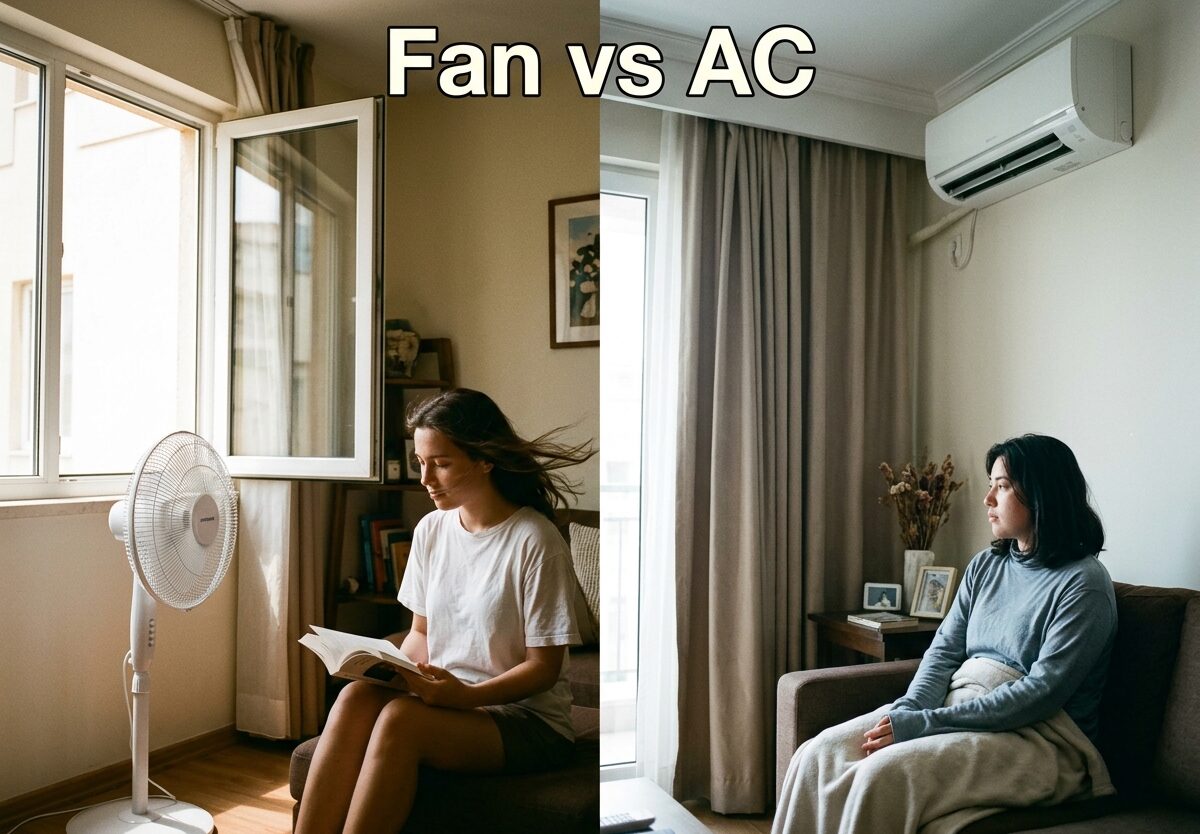
Choosing between a fan and air conditioner is one of the biggest decisions you’ll make for summer comfort. After analyzing electricity costs and cooling effectiveness across different climates, I’ve found that the choice comes down to a simple fact: fans cost around $0.01-0.02 per hour to run while air conditioners cost $0.25-1.94 per hour. That’s a difference of $20-200 per month depending on your usage patterns.
The core difference between these cooling options is fundamental. Fans move air to create a wind chill effect on your skin through evaporative cooling, but they don’t actually lower the room temperature. Air conditioners actively remove heat and humidity from indoor air, transferring it outside and genuinely cooling your living space. Understanding this difference is crucial because it affects not just your comfort but also your electricity bill.
How Ceiling Fans Work
Ceiling fans work by creating a breeze across your skin that accelerates sweat evaporation. This process is called evaporative cooling, and it’s the same reason you feel cooler when wind blows on you on a hot day. The fan doesn’t change the air temperature at all – it just makes you feel cooler by helping your body’s natural cooling system work more efficiently.
Most ceiling fans use between 30 and 100 watts of electricity depending on their size and motor type. Modern DC motor fans are significantly more efficient than traditional AC motor models, using up to 70% less energy while moving the same amount of air. This efficiency advantage makes DC fans worth the slightly higher upfront cost if you plan to run the fan frequently during summer months.
The cooling effect from a fan is entirely personal – it only cools people, not rooms. If you leave a fan running in an empty room, you’re just wasting electricity. This is why fans work best when you’re directly in the airflow path and why they’re ideal for bedrooms, home offices, and living rooms where you spend extended periods.
How Air Conditioners Work
Air conditioners work through an entirely different process called the refrigerant cycle. Your AC unit circulates refrigerant through evaporator coils inside your home, where it absorbs heat from indoor air and moisture from the humidity. The refrigerant then travels to the condenser unit outside, where it releases that absorbed heat into the outdoor air.
This process actively cools your indoor air and removes humidity as a secondary benefit. The dehumidification effect is significant in humid climates because less humid air feels more comfortable at higher temperatures. This is why 78F with AC feels more comfortable than 78F without it – the AC has removed the sticky humidity that makes heat feel oppressive.
Central air conditioning units typically use between 2000 and 5000 watts when the compressor is running, though newer high-efficiency models with better SEER ratings use significantly less energy. Window units and portable ACs use less power (500-1500 watts) but cool smaller spaces. The compressor cycles on and off to maintain your thermostat setting, so your AC isn’t running at full power continuously.
Fan vs AC: Energy Cost Comparison
The cost difference between running a fan versus an air conditioner is substantial. Based on average electricity rates of $0.14 per kilowatt-hour, a ceiling fan running 8 hours a day costs approximately $3-4 per month. A central air conditioner running the same hours costs $60-180 per month depending on its efficiency, size, and how hard it needs to work.
Here’s the breakdown: a typical 75-watt ceiling fan costs $0.01 per hour to operate. A 3-ton central AC unit uses about 3500 watts, costing $0.49 per hour. Even a smaller window AC at 1000 watts costs $0.14 per hour. Over a 30-day month running 8 hours daily, that’s $3.60 for the fan versus $42-117 for AC depending on the unit size.
The $5000 rule is a helpful guideline used by HVAC professionals. It states that if you spend more than $5000 per year on cooling costs in a hot climate, investing in a higher-SEER rating AC unit will pay for itself within 5-7 years through energy savings. This rule makes the most sense in regions with long cooling seasons where your AC runs frequently.
Your actual costs will vary based on local electricity rates, how well your home is insulated, and your thermostat settings. Every degree you raise your thermostat setting saves approximately 3-5% on cooling costs, which is why combining AC with fans is so effective – you can set the thermostat higher and still feel comfortable.
Fan vs AC: Pros and Cons Comparison
Fans offer several significant advantages beyond just low operating costs. They’re portable (except ceiling models), require no professional installation, and make minimal noise compared to air conditioners. Fans work during power outages if you have battery backup or a generator. They also don’t dry out the air or your sinuses, which matters for people with respiratory concerns.
The main limitation of fans is that they become ineffective above 95F. At high temperatures, fans just move hot air around without providing meaningful cooling relief. In humid conditions, the evaporative cooling effect is also reduced because your sweat can’t evaporate as easily. Fans also don’t improve air quality or filter allergens like many AC systems do.
Air conditioners provide genuine cooling regardless of outdoor temperature and remove humidity that makes heat feel worse. Modern units include air filtration that removes dust, pollen, and allergens from indoor air. AC allows you to close windows and doors, which keeps insects out and provides security. The consistent temperature control also protects electronics and furniture from heat damage.
The downsides of air conditioning are primarily cost and maintenance. AC requires professional installation for central systems and regular maintenance like filter changes and coil cleaning. The initial investment ranges from $500 for window units to $10,000+ for central systems. Operating costs are 10-50 times higher than fans depending on your climate and usage patterns.
When to Use Fan vs AC
For temperatures below 80F, a fan alone is usually sufficient for comfort. At these moderate temperatures, the evaporative cooling effect from airflow keeps most people comfortable without air conditioning. This is typical of spring and fall weather in many regions, or summer mornings and evenings when temperatures naturally drop.
Between 80F and 95F, the choice depends largely on humidity levels. In dry climates, fans remain effective even at the upper end of this range because sweat evaporates readily. In humid climates, the same temperatures feel much worse because humidity prevents evaporative cooling, making AC more necessary. The dew point matters more than just the temperature – anything above 65F dew point feels sticky and uncomfortable without AC.
Above 95F, air conditioning becomes necessary for most people’s comfort and health. Fans simply can’t provide meaningful relief at extreme temperatures because they’re just moving hot air around. Elderly individuals, young children, and people with health conditions are especially vulnerable to heat-related illness at these temperatures and should have access to air conditioning.
Your home’s design also affects which cooling method works best. Well-insulated homes with good shading retain cool air better, making AC more effective. Homes with poor insulation or lots of sun exposure may struggle to stay cool even with AC running constantly. In these cases, addressing insulation and shading issues can dramatically improve cooling efficiency regardless of which method you choose.
Using Fan and AC Together for Maximum Efficiency
The most cost-effective cooling strategy for many households combines both fans and air conditioning. By setting your thermostat to 78-80F instead of 72F and using ceiling fans to create a cooling breeze, you can feel just as comfortable while using significantly less energy. Each degree you raise your thermostat saves approximately 3-5% on cooling costs.
This combined approach works because the wind chill effect from fans makes you feel 4-6F cooler than the actual room temperature. So a room at 80F with a fan running feels approximately the same as a room at 74F without a fan. This temperature increase means your AC runs less frequently and for shorter cycles, which reduces both energy consumption and wear on the equipment.
For best results, run ceiling fans only in rooms you’re currently occupying and turn them off when you leave. The fan cools people, not rooms, so running it in an empty room wastes electricity. Set your AC fan to “auto” rather than “on” – this runs the blower only when cooling is needed rather than continuously, which saves energy and reduces humidity problems.
Strategic fan placement also matters. In summer, ceiling fans should rotate counterclockwise to push air down and create the wind chill effect. Portable fans should be positioned to blow air toward where you’ll be sitting or sleeping, rather than trying to cool the entire room. This targeted approach maximizes comfort while minimizing energy waste.
Health Considerations: Fan vs AC
Air conditioning can affect respiratory health in several ways that are rarely discussed. The dehumidification effect of AC removes moisture from indoor air, which can dry out sinuses and throat tissues. This dryness may aggravate bronchitis, asthma, and sinus conditions for some individuals. Using a humidifier alongside AC or setting the thermostat a bit higher can help mitigate these effects.
For babies and young children, fans are generally considered safer than air conditioning. Pediatricians often recommend fan use over AC in nurseries because fans don’t create temperature extremes and don’t dry the air as severely. The steady airflow from a fan also reduces the risk of sudden infant death syndrome (SIDS) by providing consistent air circulation around the sleeping infant.
Air conditioning does offer some health benefits that fans cannot provide. AC filters remove allergens, dust, and pollution from indoor air, which helps people with allergies and respiratory conditions. The controlled temperature also protects against heat exhaustion and heat stroke during extreme weather events. For elderly individuals and those with certain medical conditions, access to air conditioning can be literally life-threatening during heat waves.
The 3-minute rule for AC suggests that you should wait at least 3 minutes before restarting your air conditioner after it turns off. This allows the pressure in the refrigerant system to equalize, which prevents compressor damage. Following this rule extends the life of your AC unit and avoids expensive repair bills.
Fan vs AC: Which Is Better?
The answer to whether fans or air conditioners are better depends entirely on your situation. For dry climates under 90F, fans alone provide adequate comfort at a fraction of the cost. In humid regions or during extreme heat waves, air conditioning becomes necessary for both comfort and health reasons. Most households find that a combination approach offers the best balance of comfort and cost efficiency.
If electricity costs are your primary concern and you live in a moderate climate, investing in high-quality ceiling fans for your most-used rooms makes the most financial sense. You can add window AC units for the few hottest days of the year and still spend less than running central AC continuously. This strategy works particularly well in homes with good natural ventilation and shading.
For households in hot, humid climates or with family members who have health conditions affected by heat, central air conditioning is worth the investment. The upfront cost is higher, but the consistent comfort, air filtration, and humidity control provide real quality of life improvements. You can still use fans alongside your AC to reduce operating costs by raising the thermostat a few degrees.
Whatever option you choose, understanding how each cooling method works helps you use it more efficiently. Fans cool people through evaporative cooling, while AC cools and dehumidifies indoor air. The right choice depends on your climate, budget, health needs, and how you use your living spaces throughout the day.
FAQs
What is the $5000 rule for AC?
The $5000 rule states that if you spend more than $5000 annually on cooling costs in a hot climate, upgrading to a higher SEER-rated AC unit will pay for itself through energy savings within 5-7 years. This guideline helps homeowners decide whether investing in a more efficient system makes financial sense.
Is it better to run a fan or AC?
Fans cost 10-50 times less to run than air conditioning and work well for temperatures under 90F, especially in dry climates. However, AC is necessary for genuine cooling above 95F or in humid conditions. The most efficient approach combines both: set AC to 78-80F and use fans to feel cooler.
Is AC harmful for bronchitis?
AC can aggravate bronchitis for some people because it removes humidity from indoor air, which may dry out airways and irritate respiratory tissues. Using a humidifier alongside AC or keeping the thermostat set higher (78-80F) helps reduce this drying effect while still providing cooling benefits.
What is the 3 minute rule for AC?
The 3-minute rule means waiting at least 3 minutes after your AC turns off before restarting it. This allows refrigerant pressures to equalize throughout the system, preventing compressor damage that can occur from starting against high pressure. Following this rule extends your AC’s lifespan and prevents costly repairs.
Does AC dry out your sinuses?
Yes, air conditioning removes moisture from indoor air as part of the cooling process, which can dry out nasal passages and sinuses. This dryness may cause discomfort for people with sinus issues. Using a humidifier, staying hydrated, and not overcooling your space helps reduce sinus dryness while running AC.
Is AC good for BP patients?
Air conditioning can benefit blood pressure patients by preventing heat stress during hot weather, which can cause dangerous BP spikes. However, extremely cold AC temperatures may constrict blood vessels. The ideal approach is setting AC to a moderate temperature (75-78F) rather than very cold settings to maintain comfort without extreme temperature changes.
Conclusion
Fan vs AC comparisons ultimately come down to your specific circumstances. The $20-200 monthly cost difference is significant, but so is the comfort difference during extreme heat. By understanding how each cooling method works and using them strategically based on temperature and humidity, you can stay comfortable while keeping energy costs manageable. The best solution for most homes isn’t choosing between fan or AC – it’s using both intelligently to maximize comfort while minimizing electricity consumption.




Leave a Comment