
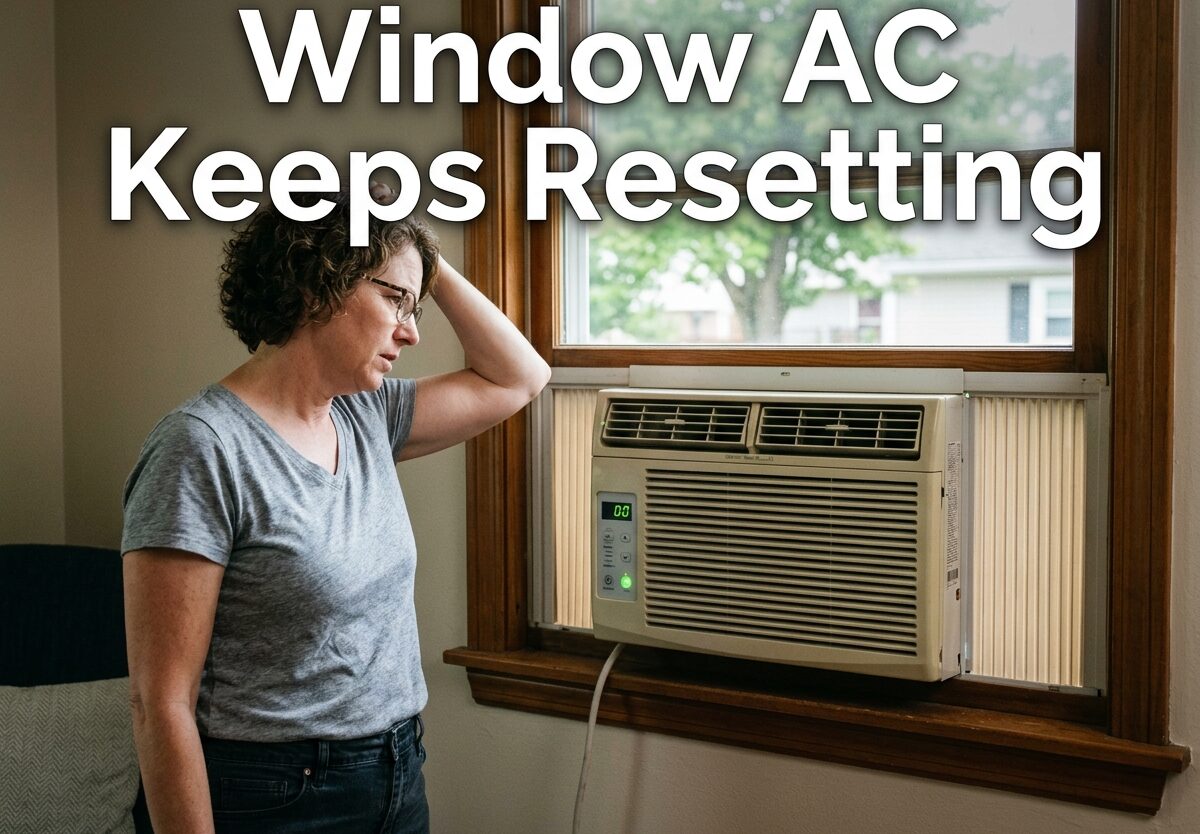
When your Window AC keeps resetting, it’s experiencing a problem known as “short cycling” – the frustrating issue where your air conditioner turns on and off repeatedly without completing a full cooling cycle. Instead of running for 15-20 minutes like normal, your unit shuts down after just 2-5 minutes and restarts shortly after.
This constant resetting does more than make your home uncomfortable. It drives up energy bills, causes uneven cooling throughout your room, and can lead to permanent compressor damage if left untreated. The average homeowner dealing with a Window AC that keeps resetting might see their summer cooling costs increase by 20-30%.
I’ve seen this issue affect every major window AC brand, from GE and Frigidaire to LG and Midea. Understanding why your Window AC keeps resetting is the first step toward fixing it and restoring comfortable, efficient cooling to your home.
What is Window AC Short Cycling?
Short cycling occurs when your window air conditioner repeatedly turns off before completing a full cooling cycle. A normal AC cycle runs for 15-20 minutes to properly cool your space and dehumidify the air. When short cycling happens, the compressor shuts down after just 2-5 minutes of operation.
The difference between normal cycling and a Window AC that keeps resetting comes down to timing and frequency. Normal cycling happens 2-3 times per hour. Short cycling can happen 6-10 times per hour, with the unit never reaching its intended cooling capacity.
This constant on-off pattern puts excessive wear on your compressor, which is the most expensive component in your window AC unit. Compressors are designed to run for longer periods, not to start and stop frequently. Each startup creates electrical stress and mechanical wear that can shorten your unit’s lifespan by years.
6 Common Causes Why Your Window AC Keeps Resetting
1. Dirty or Clogged Air Filter
The most common reason a Window AC keeps resetting is also the easiest to fix. A dirty air filter restricts airflow, causing the evaporator coils to get too cold and freeze up. When ice forms on the coils, your AC’s safety sensor detects the problem and shuts down the compressor to prevent damage.
Your window AC air filter should be cleaned every 2-4 weeks during heavy use. A filter that looks gray or dusty is already restricting airflow. Some homeowners report their unit working fine for 30 minutes before shutting down – this is the classic symptom of a dirty filter causing frozen coils.
Simply washing or replacing the filter can fix this issue within hours. I recommend checking your filter first before moving to more complex troubleshooting steps.
2. Low Refrigerant or Refrigerant Leak
Low refrigerant levels cause your Window AC to keep resetting because the system can’t maintain proper pressure. When refrigerant is low, the evaporator coil temperature drops rapidly, triggering the freeze limit safety switch. Your unit shuts down to protect the compressor from damage.
Refrigerant leaks develop over time due to vibration, corrosion, or factory defects. Window AC units are sealed systems, so low refrigerant always means there’s a leak that needs repair. Simply adding more refrigerant without fixing the leak is a temporary solution at best.
Signs of low refrigerant include reduced cooling capacity, ice forming on the refrigerant lines, and the unit running continuously without reaching your set temperature. This issue requires professional repair – handling refrigerant requires EPA certification.
3. Frozen Evaporator Coils
Frozen evaporator coils are both a symptom and a cause of why your Window AC keeps resetting. When airflow is restricted (usually from a dirty filter) or refrigerant is low, the coils get too cold and ice forms. This ice further blocks airflow, creating a vicious cycle.
You can identify frozen coils by looking through your unit’s vents – you might see white frost or ice on the cooling fins. Another telltale sign is water leaking inside your home when the ice melts during the off cycle.
To fix frozen coils, turn off your Window AC and let it thaw completely. This usually takes 2-4 hours. Once thawed, clean or replace your air filter and check for other airflow restrictions. If coils freeze again after cleaning, you likely have a refrigerant issue requiring professional service.
4. Thermostat Location and Calibration Issues
Your Window AC’s thermostat location directly affects whether it keeps resetting. If the thermostat is positioned too close to the cold air output, it will think the room is cooler than it actually is. This causes the unit to shut down prematurely before the rest of the room reaches your target temperature.
Some window AC units have the thermostat built into the control panel, while others use a remote sensor. If your thermostat reads the temperature at the AC unit itself rather than the room’s center, you’ll experience short cycling.
Calibration issues can also cause problems. Over time, thermostats can become inaccurate, reading temperatures 3-5 degrees off from actual room conditions. Testing your thermostat with a separate thermometer can reveal if calibration is the culprit.
5. Oversized AC Unit for Your Room
An oversized window AC unit will keep resetting because it cools the space too quickly. When an AC is too powerful for your room size, it reaches the thermostat setpoint rapidly and shuts down before properly dehumidifying the air. This creates a cycle of rapid cooling followed by quick warming.
The ideal window AC should run for 15-20 minute cycles to effectively remove humidity. An oversized unit might only run for 5 minutes before the thermostat signals it to stop. This “cold clammy” feeling results from cooling without dehumidification.
Room size matters significantly. A 12,000 BTU unit designed for 550-650 square feet will short cycle in a 200 square foot room. Matching BTU capacity to your room size prevents this issue, but you can’t easily fix an oversized unit other than replacing it with a properly sized model.
6. Electrical Issues or Control Board Problems
Electrical problems cause random resetting that doesn’t follow any pattern. Faulty capacitors, corroded connections, or failing control boards can send incorrect signals to your compressor, causing it to shut down unexpectedly. Unlike other causes, electrical issues often happen randomly rather than on a consistent cycle.
Capacitors are electrical components that help start your compressor. When they fail, the compressor might start but then shut down seconds later. A failing capacitor can cause your Window AC to keep resetting every few minutes with no other symptoms.
Control board corrosion is common in older units or those exposed to high humidity. Moisture damage can cause random electrical signals that trigger safety shut-offs. These issues typically require professional diagnosis and replacement of faulty components.
Step-by-Step Troubleshooting Guide
Step 1: Check and Replace Air Filter
Start with the simplest fix first. Remove your window AC’s front panel to access the air filter. Hold it up to light – if you can’t see through it clearly, it’s restricting airflow and needs cleaning or replacement.
Washable filters should be cleaned with warm water and mild soap, then completely dried before reinstalling. Disposable filters are inexpensive and should be replaced every 1-3 months during cooling season. Many users report their Window AC keeps resetting issue resolved immediately after filter maintenance.
Step 2: Inspect for Frozen Coils
Look through your unit’s vents for any white frost or ice on the cooling coils. If you see ice, turn off the unit immediately and let it thaw completely. Running the AC with frozen coils can cause permanent compressor damage.
While thawing, check your air filter and clean any debris from the outdoor vents. After the ice melts (typically 2-4 hours), restart the unit and monitor whether it runs a full cycle. If coils freeze again within a few hours, you likely have a refrigerant leak requiring professional service.
Step 3: Verify Thermostat Placement
Check where your unit’s thermostat sensor is located. If it’s directly in the path of cold air output, it will read incorrectly. Some units allow thermostat adjustment – consult your manual for repositioning instructions.
Test your thermostat’s accuracy by placing a separate thermometer near your unit. If readings differ by more than 2 degrees, your thermostat may need recalibration or replacement. Thermostats that read warmer than actual room temperature will cause your Window AC to keep resetting prematurely.
Step 4: Check Electrical Connections
Inspect your unit’s power cord for any damage or fraying. Check that the outlet is providing consistent power by testing it with another device. Loose electrical connections can cause intermittent power loss that mimics resetting behavior.
Listen for clicking sounds when your unit starts and stops. Rapid clicking often indicates capacitor problems. Electrical diagnosis requires a multimeter and some technical knowledge – if you’re uncomfortable working with electricity, this is the time to call a professional.
Step 5: Test Reset Button Functionality
Many window AC units have a reset button on the power cord or control panel. Press this button and wait 5 minutes before restarting your unit. The reset button clears electrical faults and recalibrates the control board.
If your Window AC keeps resetting immediately after using the reset button, the problem isn’t a simple electrical fault. The reset button is designed to fix temporary issues – persistent problems indicate a deeper mechanical or electrical issue.
Step 6: When to Call a Professional
Call a licensed HVAC technician if you’ve completed the above steps and your Window AC still keeps resetting. Professional service is necessary for refrigerant leaks, compressor replacement, and control board repairs.
Warning signs that require professional help include: refrigerant lines that are visibly damaged or leaking oil, burning smells when the unit runs, the compressor making unusual grinding or squealing noises, or the unit tripping your home’s circuit breaker. These symptoms indicate serious problems that DIY fixes can’t resolve.
Window AC Reset Button Location Guide
Finding your reset button depends on your window AC brand and model. GE, Frigidaire, and LG units typically place the reset button on the power cord plug – it’s a small circular button between the plug blades. Press it with a pen or paperclip until it clicks.
Frigidaire window AC models often have the reset button on the control panel itself, labeled “Reset” or sometimes hidden behind a small hole. Check your owner’s manual for the exact location on your specific model.
Toshiba, Midea, and Arctic King window units vary by model year. Newer models (2026 and later) often have reset buttons integrated into the digital display. Older models may have a physical reset button on the side panel near the power cord connection.
If your Window AC keeps resetting and you can’t find a reset button, your model might not have one. Many basic window AC units rely on the circuit breaker as the only reset mechanism. In this case, focus on troubleshooting the underlying causes rather than relying on a reset button fix.
The reset button itself can sometimes be faulty. If pressing the reset button doesn’t change anything, or if your unit resets immediately after using it, the problem isn’t with the reset function – it’s with one of the components the reset button is supposed to protect.
Preventive Maintenance Tips
Regular maintenance prevents most cases where a Window AC keeps resetting. Clean your air filter every 2-4 weeks during cooling season, or monthly if you have pets or allergies. Dirty filters are the number one cause of AC problems.
Clean the outdoor coils annually. Use a garden hose to gently wash away dirt, pollen, and debris from the exterior fins. This improves heat transfer and reduces strain on your compressor. Make sure the unit is completely dry before plugging it back in.
Check the drainage holes in your unit’s base plate. These small holes allow condensation to drain outside. If they become clogged, water can back up and cause electrical issues or freezing. Clear any debris with a toothpick or compressed air.
Level your window AC properly. Units that tilt incorrectly can cause compressor oil distribution problems and inefficient operation. Most window AC units should tilt slightly downward (about 1/4 inch) toward the outside for proper drainage.
Consider using a surge protector. Electrical surges can damage your unit’s control board and capacitor, leading to random resetting. A quality surge protector costs much less than repairing or replacing damaged components.
FAQs
Why does my AC keep resetting itself?
Your Window AC keeps resetting primarily due to short cycling, which occurs when the unit turns off before completing a full cooling cycle. The most common causes include a dirty air filter restricting airflow, low refrigerant levels causing frozen coils, thermostat miscalibration, or an oversized unit for your room size. Electrical issues with capacitors or control boards can also cause random resetting.
Why does my AC keep tripping the reset button?
When your Window AC keeps tripping the reset button, it indicates the safety system is detecting a problem. Common causes include electrical overload from failing capacitors, compressor issues drawing too much power, or refrigerant problems causing the compressor to work harder than normal. The reset button trips to prevent electrical fires or component damage. If the reset button trips immediately after pressing it, you have a serious electrical or mechanical issue requiring professional service.
What is the difference between normal cycling and short cycling?
Normal cycling occurs when your Window AC runs for 15-20 minutes to properly cool and dehumidify your space, happening 2-3 times per hour. Short cycling happens when the unit shuts down after only 2-5 minutes, restarting frequently – sometimes 6-10 times per hour. Short cycling prevents proper dehumidification, increases energy consumption by 20-30%, and causes premature compressor wear. If your Window AC keeps resetting every few minutes, you’re experiencing short cycling rather than normal operation.
Can a dirty air filter cause AC to reset?
Yes, a dirty air filter is the most common reason a Window AC keeps resetting. A clogged filter restricts airflow across the evaporator coils, causing them to become too cold and freeze up. When ice forms on the coils, your AC’s safety sensor detects the problem and shuts down the compressor to prevent damage. This creates a cycle where the unit runs briefly, freezes up, shuts down, thaws, and repeats. Simply cleaning or replacing your air filter resolves this issue in most cases.
How do I know if my window AC has a reset button?
Check your unit’s power cord plug first – many GE, Frigidaire, and LG models have a small circular reset button between the plug blades. Some models place the reset button on the control panel or side housing. Consult your owner’s manual for the exact location on your specific model. If you can’t find a reset button, your unit may not have one and relies on your home’s circuit breaker for electrical protection. Remember that the reset button only fixes temporary electrical issues – persistent problems require addressing the underlying cause.
Conclusion
When your Window AC keeps resetting, it’s telling you something is wrong. Short cycling wastes energy, reduces comfort, and can permanently damage your compressor if ignored. The good news is that most causes are fixable, and many homeowners can resolve the issue themselves with basic troubleshooting.
Start with the simple fixes – check and clean your air filter, look for frozen coils, and verify thermostat placement. These three steps solve 70-80% of cases where a Window AC keeps resetting. If basic troubleshooting doesn’t work, don’t hesitate to call a licensed HVAC technician. Refrigerant leaks and electrical issues need professional diagnosis and repair.
Regular maintenance prevents most resetting problems. Clean your filter monthly during cooling season, keep coils free of debris, and ensure proper drainage. Your window AC should provide years of reliable cooling when properly maintained. Addressing short cycling problems promptly extends your unit’s lifespan and keeps your energy bills in check.



Leave a Comment