
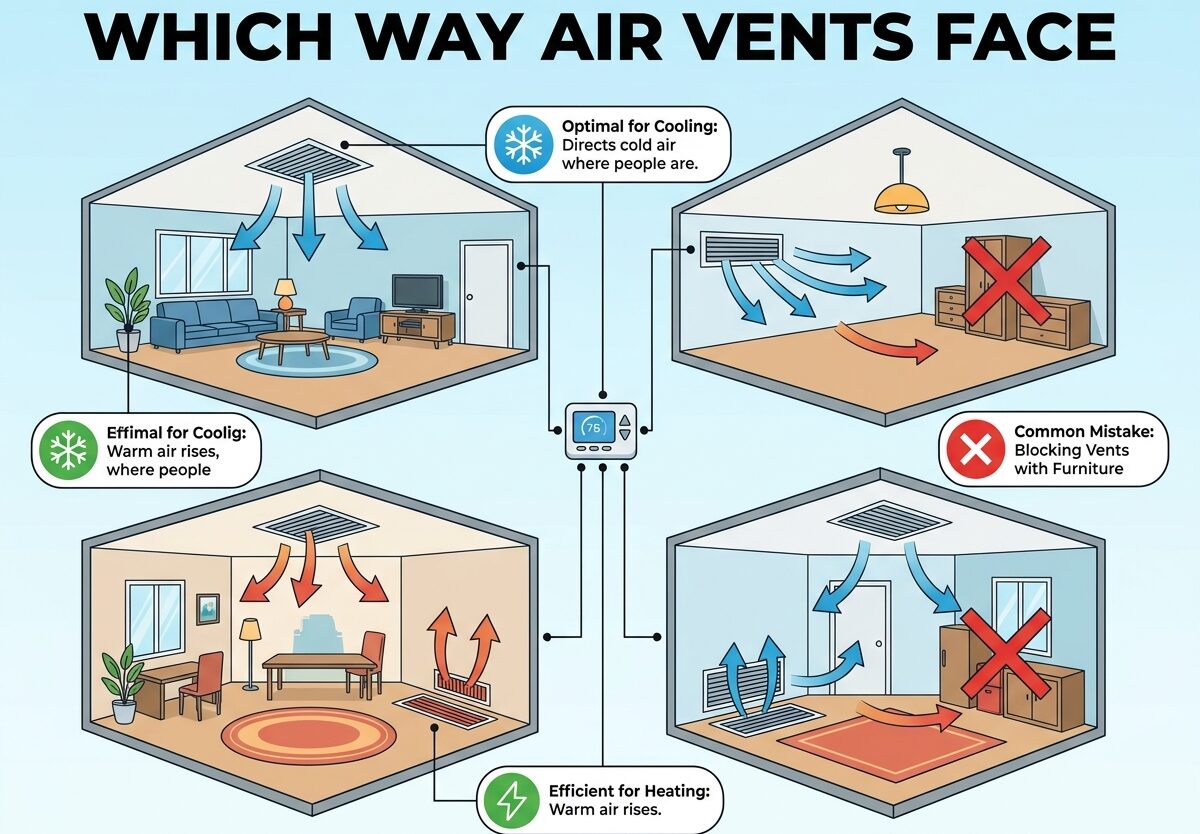
You might have seen the viral TikTok video claiming there’s a “correct” way your air vent covers should face. While the internet debate continues, the truth about vent direction is rooted in physics, not aesthetics. This guide explains which way air vents face and why it matters for your home comfort and energy bills.
What Is a Return Air Vent?
A return air vent is different from a supply vent, and understanding this distinction is essential before we discuss direction. Supply vents push conditioned air into your rooms, while return vents pull air back to your HVAC system to be reconditioned. Your home likely has both types throughout each room.
Return vents are typically larger and located on walls or ceilings. They pull air from the room and send it back through ductwork to be filtered, heated, or cooled again. Supply vents are usually smaller and deliver the conditioned air into your living spaces.
When homeowners ask which way air vents face, they’re usually asking about return air vent grilles. The direction these grilles face affects how efficiently your HVAC system circulates air throughout your home.
The Universal Vent Direction Rule
Here is the core principle that governs proper vent direction: if the vent is low, it should face down. If the vent is high, it should face up. This rule applies to both return vents and supply vents in most residential situations.
This recommendation comes down to basic physics. Cold air is denser than warm air, which means it naturally sinks toward the floor. Conversely, warm air rises toward the ceiling. Your HVAC system works with these natural convection currents when configured correctly.
When a low-mounted vent faces downward, it can effectively pull cold air that has pooled near the floor or direct supply air along the floor where it can rise naturally. When a high-mounted vent faces upward, it captures rising warm air or delivers air that will sink as it cools. This creates efficient air circulation without working against gravity.
Reddit discussions among homeowners and HVAC professionals consistently confirm this universal rule. One technician explained that pointing low vents downward helps “pull from the floor level where cold air collects” while high vents facing up allows warm air to be captured at its natural collection point near the ceiling.
Vent Direction for Cooling
During summer months, your air conditioning creates cold air that should sink. This is when upward-facing supply vents work best, pushing cool air upward where it can naturally descend and mix with room air. The circulation pattern keeps you comfortable without creating drafts.
For return vents during cooling mode, the positioning matters more than the grille direction. High wall or ceiling return vents work well because warm air rises and collects near the ceiling, where the return can pull it back to be reconditioned. This prevents the hot air from “trapping” you at the living level.
If you have second-floor rooms that always feel warmer despite your AC running, check your vent directions. Upward-facing supply vents on the second floor help push cool air into the room, while properly positioned high return vents pull the accumulated warm air away.
Pairing ceiling fans with upward-facing vents improves circulation even further. The fan blade direction should be set to pull air upward during summer months, creating a wind-chill effect that makes the room feel cooler while allowing your thermostat to run slightly higher.
Vent Direction for Heating
Winter heating works in reverse. Your furnace produces warm air that rises, which means supply vents should generally face downward during heating season. This pushes warm air toward the floor, where it can rise naturally to warm the room while preventing it from immediately escaping back into the return vent.
Low wall or baseboard supply vents work well for heating because they direct warm air across the floor before it rises. This creates an even temperature from floor to ceiling and prevents the stratification where your feet are cold but your head is hot.
Return vents during heating season should be positioned low on walls to pull the cool air that has sunk to floor level. This creates a convection loop: warm air rises from your supply vents, cools at the ceiling, and sinks back to be returned through the low-positioned vents.
If your home has multiple floors, you may notice the first floor feels warm while the second floor stays cold in winter. This often happens when supply vents on the upper level face the wrong direction. Downward-facing vents on the second floor help push warm air into the living space before it naturally rises toward the ceiling.
Vent Direction by Room Type
Ceiling Vent Direction
Ceiling-mounted vents are common in newer homes and apartments. If your ceiling vent is positioned near a wall, it should blow air outward away from the wall. This prevents the air from immediately hitting the wall and getting trapped in the corner instead of circulating through the room.
Ceiling return vents work best when they face upward to capture the warmest air that has risen. However, some ceiling returns have filters and the grille direction may be fixed. In those cases, ensuring the vent is not blocked by furniture is more important than the exact direction.
Wall Vent Direction
Wall vents are typically mounted at various heights. The universal rule applies directly here. High wall vents should face upward, and low wall vents should face downward. This holds true whether the vent is a supply or return.
For high wall supply vents, some HVAC technicians recommend angling them toward the center of the room rather than straight up. This helps the air travel farther before rising and mixing. For low wall returns, facing downward allows them to pull cool air that has settled near the floor.
Floor Vent Direction
Floor vents, also called baseboard grilles, are typically supply vents in most homes. During summer, you can leave them blowing upward. During winter, adjusting them to blow at an angle toward the room (rather than straight up) helps push warm air across the floor where it can rise naturally.
Floor return vents are less common but follow the same logic. If you have a floor-level return, it should face downward to pull cool air that has sunk. Some floor returns are designed to pull air vertically downward through the floor rather than horizontally.
Bedroom Vent Guidance
Bedrooms present a unique challenge because you’re sleeping and want minimal direct airflow on you while maintaining comfortable temperatures. For supply vents in bedrooms, angling the direction away from the bed (rather than directly at it) provides better overall circulation without creating drafts that disrupt sleep.
High ceilings in bedrooms mean warm air collects further above you, so upward-facing ceiling vents work well for both heating and cooling. Low ceilings require more attention to vent direction since the air doesn’t have as much room to mix before reaching you.
Frequently Asked Questions
Does it matter which way air vents face?
Yes, it does matter. The direction affects airflow efficiency, energy consumption, and how evenly temperatures distribute throughout your home. Low vents should face down and high vents should face up to work with natural convection currents.
Should wall vents point up or down?
It depends on where the vent is mounted. High wall vents should point up, and low wall vents should point down. This universal rule ensures your HVAC system works with gravity rather than against it.
Which direction should return air vents face?
Return air vents should face opposite to their mounting height. High return vents should face up to capture rising warm air. Low return vents should face down to pull cool air that has settled.
Which way should air vents face in a bedroom?
Bedroom vents should angle away from the bed rather than directly at sleeping areas. Ceiling vents work well when blowing outward from walls. The goal is circulation without direct drafts on sleepers.
Which way should air vents face in winter?
In winter, supply vents should generally face downward to push warm air across the floor where it can rise naturally. Return vents should be positioned low to pull the cool air that has sunk to floor level.
Conclusion
The answer to “which way air vents face” is straightforward once you understand the physics. Low vents face down, and high vents face up. This simple rule applies to both supply and return vents throughout your home.
Adjusting your vent direction seasonally can improve comfort and reduce energy costs. In summer, upward-facing supply vents push cool air where it can sink and mix. In winter, downward-facing supply vents push warm air across the floor before it rises.
If you notice persistent hot or cold spots despite correct vent directions, the issue may be elsewhere in your HVAC system. Restricted airflow, dirty filters, undersized ductwork, or an improperly sized HVAC unit can all cause uneven heating and cooling that vent direction alone cannot fix.
For new installations or significant adjustments, consulting a licensed HVAC technician ensures your system is configured optimally for your specific home layout and climate. The investment typically pays for itself through improved efficiency and comfort.




Leave a Comment