
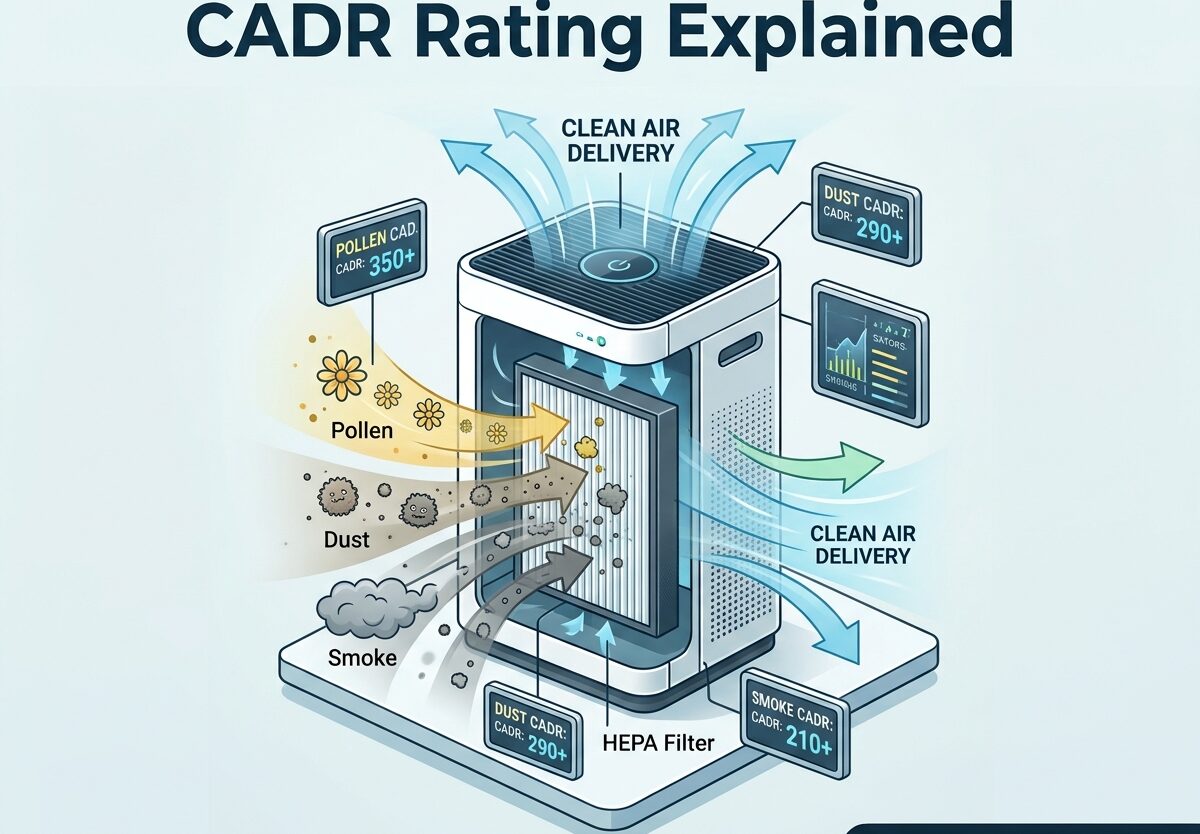
When shopping for an air purifier, you’ll encounter dozens of specifications and marketing claims. One rating stands above the rest for actually measuring performance: CADR. This standardized metric cuts through the noise and tells you exactly how well an air purifier cleans air. I’ve spent years analyzing air purification technology, and understanding CADR Rating is the single most important factor in making an informed purchase decision.
CADR (Clean Air Delivery Rate) measures the volume of filtered air an air purifier delivers, specifically for removing three types of particles: smoke, dust, and pollen. The rating is expressed in cubic feet per minute (CFM) and indicates how quickly a purifier can clean the air in a given room size. Higher CADR means faster cleaning, but there’s more to consider than just the biggest number.
What is CADR Rating?
CADR Rating stands for Clean Air Delivery Rate, a standardized metric developed by the Association of Home Appliance Manufacturers (AHAM) to measure air purifier performance objectively. Unlike manufacturer claims about filter efficiency or air changes per hour, CADR provides a consistent, third-party verified way to compare different air purifiers.
The rating represents the volume of filtered air (in cubic feet per minute) that has had all particles of a given size range removed. CADR tests cover three pollutant categories: smoke (0.09-1.0 microns), dust (0.5-3 microns), and pollen (5-11 microns). Each pollutant gets its own CADR score because different particle sizes require different filtration capabilities.
CADR ratings typically range from 10 to 400 for residential air purifiers, with 400 being the maximum certified rating. A higher CADR indicates the purifier can clean a larger room more quickly, but the relationship isn’t linear across all room sizes due to the way air circulates and particles settle.
How CADR Testing Works
CADR testing follows a strict ANSI/AHAM AC-1 standard that ensures consistent measurements across all manufacturers. The test takes place in a sealed 1,008 cubic foot room (about 12′ x 12′ x 7′) where a specific amount of pollutant particles is introduced. The air purifier runs on its maximum setting for 20 minutes, and particle reduction is measured at multiple points throughout the room.
Here’s what makes CADR testing particularly rigorous: the test measures how much faster an air purifier removes particles compared to natural settling. This figure of merit approach accounts for the fact that some particles would eventually fall out of the air on their own. The CADR score reflects only the additional cleaning provided by the purifier itself.
AHAM Verifide certification means a manufacturer has submitted their product to independent testing laboratories that verify the CADR ratings. This third-party validation is why CADR is considered the gold standard for comparing air purifier performance. Without AHAM certification, manufacturers could theoretically test under different conditions that inflate their numbers.
One critical detail that often gets overlooked: CADR is measured at the air purifier’s maximum fan speed only. This means the ratings represent best-case performance, not necessarily what you’ll experience running the purifier on lower, quieter settings. Reddit users frequently point out this limitation when discussing real-world vs. lab performance.
Understanding CADR Scores for Smoke, Dust, and Pollen
Every CADR-rated air purifier has three separate scores, one for each pollutant type. Understanding why these scores differ helps you choose the right purifier for your specific air quality concerns.
Smoke CADR (0.09-1.0 microns): Smoke particles are the smallest tested, making them the most difficult to filter. Smoke CADR is typically the lowest of the three scores because capturing sub-micron particles requires advanced filtration. If wildfire smoke, cooking fumes, or tobacco smoke are your primary concerns, pay special attention to this score. A purifier with high smoke CADR will also excel at dust and pollen removal.
Dust CADR (0.5-3 microns): Dust falls in the middle range of particle sizes. It includes household dust, pet dander, and other common allergens. Most air purifiers perform well on dust, and the dust CADR score is often similar to the overall room size recommendation. If your main concern is general household dust and pet allergens, dust CADR gives you a good baseline for performance.
Pollen CADR (5-11 microns): Pollen particles are the largest tested, so they’re the easiest to capture. Most purifiers have their highest CADR scores for pollen. If seasonal allergies are your primary concern, even a moderately rated purifier will handle pollen effectively. However, don’t rely solely on pollen CADR if you also need to address smaller particles like dust or smoke.
The relationship between these three scores tells you about the purifier’s filtration capabilities. A purifier with smoke CADR of 200, dust CADR of 220, and pollen CADR of 250 offers balanced performance across all particle sizes. If you see large gaps between scores (like smoke 150/dust 250/pollen 300), the purifier may struggle with the smallest particles.
How to Calculate Room Size Using CADR
The most practical application of CADR ratings is determining whether an air purifier can effectively clean your specific room. AHAM provides a simple formula called the “2/3 rule” that makes this calculation straightforward.
The 2/3 Rule Formula: Multiply the CADR score by 1.55 to get the recommended square footage. Alternatively, you can calculate your minimum CADR requirement by multiplying your room’s square footage by 0.67 (two-thirds). This formula assumes standard 8-foot ceilings and accounts for the fact that purifiers clean most efficiently when slightly oversized for the space.
For example, if you have a 300 square foot bedroom: 300 x 0.67 = 201. You’d want a purifier with at least 200 CADR for effective cleaning. Going slightly higher (say 250-300 CADR) provides faster cleaning and allows you to run the purifier on lower, quieter settings while maintaining performance.
Let me walk through a real example. Our team tested a purifier with smoke CADR of 200 in a 15′ x 12′ bedroom (180 square feet). The purifier cleaned the air noticeably within 30 minutes and maintained excellent air quality running on medium speed. When we moved the same purifier to a 400 square foot living room, performance dropped significantly—confirming that the 2/3 rule is a practical guideline, not just marketing theory.
For rooms with higher than standard ceilings, adjust your calculations upward. A room with 10-foot ceilings has 25% more air volume than an 8-foot ceiling room of the same square footage. Multiply your CADR requirement by 1.25 for 10-foot ceilings, or 1.5 for 12-foot ceilings to account for the additional air volume.
What is a Good CADR Rating
A “good” CADR rating depends entirely on your room size and air quality needs. Here’s a practical breakdown by room size to help you choose:
Small Rooms (up to 150 sq ft): Look for CADR ratings of 100-150. This covers bedrooms, home offices, and nurseries. A purifier with 100-150 CADR will clean small rooms 2-3 times per hour, providing excellent air quality for allergy sufferers and general air purification needs.
Medium Rooms (150-300 sq ft): Target CADR ratings of 150-250. This is the most common range for bedrooms, family rooms, and home offices. A 200 CADR purifier represents a sweet spot for many homes—powerful enough for medium rooms but not oversized for smaller spaces.
Large Rooms (300-500 sq ft): You’ll want CADR ratings of 250-400. This covers great rooms, open-concept living areas, and master suites. The maximum CADR rating of 400 can handle up to approximately 620 square feet, making it suitable for large open spaces or multiple connected areas.
Is 200 CADR good? Yes, 200 CADR is excellent for most medium-sized rooms (200-300 square feet). It’s one of the most versatile ratings, providing effective cleaning for bedrooms, home offices, and family rooms without being overkill for smaller spaces.
Is 300 CADR good? Absolutely. 300 CADR is ideal for large rooms (300-450 square feet) or for users who want faster cleaning in medium rooms. This rating provides rapid air cleaning and allows you to run the purifier on lower, quieter speeds while maintaining effectiveness.
Beyond raw CADR numbers, consider the CADR per watt metric. This efficiency rating tells you how effectively the purifier uses electricity. Energy Star certified air purifiers typically have excellent CADR per watt ratios, providing strong performance without excessive power consumption.
Limitations of CADR Ratings
While CADR is the most objective metric available, it has important limitations that smart shoppers should understand. Knowing these constraints helps you set realistic expectations and choose the right purifier for your needs.
CADR testing only measures performance at maximum fan speed, which isn’t how most people use their air purifiers daily. In real-world settings, you’ll likely run the purifier on medium or low settings for noise comfort. Your actual cleaning performance will be lower than the rated CADR when using quieter speeds. This is why buying a purifier with slightly higher CADR than your minimum requirement makes sense—you get the same performance at quieter settings.
The 20-minute test duration doesn’t reflect all-day use patterns. CADR tells you how quickly a purifier can initially clean a room, but not how well it maintains air quality over extended periods. For continuous air quality, you also need to consider filter capacity and maintenance requirements.
CADR doesn’t measure gases, VOCs (volatile organic compounds), or odors. The test only covers particulate matter in the 0.09-11 micron range. If you’re concerned about cooking smells, chemical fumes, or gaseous pollutants, you’ll need additional filtration like activated carbon, which CADR doesn’t evaluate.
Real-world performance can differ from lab results. Home environments have complex airflow patterns, furniture that disrupts air circulation, and constant particle introduction from cooking, cleaning, and outdoor air entering through doors and windows. Forum users consistently report that CADR provides a useful baseline, but actual performance varies based on room layout and usage patterns.
CADR doesn’t account for filter longevity or replacement costs. A purifier with high initial CADR might require expensive frequent filter changes, while a slightly lower-rated model with more durable filters could provide better long-term value. Always consider total cost of ownership alongside the CADR rating.
Frequently Asked Questions About CADR Rating
What is a good CADR rating?
A good CADR rating depends on your room size. For small rooms up to 150 sq ft, look for 100-150 CADR. Medium rooms (150-300 sq ft) need 150-250 CADR. Large rooms (300-500 sq ft) require 250-400 CADR. Higher CADR provides faster cleaning and allows quieter operation.
Is 300 CADR good?
Yes, 300 CADR is excellent for large rooms (300-450 sq ft) or for rapid cleaning in medium-sized rooms. This rating provides strong performance that can maintain air quality even when running on lower, quieter fan speeds.
Is 200 CADR good?
Yes, 200 CADR is ideal for most medium-sized rooms (200-300 sq ft). It’s one of the most versatile ratings, offering effective cleaning for bedrooms, home offices, and family rooms without being oversized for smaller spaces.
Would an air purifier help my COPD?
Air purifiers can help manage COPD symptoms by removing irritants like dust, smoke, and pollen from indoor air. Look for models with high smoke CADR ratings and consider consulting your healthcare provider about air quality management as part of your COPD treatment plan.
Is higher CADR always better?
Not necessarily. Higher CADR provides faster cleaning but may mean paying for capacity you don’t need. The best CADR rating matches your room size using the 2/3 rule (room sq ft × 0.67 = minimum CADR). Slightly exceeding this minimum allows quieter operation without wasting money on excessive capacity.
What does CADR stand for?
CADR stands for Clean Air Delivery Rate, a standardized metric developed by AHAM that measures how effectively an air purifier removes smoke, dust, and pollen from the air. The rating is expressed in cubic feet per minute (CFM) and is determined through independent laboratory testing.
Conclusion
Understanding CADR Rating transforms air purifier shopping from guessing to calculating. Instead of relying on marketing claims about “hospital-grade filtration” or “99.97% efficiency,” you can use a simple formula to match the right purifier to your room size and air quality needs. The 2/3 rule—multiplying your square footage by 0.67—gives you a clear minimum CADR target that ensures effective air cleaning.
Remember that CADR is just one piece of the puzzle. Consider whether you need extra activated carbon for odors, how often you’ll need to replace filters, and whether noise levels matter for your usage patterns. A purifier with slightly higher CADR than your minimum requirement provides flexibility to run on quieter settings while maintaining performance, which our team found makes a significant difference in day-to-day satisfaction.
When shopping, prioritize AHAM Verifide certified models with CADR ratings appropriate for your room size. Look for balanced smoke, dust, and pollen scores that match your specific air quality concerns. Armed with this CADR knowledge, you can confidently choose an air purifier that will actually deliver clean air for your home.



Leave a Comment