
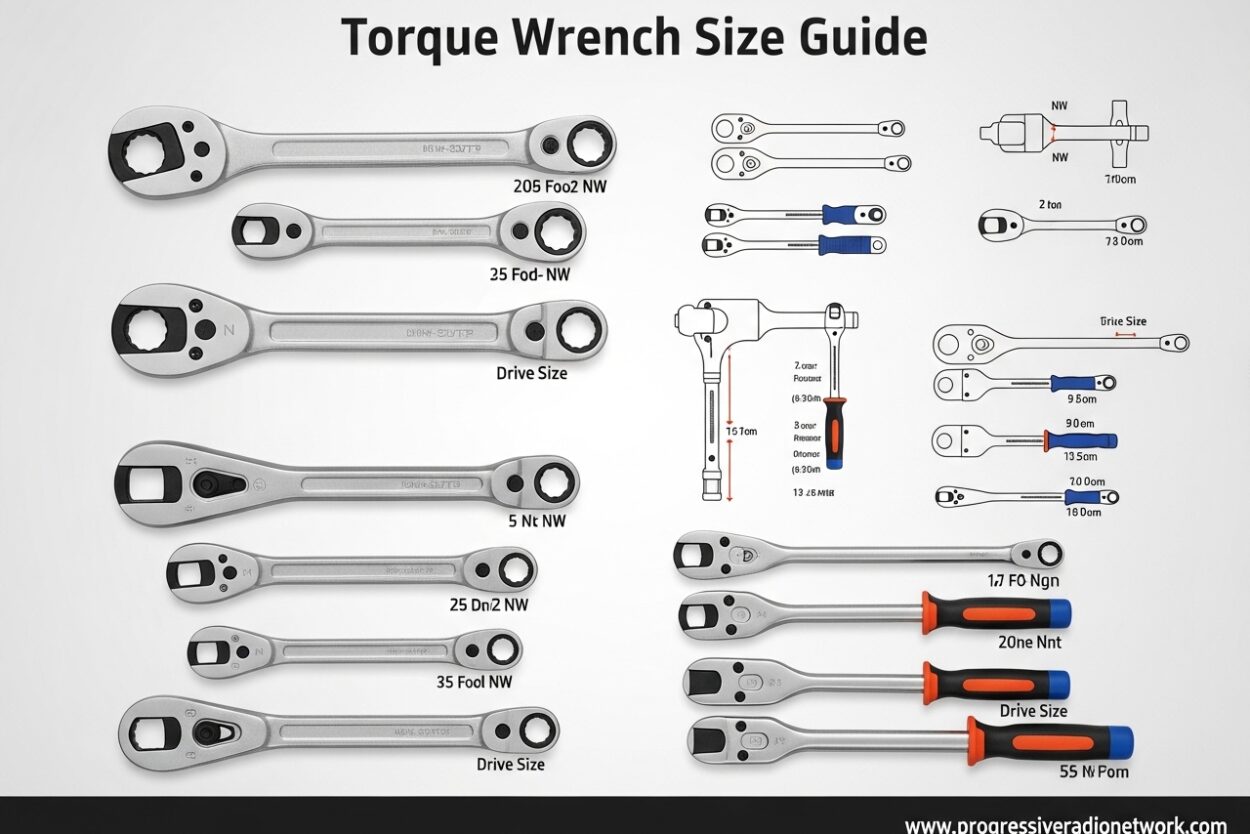
Choosing the right torque wrench size can make the difference between a properly tightened fastener and a stripped thread or damaged component. After working with hundreds of DIY mechanics and professionals, I’ve seen how confusing torque wrench sizes can be at first. The truth is, torque wrench size refers to the square drive size – the part that connects to your sockets – and it directly determines how much torque the tool can deliver.
There are five main drive sizes: 1/4-inch, 3/8-inch, 1/2-inch, 3/4-inch, and 1-inch. Each size has a specific torque range and ideal applications. Using the wrong size means either not getting enough torque or risking damage by over-tightening. Let me break down exactly what each size is for so you can choose the right tool for your next project.
Torque Wrench Size Chart: Quick Reference
Here’s a complete overview of all five drive sizes with their torque ranges and common uses. This chart covers everything from delicate electronics work to heavy industrial applications.
| Drive Size | Torque Range (ft-lbs) | Torque Range (Nm) | Best For |
|---|---|---|---|
| 1/4-inch | 1.5-17 ft-lbs | 2-23 Nm | Bicycles, electronics, small engines |
| 3/8-inch | 15-75 ft-lbs | 20-100 Nm | Spark plugs, motorcycles, light automotive |
| 1/2-inch | 30-250 ft-lbs | 40-340 Nm | Lug nuts, suspension, general automotive |
| 3/4-inch | 100-600 ft-lbs | 135-810 Nm | Heavy trucks, machinery, industrial |
| 1-inch | 200-2000 ft-lbs | 270-2700 Nm | Construction, heavy equipment |
Understanding torque measurements is important. Foot-pounds (ft-lbs) measure rotational force, while Newton-meters (Nm) is the metric equivalent. Smaller torque wrenches often use inch-pounds (in-lbs) for more precise measurements on delicate fasteners. The key is matching your wrench’s range to your application’s torque specifications.
1/4-Inch Drive Torque Wrench: Precision for Small Fasteners
The 1/4-inch drive is the smallest and most precise torque wrench size. With a typical range of 20-200 in-lbs (2-23 Nm), it’s designed for delicate work where over-tightening could cause serious damage. I’ve found this size essential for bicycle maintenance, especially when working with carbon fiber components that require exact torque specifications.
This size excels at small engine repair, electronics work, and firearm maintenance. The compact design gives you excellent access in tight spaces where larger wrenches simply won’t fit. Many motorcycle mechanics also keep a 1/4-inch drive for small fasteners on engine covers and bodywork. If you work with precision fasteners under 20 ft-lbs, this size is worth adding to your collection.
3/8-Inch Drive Torque Wrench: The Versatile Middle Ground
The 3/8-inch drive occupies the sweet spot between precision and power. With torque ranges typically spanning 15-75 ft-lbs (20-100 Nm), this size handles a wide variety of tasks. It’s my go-to for spark plug work, motorcycle maintenance, and light automotive applications.
Most car spark plugs require between 15-25 ft-lbs of torque, making the 3/8-inch drive perfect for the job. Motorcycle enthusiasts rely on this size for engine bolts, brake calipers, and suspension components. The 3/8-inch drive offers better leverage than the 1/4-inch while still maintaining good accuracy for medium-torque applications. Many professional mechanics reach for this size daily because it covers such a broad range of common repair tasks.
1/2-Inch Drive Torque Wrench: The Automotive Standard
The 1/2-inch drive is the most common and versatile torque wrench size for automotive work. With typical ranges of 30-250 ft-lbs (40-340 Nm), it covers the vast majority of car and truck maintenance tasks. If you only buy one torque wrench for general vehicle work, this should be it.
This size handles lug nuts (typically 80-100 ft-lbs for passenger cars), suspension work, engine mounts, and most drivetrain components. The 1/2-inch drive is the industry standard for a reason – it combines sufficient torque capacity with good accuracy across its range. Most tire shops and automotive factories use 1/2-inch drive exclusively. I’ve used this size for everything from engine rebuilds to suspension overhauls, and it rarely leaves me wanting more capacity.
3/4-Inch Drive Torque Wrench: Heavy-Duty Applications
The 3/4-inch drive steps up into serious territory with torque ranges from 100-600 ft-lbs (135-810 Nm). This size is designed for heavy trucks, commercial equipment, agricultural machinery, and industrial applications. Most DIY mechanics won’t need this size unless they’re working on diesel trucks or farm equipment.
Commercial mechanics use the 3/4-inch drive for truck wheel bearings, heavy equipment maintenance, and large engine components. The increased drive size means you can apply more torque without risking damage to the tool. If you’re working on diesel engines, commercial vehicles, or construction equipment, this size becomes essential. For typical passenger car work, the 1/2-inch drive will handle almost everything.
1-Inch Drive Torque Wrench: Industrial Power
The 1-inch drive represents the extreme end of torque wrench sizing, with ranges from 200-2000 ft-lbs (270-2700 Nm). This is specialized equipment for construction, heavy industry, and large-scale machinery. You’ll find these in shipyards, mining operations, and heavy equipment repair facilities.
Industrial applications include construction equipment, large diesel engines, structural bolts, and heavy machinery assembly. The 1-inch drive is overkill for anything but the most demanding industrial applications. Most professional auto mechanics will never encounter a situation requiring this much torque capacity. This size is purely for specialized industrial use.
What Size Torque Wrench Do I Need?
Choosing the right torque wrench size starts with understanding your specific applications. Here’s how to match the drive size to your projects:
For bicycle maintenance: A 1/4-inch drive with inch-pound scale is ideal. Most bike components require 5-15 Nm of torque, which falls perfectly in this range. Carbon fiber parts especially need precise torque to prevent damage.
For motorcycle work: You’ll want both 1/4-inch and 3/8-inch drives. Small fasteners use the 1/4-inch, while engine bolts and brake components typically require the 3/8-inch range.
For automotive repair: Start with a 1/2-inch drive as your primary tool. Add a 3/8-inch for spark plugs and smaller components. Most car work falls within these two sizes.
For trucks and heavy equipment: The 3/4-inch drive becomes necessary for larger fasteners and higher torque specifications. Diesel engines and truck components often exceed the capacity of 1/2-inch drives.
The 20% Rule for Torque Wrench Accuracy
Here’s something most articles don’t mention – the 20% rule. For the most accurate results, keep your torque settings between 20% and 85% of your wrench’s maximum capacity. Using a wrench at its absolute minimum or maximum reduces accuracy.
For example, if you have a 1/2-inch drive with a 150 ft-lb maximum, the sweet spot is between 30-128 ft-lbs. Below 30 ft-lbs, consider stepping down to a 3/8-inch drive for better precision. This rule explains why professional mechanics own multiple sizes – each covers a specific optimal range. Many forum discussions confirm this practice, and it’s something I’ve experienced firsthand in the shop.
Which Torque Wrench Size Should You Buy First?
For beginners starting their tool collection, the 1/2-inch drive is the best first purchase. It covers 80-90% of typical automotive maintenance tasks. Most car repairs fall within 30-100 ft-lbs, which sits comfortably in the middle of a standard 1/2-inch drive’s range.
After you have the 1/2-inch, add a 3/8-inch for spark plugs and smaller fasteners. The combination of these two sizes will handle virtually anything on a typical passenger vehicle. Many Reddit users in mechanic communities confirm this two-wrench setup works perfectly for most DIY enthusiasts. Only expand to 1/4-inch or 3/4-inch drives if your specific projects require them.
Do Mechanics Use 1/2 or 3/8?
Professional mechanics typically use both sizes, but the 1/2-inch drive sees more daily use. For general automotive work, the 1/2-inch handles the majority of tasks including lug nuts, suspension components, and engine work. The 3/8-inch comes out for spark plugs, intake manifolds, and other medium-torque applications.
Many shops have all three common sizes (1/4, 3/8, 1/2) to cover every situation efficiently. The 1/2-inch remains the workhorse, but having options means always using the right tool for the job. I’ve found that reaching for the appropriately sized wrench rather than making do with what’s available leads to better, more consistent results.
Torque Conversion Chart: ft-lbs to Nm
Working with torque specifications often means converting between measurement systems. Here’s a quick reference chart covering common torque values:
| Foot-Pounds | Newton-Meters | Typical Application |
|---|---|---|
| 10 ft-lbs | 14 Nm | Small engine covers |
| 20 ft-lbs | 27 Nm | Spark plugs (some engines) |
| 30 ft-lbs | 41 Nm | Oil drain plugs |
| 50 ft-lbs | 68 Nm | Wheel lug nuts (compact cars) |
| 80 ft-lbs | 108 Nm | Standard lug nuts |
| 100 ft-lbs | 136 Nm | Lug nuts (trucks/SUVs) |
| 150 ft-lbs | 203 Nm | Suspension components |
| 200 ft-lbs | 271 Nm | Driveshaft bolts |
Having these conversions handy saves time when working from service manuals that use different measurement systems. Many modern vehicles specify torque in Nm, while older American vehicles often use ft-lbs. Keep this chart in your toolbox for quick reference during projects.
Torque Wrench Size Tips and Maintenance
Proper care ensures your torque wrench maintains accuracy for years. Always store your torque wrench at its lowest setting to relieve spring tension. This simple practice prevents calibration drift and extends the tool’s life significantly.
Calibration matters. Even quality torque wrenches can drift from accuracy over time. Professional mechanics recommend annual calibration for tools used regularly. For occasional DIY use, checking calibration every few years is usually sufficient. Many quality manufacturers offer calibration services, or you can use a torque tester to verify accuracy at home.
Quality considerations matter when choosing any torque wrench size. Cheaper tools may save money upfront but often lack accuracy consistency. Brands like Tekton offer excellent quality with lifetime warranties at reasonable prices. Professional mechanics often prefer Snap-on or ICON for shop use, while Pittsburgh Pro from Harbor Freight provides a budget-friendly option for occasional use.
FAQ
What size of torque wrench do I need?
For automotive work, start with a 1/2-inch drive (30-250 ft-lbs) as it covers 80-90% of car maintenance tasks. Add a 3/8-inch drive (15-75 ft-lbs) for spark plugs and smaller fasteners. Bicycle maintenance requires a 1/4-inch drive with inch-pound scale for precision work.
Which is bigger, 1/4 or 3/8 torque wrench?
3/8-inch drive is larger than 1/4-inch drive. The drive size refers to the square anvil that connects to sockets – 3/8 is bigger than 1/4. Larger drive sizes handle higher torque ranges. The 3/8-inch typically covers 15-75 ft-lbs while 1/4-inch handles smaller fasteners at 20-200 in-lbs.
Should I get a 1/2 or 3/4 torque wrench?
For most automotive and light truck work, the 1/2-inch drive is sufficient and recommended. Choose 3/4-inch drive only if you work on heavy trucks, diesel engines, or industrial equipment requiring torque over 100 ft-lbs. The 1/2-inch covers 30-250 ft-lbs which handles virtually all passenger vehicle applications.
Do mechanics use 1/2 or 3/8?
Professional mechanics use both sizes regularly. The 1/2-inch drive is the daily workhorse for lug nuts, suspension, and engine work. The 3/8-inch drive comes out for spark plugs, intake manifolds, and medium-torque applications. Most shops have all three common sizes (1/4, 3/8, 1/2) to cover every situation efficiently.
What is the 20 rule for torque wrenches?
The 20% rule states you should use your torque wrench between 20-85% of its maximum capacity for optimal accuracy. Using a wrench at its absolute minimum or maximum reduces precision. For example, a 150 ft-lb wrench is most accurate between 30-128 ft-lbs. This is why pros own multiple sizes.
Is 1/2 or 3/8 better for lug nuts?
1/2-inch drive is the industry standard for lug nuts and the better choice for this application. Most passenger car lug nuts require 80-100 ft-lbs of torque, which sits in the optimal range of a 1/2-inch drive (30-250 ft-lbs). While a 3/8-inch might technically reach this range, the 1/2-inch provides better leverage and accuracy at higher torque values.
How do I know what size torque wrench to get?
Match your torque wrench size to your specific projects. Check the torque specifications for the fasteners you’ll be working with. For general automotive: 1/2-inch drive. For motorcycles and spark plugs: 3/8-inch drive. For bicycles and precision work: 1/4-inch drive. Choose a size where your required torque falls in the middle 60% of the wrench’s range.
Conclusion
Understanding torque wrench size doesn’t need to be complicated. The 1/2-inch drive handles most automotive tasks, the 3/8-inch covers spark plugs and medium applications, and the 1/4-inch provides precision for small fasteners. Most DIY mechanics will find that a 1/2-inch and 3/8-inch combination covers virtually every project they’ll encounter.
Remember the 20% rule for optimal accuracy, store your wrench at its lowest setting, and invest in quality from reputable brands. The right torque wrench size means properly tightened fasteners every time, protecting your components and ensuring safe, reliable results. Start with the 1/2-inch drive and expand your collection as your projects demand.






Leave a Comment