
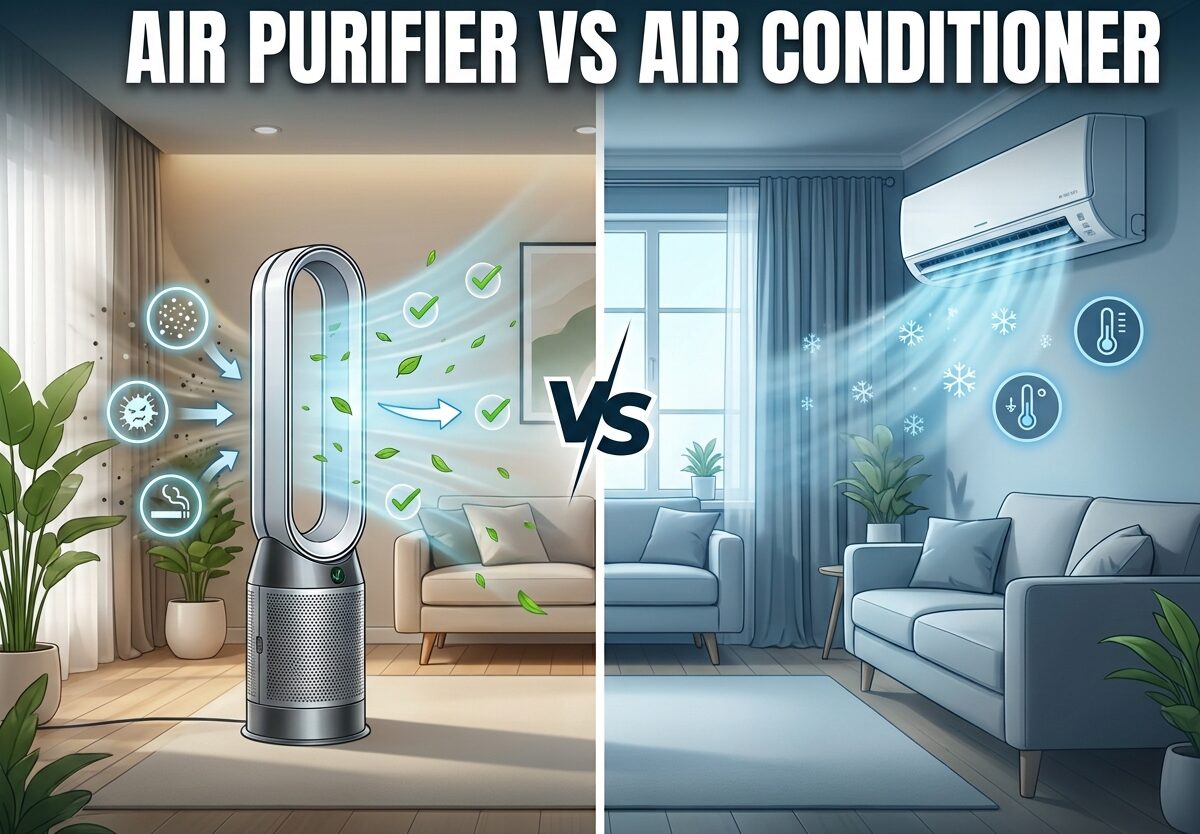
When shopping for home appliances, many people find themselves confused about the difference between an air purifier and an air conditioner. While both devices move air through your home and have filters, they serve completely different purposes. An air purifier is designed to clean your indoor air by removing pollutants, allergens, and particles. An air conditioner is designed to cool your home and control humidity.
This Air Purifier vs Air Conditioner comparison matters because choosing the wrong device won’t solve your actual problem. If you’re suffering from allergies, an air conditioner won’t provide relief. If you’re overheating in summer, an air purifier won’t cool you down. Let me break down exactly how each device works and which one you actually need.
Table of Contents
How Air Purifiers Work
Air purifiers are dedicated air cleaning machines designed to run continuously and remove contaminants from your indoor air. They work by pulling air through a series of specialized filters that capture different types of pollutants. Most quality air purifiers use True HEPA filters as their primary filtration method.
HEPA stands for High-Efficiency Particulate Air, and these filters are certified to capture 99.97% of particles as small as 0.3 microns. This includes dust, pollen, pet dander, mold spores, bacteria, and even some viruses. The best air purifiers combine HEPA filtration with activated carbon filters that trap gases, odors, and volatile organic compounds (VOCs).
Unlike air conditioners, air purifiers are designed for 24/7 operation. They continuously cycle the air in a room, typically completing 2-5 air changes per hour. This constant turnover is essential for maintaining clean indoor air quality. Air purifiers also typically include multiple filtration stages: a pre-filter catches large particles like hair and dust, the HEPA filter captures microscopic particles, and activated carbon handles odors and chemical pollutants.
The key advantage of dedicated air purifiers is their specialized focus. They don’t need to compromise between cooling and cleaning—every aspect of their design is optimized for filtration efficiency. The fans are sized for consistent airflow through dense filters, and the housings are sealed to prevent purified air from leaking out unfiltered.
How Air Conditioners Work
Air conditioners work on a completely different principle. They don’t clean air as their primary function—they cool it. Through a refrigeration cycle, ACs remove heat and moisture from indoor air and expel it outside. This process naturally reduces humidity as water vapor condenses on the cold evaporator coils.
Most air conditioners do include filters, but these filters serve a different purpose. AC filters protect the equipment from dust buildup that could reduce efficiency or cause damage. They use MERV-rated filters (Minimum Efficiency Reporting Value), typically in the MERV 8-11 range for residential systems. These filters capture larger particles to keep the AC system running cleanly, but they’re not designed for the high-efficiency particle removal that HEPA filters provide.
According to EPA research, the average central air conditioner runs only about 25% of the time. Even in hot climates, your AC cycles on and off as needed to maintain temperature. This limited operation means AC filters simply can’t provide continuous air cleaning, no matter how good the filter might be.
Window units and portable air conditioners work on the same principle but cool individual rooms rather than whole homes. They also include basic filters, typically washable screens that catch lint and large dust particles. Some newer models include slightly better filtration, but none approach HEPA-level efficiency.
Air Purifier vs Air Conditioner: Key Differences
Understanding the fundamental differences between these devices helps explain why they can’t replace each other. Let me break down the core distinctions:
Primary Purpose: Air purifiers exist to clean air. Air conditioners exist to cool air. This single difference drives every design decision and capability gap between the two devices.
Filtration Technology: Air purifiers use True HEPA filters rated to capture 99.97% of particles down to 0.3 microns. Air conditioners typically use MERV 8-11 filters designed to protect equipment, not clean air. The best AC filters achieve 62-95% efficiency in ideal conditions, compared to the consistent 99.97% of HEPA filters.
Operation Time: Air purifiers are designed to run continuously, cycling all the air in a room multiple times per hour. Air conditioners run only when cooling is needed, often less than 25% of the time even in summer. You can’t filter air effectively when the system is off.
Particle Size Capture: HEPA filters in air purifiers capture microscopic particles including bacteria, fine dust, and allergens. AC filters primarily catch larger particles like hair, lint, and visible dust. The smallest particles that affect your health pass right through standard AC filters.
Energy Consumption: Air purifiers typically use 30-100 watts running continuously—similar to a light bulb. Air conditioners use 500-3500 watts but only when cooling. Running both devices costs more than either alone, but they serve different needs.
Additional Benefits: Air purifiers can remove smoke, odors, and VOCs through activated carbon filters. Air conditioners reduce humidity and make hot spaces comfortable. Each device excels at its specific function but cannot replace the other.
Comparison Summary
| Feature | Air Purifier | Air Conditioner |
|---|---|---|
| Primary Function | Clean indoor air | Cool and dehumidify |
| Filter Type | True HEPA + Carbon | MERV 8-11 |
| Filtration Efficiency | 99.97% at 0.3 microns | 62-95% at larger particles |
| Operation Pattern | 24/7 continuous | Cycling on/off |
| Energy Use | 30-100 watts | 500-3500 watts |
| Best For | Allergies, asthma, air quality | Cooling, comfort, humidity |
Why Your AC Filter Cannot Replace an Air Purifier
I frequently see people ask if they can just upgrade their AC filter to MERV 13 or higher and skip buying an air purifier. While upgrading your AC filter helps somewhat, it cannot replace a dedicated purifier for several important reasons.
First, even the best AC filters can’t match HEPA performance. The highest-rated MERV 13 filters achieve about 62% filtration efficiency for smaller particles in real-world conditions. Compare this to the guaranteed 99.97% efficiency of True HEPA filters. For allergy sufferers, that 37% gap means millions of particles still circulating in your air.
Second, your AC simply doesn’t run enough to filter air effectively. Remember the EPA statistic: ACs run about 25% of the time. Your air purifier needs to run continuously to maintain clean air. During the 75% of time your AC is off, pollutants continue to accumulate without being removed.
Third, high-MERV filters can actually damage your AC system. Dense filters restrict airflow, which can strain your AC fan motor and reduce system efficiency. HVAC professionals typically recommend against using filters above MERV 11 in residential systems unless they’ve been specifically modified to handle the increased resistance.
Fourth, AC filters don’t address gases and odors. HEPA filters capture particles, but activated carbon filters in air purifiers trap VOCs, cooking odors, and chemical fumes that pass straight through AC filters. If you’re concerned about air quality beyond just dust, an AC filter alone won’t help.
Finally, window AC units and portable air conditioners can’t even accept upgraded filters. You’re limited to the basic washable screens they come with, which catch only visible lint and hair. If you rent and use window units, an air purifier is your only option for cleaner air.
Health Benefits and Who Needs Each Device
The choice between an air purifier and air conditioner often comes down to specific health needs and living situations. Let me break down who benefits most from each device.
Allergy and Asthma Sufferers: If you struggle with seasonal allergies, pet allergies, or asthma, an air purifier is essential. Pollen, pet dander, dust mites, and mold spores trigger allergic reactions—and these are exactly what HEPA filters capture. Real user reports consistently show significant improvement in congestion and symptoms when running a quality air purifier in bedrooms and living areas.
People with COPD and Respiratory Conditions: Would an air purifier help COPD? Yes. Chronic obstructive pulmonary disease and other respiratory conditions make you especially sensitive to air quality. Clean air reduces irritation and helps prevent exacerbations. Many COPD patients report easier breathing when using air purifiers at home.
Wildfire Smoke Areas: If you live in an area affected by wildfires, an air purifier can be literally life-saving. Smoke particles are extremely small and penetrate deep into lungs. Only a high-quality air purifier with a HEPA filter can effectively remove these dangerous particles from indoor air.
Hot and Humid Climates: If your main concern is heat and humidity, an air conditioner is what you need. AC provides relief from high temperatures and reduces humidity that can encourage mold growth. People in hot southern climates often consider AC essential for comfort and safety during summer months.
Pet Owners: While AC helps somewhat with pet hair and dander, an air purifier makes a noticeable difference. Pet dander is a potent allergen that floats in the air long after you’ve vacuumed. A purifier running continuously captures dander before it settles, providing real relief for allergic family members.
Benefits of Using Both Devices Together
Here’s something many people don’t realize: air purifiers and air conditioners actually work better together. They complement each other rather than competing, and using both can give you the best of both worlds.
Air conditioners help control humidity, which prevents mold growth and dust mite populations. Lower humidity means fewer allergens in your home overall. Meanwhile, your air purifier removes the allergens that do make it indoors, providing comprehensive protection.
Strategic placement matters. Position your air purifier away from your AC vents to avoid competing airflow. Many users find success placing the purifier near their bed or favorite chair, where they spend the most time breathing the air. The AC can handle overall comfort while the purifier creates a clean air zone where you need it most.
There’s also a synergy in maintenance. Both devices have filters that need regular attention, but they serve different purposes. Your AC filter protects expensive equipment and needs changing every 1-3 months. Your purifier filter protects your health and needs changing every 6-12 months depending on use. Maintaining both ensures optimal performance and air quality.
Energy-wise, running both isn’t as wasteful as it might sound. Your AC cycles on and off as needed, while a modern air purifier uses very little electricity—often less than $10 per month for continuous operation. The combined cost is reasonable for the improvement in both comfort and health.
Which Device Should You Choose?
Choosing between an air purifier and air conditioner doesn’t have to be complicated. Start by identifying your primary need:
Choose an Air Purifier If: You have allergies, asthma, or respiratory concerns; you live with pets; you’re bothered by odors or cooking fumes; you want protection from wildfire smoke or pollution; or someone in your home has a compromised immune system. Clean air is essential for health, and only an air purifier provides it.
Choose an Air Conditioner If: Your main problem is heat and humidity; you live in a hot climate; you’re uncomfortable due to temperature; or you’re concerned about mold growth from excess moisture. Comfort and humidity control require an AC.
Choose Both If: You can afford it and want both clean air and comfortable temperatures; you have allergies and live in a hot, humid climate; or you want the healthiest possible indoor environment. Many households, especially those with allergy sufferers, benefit tremendously from running both devices.
There’s one warning I’ll offer: be cautious about 2-in-1 devices that combine cooling and purification in a single unit. While these combo units seem convenient, they inevitably compromise on both functions. The filtration is rarely as good as a dedicated purifier, and the cooling is rarely as effective as a dedicated AC. For serious air quality or cooling needs, separate devices simply perform better.
Frequently Asked Questions
What is better, an air conditioner or an air purifier?
Neither is inherently better—they serve different purposes. An air conditioner is better if your primary need is cooling and humidity control. An air purifier is better if you need to remove allergens, dust, smoke, and other pollutants from your air. Many households benefit from using both devices together for optimal indoor air quality and comfort.
Would an air purifier help my COPD?
Yes, air purifiers can help people with COPD. Clean air reduces respiratory irritation and may help prevent symptom flare-ups. A quality HEPA air purifier removes the small particles that can aggravate COPD, including dust, pollen, pet dander, and smoke. Many COPD patients report easier breathing when using air purifiers in their homes, especially in bedrooms where they spend hours sleeping.
Can an AC filter really replace an air purifier?
No, an AC filter cannot replace an air purifier. Even the best MERV 13 AC filters capture only about 62% of particles compared to the 99.97% captured by True HEPA filters. More importantly, your AC only runs about 25% of the time, while effective air cleaning requires continuous filtration. AC filters also don’t remove gases, odors, or VOCs. A dedicated air purifier is necessary for serious air cleaning.
What is the 2/3 rule for air purifiers?
The 2/3 rule for air purifiers states that a purifier should be sized to deliver 2/3 of its Clean Air Delivery Rate (CADR) to the room’s total area. For example, a purifier with a CADR of 300 can effectively clean a 200 square foot room. This rule helps ensure adequate air changes per hour for effective air cleaning. Always check the CADR rating and recommended room size before purchasing.
What are the disadvantages of an air purifier?
The main disadvantages of air purifiers include ongoing costs for filter replacements (every 6-12 months), noise from the fan (especially on higher settings), and limited coverage area (one unit per room typically). Quality purifiers also require an upfront investment of $100-500. However, most users find these disadvantages are outweighed by the health benefits, especially for allergy and asthma sufferers.
Do air conditioners trigger allergies?
Air conditioners can sometimes trigger allergies, but they can also help. Poorly maintained AC units may harbor mold and dust in their ducts or filters, which can aggravate allergies when the system runs. However, properly maintained ACs that control humidity can actually reduce allergens like mold and dust mites. The key is regular filter changes and professional cleaning to prevent allergen buildup in the system.
Conclusion
The Air Purifier vs Air Conditioner debate really comes down to understanding what each device does best. Air purifiers clean your air by removing 99.97% of particles, allergens, and pollutants. Air conditioners cool your home and control humidity but only provide basic filtration through MERV-rated filters.
If you’re suffering from allergies, asthma, or other respiratory concerns, an air purifier is the device that will help. If you’re overheating and need comfort cooling, an air conditioner is what you need. Many households find the best solution is using both devices together—clean air plus comfortable temperature equals the healthiest indoor environment possible.
Just remember that upgrading your AC filter or choosing a 2-in-1 combo unit won’t give you the same performance as dedicated devices designed for their specific purpose. For serious air quality or cooling needs, separate equipment simply works better.
Leave a Comment