
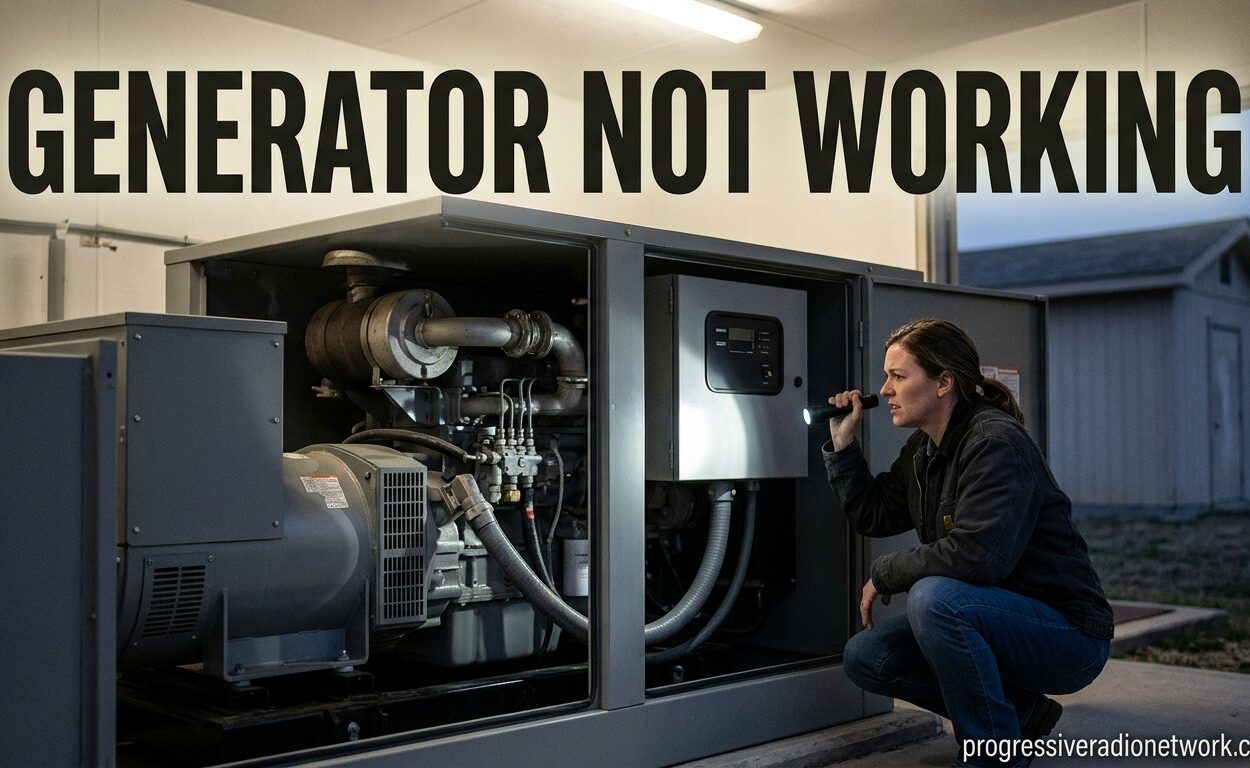
Flip the switch, pull the cord, and nothing happens — that is the moment you realize your generator not working is a real problem. Whether you are facing a power outage, gearing up for a camping trip, or running tools on a job site, a dead generator leaves you stuck. Our team has spent years testing, repairing, and troubleshooting portable and standby generators across Honda, Generac, Champion, and WEN models. We built this guide to walk you through every common failure point in plain language.
The good news is that most generator problems trace back to a handful of causes. Fuel issues, dead batteries, fouled spark plugs, clogged carburetors, and low oil account for over 80 percent of the failures we see. In most cases you can fix the problem yourself in under 30 minutes with basic hand tools. For situations where your generator starts but shuts down after a few minutes, we also have a dedicated generator troubleshooting guide that covers stalling and shutdown causes in detail.
This guide covers the full troubleshooting path from simplest fixes to advanced electrical problems like AVR failure and lost residual magnetism. Work through each section in order and you will find the issue fast.
Quick Troubleshooting Checklist: Generator Not Working
Run through this checklist before digging into anything complex. These eight checks solve the majority of generator not working complaints in under five minutes.
- Check the fuel level — Fill the tank with fresh gas under two months old. Old fuel is the number one cause of starting failure.
- Open the fuel valve — Make sure the fuel shutoff valve between the tank and carburetor is fully open.
- Set the choke correctly — Close the choke for a cold start, then open it once the engine warms up.
- Check the oil level — Low oil triggers an automatic shutdown. Top it off to the full mark on the dipstick.
- Inspect the spark plug — Pull the plug, check for fouling, clean or replace if needed, and verify the gap.
- Test the battery — For electric-start models, confirm the battery holds at least 12 volts and terminals are clean.
- Unplug all loads — Remove everything from the outlets before starting. Connected electronics can prevent startup.
- Check the circuit breaker — Reset any tripped breakers on the control panel before drawing power.
If none of these solve the problem, move on to the detailed sections below for deeper diagnosis.
Why Is My Generator Not Working? Common Causes Explained
Generators fail for predictable reasons. The engine side — fuel, spark, compression, and air — handles starting and running. The electrical side — alternator, AVR, breakers — handles producing usable power. A generator not working usually falls into one of three categories: it will not start at all, it starts but produces no electricity, or it shuts down shortly after starting.
We will cover each category in detail, starting with the most common and easiest to fix.
Fuel System Problems
Fuel-related issues are the single most common reason a generator not working ends up in your driveway instead of powering your home. Gasoline goes bad faster than most people realize, and even a small amount of stale fuel can gum up the entire system.
Empty or Low Fuel
It sounds obvious, but we see it constantly. Generator fuel gauges are notoriously inaccurate, especially on older portable units. The float sender can stick and show a quarter tank when the tank is actually dry.
Always verify fuel level by removing the cap and looking inside or shaking the unit gently. If you hear liquid sloshing, you have fuel. If not, fill up. Use only fresh gasoline with an octane rating of 87 or higher.
Stale or Bad Gas
Gasoline starts breaking down in as little as 30 days. Ethanol-blended fuel (E10) absorbs moisture from the air, which separates and creates a layer of water in your tank. This water corrodes internal components and prevents combustion.
Forum users on r/Generator and r/smallengines repeatedly emphasize this point: bad gas is the leading cause of generators refusing to start after sitting unused for a season. If your fuel smells sour, looks cloudy, or has been sitting for more than two months, drain it completely.
Dispose of old fuel at a local hazardous waste facility. Never pour it on the ground or down a drain. Refill with fresh gas and add a fuel stabilizer like STA-BIL or Sea Foam to extend shelf life to 12 months or more.
Clogged Fuel Lines and Filter
Between the tank and carburetor, fuel passes through a shutoff valve and often an inline filter. Old fuel leaves varnish deposits that slowly restrict flow. A partially clogged line lets enough fuel through for idling but starves the engine under load.
To check, disconnect the fuel line at the carburetor and let fuel drain into a container. You should see a steady stream. A slow drip means a clog. Replace inline filters annually and run a carburetor cleaner through the system every 50 hours of operation.
Fuel Valve Closed or Blocked
The fuel shutoff valve is a simple lever, but it is easy to overlook. If the valve is closed, no fuel reaches the carburetor and the generator will not start. We have seen units returned to stores over a closed fuel valve.
Open the valve fully and listen for fuel flowing into the carburetor bowl. If you hear nothing, the valve itself may be clogged with sediment. Remove and clean it with carburetor spray.
Battery and Electric Start Issues
If your generator has electric start and the engine will not crank, the battery is the prime suspect. Even new batteries can fail, and many users do not realize that generator batteries slowly drain even when the unit sits idle.
Dead Battery
Test the battery with a multimeter. A healthy 12-volt battery should read between 12.4 and 12.7 volts when fully charged. Anything under 12.0 volts means the battery cannot deliver enough current to crank the engine.
Recharge using a trickle charger or jump-start from a car battery using jumper cables. Connect positive to positive and negative to a grounded metal frame on the generator, never directly to the negative terminal, to avoid sparks near the fuel system.
Corroded Battery Terminals
White or green buildup on the terminals prevents current flow even when the battery is fully charged. Disconnect the battery, then clean terminals with a wire brush and a mixture of baking soda and water. Coat the cleaned terminals with dielectric grease to prevent future corrosion.
This is a five-minute fix that solves a surprising number of electric-start failures. Check terminals every three months if your generator lives in a humid environment.
Solenoid Clicks But Engine Will Not Crank
A single click or rapid clicking when you press the start button points to the starter solenoid. The solenoid receives power but cannot push the starter gear into position. This usually means the battery voltage is too low to fully engage the solenoid, though a failed solenoid or stuck starter motor are also possible.
Try a manual recoil start if your generator has one. If the pull start works, you confirmed the engine is fine and the problem is purely on the electric-start side.
Spark Plug Failure
The spark plug ignites the fuel-air mixture inside the engine cylinder. A fouled, worn, or improperly gapped plug means no spark, which means no combustion, which means your generator not working sits silent.
Remove the spark plug using a spark plug socket. Inspect the electrode tip — it should be clean and tan or light brown. Black sooty buildup means the mixture is too rich. White blistering means it is too lean. Heavy oil fouling indicates worn piston rings, which is a bigger repair.
Clean a fouled plug with a wire brush and spark plug cleaner. Check the gap using a feeler gauge — most portable generators call for 0.028 to 0.031 inches. Adjust by gently bending the ground electrode. If the porcelain insulator is cracked or the electrode is rounded, replace the plug entirely.
Spark plugs are inexpensive. When in doubt, swap in a new one. We recommend carrying a spare at all times, especially during storm season.
Carburetor Problems
The carburetor mixes air and fuel in the correct ratio for combustion. When old fuel evaporates inside the carburetor bowl, it leaves behind a hard varnish that clogs the tiny jets and passages. A clogged carburetor is the most common reason a generator not working fails after sitting for months.
Symptoms include rough idling, surging (engine speed going up and down), black smoke from the exhaust, or complete failure to start. If you can keep the generator running only by partially choking it even when warm, the carburetor is partially blocked.
To clean the carburetor, start by draining the bowl. Locate the drain screw at the bottom of the carburetor and open it with a wrench. Catch the fuel in a container. If what comes out is dark, cloudy, or smells like varnish, you have found your problem.
Remove the bowl, float, and main jet. Soak metal parts in carburetor cleaner for 20 minutes, then blow out every passage with compressed air or carb cleaner spray. Reassemble with fresh gaskets.
If cleaning does not restore proper function, a replacement carburetor costs between 25 and 60 dollars and installs in under an hour. Many users find replacement easier and more reliable than repeated cleaning attempts.
Low Oil Shutdown
Modern generators have a low-oil shutdown switch that kills the engine when oil drops below a safe level. This protects the engine from catastrophic damage, but it also means a low oil level will leave your generator not working with no obvious explanation.
Check the oil by removing the dipstick, wiping it clean, reinserting it without screwing it in, and pulling it back out. The oil should reach the full mark. If it is low, add the oil specified in your manual — typically 10W-30 for most portable generators.
The low-oil sensor itself can fail and trigger false shutdowns. A common complaint on power equipment forums is the overload or low-oil light coming on even when oil levels are correct. To test, disconnect the low-oil sensor wire (usually a single wire going to the crankcase) and try starting. If the generator runs normally with the sensor disconnected, replace the sensor.
Never run the generator long-term with the sensor disabled. It exists to prevent permanent engine damage.
Generator Running But No Power Output
This is one of the most frustrating scenarios. The engine starts, runs smoothly, but nothing comes out of the outlets. When your generator not working looks like this, the problem is on the electrical side rather than the engine side.
Tripped Circuit Breaker
Start with the simplest check. Most generators have one or more circuit breakers on the control panel. A tripped breaker pops outward and cuts power to protect the wiring. Press it firmly back in to reset.
If the breaker trips again immediately, you have a short circuit somewhere. Unplug everything, reset the breaker, and test the outlet with a multimeter. If it still trips with no load, the breaker itself may be faulty or there is an internal wiring problem.
AVR (Automatic Voltage Regulator) Failure
The AVR regulates the voltage coming out of the alternator. Without it, voltage swings wildly or drops to zero. AVR failure is a common issue that forum users report frequently but most troubleshooting articles barely mention.
Symptoms of AVR failure include zero voltage output, fluctuating voltage, or output that drops as soon as you connect a load. To test, start the generator and measure voltage at the outlets with a multimeter. A healthy generator produces 120 volts plus or minus 5 volts at each receptacle.
If you see zero volts or wildly fluctuating readings, the AVR is the prime suspect. Replacement AVRs are available for 30 to 80 dollars depending on the model. Installation requires opening the alternator housing and swapping the small circuit board — a 30-minute job for anyone comfortable with a screwdriver.
Lost Residual Magnetism and Field Flashing
This is a lesser-known but surprisingly common problem. Generators rely on residual magnetism in the rotor to bootstrap power generation. If a generator sits unused for a long time or runs without a load, the rotor can lose this magnetism. The engine runs fine, but there is no magnetic field to generate electricity.
The fix is called field flashing, and it restores magnetism using an external power source. The most common method is the drill trick. Plug a corded electric drill into the generator outlet, start the engine, then squeeze the drill trigger while spinning the chuck rapidly by hand in the reverse direction. The drill motor acts as a small generator and sends current back into the alternator, restoring magnetism.
Alternatively, connect a 12-volt battery briefly to the field winding using jumper wires. Consult your manual for the correct terminals, as wiring varies by model. Field flashing works in about 80 percent of cases where the generator produces zero output despite running normally.
Damaged Stator or Rotor
If AVR replacement and field flashing do not restore output, the alternator windings themselves may be damaged. This is the most expensive repair and usually requires professional service. Burned windings result from overloading, overheating, or age.
Test by measuring resistance across the stator and rotor windings with a multimeter set to ohms. Compare readings to the values in your service manual. Open circuits or shorted windings confirm internal damage.
Choke and Starting Procedure Mistakes
Incorrect starting procedure is an underrated cause of generator failure. The choke controls the air-fuel mixture, and getting it wrong prevents the engine from starting or makes it stall immediately.
For a cold engine, move the choke lever to the closed (or choke) position. Turn on the fuel valve. Set the engine switch to ON. Pull the recoil cord firmly or press the electric start button. Once the engine fires, let it run for 10 to 15 seconds, then move the choke to the open (or run) position.
Leaving the choke closed too long floods the engine with fuel. If the engine starts then dies with black smoke, open the choke fully and pull the cord several times to clear the excess fuel before trying again.
For a warm engine that was running recently, skip the choke entirely. Starting a warm generator with the choke closed floods it immediately.
Preventive Maintenance to Avoid Generator Failure
The best fix is preventing the problem in the first place. Most generator not working scenarios are preventable with a simple maintenance routine. Here is what our team recommends based on years of testing and repair work.
Fuel management: Always add fuel stabilizer when filling the tank. If you do not plan to use the generator for 30 days or more, run the engine until it stalls from fuel starvation. This empties the carburetor bowl and prevents varnish buildup. Never store a generator with fuel in the carburetor.
Oil changes: Change the oil after the first 20 hours on a new generator, then every 50 to 100 hours of operation thereafter. Use the viscosity grade recommended in your manual. Check oil level before every use.
Air filter cleaning: A dirty air filter restricts airflow and causes rich running, hard starting, and power loss. Clean or replace the air filter every 25 hours of operation. In dusty environments, check it more frequently. Wash foam filters in warm soapy water, let them dry, then apply a light coat of filter oil.
Spark plug replacement: Replace the spark plug every 100 hours or at the start of each season, whichever comes first. A fresh plug ensures reliable starting and efficient combustion.
Battery maintenance: For electric-start models, connect a trickle charger during storage. Check terminals monthly for corrosion and clean as needed. Replace the battery every 2 to 3 years even if it still holds a charge.
Run under load: Start your generator every 30 to 60 days and run it for 20 minutes with a moderate load connected, such as a space heater or work light. This keeps the carburetor clear, the battery charged, and the alternator magnetized.
Safety Warning: Carbon Monoxide
Never operate a generator indoors, in a garage, or near open windows. Generators produce carbon monoxide, an invisible, odorless gas that kills over 70 people in the United States each year. Always run generators outdoors at least 20 feet from any structure, with the exhaust pointed away from buildings. Install battery-operated carbon monoxide detectors in your home if you use a generator regularly.
When to Call a Professional
Some problems go beyond DIY repair. If you have worked through this entire guide and your generator still will not start or produce power, it is time to call a professional. Internal engine damage, burned alternator windings, and complex electrical faults require specialized tools and expertise.
For brand-specific help, contact an authorized service dealer. Honda, Generac, Champion, and WEN all maintain dealer networks with trained technicians. Have your model and serial number ready when you call — this speeds up diagnosis and ensures you get the right parts.
If your generator is still under warranty, do not attempt internal repairs yourself. Opening the engine or alternator housing can void the warranty. Let the dealer handle it.
FAQs
What is the most common problem of generators?
The most common generator problem is stale or contaminated fuel. Gasoline breaks down in 30 to 60 days, leaving varnish deposits that clog the carburetor and fuel lines. Other frequent issues include dead batteries on electric-start models, fouled spark plugs, low oil triggering shutdown sensors, and clogged air filters.
Why did my generator just stop working?
Sudden generator failure usually traces to one of several causes: it ran out of fuel, the oil level dropped low enough to trigger the shutdown sensor, a circuit breaker tripped under heavy load, the spark plug failed, or the AVR stopped regulating voltage. Start by checking fuel level, oil level, and the circuit breakers, then inspect the spark plug.
How to get a stubborn generator to start?
Open the fuel valve, set the choke to closed for a cold engine, ensure nothing is plugged into the outlets, verify the oil is full, and pull the recoil cord firmly. If it still will not start, drain old fuel and refill with fresh gas, clean or replace the spark plug, and check the carburetor bowl for varnish buildup. Adding a splash of fresh gas directly into the carburetor throat can sometimes get a stubborn engine to fire.
How do I reboot a generator?
To reboot a generator, turn off the engine switch, unplug all connected devices, reset all circuit breakers on the control panel, turn the fuel valve off, then back on, and start the engine. Once it is running smoothly with no load, gradually reconnect devices one at a time. For inverter generators, holding the power button for 5 to 10 seconds performs a system reset.
Conclusion
A generator not working is almost always fixable without a service call. The vast majority of failures come down to stale fuel, a dead battery, a fouled spark plug, a clogged carburetor, or low oil. Work through the troubleshooting checklist at the top of this guide first — it solves most problems in minutes.
For the trickier case of a generator running but producing no power, remember to check the circuit breakers, test the AVR, and try field flashing to restore residual magnetism. These steps cover the electrical-side failures that most basic guides skip entirely.
Consistent preventive maintenance — fresh fuel with stabilizer, regular oil changes, periodic test runs under load, and proper storage — keeps your generator ready when you need it most. For more help, check out our generator cutting out guide and other related troubleshooting guides, or browse our troubleshooting appliance problems resource for fixing other household equipment.





Leave a Comment