
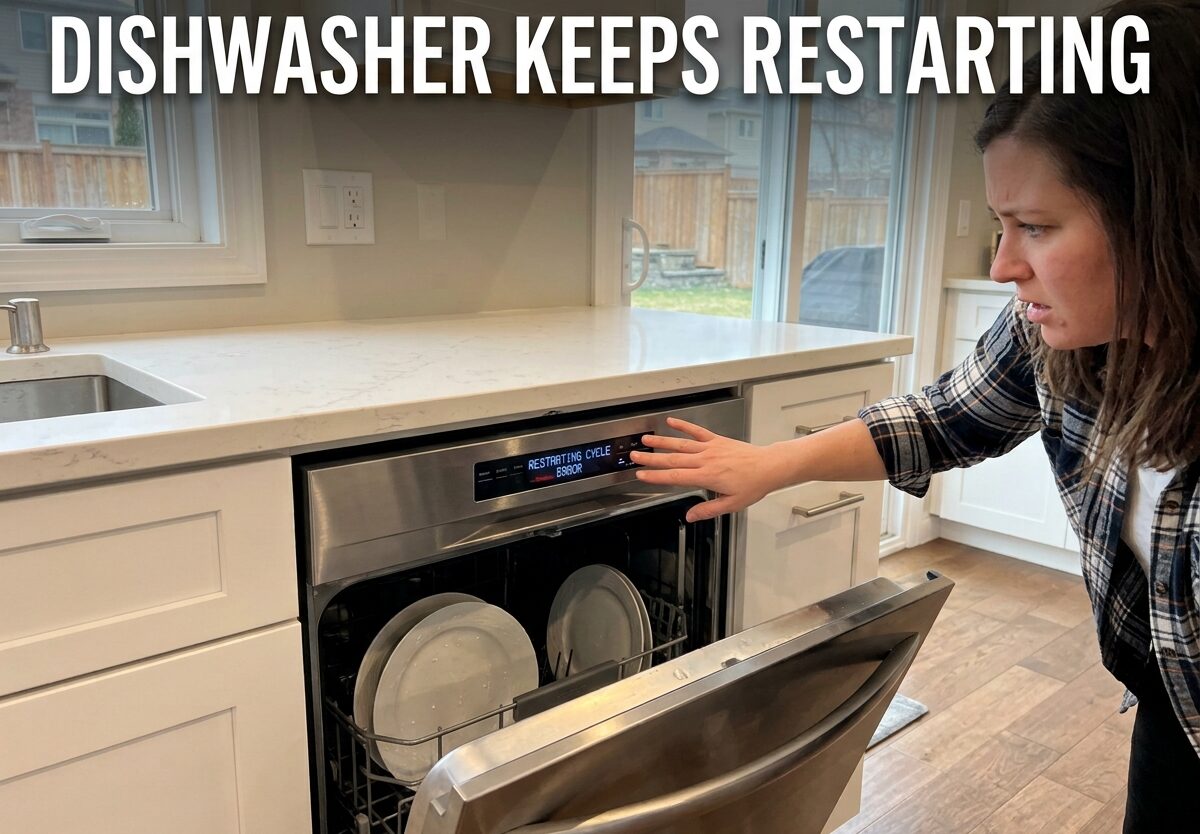
There’s nothing more frustrating than loading your dishwasher, starting a cycle, and coming back later to find it either stopped completely or still running because it keeps restarting. This common issue affects thousands of homeowners annually, leaving them with dirty dishes and mounting frustration.
A dishwasher that keeps restarting typically points to specific component failures or sensor issues that interrupt the wash cycle. The good news is that most causes are diagnosable at home, and some fixes are simple enough for DIY repair. In this guide, I’ll walk you through every possible cause, how to identify which one is affecting your machine, and what steps you can take to resolve the problem.
Whether your dishwasher restarts every few minutes, stops mid-cycle and won’t resume, or seems to get stuck in an endless restart loop, understanding the root cause is the first step toward a solution. Let’s dive into the most common reasons your dishwasher keeps restarting and how to fix them.
8 Common Reasons Your Dishwasher Keeps Restarting
1. Faulty Door Latch Assembly
The door latch assembly is the single most common cause of dishwasher restarting issues. When your dishwasher door doesn’t close properly or the latch switch fails to engage, the control board thinks the door is open and immediately pauses or restarts the cycle for safety reasons.
Symptoms of a faulty door latch include the cycle starting but stopping within minutes, the door not feeling securely closed when latched, or the dishwasher door latch appearing loose or misaligned. You might notice the latch mechanism feels sticky or doesn’t “click” into position as it should.
Testing the door latch is relatively simple. Start by visually inspecting the latch for any visible damage, debris, or buildup that could prevent proper engagement. Clean the latch and surrounding area with a damp cloth to remove any detergent residue or food particles. If the latch appears damaged or the door still doesn’t secure properly, you may need to replace the door latch assembly.
Replacement door latches typically cost between $20-60 for most dishwasher brands and can be installed in under 30 minutes with basic tools. This is often one of the easiest fixes for dishwasher restarting issues.
2. Malfunctioning Control Board
The control board serves as your dishwasher’s brain, coordinating every component and cycle stage. When it malfunctions, you may experience erratic behavior including random restarts, cycles that won’t complete, or error codes that appear without explanation.
Control board issues often develop gradually. You might notice your dishwasher behaving inconsistently before it begins restarting regularly. Common warning signs include unresponsive buttons, delayed responses to commands, or the control panel flickering during operation.
Moisture damage is a leading cause of control board failure. Over time, steam and humidity from the dishwasher can penetrate the control panel housing, causing corrosion on the circuit board. This is particularly common in dishwashers older than 5-7 years.
Diagnosing a bad control board requires eliminating other potential causes first. Once you’ve ruled out door latch, power supply, and sensor issues, a malfunctioning control board becomes more likely. Control board replacement typically costs $150-300 for the part alone, and installation may require professional assistance unless you’re comfortable with electrical repairs.
3. Power Supply Issues
Inconsistent power supply can cause your dishwasher to restart repeatedly. This includes problems with your home’s electrical system, the dishwasher outlet, or the power connection within the unit itself.
Start troubleshooting power issues by checking your home’s circuit breaker panel. Look for any tripped breakers or blown fuses that supply power to the dishwasher. Reset the breaker if necessary, but if it trips again immediately, you may have a short circuit requiring professional diagnosis.
Test the electrical outlet by plugging in another appliance or using a multimeter to verify consistent voltage. The outlet should provide steady 120V power without fluctuation. If voltage drops when the dishwasher starts running, you may have a wiring issue in your home’s electrical system.
Inside the dishwasher, check the junction box where the power cord connects to the unit’s internal wiring. Loose connections here can cause intermittent power loss, triggering restarts. Always disconnect power before inspecting any internal electrical connections.
4. Water Supply Problems
Your dishwasher requires consistent water pressure and flow to complete its cycles properly. When water supply issues occur, the dishwasher may restart as it attempts to compensate for insufficient water intake.
The water inlet valve controls water flow into your dishwasher. When this valve fails partially, it may allow some water in but not enough for proper operation. Your dishwasher will sense the low water level and restart the cycle, creating a frustrating loop.
Check your home’s water supply to the dishwasher by ensuring the water supply valve under the sink is fully open. Inspect the supply line for kinks, bends, or damage that could restrict water flow. If you have low water pressure throughout your home, this could also affect dishwasher performance.
Testing water inlet valve function often requires removing the dishwasher’s lower access panel and running the cycle while observing water flow. If the valve doesn’t open fully or water flow appears restricted, replacement is typically necessary. Water inlet valves cost approximately $30-80 and are relatively straightforward to replace.
5. Faulty Float Switch
The float switch monitors water level inside your dishwasher tub and signals the control board when the appropriate fill level is reached. When this switch malfunctions, your dishwasher may receive incorrect water level readings, causing it to restart or stop prematurely.
A stuck float is often caused by detergent buildup, food particles, or mineral deposits around the float assembly. The float, typically located in the front bottom corner of the tub, should move up and down freely. If it’s stuck in the raised position, your dishwasher will “think” it’s already full and won’t allow proper filling.
Cleaning the float assembly can often resolve this issue. Remove any visible debris around the float mechanism and test its movement by gently lifting and releasing it. The float should drop back down smoothly without sticking.
If cleaning doesn’t resolve the issue, the float switch itself may have failed electrically. Testing requires a multimeter to check for proper continuity when the float is raised and lowered. Float switches are inexpensive parts (usually $15-40) and simple to replace on most dishwasher models.
6. Blown Thermal Fuse
The thermal fuse is a safety device designed to protect your dishwasher from overheating. When it blows due to excessive heat, it cuts power to the control board or motor, causing the dishwasher to stop or restart unexpectedly.
Thermal fuse failure often results from other underlying issues. Restricted water flow, failing pumps, or ventilation problems can cause your dishwasher to overheat, triggering the thermal fuse. Simply replacing the fuse without addressing the root cause will typically result in repeated failures.
Testing a thermal fuse requires a multimeter to check for continuity. A blown fuse will show no continuity, indicating the circuit is broken. If you confirm the fuse has blown, investigate why your dishwasher was overheating before replacing it.
Common causes of overheating include restricted water flow due to clogged filters or spray arms, failing circulation pumps, or blocked ventilation. Address these issues before installing a new thermal fuse to prevent repeat failure.
7. Circulation Pump Failure
The circulation pump is responsible for spraying water throughout the dishwasher during the wash cycle. When this pump begins to fail, it may work intermittently or draw inconsistent power, causing the dishwasher to restart as it attempts to compensate.
Symptoms of circulation pump issues include unusually quiet operation during the wash cycle, dishes that come out dirty despite proper loading, or grinding noises during operation. You might also notice the pump starting but then stopping repeatedly.
Circulation pump failure is more common in older dishwashers (8+ years) and can be caused by worn bearings, seal failures allowing water into the motor, or electrical issues within the pump itself. Unfortunately, circulation pump replacement is one of the more expensive dishwasher repairs, typically costing $150-400 for parts and labor.
Before condemning the circulation pump, ensure nothing is blocking the spray arms or filters that could restrict water flow and cause the pump to struggle.
8. Drain Pump Problems
While less common than other causes, a failing drain pump can also cause restart issues. If your dishwasher cannot drain water properly between cycle stages, it may restart or pause as water accumulates in the tub.
Drain pump problems often manifest as water remaining in the bottom of the dishwasher after cycles complete, slow drainage, or unusual noises during drain cycles. You might also notice the dishwasher stopping mid-cycle and displaying drain-related error codes.
Before replacing the drain pump, check the drain hose for kinks or clogs and inspect the drain filter for debris buildup. Many apparent drain pump failures are actually caused by obstructions in the drain system.
Drain pumps typically cost $75-200 and are moderately difficult to replace, requiring some disassembly of the dishwasher’s lower components.
Step-by-Step Troubleshooting Guide
Now that you understand the potential causes, let’s walk through a systematic troubleshooting process to identify what’s causing your dishwasher to keep restarting. Follow these steps in order to efficiently diagnose the issue.
Tools You’ll Need:
- Multimeter for electrical testing
- Screwdriver set (Phillips and flathead)
- Flashlight or work light
- Small brush for cleaning
- Towels for water cleanup
Safety First: Always disconnect power to your dishwasher before performing any inspection or repair. Either unplug it or turn off the circuit breaker. Never work on electrical components with power connected.
Step 1: Verify the Door Latch
Start with the simplest and most common cause. Inspect the door latch for visible damage or debris. Clean the latch area thoroughly and test the door closure. The door should click securely into place with no wiggle or movement when latched. If the latch feels loose or damaged, replacement is likely needed.
Step 2: Check Power Supply
Verify your circuit breaker hasn’t tripped and the outlet is providing consistent power. Listen for any clicking sounds from the junction box when the dishwasher attempts to start, which could indicate loose wiring connections.
Step 3: Inspect Water Supply
Ensure the water supply valve under your sink is fully open. Check the supply line for kinks or damage. Run a short cycle while observing water flow into the tub (you may need to remove the lower access panel to see this).
Step 4: Test the Float Switch
Locate the float assembly in the tub bottom. Lift and release it to ensure free movement. Clean around the float area to remove any debris that could cause sticking.
Step 5: Check for Error Codes
Many modern dishwashers display error codes when issues occur. Note any flashing lights or code displays and consult your owner’s manual for interpretation. These codes can significantly narrow down the problem.
Step 6: Inspect Filters and Spray Arms
Remove and clean all filters. Check that spray arms spin freely and their holes aren’t clogged with mineral deposits or debris. Restricted water flow can cause multiple issues leading to restarts.
Step 7: Test Components with Multimeter
If you’re comfortable with electrical testing, use a multimeter to test the door latch switch, float switch, and thermal fuse for proper continuity. This can definitively identify which component has failed.
Brand-Specific Reset Procedures
Sometimes a simple reset can resolve minor electronic glitches causing restart issues. Here are reset procedures for major dishwasher brands:
Whirlpool/KitchenAid/Maytag: Press the “Heated Dry” button, then press “Normal Wash,” then “Heated Dry” again, then “Normal Wash” again. All lights should illuminate, indicating the diagnostic mode. Press “Cancel” to exit and reset the control board.
Bosch: Press and hold the “Start” button for 3-5 seconds until the active light turns off. This resets most Bosch models. For newer models with a display, look for a “Reset” option in the menu.
Samsung: Press and hold the “Power” button and the “Auto” button simultaneously for 3 seconds. The display should flash, indicating a reset. For models without physical buttons, press “Power” twice within 3 seconds.
LG: Many LG models reset by pressing and holding the “Power” button for 3-5 seconds. For turbo mode restart issues specifically noted by users, try selecting a different cycle first before attempting the reset.
GE: Press the “Reset” or “Start/Reset” button and hold for 10 seconds. The pump should run for 2 minutes as the system resets. For older GE models, open the door during a cycle and press “Start/Reset” twice.
Kenmore: Most Kenmore dishwashers (manufactured by various companies) use the same reset procedures as the manufacturer brand. SearsPartsDirect provides model-specific instructions if needed.
DIY vs Professional Repair: Cost Guide
Deciding whether to tackle repairs yourself or call a professional depends on the specific issue, your comfort level with appliance repair, and the cost of parts versus service fees. Use this guide to help decide.
Suitable for DIY Repair:
- Door latch assembly replacement ($20-60 parts)
- Float switch cleaning or replacement ($15-40 parts)
- Filter and spray arm cleaning (no cost)
- Water inlet valve replacement ($30-80 parts)
- Thermal fuse replacement ($10-30 parts)
Consider Professional Repair:
- Control board replacement ($150-300 parts + $150-200 labor)
- Circulation pump replacement ($150-400 parts + $150-200 labor)
- Drain pump replacement ($75-200 parts + $100-150 labor)
- Electrical diagnosis beyond basic component testing
- Multiple component failures
When to Consider Replacement:
If your dishwasher is over 10 years old, repair costs exceed 50% of replacement cost, or multiple components have failed simultaneously, replacement may be more economical than repair. The average dishwasher lifespan is 10-15 years with proper maintenance.
Frequently Asked Questions
Why does my dishwasher start and stop repeatedly?
Your dishwasher starts and stops repeatedly when the control board receives interrupted signals from door latch switches, float sensors, or thermal fuses. This safety feature prevents operation when conditions aren’t suitable for completing the cycle properly. The most common causes include a faulty door latch that doesn’t engage properly, a malfunctioning float switch stuck in the wrong position, or power supply inconsistencies. Addressing these underlying issues typically resolves the start-stop pattern.
What is the lifespan of an average dishwasher?
The average dishwasher lasts between 10-15 years with proper maintenance and regular care. Higher-end models from brands like Bosch and Miele often last toward the longer end of this range, while budget models may need replacement after 8-10 years. Factors affecting lifespan include water quality, usage frequency, maintenance habits like filter cleaning, and whether problems are addressed promptly or allowed to worsen. Regular cleaning of filters, spray arms, and door gaskets can extend your dishwasher’s life by several years.
Why does my dishwasher keep needing to be reset?
Your dishwasher keeps needing to be reset when underlying issues aren’t being addressed, only temporarily bypassed. Common causes include a failing control board that’s deteriorating, moisture damage to electronic components, or a door latch that intermittently fails. Simply resetting the dishwasher without fixing the root cause will always result in repeated issues. The need for frequent resets typically indicates progressive component failure that will eventually require repair or replacement. Diagnosing the specific cause now can prevent more expensive damage later.
How to tell if a dishwasher control board is bad?
A bad dishwasher control board typically shows multiple symptoms including unresponsive buttons that don’t register presses, the control panel flickering or dimming during operation, error codes appearing for no apparent reason, and cycles stopping at random points. You might notice the dishwasher behaving inconsistently or not responding to any commands. Control board issues often develop gradually, so you may experience intermittent problems before complete failure. Testing requires a multimeter to check for proper voltage output, but since control boards are complex electronic components, definitive diagnosis often requires professional assessment.
How do I reset a dishwasher control board?
Resetting a dishwasher control board varies by brand but typically involves either holding specific button combinations or disconnecting power. For most models, turn off the dishwasher at the circuit breaker or unplug it for 5 minutes, then restore power. This simple power cycle often clears minor electronic glitches. Brand-specific reset procedures include pressing and holding the Start button on Bosch models, the Power button on LG models, or using button sequences like Heated Dry-Normal Wash-Heated Dry-Normal Wash on Whirlpool machines. Consult your owner’s manual for model-specific instructions, as reset procedures vary significantly between manufacturers.
Is it normal for a dishwasher to pause during cycle?
Yes, it’s normal for dishwashers to pause briefly during certain cycle stages. These intentional pauses occur when the dishwasher heats water between cycles, switches between wash and rinse phases, or allows detergent to activate. However, pauses lasting longer than a few minutes or frequent stopping and restarting isn’t normal. If your dishwasher pauses for extended periods, stops completely and won’t resume, or restarts the entire cycle repeatedly, this indicates a problem. Normal pauses are brief and part of the programmed cycle, while problematic stopping results from component failures or sensor issues.
Conclusion
A dishwasher that keeps restarting is frustrating but usually diagnosable with systematic troubleshooting. Start with the simple fixes like checking the door latch and cleaning filters before moving to more complex issues like control board or pump problems. Most homeowners can resolve basic issues themselves, but don’t hesitate to call a professional for electrical diagnostics or expensive component replacements.
Regular maintenance can prevent many dishwasher restarting issues. Clean filters monthly, inspect door gaskets for wear, and address minor problems promptly before they escalate into major failures. When properly maintained, your dishwasher should provide reliable service for over a decade.
If your dishwasher keeps restarting despite troubleshooting all common causes, or if repair costs approach half the price of replacement, it may be time to consider upgrading to a new model. Modern dishwashers offer improved efficiency and reliability compared to units older than 10 years.



Leave a Comment