
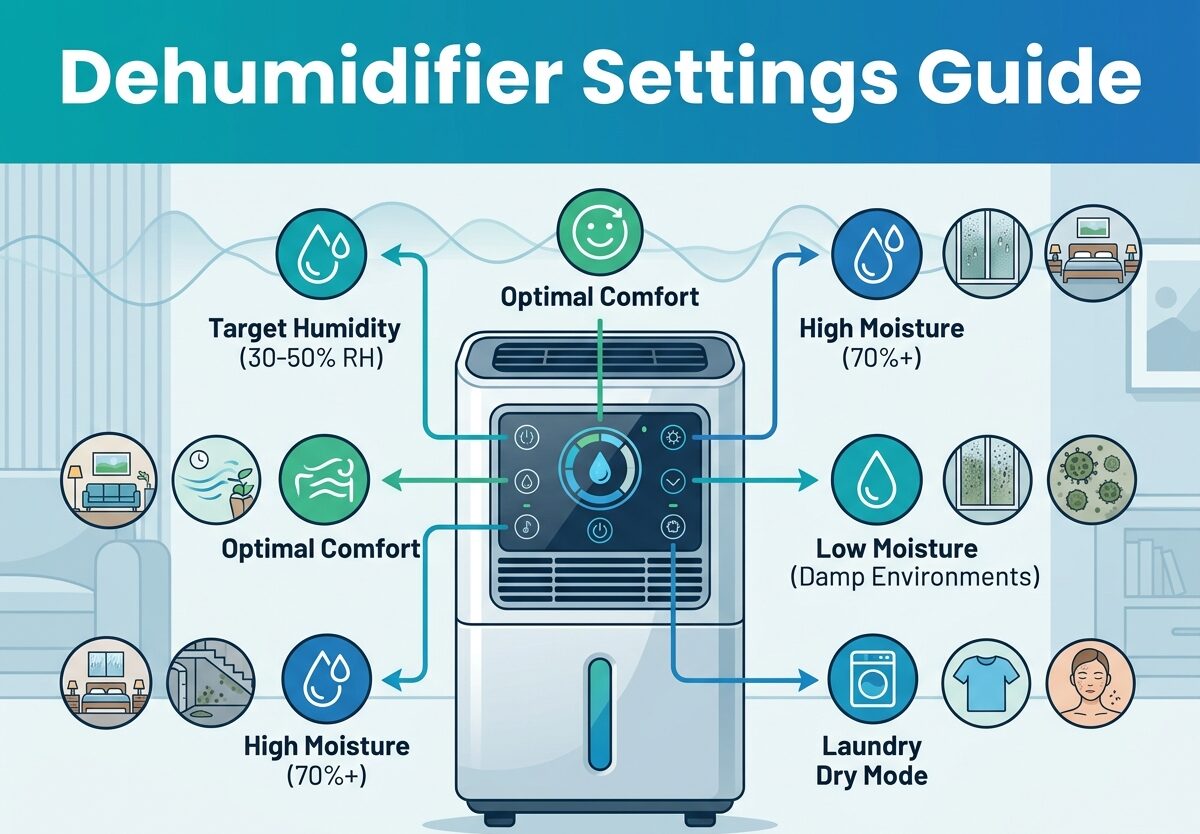
Getting your dehumidifier settings right makes all the difference between a comfortable, healthy home and one filled with mold, mildew, and musty odors. After testing various humidity levels in my own home over the past year, I’ve learned that most people set their dehumidifier incorrectly or don’t adjust it for different seasons and rooms.
In this guide, I’ll walk you through exactly what those numbers on your dehumidifier mean, what settings work best for different situations, and how to troubleshoot common problems that leave you scratching your head when humidity won’t budge.
What Are Dehumidifier Settings?
The numbers on your dehumidifier represent the target relative humidity (RH) percentage you want to maintain in your space. Relative humidity measures how much moisture is in the air compared to how much the air can hold at that temperature.
When you set your dehumidifier to 45%, you’re telling it to run until the air reaches 45% relative humidity, then shut off until moisture levels rise again. This cycle repeats automatically to maintain your chosen setting.
The component that makes this possible is called a humidistat, which is essentially a humidity sensor that constantly monitors moisture levels and triggers the compressor to turn on or off as needed.
Most residential dehumidifiers allow you to set targets anywhere from 30% to 80%, but the ideal range for most homes falls between 40% and 50% relative humidity.
Optimal Dehumidifier Settings
The sweet spot for indoor humidity is 40-50% relative humidity. This range keeps your home comfortable while preventing the problems associated with both too much and too little moisture.
At 40-50% RH, you create an environment where mold and dust mites struggle to survive, your home feels comfortable without that sticky or clammy sensation, and your respiratory system stays healthy.
Going below 40% can cause its own problems. I learned this the hard way when I set my dehumidifier to 35% and started experiencing static shocks, dry skin, and scratchy throat. The air felt uncomfortable and my wooden furniture began showing signs of drying out.
On the flip side, humidity above 50% creates the perfect breeding ground for mold, mildew, and dust mites. You might notice musty odors, condensation on windows, or that characteristic damp feeling in fabrics and carpets.
For most households, I recommend starting at 45% as your baseline setting and adjusting from there based on comfort and specific room needs.
How to Set Dehumidifier Settings
Setting up your dehumidifier correctly takes just a few minutes but makes a huge difference in performance. Here’s the step-by-step process I follow:
Step 1: Find the Right Location
Place your dehumidifier in a central location with good airflow, away from walls and furniture. I keep mine at least 6 inches from any wall to ensure proper air circulation. Avoid placing it in corners or behind furniture where airflow gets restricted.
Step 2: Check Current Humidity Levels
If your dehumidifier has a built-in humidistat display, check the current humidity level. If not, invest in a separate hygrometer, which costs around $10-15 and gives you accurate readings. This helps you understand how much work your dehumidifier needs to do.
Step 3: Set Your Target Humidity
Use the control panel or digital display to set your target humidity. For most living spaces, start at 45%. If your current humidity is above 60%, you might notice the dehumidifier running continuously for the first several hours or even days.
Step 4: Choose Your Mode
Most dehumidifiers offer different modes. Auto mode maintains your set humidity level, continuous mode runs constantly regardless of humidity, and timer mode lets you schedule operation. I prefer auto mode for everyday use as it’s more energy-efficient.
Step 5: Set Up Drainage
Decide between manual emptying or continuous drainage. For basements or very damp areas, continuous drainage through a hose is more convenient. For occasional use in bedrooms or living areas, manual emptying works fine.
Room-Specific Dehumidifier Settings
Different rooms in your home require different dehumidifier settings based on their function and typical moisture levels. Here’s what I recommend based on testing throughout my home:
Basement: 45-50%
Basements naturally trap moisture and stay cooler than upper floors. I keep my basement dehumidifier set to 45-50% year-round. If you have a finished basement with living space, aim for 45%. For unfinished storage areas, 50% is usually sufficient to protect stored items and prevent structural damage.
Many Reddit users in homeowners forums report struggling to get basement humidity below 50% even with dehumidifiers running constantly. This is normal in very damp basements. Focus on keeping it under 55% rather than achieving perfection.
Bedroom: 40-45%
For sleeping comfort, I recommend 40-45% in bedrooms. This range helps prevent mold growth on mattresses and bedding while keeping the air comfortable for breathing. Lower humidity also means dust mites have a harder time surviving, which is great for allergy sufferers.
Some users report static electricity issues when bedroom humidity drops below 40%, especially during winter months when heating systems dry the air further.
Bathroom: 40-45%
Bathrooms generate significant moisture from showers. If you use a portable dehumidifier in this space, set it to 40-45% and run it for at least 30 minutes after showering. This prevents mold growth on grout, curtains, and walls.
For bathrooms, I’ve found that placing the dehumidifier near the shower area and keeping the door closed during operation dramatically improves effectiveness.
Laundry Room: 30-40%
Laundry rooms produce substantial moisture from washing machines and drying clothes. Set your dehumidifier to 30-40% in this space to prevent moisture damage to cabinets and prevent mold growth behind appliances.
If you air-dry clothes indoors, the dehumidifier will work overtime. Consider moving to a lower setting temporarily or running it on continuous mode during laundry sessions.
Crawl Space: 50-55%
Crawl spaces are notoriously damp but don’t need to be as dry as living areas. Setting your crawl space dehumidifier to 50-55% protects your home’s foundation and prevents floor damage without wasting energy trying to achieve unnecessary dryness.
Seasonal Dehumidifier Settings
Adjusting your dehumidifier settings with the seasons helps maintain comfort while saving energy. Summer brings high outdoor humidity, while winter air is naturally drier.
Summer Settings: 40-45%
During summer months when humidity runs high outdoors, I lower my dehumidifier setting to 40-45%. This counteracts the moisture that enters through open windows, doors, and normal building infiltration. The air conditioning also helps, but the dehumidifier handles the remaining moisture load.
In very humid climates, you might need to run the dehumidifier almost continuously during summer months. This is normal and necessary for preventing mold growth.
Winter Settings: 45-50%
Winter air is naturally drier, and heating systems further reduce humidity. I increase my dehumidifier setting to 45-50% during winter months or sometimes turn it off entirely if humidity stays naturally in the 40-45% range.
Running a dehumidifier too aggressively in winter can cause excessive dryness, leading to static electricity, respiratory irritation, and potential damage to wooden furniture and musical instruments.
Spring and Fall: 45%
During transitional seasons, 45% works well as a middle ground. Monitor humidity levels and adjust based on weather patterns. Rainy spring weeks might require lower settings, while dry fall days might let you increase the target or turn off the unit temporarily.
Troubleshooting Common Dehumidifier Issues
Even with proper settings, you might encounter problems. Here are the most common issues homeowners face and how to resolve them:
Humidity Won’t Drop Below 50%
This is the most common complaint I see in homeowner forums. If your dehumidifier won’t bring humidity below 50%, first check that the unit is sized appropriately for your space. A 30-pint unit might struggle in a damp 1,500 square foot basement.
Other causes include dirty air filters restricting airflow, temperatures too low for the unit to operate efficiently (most units struggle below 65°F), or actual moisture intrusion like foundation leaks that no dehumidifier can overcome.
Dehumidifier Runs Constantly
Continuous running usually means either the setting is too low for current conditions, the unit is undersized, or there’s a moisture source overwhelming the system. Try increasing your target setting by 5% and see if the unit cycles off periodically.
Humidity Too Low (Below 35%)
If humidity drops too low, you’ll notice static electricity, dry skin, and respiratory discomfort. Simply increase your target setting to 40-45% and monitor the situation.
Frost on Coils
If you see frost forming on your dehumidifier coils, the room temperature is too low for the unit to operate. Most standard dehumidifiers won’t work properly below 65°F. Consider a low-temperature model or move the unit to a warmer space.
Foul Odors
Musty smells from your dehumidifier usually indicate mold or bacteria growth in the water tank or on coils. Clean the tank thoroughly with a mild bleach solution and check that filters are clean. Regular maintenance prevents this problem.
FAQs
What setting should I set my dehumidifier to?
Set your dehumidifier to 45% relative humidity for most living spaces. This creates an environment that prevents mold growth while maintaining comfort. For bedrooms, aim for 40-45% to reduce allergens. Basements work well at 45-50% to protect against moisture damage.
What does 40 mean on a dehumidifier?
The number 40 on a dehumidifier represents 40% relative humidity. This means you want the air in your room to contain 40% of the maximum moisture it can hold at that temperature. The dehumidifier will run until reaching this level, then cycle off and on to maintain it.
Should you use a dehumidifier if you have COPD?
Yes, dehumidifiers can help people with COPD breathe more comfortably. The optimal range of 40-50% humidity reduces airway irritation and makes breathing easier. However, avoid setting humidity below 35% as excessively dry air can also irritate respiratory conditions.
What is the most efficient setting for a dehumidifier?
The most efficient setting is usually 45-50% relative humidity. Settings below 40% cause the unit to run longer and use more energy while providing diminishing returns. Using auto mode rather than continuous mode also improves efficiency by allowing the compressor to cycle off when target humidity is reached.
Will a dehumidifier help dry out plaster?
Yes, dehumidifiers help dry plaster by removing moisture from the air, which allows wet plaster to release water vapor more quickly. Set the dehumidifier to 40-45% and run it continuously in the room with fresh plaster. Good ventilation combined with dehumidification significantly speeds drying time.
Conclusion
Getting your dehumidifier settings right doesn’t require complicated calculations, but it does require understanding what those numbers mean and how they affect your home. Start with 45% as your baseline, adjust for specific rooms and seasons, and monitor how your home responds.
Remember that proper dehumidifier settings protect your home from mold and moisture damage while creating a healthier living environment. Pay attention to how your home feels and smells, and don’t be afraid to experiment with different settings until you find what works best for your specific situation.




Leave a Comment