
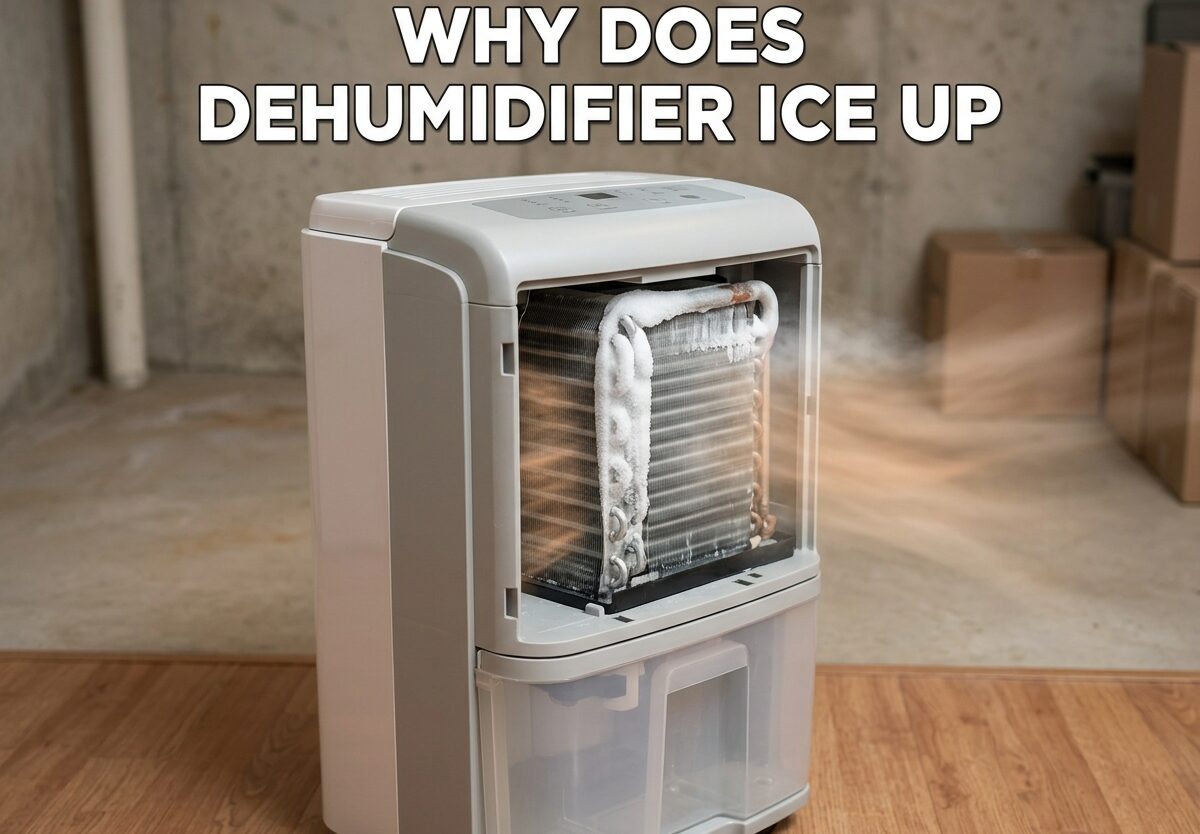
If you’ve noticed ice building up on your dehumidifier, you’re not alone. This is one of the most common problems homeowners face with dehumidifiers, especially in basements and cooler spaces. A dehumidifier ices up when the cooling coils become so cold that condensation freezes instead of draining as liquid water. This typically happens when room temperature drops below 65°F (18°C) or when airflow is restricted by dirty filters or blocked vents.
The ice buildup prevents your unit from removing moisture effectively and can cause permanent damage if left unchecked. I’ve researched the science behind this issue and compiled the most common causes along with practical solutions to help you get your dehumidifier working properly again.
Why Does Dehumidifier Ice Up – The Science Behind It
Dehumidifiers work by drawing warm, moist air over cold evaporator coils. When the warm air hits these cold coils, the moisture condenses into water droplets that collect in the tank or drain away. The coils need to be cold enough to cause condensation, but not so cold that the water freezes into ice.
Under normal conditions, the refrigerant in the coils maintains a temperature just above freezing. This allows water to condense and flow into the collection tank. However, several factors can cause the coil temperature to drop below freezing, turning that condensation into ice. Once ice begins to form, it insulates the coils and makes them even colder, creating a cycle that leads to more ice buildup.
The critical temperature threshold is 65°F (18°C). When room temperature falls below this point, standard dehumidifiers struggle to maintain proper coil temperature. This explains why basement dehumidifiers are particularly prone to icing during winter months when temperatures drop.
Normal frost that appears briefly when the unit starts is typically not a concern. This light frost usually melts within a few minutes of operation as the system reaches equilibrium. Problematic ice buildup, however, persists and grows thicker over time, eventually blocking airflow completely.
7 Common Causes of Dehumidifier Icing Up
1. Room Temperature Too Low (Most Common Cause)
This is the number one reason dehumidifiers ice up. Standard residential dehumidifiers are designed to operate in temperatures above 65°F (18°C). When the room temperature drops below this threshold, the coils become too cold and condensation freezes instantly.
Basements are particularly susceptible to this problem during fall and winter months. I’ve seen countless reports from homeowners who only notice the icing issue when temperatures drop seasonally. The solution is simple: either move the unit to a warmer location or invest in a low-temperature dehumidifier designed for basement use.
Some modern units include auto-defrost features that can handle temperatures as low as 41°F (5°C). If you need to dehumidify a cold space, these specialized models are worth considering.
2. Dirty Air Filter Restricting Airflow
Your dehumidifier’s air filter is the first line of defense against dust and debris. Over time, this filter becomes clogged and restricts airflow across the cooling coils. When warm air can’t reach the coils efficiently, the coil temperature drops drastically and ice begins to form.
This is one of the easiest problems to fix. I recommend checking your filter monthly and cleaning it every 2-4 weeks depending on usage. Most filters can be cleaned with warm water and mild soap, then allowed to air dry completely before reinstalling.
A simple way to check if your filter is causing the issue is to run the unit with the filter removed temporarily (for just a few minutes). If the icing stops, you’ve found your culprit. Just remember to never run the unit without a filter for extended periods.
3. Blocked or Clogged Coils
Dust, pet hair, and debris can accumulate directly on the cooling coils over time. This buildup acts as insulation, preventing proper heat transfer and causing the coils to become abnormally cold. The result is rapid ice formation that can completely cover the coils within hours.
Users on HVAC forums consistently report that dirty coils are responsible for most recurring icing problems. Even with regular filter maintenance, fine dust can eventually coat the coils and reduce efficiency.
Cleaning coils requires accessing the internal components of your dehumidifier. You can use a soft brush or compressed air to gently remove debris from the coil surfaces. For stubborn buildup, a coil cleaning solution specifically designed for HVAC equipment can help dissolve accumulated grime.
4. Faulty Humidistat
The humidistat is the sensor that measures humidity levels and tells your dehumidifier when to run. When this component malfunctions, it can cause the unit to run continuously even when humidity levels are already low. This excessive runtime leads to coil icing as the coils stay cold far longer than necessary.
A telltale sign of humidistat failure is a dehumidifier that never cycles off. If your unit runs constantly regardless of the humidity setting, the humidistat may be the problem. Some models allow you to test this by setting the humidity to the highest setting. If the unit continues running non-stop, the humidistat likely needs replacement.
This repair typically requires professional service unless you’re comfortable working with electrical components and can source the correct replacement part for your specific model.
5. Low Refrigerant Level
Your dehumidifier relies on refrigerant to cool the coils and extract moisture from the air. When refrigerant levels drop due to a leak or improper charging, the system cannot maintain proper pressure. This causes the coils to become abnormally cold and ice up quickly.
Unlike some other causes, low refrigerant typically produces ice very rapidly. Users report seeing ice form within just a few minutes of turning on the unit. If you notice ice developing this quickly, low refrigerant is a likely culprit.
Refrigerant leaks are not a DIY fix. A certified HVAC technician will need to locate and repair the leak, then recharge the system with the correct type and amount of refrigerant. The cost of this repair can sometimes approach the price of a new unit, so replacement may be the more economical option.
6. Oversized Unit for the Space
Bigger isn’t always better when it comes to dehumidifiers. An oversized unit for your square footage will cycle on and off rapidly, never running long enough to establish stable operation. This short-cycling causes temperature fluctuations that lead to icing.
A properly sized dehumidifier should run for longer periods but cycle off occasionally. If your unit constantly turns on and off every few minutes, it’s likely too large for the space. The rapid cooling followed by warm periods creates perfect conditions for ice formation.
Manufacturers provide square footage guidelines for each model. Measuring your space and choosing an appropriately sized unit can prevent this issue. In some cases, running a larger unit on a lower setting can help, but a properly sized unit will always perform better.
7. Poor Air Circulation Around the Unit
Your dehumidifier needs adequate clearance to draw in air and exhaust it properly. When placed too close to walls, furniture, or other obstructions, airflow becomes restricted. This restriction prevents warm air from reaching the coils effectively, causing them to over-cool and ice up.
Most manufacturers recommend at least 6-12 inches of clearance on all sides of the unit. I’ve seen countless cases where simply moving a dehumidifier away from a corner or wall completely resolved icing issues.
Also consider whether curtains, storage items, or other objects might be blocking the intake or exhaust vents. Keeping the area around your dehumidifier clear ensures proper airflow and helps prevent many common problems.
How to Fix an Iced-Up Dehumidifier
Step 1: Turn Off the Unit Immediately
When you notice ice on your dehumidifier, the first step is to turn it off and unplug it. Continuing to run a frozen unit can damage the compressor and other components. The compressor relies on refrigerant flow for cooling, and ice buildup restricts this flow, potentially causing the compressor to overheat.
Never try to chip or scrape ice off the coils. The coils are made of thin metal that can be easily damaged. You could also puncture a refrigerant line, which would require professional repair or unit replacement.
Step 2: Allow Complete Defrosting
Place towels around the unit to catch water as the ice melts. Let the dehumidifier sit for at least 2-4 hours, or overnight if the ice buildup is substantial. All ice must be completely melted before proceeding to the next steps.
Some users speed up this process by directing a fan toward the unit or placing it in a warmer room. Just avoid using heat sources like hair dryers, which can damage plastic components and create condensation inside electrical parts.
Step 3: Clean the Air Filter
Once the unit is completely defrosted, remove and inspect the air filter. Hold it up to a light source. If you can’t see light through the filter, it needs cleaning. Wash it with warm water and mild soap, rinse thoroughly, and let it air dry completely.
While the filter is drying, use a vacuum with a brush attachment to remove any visible dust from the vents and exterior grilles. This simple maintenance step resolves many icing issues.
Step 4: Check and Clean the Coils
Access the coils according to your owner’s manual (this may require removing a panel). Look for visible dust, debris, or pet hair on the coil surfaces. Use a soft brush or vacuum to gently remove any buildup. For stubborn dirt, a commercial coil cleaner can be applied according to the manufacturer’s instructions.
Be very gentle when cleaning coils. The aluminum fins bend easily, and damage to the fins will reduce efficiency even if the coils are clean.
Step 5: Verify Proper Placement
Ensure the unit has adequate clearance on all sides (6-12 inches minimum). Check that nothing is blocking the intake or exhaust vents. If the unit is in a particularly cold area, consider relocating it to a warmer space.
For basement installations, placing the unit on a raised platform can improve airflow and help prevent icing. Also verify that the room temperature stays above 65°F (18°C) whenever the dehumidifier is running.
Step 6: Test the Unit
After completing the above steps, plug in the unit and turn it on. Monitor it closely for the first hour of operation. If ice begins to form again within this time, the problem may be low refrigerant or a faulty component requiring professional service.
If the unit runs without icing for several hours, you’ve likely resolved the issue. Continue monitoring periodically and repeat the cleaning process monthly to prevent future problems.
Signs Your Dehumidifier Has a Refrigerant Leak
Low refrigerant is a more serious issue that typically requires professional repair. Unlike dirty filters or poor placement, this problem won’t be resolved with simple maintenance. Here are the telltale signs that your dehumidifier may have a refrigerant leak.
Ice forms within minutes of startup. If you notice significant ice buildup just 5-10 minutes after turning on the unit, low refrigerant is very likely the cause. Other problems typically take longer to manifest.
Ice pattern is uniform and soft. Refrigerant-related ice often covers the coils evenly and has a softer, slushier consistency compared to the hard ice formed by airflow issues.
Unit runs but removes little moisture. Without proper refrigerant levels, your dehumidifier cannot efficiently extract water from the air. You may notice the tank collects very little water even after hours of operation.
Visible oil residue around connections. Refrigerant carries oil through the system. If you notice oily spots near refrigerant lines or connections, this indicates a leak.
If you observe these signs, contact a qualified appliance repair technician or consider replacement if the unit is older. Refrigerant repairs typically cost between $100-300, which may not be worthwhile for an aging dehumidifier.
Prevention Tips to Stop Dehumidifier Icing
Preventing ice buildup is easier than dealing with it after it occurs. These simple maintenance habits and operational guidelines can help keep your dehumidifier running efficiently year-round.
Maintain adequate room temperature. Never run a standard dehumidifier in temperatures below 65°F (18°C). For basement or garage use, choose a model specifically designed for low-temperature operation. Some units can function in temperatures as low as 41°F (5°C).
Clean the filter monthly. A clean filter is the single most effective prevention measure. Mark your calendar or set a phone reminder to check and clean the filter every 4 weeks. This simple 5-minute task prevents the majority of icing problems.
Provide proper clearance. Maintain 6-12 inches of space around all sides of the unit. Never place it directly against a wall or in a corner. Ensure furniture, curtains, or storage items don’t block air intake or exhaust.
Consider humidity level. Setting your dehumidifier to an unrealistically low humidity level (below 30%) can cause excessive runtime and icing. Most experts recommend 40-50% humidity for comfort and mold prevention.
Perform annual deep cleaning. Once a year, perform a thorough cleaning of the coils, drain pan, and interior components. This annual maintenance removes accumulated dust that filters can’t catch and helps ensure reliable operation.
Allow defrost cycles. If you notice light frost forming briefly when the unit starts, this is normal. However, if you see persistent ice, turn off the unit and allow it to defrost completely before restarting. Some users find success running the unit on a timer to allow periodic defrosting.
Consider replacement for older units. Dehumidifiers typically last 5-10 years. If your unit is older and experiencing repeated icing issues despite proper maintenance, replacement may be more cost-effective than repair. Newer models also tend to be more energy-efficient.
FAQs
How do I stop my dehumidifier from icing up?
To stop dehumidifier icing, ensure room temperature stays above 65°F (18°C), clean or replace the air filter monthly, maintain 6-12 inches of clearance around the unit, and check that air vents aren’t blocked. If ice persists after these steps, the issue may be low refrigerant requiring professional repair.
Is there supposed to be ice in my dehumidifier?
Light frost that appears briefly when starting the unit is normal and should melt within a few minutes. However, persistent ice that grows thicker over time is not normal and indicates a problem. Common causes include room temperature below 65°F, dirty filters, blocked airflow, or low refrigerant levels.
How to tell if a dehumidifier needs refrigerant?
Signs of low refrigerant include ice forming within minutes of startup, the unit running but removing little water, uniform soft ice pattern on coils, and visible oily residue near refrigerant connections. These symptoms indicate a leak that requires professional repair or unit replacement.
Why is my dehumidifier icing up and leaking?
When a dehumidifier ices up, water from melting ice can overflow the collection tank and cause leaking. The ice prevents proper drainage, and when the unit cycles off, the melting ice has nowhere to go but onto your floor. Fix the underlying icing issue first, and the leaking should stop.
Can a frozen dehumidifier cause damage?
Yes, running a frozen dehumidifier can damage the compressor and other components. The ice restricts refrigerant flow, causing the compressor to overheat. Always turn off and unplug a frozen unit immediately and allow it to defrost completely before restarting to prevent permanent damage.
Conclusion
Dehumidifier ice up is a frustrating but usually preventable problem. The most common causes are room temperature below 65°F, dirty air filters, and restricted airflow around the unit. By maintaining proper temperature conditions, cleaning filters monthly, and ensuring adequate clearance, most icing issues can be prevented entirely.
When ice does occur, turn off the unit immediately and allow complete defrosting before attempting any troubleshooting. Start with the simple solutions (filter cleaning, checking placement) before moving to more complex possibilities like low refrigerant or faulty components.
If you’ve tried all the maintenance steps and icing persists, especially if ice forms rapidly within minutes of startup, consult a professional technician. Low refrigerant or component failure may be the cause, and these issues require specialized knowledge to repair safely and effectively.





Leave a Comment