
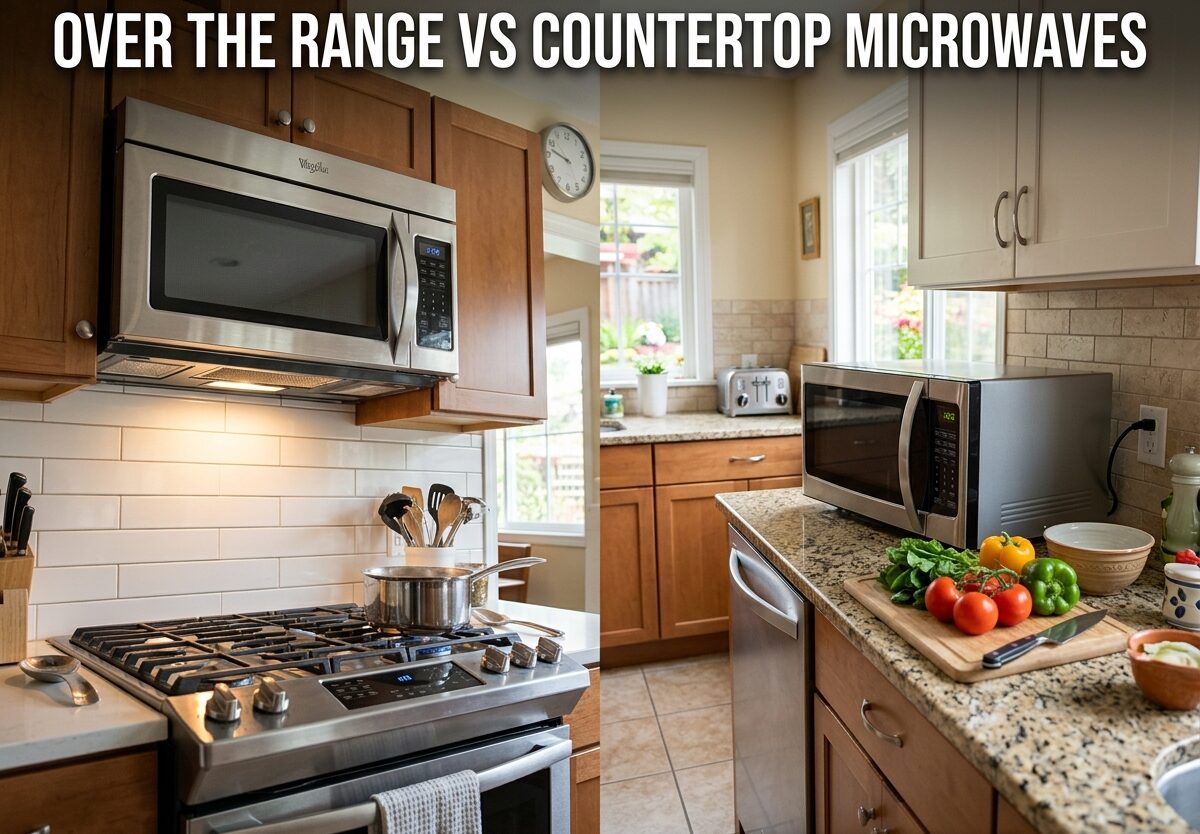
Choosing between over the range vs countertop microwaves is one of the most common kitchen design decisions homeowners face. Countertop models offer accessibility and affordability, while over-the-range (OTR) units save counter space and provide built-in ventilation. The right choice depends on your kitchen layout, budget, accessibility needs, and how you cook.
After researching this topic extensively, I’ve found that most users prioritize different factors: some need maximum counter space, others require easy access for family members, and many are concerned about ventilation performance. This guide breaks down everything you need to know to make the right decision for your situation.
Over The Range Vs Countertop Microwaves: Quick Comparison
The fundamental difference between these two microwave types comes down to placement and functionality. Countertop microwaves sit on your counter and plug into a standard outlet, while OTR microwaves mount above your range and include an exhaust fan system.
Countertop models typically cost between $50 and $400, with most quality units falling in the $150-250 range. Over-the-range microwaves start around $300 and can exceed $800 for premium models with convection features. The price gap reflects both the additional ventilation components and the complexity of OTR installation.
For quick reference, here are the core differences:
Countertop Microwaves: Easy to install, fully accessible, portable, budget-friendly, but consume counter space and lack ventilation.
Over-the-Range Microwaves: Space-saving design, built-in ventilation, streamlined appearance, but harder to install, less accessible, and more expensive to replace.
Countertop Microwaves: Everything You Need to Know
Countertop microwaves are the most common and familiar type. These freestanding units simply need a flat surface and a standard electrical outlet to operate. They come in a wide range of sizes, from compact 0.5 cubic foot models perfect for dorm rooms to family-sized units exceeding 2.2 cubic feet.
These microwaves typically offer wattage ranging from 700 to 1,250 watts, with most quality models providing 900-1,100 watts for even cooking. The higher the wattage, the faster and more evenly your food will cook. I’ve found that 1,000 watts is the sweet spot for most households.
The main advantages of countertop models include straightforward installation, easy accessibility for all family members, and simple replacement when the unit fails. If your microwave breaks, you can unplug it and buy a new one the same day. There’s no need to call an installer or worry about cabinet modifications.
Countertop microwaves also tend to offer larger interior capacities relative to their exterior dimensions. A 2.0 cubic foot countertop model often provides more usable cooking space than a similarly-sized OTR unit. This matters if you regularly heat large dishes or cook for a big family.
However, the primary drawback is counter space consumption. In smaller kitchens, dedicating 2-3 feet of counter space to a microwave can be a significant sacrifice. Many homeowners find themselves constantly moving the microwave around to create workspace for food prep.
Another consideration is visual clutter. Countertop microwaves sit in plain view, and some kitchen designers feel they disrupt the clean lines of a well-designed kitchen. However, this is largely a matter of personal preference.
For renters, countertop microwaves are often the only practical option. They require no permanent installation and can move with you to your next home. This flexibility makes them ideal for anyone not planning to stay in their current space long-term.
Over-the-Range Microwaves: Complete Overview
Over-the-range microwaves mount between your upper cabinets, directly above your stove or cooktop. These units combine microwave cooking functionality with a ventilation system that can either recirculate air through filters or vent it outside through ductwork.
Standard OTR microwaves measure approximately 30 inches wide to match standard cooktop dimensions, with widths of 24 and 36 inches also available for non-standard setups. Height typically ranges from 16-17 inches, and depth extends about 15-17 inches from the wall.
The ventilation capacity of OTR microwaves is measured in CFM (cubic feet per minute). Most models offer 200-400 CFM, which is adequate for light cooking but may struggle with high-heat searing or wok cooking. Dedicated range hoods typically provide 400-600+ CFM for more serious ventilation needs.
Installation is significantly more complex than countertop models. OTR units require mounting brackets, proper electrical wiring (often needing a dedicated circuit), and either ductwork for external venting or appropriate filters for recirculation mode. Professional installation typically costs $150-400 on top of the unit price.
The space-saving benefit is substantial. By mounting above the range, OTR microwaves free up valuable counter space for food preparation, small appliances, or decorative elements. This can be a game-changer in smaller kitchens where every square inch matters.
Many homeowners appreciate the streamlined, built-in appearance of OTR microwaves. They create a cohesive look with other wall ovens and can give kitchens a more polished, finished appearance. The integrated cooktop lighting is another practical benefit that many users appreciate.
However, accessibility is a significant concern. OTR microwaves typically mount 54-66 inches above the floor, which can be difficult or dangerous for shorter adults, children, or anyone with mobility issues. Reaching for hot food at chest or head height creates genuine safety concerns.
Reliability is another consideration I’ve discovered through extensive research. OTR microwaves operate in one of the harshest environments for electronics—directly above a heat source, constantly exposed to steam, grease, and cooking byproducts. This environmental stress can reduce lifespan compared to countertop models.
Replacement is also more challenging. When an OTR microwave fails, you’re not just swapping out the unit—you may need to reinstall mounting brackets, reconnect ductwork, and potentially modify your cabinetry if replacement dimensions differ from the original.
Head-to-Head Comparison: Installation, Space, and Performance
Installation represents the most dramatic difference between these microwave types. Countertop models require almost no setup—just unpack, place on counter, and plug in. The entire process takes less than five minutes and requires no tools or special skills.
Over-the-range installation is a significant project. It involves mounting a bracket, securing the unit, connecting electrical wiring, and configuring ventilation. For ducted installations, you may need to cut through cabinetry and connect to existing ductwork. This typically requires 2-4 hours even for experienced DIYers, and most homeowners opt for professional installation.
Electrical requirements also differ. Countertop microwaves plug into standard 120-volt outlets and typically draw 8-13 amps. OTR models may also use standard outlets, but many manufacturers and local codes require a dedicated 20-amp circuit due to the combined load of microwave plus ventilation fan and lights.
Space utilization tells an interesting story. While OTR microwaves save counter space, they consume cabinet space above the range. In some kitchens, this upper cabinet space is more valuable than counter space—particularly for storing dishes, cookware, or pantry items. The net space gain depends entirely on your kitchen’s configuration and storage needs.
Capacity comparison reveals another important distinction. While OTR microwaves often list similar cubic foot measurements to countertop models, the actual usable space is typically smaller. The turntable and internal components must fit within a slimmer exterior profile, reducing effective cooking capacity. Consumer Reports data suggests usable capacity is often 50% less than claimed.
Ventilation performance varies widely. OTR microwaves provide basic ventilation that works adequately for everyday cooking—boiling water, reheating, light sautéing. However, they generally cannot match the performance of dedicated range hoods for heavy cooking, high-heat searing, or wok cooking. The fan noise also tends to be louder than standalone range hoods.
Filter maintenance is an ongoing consideration for OTR models. Grease filters require regular cleaning (typically monthly for heavy cooking), and charcoal filters for recirculating installations need replacement every 6-12 months. Countertop microwaves have no such maintenance requirements beyond basic cleaning.
Lifespan differences have emerged from user reports and reliability data. Countertop microwaves typically last 9-10 years with proper care. OTR models average 7-8 years, partly due to the harsh operating environment above the range. The constant exposure to heat, steam, and grease accelerates component wear, particularly affecting control panels and electronic components.
Replacement difficulty represents a significant long-term consideration. When a countertop microwave fails, you simply unplug it and buy a new one. Replacing an OTR microwave involves removing the old unit, potentially reinstalling mounting brackets, reconnecting ductwork, and ensuring the new unit fits your existing cabinet cutout. This complexity often leads homeowners to delay replacement, continuing to use a malfunctioning unit.
Real-World Considerations from User Experiences
After analyzing forum discussions and user experiences, several real-world considerations emerge that don’t always appear in manufacturer specifications. These insights from actual homeowners can help you anticipate issues before making your decision.
Steam and grease damage is a surprisingly common problem with OTR microwaves. Users on Reddit and other forums frequently report that OTR units are in “the worst possible place for electronics” due to constant exposure to cooking byproducts. This can lead to premature failure of control panels, button malfunctions, and corrosion of internal components.
Safety concerns reach beyond simple accessibility. Multiple users report incidents of hot food or liquids spilling when removing items from an OTR microwave at height. For families with children or shorter adults, this creates genuine risk. The motion of reaching up and pulling down hot containers is inherently less stable than retrieving food at counter level.
Ventilation disappointment is another common theme. Many users find OTR microwave ventilation inadequate compared to dedicated range hoods. The CFM ratings are often optimistic for real-world performance, and the fan placement above the range doesn’t capture smoke and steam as effectively as a properly positioned hood. Some users eventually replace OTR units with range hoods and move to countertop microwaves.
Brand consolidation is an eye-opening discovery. Forum discussions reveal that many OTR microwaves across different price points and brand names are manufactured by the same company (Midea) using similar components. This means paying more doesn’t necessarily mean better quality—some users report identical failure patterns across brands at vastly different price points.
Replacement regrets appear frequently in user discussions. Homeowners who initially chose OTR models for the space-saving benefit often express frustration when the unit fails. The cost and hassle of replacement leads many to switch to countertop models for their next purchase, even if it means sacrificing counter space.
Countertop drawbacks also deserve honest consideration. Users consistently report the visual impact of a large appliance on their counter. In open-concept kitchens, the microwave is visible from living areas, and some homeowners find this disrupts their design aesthetic. Counter space constraints also create daily frustration, particularly in smaller kitchens or during holiday cooking.
Mobility issues affect some users unexpectedly. Homeowners who don’t consider future mobility needs may find OTR microwaves problematic if they develop physical limitations. Countertop models offer more flexibility as needs change over time, while OTR units represent a more permanent commitment to a specific configuration.
Which Type is Right for You?
Choose a countertop microwave if you prioritize accessibility, easy replacement, and flexibility. These models are ideal for renters, families with children, shorter adults, anyone with mobility concerns, or those who frequently cook large dishes. They’re also the better choice if you do heavy cooking that requires serious ventilation—pair your countertop microwave with a dedicated range hood for the best of both worlds.
Choose an over-the-range microwave if counter space is at a premium and you have a standard household with average-height adults. These models work well in new construction or full kitchen remodels where ventilation and electrical systems are being installed anyway. They’re also appropriate if you value the streamlined, built-in aesthetic and do mostly light to moderate cooking that doesn’t overwhelm the ventilation system.
Built-in microwaves offer a third option worth considering. These install into cabinetry or walls at counter height, combining the space-saving benefits of OTR models with the accessibility of countertop units. However, they’re the most expensive option and require professional installation during construction or major renovation.
Drawer microwaves provide another alternative, installing below the counter for maximum accessibility while freeing up both counter and upper cabinet space. These are particularly popular in universal design and aging-in-place scenarios, though they come at a premium price point.
Your decision should ultimately reflect your specific kitchen configuration, household needs, and long-term plans. Consider how you cook, who will use the microwave, your budget for both purchase and potential replacement, and how long you plan to stay in your current home.
Frequently Asked Questions
Are over-the-range microwaves better than countertops?
Neither type is universally better—it depends on your priorities. Over-the-range microwaves save counter space and provide built-in ventilation, making them ideal for small kitchens and streamlined designs. Countertop microwaves offer better accessibility, easier replacement, and lower costs. Choose OTR for space-saving and aesthetics; choose countertop for accessibility and flexibility.
What are the disadvantages of over-the-range microwaves?
OTR microwaves have several significant drawbacks: difficult and expensive installation, limited accessibility for shorter users and children, poor ventilation compared to dedicated range hoods, shorter lifespan due to heat and steam exposure, challenging replacement process, safety concerns when handling hot food at height, and higher upfront costs. They also expose electronics to grease and steam, accelerating component failure.
Is a microwave over the stove outdated?
Over-the-range microwaves remain popular in 2026 and are not considered outdated. Modern designs offer sleek appearances and improved functionality. However, some homeowners and designers prefer dedicated range hoods for better ventilation performance. The choice between OTR microwaves and range hoods comes down to personal preference, cooking style, and kitchen design priorities rather than obsolescence.
What is the difference between over the counter and over-the-range microwaves?
‘Over-the-counter’ typically refers to built-in microwaves installed at counter height within cabinetry, while ‘over-the-range’ specifically means microwaves mounted above the stove or cooktop. Over-the-range models include ventilation systems and lighting for the cooktop below. Over-the-counter (built-in) microwaves don’t provide ventilation and are installed at standard counter height for better accessibility. Both save counter space but serve different installation needs.
What is the average lifespan of an over the stove microwave?
Over-the-range microwaves typically last 7-8 years on average, compared to 9-10 years for countertop models. The shorter lifespan results from constant exposure to heat, steam, and cooking byproducts in the harsh environment above the range. Proper maintenance, including regular filter cleaning and avoiding excessive steam exposure, can help extend the lifespan closer to the 10-year mark.
What is the most common microwave failure?
The most common microwave failure is magnetron failure, which is the component that generates the microwaves for cooking. Other frequent failures include blown thermal fuses (often from overheating), control panel and button failures (particularly in OTR units exposed to steam), turntable motor issues, and door switch problems. Magnetron replacement is often the most expensive repair, frequently making replacement more economical than repair.
Is it worth fixing an over the range microwave?
Whether an OTR microwave is worth fixing depends on the repair cost versus replacement cost and the unit’s age. Simple repairs under $100 may be worthwhile for units under 5 years old. However, expensive repairs like magnetron replacement (often $200-400+) typically aren’t worth it when you can buy a new OTR microwave for $300-500. Consider also the hassle of potentially reinstalling mounting brackets and reconnecting ductwork with a new unit.
Conclusion: Making Your Decision
The choice between over the range vs countertop microwaves ultimately comes down to your specific needs and kitchen situation. Countertop models offer accessibility, affordability, and flexibility, making them ideal for families, renters, and anyone who values easy replacement. Over-the-range units save counter space and provide integrated ventilation, perfect for small kitchens and homeowners prioritizing a streamlined aesthetic.
Consider your household members’ needs, cooking style, budget for both purchase and potential replacement, and long-term plans for your home. If you’re still unsure, a countertop microwave with a dedicated range hood offers the best of both worlds—superior ventilation and full accessibility without the drawbacks of OTR installation and maintenance.
Whatever you choose, understanding the trade-offs between these microwave types will help you make a decision that serves your needs for years to come. The right microwave for you is the one that fits your lifestyle, kitchen, and budget while keeping your family safe and your cooking convenient.





Leave a Comment