
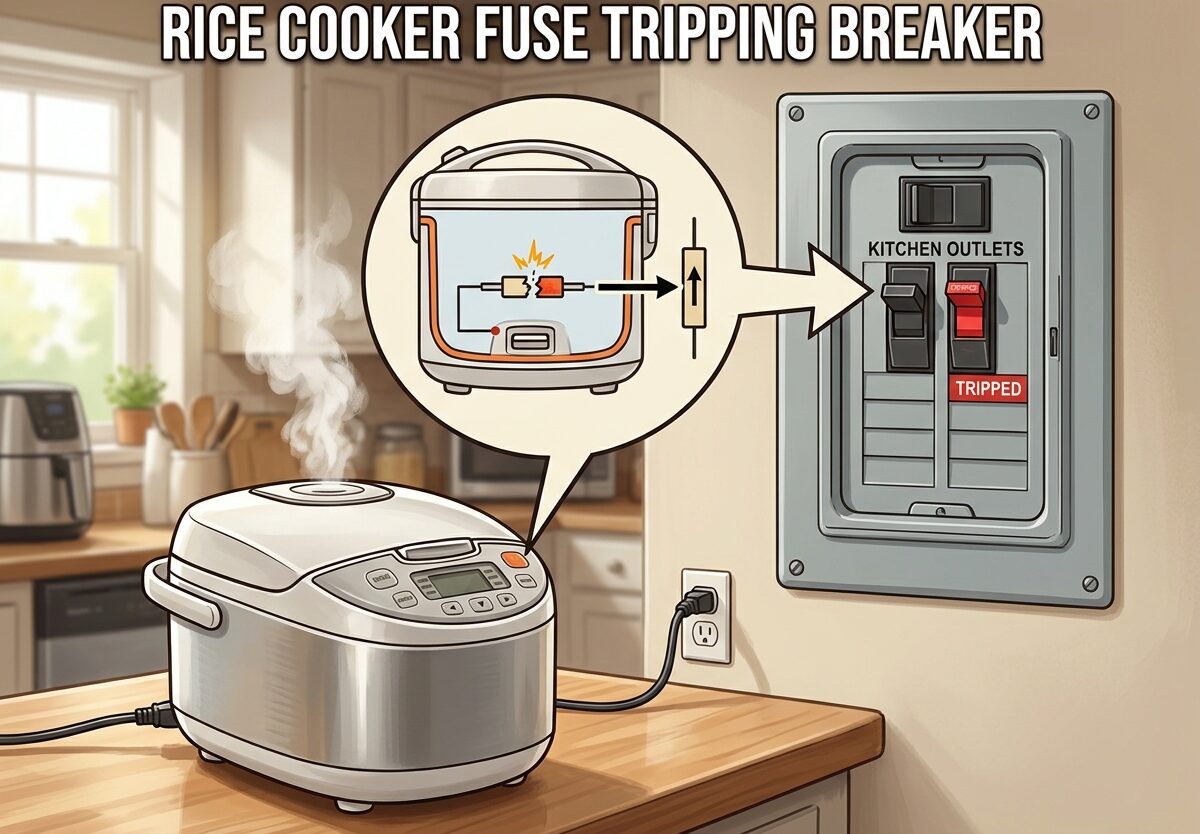
Your rice cooker suddenly tripped the circuit breaker, and now you’re wondering what went wrong. This common issue affects many rice cooker owners, from basic models to high-end induction units like Zojirushi and Sanyo. A rice cooker fuse tripping breaker typically indicates an electrical fault that requires attention before you can safely use the appliance again.
When your rice cooker trips the breaker, it’s actually a safety feature working as designed. The circuit breaker detects an abnormal electrical condition and cuts power to prevent potential fire hazards or equipment damage. Understanding why this happens and how to diagnose the problem can help you decide whether to repair or replace your rice cooker.
Why Does My Rice Cooker Keep Tripping the Breaker?
A rice cooker repeatedly tripping your circuit breaker usually stems from one of three electrical faults: a short circuit, a ground fault, or an overloaded circuit. Each type of fault creates different symptoms and requires specific troubleshooting approaches.
Short circuits occur when live electrical current bypasses the normal resistance path and flows directly to neutral or ground. This creates a sudden spike in current that triggers the breaker immediately. In rice cookers, short circuits commonly develop in the heating element, power board components, or damaged wiring within the cord.
Ground faults happen when current leaks from the intended path and flows through an unintended ground connection. This often occurs due to deteriorated insulation around internal wires or moisture intrusion into the electrical compartment. Ground faults are particularly dangerous because they can electrify the rice cooker’s exterior casing.
Overloaded circuits develop when your rice cooker demands more current than the circuit can safely supply. This frequently happens in older homes with outdated wiring or when multiple high-wattage appliances share the same circuit. Most standard rice cookers draw 500-700 watts, while induction models can exceed 1000 watts.
Thermal fuse failure represents another common cause of breaker tripping. Unlike the circuit breaker in your electrical panel, the thermal fuse is located inside your rice cooker and blows when internal temperatures exceed safe limits. Once blown, the thermal fuse creates an open circuit that prevents the rice cooker from powering on at all.
Safety First: Pre-Inspection Precautions
Before attempting any diagnosis or repair of a rice cooker that’s been tripping breakers, follow these critical safety steps. Electrical appliances can retain dangerous charge even when unplugged, and internal components may reach extremely high temperatures during operation.
Always unplug the rice cooker from the electrical outlet before performing any inspection or testing. Never attempt to bypass or disable any safety features, including thermal fuses or circuit breakers. These devices exist to protect you from fire and electrocution hazards.
If you’re uncomfortable working with electrical components or lack basic testing tools like a multimeter, contact a professional appliance repair technician. Complex repairs involving power boards, IGBT transistors, or internal wiring should always be handled by qualified professionals.
Keep a working fire extinguisher nearby when testing any appliance that has been exhibiting electrical faults. Never leave a rice cooker unattended while it’s plugged in after experiencing breaker tripping issues.
Step-by-Step Rice Cooker Troubleshooting Guide
Follow this systematic approach to identify why your rice cooker fuse keeps tripping the breaker. This process will help you narrow down the specific fault and determine whether repair is feasible.
Step 1: Initial Assessment and Breaker Reset
Locate your electrical panel and identify the tripped breaker. The breaker handle will typically be in the middle position or clearly switched to OFF. Before resetting, unplug your rice cooker from the outlet.
Wait at least 5 minutes before resetting the breaker. This allows any residual heat in the electrical system to dissipate. Flip the breaker firmly to the OFF position first, then switch it to ON. You should feel or hear it click into place.
If the breaker immediately trips again without anything plugged in, the issue is with your home’s wiring, not the rice cooker. Contact a licensed electricarian immediately.
Step 2: Visual Inspection of Power Cord and Plug
Examine the entire length of the power cord for any visible damage. Look for cuts, fraying, kinks, or areas where the insulation has worn away to expose the internal wires. Pay special attention to where the cord enters the rice cooker body, as this is a common failure point.
Inspect the plug prongs for corrosion, bending, or burn marks. Any discoloration indicates excessive heat or arcing, which means the plug should be replaced. Check the outlet face for burn marks or a melted appearance around the plug openings.
Replace the power cord if you find any damage. Most rice cooker power cords can be unscrewed from the internal chassis and replaced with generic replacement cords available at hardware stores.
Step 3: Testing with Different Outlets
Plug your rice cooker into a different outlet on a separate circuit if possible. This helps determine whether the issue is with the rice cooker itself or with the original outlet or circuit. Ideally, test an outlet on a different floor or opposite side of your home.
If the rice cooker trips the breaker on a different circuit, the problem is definitely with the appliance itself. If it only trips on one specific circuit, the issue may be with that circuit’s wiring or an overloaded circuit shared with other appliances.
For this test, ensure no other high-wattage appliances are running on either circuit. Turn off air conditioners, microwaves, toasters, and other devices that could contribute to circuit overload.
Step 4: Heating Element Continuity Test
You’ll need a multimeter for this test. Set your multimeter to continuity mode or the lowest ohms setting. The heating element is the most common source of short circuits in rice cookers.
Access the heating element terminals by removing the bottom cover of your rice cooker. You’ll typically need to remove several screws, and some models may have security screws that require specialty bits. On some models, you can access the heating element contacts through the cooking pot opening.
Touch one multimeter probe to each heating element terminal. A good heating element will show continuity (near zero ohms). If your multimeter shows infinite resistance or no continuity, the heating element has an open circuit and needs replacement. If you measure continuity between either terminal and the metal chassis, the heating element has shorted to ground and is causing your breaker to trip.
Step 5: Thermal Fuse Diagnosis
The thermal fuse is a small safety device typically located near the heating element or on the power control board. It’s designed to blow when temperatures exceed safe limits, preventing fire hazards.
Test the thermal fuse using your multimeter in continuity mode. Touch the probes to both ends of the fuse. If there’s no continuity, the thermal fuse has blown and needs replacement. Common thermal fuse ratings for rice cookers include 192°C, 228°C, and 240°C.
Important: A blown thermal fuse indicates an underlying problem that caused excessive heat. Simply replacing the fuse without addressing the root cause will result in the new fuse blowing again, possibly creating a fire hazard.
Step 6: Power Board and IGBT Inspection (for Induction Models)
Induction rice cookers like the Sanyo ECJ-JG10W contain complex power electronics including an IGBT (Insulated Gate Bipolar Transistor) that controls the heating coil. These components can fail and create short circuits that trip breakers.
Visually inspect the power board for any burned components, brown discoloration on the circuit board, or bulging capacitors. Look specifically at the IGBT, which is typically a three-legged component mounted on a heat sink. Brown markings around the IGBT or diodes indicate overheating and possible failure.
Testing IGBTs requires advanced multimeter skills. The component should show specific resistance patterns between the gate, collector, and emitter terminals. If you’re unfamiliar with testing power semiconductors, this is the point where professional repair becomes the recommended option.
Some users on electronics forums have discovered that disconnecting the heating element allows the power board to function without tripping the breaker, which indicates a shorted heating element rather than a failed power board. This isolation test can help narrow down the faulty component.
Common Rice Cooker Electrical Faults
Certain types of electrical faults appear repeatedly across different rice cooker brands and models. Understanding these common issues can accelerate your diagnosis process.
Heating element short circuits typically develop after years of thermal cycling causes the insulation between the heating coil and the outer casing to deteriorate. This creates a path for current to flow directly to ground, triggering immediate breaker trips when the rice cooker powers on. The fix requires complete heating element replacement.
Repeated thermal fuse blowing often puzzles DIYers because replacing the fuse doesn’t solve the problem. The thermal fuse is a symptom, not the root cause. Common triggers include failed thermostats that don’t shut off heating, blocked ventilation causing heat buildup, or voltage irregularities from your power supply.
IGBT transistor failure affects induction rice cookers specifically. This component switches high current to the induction coil and operates under significant stress. When an IGBT fails, it typically creates a direct short circuit that trips the breaker immediately upon power-up. Replacing an IGBT requires soldering skills and finding the exact replacement component.
Varistor or ZNR surge absorber failures occur from voltage spikes in your home’s electrical supply. These components are designed to sacrifice themselves by shorting during overvoltage events, thereby protecting more expensive components. A failed varistor will often show visible cracking or burn marks and causes immediate breaker tripping.
Power board damage indicators include brown discoloration around components, cracked solder joints, or corroded contacts from moisture exposure. One Reddit user documented their Zojirushi rice cooker issue where the internal glass tube fuse (SOC ST15 125V 15A) kept blowing. The culprit turned out to be a failed varistor that created a short circuit path.
Repair vs Replace: Making the Right Choice
After identifying the specific fault with your rice cooker, you’ll need to decide whether repair makes practical and economic sense. Several factors should influence this decision.
Consider the age and original cost of your rice cooker. Basic rice cookers costing less than $50 typically aren’t worth professional repair, as service charges often exceed the replacement cost. High-end induction models from brands like Zojirushi or Cuckoo costing $200-500 may warrant repair investment.
The complexity of the required repair matters significantly. Heating element replacement is relatively straightforward and DIY-friendly for most models. Power board repairs involving IGBT replacement require soldering skills and electronic component sourcing. Thermal fuse replacement is intermediate difficulty but indicates underlying problems that may recur.
Availability of replacement parts affects feasibility. Major brands like Zojirushi maintain parts distribution networks, while lesser-known brands may not offer replacement components. Search for your specific model number plus “replacement parts” to assess availability before committing to repair.
Professional repair costs typically range from $80-150 for simple repairs to $200+ for complex power board work. If your rice cooker originally cost less than $150 and is more than 3-4 years old, replacement usually makes more financial sense.
Prevention Tips to Avoid Future Breaker Tripping
Once your rice cooker is repaired or replaced, implement these preventive measures to avoid future electrical issues and extend your appliance’s lifespan.
Use a dedicated circuit for your rice cooker whenever possible. Avoid running other high-wattage appliances on the same circuit while cooking. This is especially important for induction rice cookers that draw significant power during the heating phase.
Inspect your power cord regularly for signs of wear. Never wrap the cord tightly around the rice cooker immediately after use, as this can damage the insulation from residual heat. Allow the cord to cool before storage.
Clean ventilation ports and fans to prevent heat buildup. Blocked ventilation causes internal temperatures to rise, which can stress components and trigger thermal fuses. Use compressed air to blow out dust from vents and cooling fans every few months.
Avoid using extension cords with rice cookers. If you must use one, ensure it’s rated for at least 15 amps and is as short as possible. Long, underserved extension cords create voltage drops that can cause components to overheat.
Consider using a surge protector for your rice cooker, especially if you live in an area with frequent power fluctuations or lightning activity. Quality surge protectors can sacrifice themselves to protect your appliances from damaging voltage spikes.
Don’t exceed the recommended capacity of your rice cooker. Overfilling can cause overflow into electrical components, creating short circuits and corrosion over time. Follow manufacturer guidelines for maximum rice and water amounts.
Frequently Asked Questions
Why does my rice cooker keep tripping the breaker?
Your rice cooker keeps tripping the breaker due to an electrical fault – either a short circuit in the heating element, a ground fault from damaged wiring, or an overloaded circuit sharing multiple appliances. Short circuits are the most common cause, creating a direct path for current flow that triggers immediate breaker shutdown.
Can I use a rice cooker without a thermal fuse?
No, you should never use a rice cooker without a functioning thermal fuse. The thermal fuse is a critical safety device that prevents fire hazards by cutting power when temperatures exceed safe limits. Bypassing or removing this safety feature creates a serious risk of electrical fire and could result in property damage or injury.
Would an appliance be damaged if a fuse blows?
The appliance itself is typically not damaged when a fuse blows – the fuse sacrificed itself to protect the appliance and your home. However, the underlying condition that caused the fuse to blow may have caused damage to other components. A blown fuse is a symptom that requires investigation to identify the root cause before safe operation can continue.
Is it safe to reset the breaker and try again?
You can safely reset the breaker once, but if it trips again immediately, stop using the rice cooker. A single trip might be a random surge, but repeated tripping indicates a persistent fault that requires repair before further use. Continuing to reset and test a faulty appliance can worsen the damage and create safety hazards.
Conclusion
Dealing with a rice cooker fuse tripping breaker issue requires patience and systematic troubleshooting. Start with the simplest checks – cord inspection and outlet testing – before progressing to component-level diagnosis with a multimeter. Remember that safety should always be your priority, and don’t hesitate to call a professional for complex repairs involving power boards or IGBT transistors.
Most rice cooker breaker tripping stems from three common causes: shorted heating elements, blown thermal fuses, or failed power board components. By following the troubleshooting steps outlined above, you can identify the specific fault and make an informed decision about repair versus replacement. For basic rice cookers more than 3-4 years old, replacement often makes the most financial sense, while premium induction models may warrant professional repair.
The key takeaway is that a rice cooker fuse tripping breaker is a warning signal you shouldn’t ignore. This safety feature protects your home from electrical fires and prevents further damage to the appliance. Whether you choose DIY repair or professional service, addressing the issue promptly will get you back to enjoying perfectly cooked rice without the frustration of tripped breakers.





Leave a Comment