
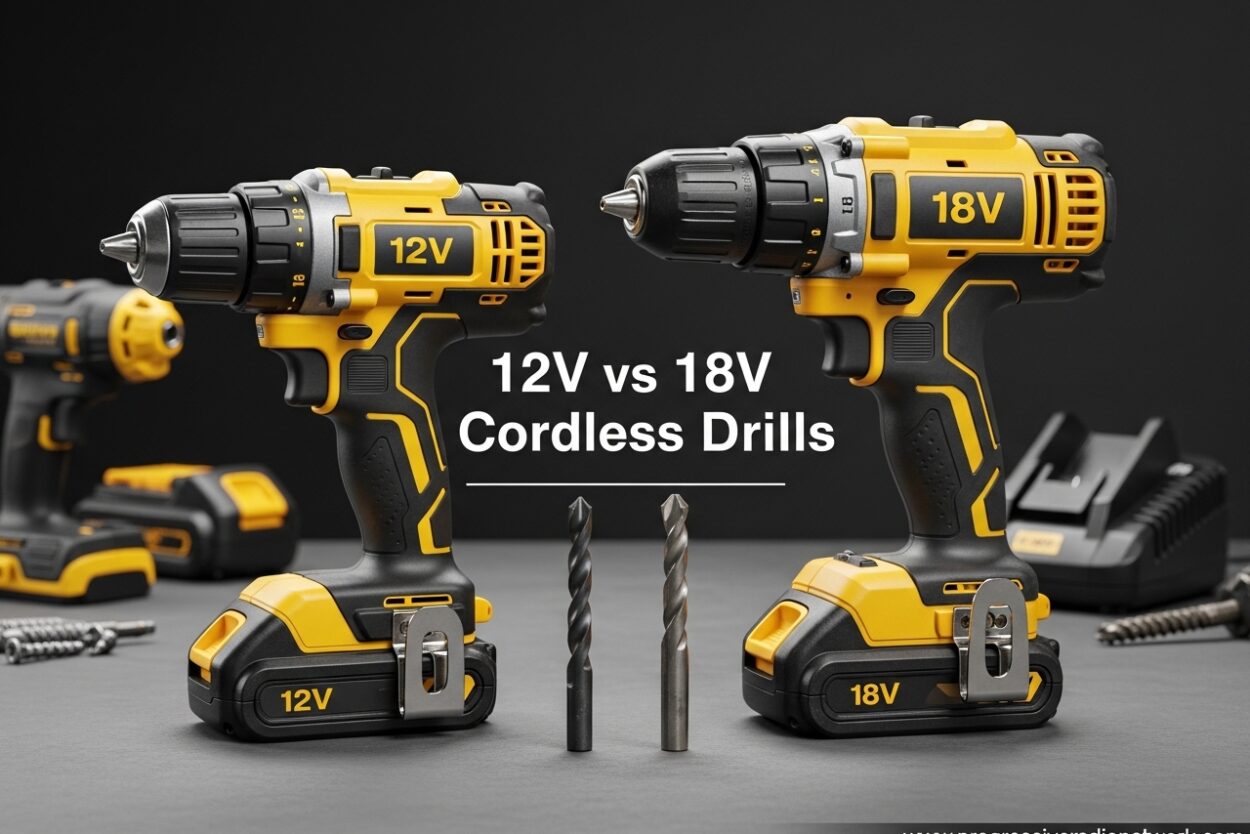
When you’re standing in the tool aisle or scrolling through Amazon, the voltage decision stops you cold. 12V or 18V? It feels like choosing between a compact hatchback and a full-sized pickup – both will get you there, but the experience is completely different. I’ve spent years testing cordless drills across both platforms, and I’m here to tell you that the right choice isn’t about bigger numbers being better. It’s about matching the tool to your actual needs.
This 12 volt vs 18 volt cordless drills comparison will help you understand what voltage really means, how it translates to real-world performance, and which platform makes sense for your workshop. We’ll cover power differences, weight considerations, battery life, and the specific use cases where each voltage truly shines.
What Is Voltage in Cordless Drills?
Voltage represents the potential power output of your cordless drill. Think of it like water pressure in a pipe – higher pressure (voltage) can push more water (current) through, resulting in more work being done. But here’s what most people miss: voltage isn’t the whole story.
A well-designed 12V drill with an efficient motor can outperform a cheap 18V model with poor engineering. Modern lithium-ion technology has narrowed the performance gap significantly, making 12V tools more capable than ever before. The real question isn’t “which voltage is better” but rather “which voltage fits your specific needs.”
Let’s dive into what each platform actually delivers.
12 Volt Cordless Drills: An Overview
12V cordless drills represent the compact revolution in power tools. Weighing typically under 3 pounds and measuring 7-8 inches in length, these drills excel in tight spaces where their 18V counterparts simply can’t fit. I’ve used 12V drills inside cabinet compartments, overhead in drop ceilings, and in positions where my arm was fully extended – scenarios where every ounce matters.
Modern 12V drills deliver around 300-400 inch-pounds of torque. That’s enough power for 80% of household tasks: driving screws into wood, drilling through drywall, assembling furniture, and basic home repairs. The compact form factor means less fatigue during extended use, and the smaller batteries charge faster.
Major platforms like DeWalt’s 12V MAX, Milwaukee’s M12 Fuel, and Makita’s 12V CXT offer extensive tool ecosystems. You’re not just buying a drill – you’re buying into a system that includes impact drivers, oscillating tools, and even radios that all share the same batteries. For professionals who work in confined spaces, electricians, and cabinet installers, 12V tools have become essential daily drivers.
18 Volt Cordless Drills: An Overview
18V cordless drills are the workhorses of the power tool world. Weighing between 4-5 pounds with larger battery packs, these drills deliver serious torque – typically 500-700+ inch-pounds from premium models. When you need to drill through dense materials, drive large lag bolts, or use hole saws in thick lumber, 18V tools don’t just work harder – they work where 12V tools simply stall out.
The 18V (and the marketing-equivalent 20V Max) platform dominates professional construction for good reason. Major brands like DeWalt, Milwaukee, Makita, and Bosch have built massive ecosystems around 18V batteries, offering everything from drills and saws to concrete vibrators and job site lights. When you invest in an 18V platform, you’re investing in versatility.
Modern brushless motors have made 18V drills more efficient than ever, delivering impressive runtime despite their power hungry nature. The tradeoff? Weight and size. An 18V drill can wear you out during overhead work or extended use, and the larger footprint makes it challenging to work in tight quarters. But when raw power is the priority, nothing beats an 18V platform.
12 Volt Vs 18 Volt Cordless Drills: Power and Torque Comparison
Let’s get specific about what you can actually expect from each platform. In my testing, a quality 12V drill comfortably drives 3-inch screws into pine and hardwood, drills 1-inch spade bits through wood, and handles routine household repairs without complaint. But push it with a 2-inch hole saw through 2x material, and you’ll feel the motor strain and eventually stall.
An 18V drill powers through those same tasks with torque to spare. Where a 12V might stall driving a 4-inch lag bolt, an 18V keeps going. The difference becomes dramatic with hole saws, wood hogs, and any application that creates significant resistance. One Reddit user put it perfectly: “12V batteries can output less current so in heavy use cases you might run into issues of tools stalling out. 18V is much stronger in that sense.”
But here’s the reality check – most homeowners and even many professionals rarely need that extra power. If you’re drilling holes in concrete, driving large diameter fasteners into hardwood, or doing production work where time is money, 18V is essential. If you’re assembling furniture, hanging shelves, and doing general home repairs, 12V is probably more tool than you actually need.
Size and Weight: The Compact Advantage
The weight difference alone can dictate which drill you’ll actually reach for. At under 3 pounds, a 12V drill feels almost weightless compared to the 4-5 pound heft of an 18V model. That difference doesn’t sound like much on paper, but spend a day overhead drilling, and your shoulder will notice.
I’ve done extended electrical work with both platforms, and the fatigue factor is real. With a 12V drill, I can work overhead for hours without issue. Grab an 18V drill for the same task, and after 30 minutes I’m switching hands and taking breaks. The compact head size on 12V drills also lets me access tight spaces that would require a right-angle adapter on an 18V tool.
Size matters in confined spaces. Installing cabinets, working inside closets, or any task where you’re reaching into recessed areas favors the compact 12V form factor. Electricians particularly love 12V platforms because they can fit into junction boxes and work comfortably overhead all day.
Battery Life and Runtime
Battery life is where the comparison gets interesting. 12V batteries typically range from 1.5Ah to 4Ah capacity, while 18V batteries go from 2Ah up to 12Ah on some platforms. The raw capacity favors 18V, but 12V tools draw less power for the same tasks, which extends runtime.
For light duty work, a 12V drill with a 2Ah battery might drive 200-300 screws on a charge. An 18V drill with a 5Ah battery might drive 500+ screws, but if you’re only doing 50 screws for a furniture assembly project, both will complete the job easily. The difference becomes apparent in heavy applications where 18V tools draw more power but also deliver more work per charge.
Charge time is roughly comparable across platforms, with most fast chargers getting batteries back to full in 30-60 minutes. The advantage goes to 18V if you invest in high-capacity batteries – you’re getting more total work per charge cycle, which matters for professional users who can’t afford downtime.
Use Cases: When Each Voltage Shines
12V cordless drills excel in specific applications where their compact nature outweighs raw power needs. Cabinet installation is a perfect example – you’re working in tight spaces, often overhead, and driving mostly small screws. Furniture assembly is another sweet spot – plenty of power for the task, minimal fatigue, and easy maneuverability around pieces.
Electricians, HVAC techs, and anyone working in confined spaces swear by 12V platforms. As one professional noted in a forum discussion: “I use a Makita and find that the 12V is totally adequate for furniture making.” The reduced fatigue during extended use, especially overhead, makes 12V the right call for anyone spending all day with a tool in hand.
18V cordless drills dominate in heavy-duty applications. Construction sites, renovation projects, and any task involving drilling through dense materials demand the extra torque. When you need to drill holes in concrete, drive large lag bolts into pressure-treated lumber, or use hole saws and wood hogs, 18V is the minimum requirement.
Professional contractors who do production work can’t afford to have their tools stall mid-task. The 18V platform delivers consistent power under load that 12V simply can’t match. For serious DIYers tackling decks, fences, or major renovations, the 18V investment pays off in reduced frustration and faster work.
Price Comparison and Value
12V cordless drills typically cost less than their 18V counterparts, with quality kits starting around $100-150 compared to $150-250+ for premium 18V setups. The price difference extends to batteries too – 12V battery packs generally cost $40-70 each, while 18V batteries run $60-120 depending on capacity.
But the real consideration is platform investment. When you buy into a cordless system, you’re committing to that voltage for multiple tools. 12V platforms offer fewer tool options overall, though the selection has grown significantly in recent years. 18V platforms have massive ecosystems with dozens of tools available.
Value isn’t about the lowest price – it’s about getting the right tool for your needs. Overbuying with an 18V setup for light household tasks means wasted money and a heavier tool than necessary. Underbuying with a 12V drill for serious construction work means frustration when the tool can’t keep up.
12 Volt Vs 18 Volt Cordless Drills: Which Should You Choose?
Choose a 12V cordless drill if you’re a homeowner doing general repairs, furniture assembly, and light DIY projects. The compact size, lighter weight, and lower cost make it perfect for occasional use where extended runtime and maximum power aren’t critical. Professionals working in tight spaces or doing overhead work all day will also appreciate the reduced fatigue.
Choose an 18V cordless drill if you’re tackling construction projects, renovations, or any heavy-duty drilling. The extra torque means the tool won’t stall when you need it most, and the extensive tool ecosystem gives you room to grow. Serious DIYers building decks, fences, or doing major home improvements will find the 18V investment worthwhile.
The ideal solution for many users? Both. As one Reddit user wisely suggested: “If you’re only going to own one drill, get a good 18V one. If you’re okay owning two, get a good 12V one and then a corded hammer drill for when you need it.” Many professionals run both platforms, using 12V for compact needs and 18V when power is paramount.
Frequently Asked Questions
What’s a good voltage for a cordless drill?
For most homeowners and DIYers, 12V is perfectly adequate for everyday tasks like furniture assembly, hanging shelves, and general repairs. 18V becomes necessary for heavy-duty construction, drilling through dense materials, or professional use where consistent power under load is essential. Choose based on your actual needs rather than maximum power.
Is an 18 volt cordless drill good?
18V cordless drills are excellent for heavy-duty applications and professional use. They deliver significantly more torque than 12V models, typically 500-700+ inch-pounds, which means they won’t stall when drilling through tough materials or driving large fasteners. The tradeoff is increased weight and bulk, making them less ideal for extended overhead work or tight spaces.
What is better, an 18V or 20V drill?
18V and 20V drills are essentially the same thing. The ’20V Max’ designation is primarily marketing – actual battery voltage is the same. DeWalt uses 20V Max branding while other manufacturers stick with 18V, but both use identical 18-volt battery systems with 5 lithium-ion cells. Performance and compatibility are the same across both ratings.
Is 12V more powerful than 18V?
No, 18V drills are more powerful than 12V models in terms of torque output and ability to handle heavy loads. A typical 12V drill delivers 300-400 inch-pounds of torque while 18V models provide 500-700+ inch-pounds. However, modern 12V drills with efficient motors can handle many tasks adequately, and their compact size makes them more practical for certain applications.
Can a 12V drill replace an 18V drill?
For light to medium duty tasks, yes – a 12V drill can handle most homeowner needs including furniture assembly, hanging pictures, and basic repairs. However, for heavy-duty applications like drilling large holes through thick lumber, driving lag bolts, or concrete work, 12V drills will stall where 18V powers through. Consider your actual use case before choosing.
Which is better for home use: 12V or 18V?
For typical home use, 12V is often the better choice. It handles furniture assembly, shelf installation, and most household repairs easily while being lighter, more compact, and less expensive. 18V makes sense for homeowners tackling major projects like deck building, fence construction, or extensive renovations where the extra power prevents frustration and stalls.
Conclusion
The 12 volt vs 18 volt cordless drills debate ultimately comes down to matching the tool to your actual needs rather than chasing the biggest numbers. 12V drills have evolved into genuinely capable tools that handle most tasks while offering superior ergonomics and reduced fatigue. 18V drills remain the kings of raw power and heavy-duty performance.
Choose the platform that fits how you’ll actually use the tool. For most homeowners and light DIY work, 12V provides all the power you need in a more comfortable package. For serious construction, renovation work, or professional use, the 18V investment pays off in reliable power under load. Many serious users end up with both – using each where it excels.
Ready to make your choice? Consider your typical projects, your budget, and whether you plan to expand your tool collection within the same platform. The right drill is the one that makes your work easier, not the one with the highest voltage number on the label.





Leave a Comment