
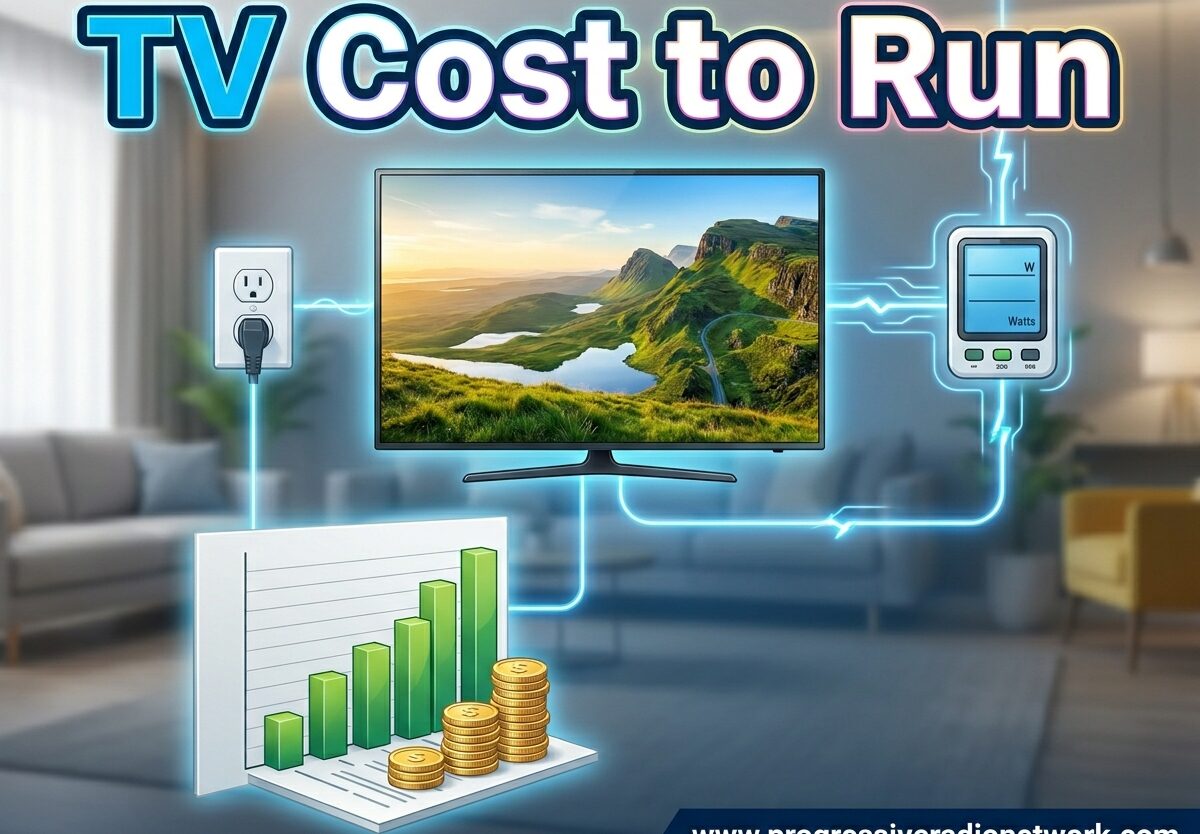
Understanding your TV cost to run can help you make smarter decisions about your home energy use. Most modern TVs cost between $15-30 per year to operate, but the actual amount depends on your TV type, size, how often you watch, and your local electricity rates.
I’ve researched real electricity consumption data and analyzed forum discussions to give you accurate, practical information about television running costs. Whether you’re concerned about your monthly bill or wondering if upgrading to a newer TV will save you money, this guide breaks down exactly what you need to know.
Understanding TV Power Consumption
TV power consumption is measured in watts, which tells you how much electricity your television uses while it’s running. A typical modern LED TV uses between 30-100 watts depending on screen size, with larger screens naturally consuming more power.
To understand your TV cost to run, you need to know about kilowatt-hours (kWh). This is the unit your electricity company uses to bill you. One kilowatt-hour equals 1,000 watts used for one hour. So if your TV uses 100 watts and you watch it for 10 hours, that’s 1 kWh of electricity.
Your electricity bill shows the rate you pay per kilowatt-hour, which varies significantly by location. The national average in the US is around 15 cents per kWh, but some states pay nearly twice that amount while others pay half.
TV Cost to Run: How Much Electricity Does Your TV Use?
The TV cost to run varies dramatically by display technology and screen size. Here’s what real-world testing shows:
LED TVs (most common): 30-100 watts depending on size. These are the most energy-efficient modern displays, with 55-inch models typically using around 60-80 watts during normal operation.
OLED TVs: 50-150 watts. OLED technology can be more power-hungry than LED, especially when displaying bright content, though newer models have improved efficiency.
LCD TVs (older): 50-200 watts. Older LCD models with CCFL backlighting use significantly more power than modern LED-backlit TVs.
Plasma TVs (discontinued): 150-400 watts. If you’re still using a plasma TV, it’s consuming 3-4 times more electricity than modern alternatives.
Screen size matters too. A 32-inch TV typically uses 30-50 watts, while a 65-inch model can use 100-150 watts. However, newer large-screen TVs are often more efficient per square inch than older smaller models.
How to Calculate Your TV’s Electricity Cost
Calculating your exact TV cost to run requires just three pieces of information. Follow this simple formula that I use:
Step 1: Find your TV’s wattage. Check the back panel, manual, or search online for your specific model. This is typically listed as “Power Consumption” in watts.
Step 2: Estimate your daily viewing hours. Be realistic – the average American watches about 3-4 hours per day, but your usage may vary.
Step 3: Check your electricity rate. Find your cost per kilowatt-hour on your utility bill. The national average is approximately $0.15/kWh.
Now use this formula: (Wattage × Hours used per day ÷ 1000) × Electricity rate = Daily cost
For example, a 70-watt TV watched for 4 hours daily at $0.15/kWh costs: (70 × 4 ÷ 1000) × $0.15 = $0.042 per day, or about $15.30 per year.
Daily, Monthly, and Annual TV Running Costs
Based on average electricity rates and typical viewing patterns, here’s what your TV cost to run looks like across different usage scenarios:
Light viewing (2 hours/day): A typical 55-inch LED TV costs about 2 cents per day, $0.60 per month, and $7.30 per year.
Average viewing (4 hours/day): The same TV costs about 4 cents per day, $1.20 per month, and $14.60 per year.
Heavy viewing (8 hours/day): Expect to pay about 8 cents per day, $2.40 per month, and $29.20 per year.
24/7 operation: Running a 55-inch TV continuously costs about 24 cents per day, $7.20 per month, and $87.60 per year.
These numbers assume a 70-watt TV at the national average electricity rate of $0.15/kWh. Your actual costs will vary based on your TV’s wattage and local electricity prices.
TV Cost to Run by State: Electricity Rate Variations
Your location significantly impacts your TV cost to run because electricity rates vary widely across states:
Highest cost states: Hawaii ($0.34/kWh), Massachusetts ($0.28/kWh), California ($0.27/kWh), Rhode Island ($0.25/kWh). In these states, a typical TV costs $25-45 per year to run.
Lowest cost states: Washington ($0.10/kWh), Louisiana ($0.11/kWh), Arkansas ($0.11/kWh), Oklahoma ($0.11/kWh). Here, the same TV costs only $9-12 annually.
National average: At $0.15/kWh, most Americans pay $15-20 per year to run their TV for typical viewing patterns.
If you live in a high-cost state like California or Hawaii, your TV cost to run can be nearly double what someone in a low-cost state pays for identical usage. This makes energy efficiency even more important if you’re watching frequently.
Factors That Affect TV Energy Consumption
Several factors beyond just wattage affect your actual TV cost to run:
Brightness settings: Running your TV at maximum brightness can increase power consumption by 20-30%. The “Vivid” or “Store” mode is particularly energy-hungry. Switching to “Standard” or “Movie” mode can save significant power without much visible difference in most rooms.
Content type: Bright, colorful content uses more power than dark scenes. This is especially true for OLED TVs, which only consume power for lit pixels. Sports and animated movies typically use more electricity than darker dramatic content.
4K and HDR content: While 4K resolution itself doesn’t necessarily use more power, HDR (High Dynamic Range) content can increase energy consumption by 10-20% due to increased brightness requirements and wider color ranges.
Smart features: Connected features like voice control, automatic updates, and background processing add minimal power draw – typically only 1-3 watts. However, these features prevent the TV from entering deep sleep mode, which can slightly increase standby costs.
Ambient light sensor: Many modern TVs automatically adjust brightness based on room lighting. This feature can reduce power consumption in dark rooms while maintaining picture quality.
Standby Power and Vampire Power: Hidden Costs
Your TV cost to run includes more than just active viewing time. Standby power, sometimes called “vampire power,” refers to electricity your TV consumes when turned off but still plugged in.
Modern TVs typically use 0.5-2 watts in standby mode. This might seem negligible, but it adds up over time. At 1 watt of standby power, your TV costs about $1.30 per year just sitting idle.
While this isn’t a huge expense, it becomes more significant when you consider all the devices in your home. The average household has 40+ devices constantly drawing standby power, adding $100-200 to annual electricity bills.
Smart plugs and power strips can eliminate standby power entirely. Simply plug your TV into a switched outlet and flip the switch off when you’re done watching. This also protects your equipment from power surges.
Some modern TVs include “zero watt” standby switches that completely cut power when turned off. If vampire power concerns you, look for this feature when shopping.
TV vs Other Appliances: Energy Comparison
When considering your TV cost to run, it helps to understand how television energy use compares to other household appliances:
Refrigerator: 100-400 watts running 24/7 = $150-300 per year
Air conditioner: 3000-5000 watts = $300-700 per year depending on usage
Electric water heater: 4000-5000 watts = $400-600 per year
LED TV (55-inch, 4 hours/day): 70 watts = $15-20 per year
Your TV typically accounts for less than 2% of your total electricity bill, far less than major appliances like HVAC, water heating, and refrigeration. However, TV costs are more controllable since you can reduce them through viewing habits and settings adjustments.
If you’re looking to reduce your overall electricity bill, focusing on heating, cooling, and water heating will have much larger impacts than optimizing your TV usage.
Gaming Console and Streaming Device Power Costs
When calculating your total TV cost to run, don’t forget connected devices. These can sometimes exceed the TV’s power consumption:
Streaming sticks: 2-5 watts = negligible cost (under $3/year)
Gaming consoles (standby): 10-15 watts = $13-20/year in standby alone
Gaming consoles (gaming): 70-200 watts = $15-50/year depending on usage patterns
Active gaming can significantly increase your total entertainment system costs. A PlayStation 5 or Xbox Series X can use 150-200 watts during intensive gaming – 2-3 times what your TV consumes.
If you’re a heavy gamer, your console’s power consumption might exceed your TV’s. Enabling power-saving settings and fully shutting down (not just standby) when not gaming can reduce these costs by 70%.
Proven Ways to Reduce Your TV Cost to Run
You can significantly reduce your TV cost to run with these simple, proven strategies:
Adjust picture settings: Switch from “Vivid” or “Store” mode to “Standard” or “Movie” mode. This single change can reduce power consumption by 20-30% without meaningful picture quality loss in most home environments.
Enable power-saving features: Most modern TVs include eco-modes that automatically reduce brightness and power consumption. These can save 10-15% on energy costs with minimal impact on viewing experience.
Use ambient light wisely: Watching in a darker room allows you to reduce brightness settings while maintaining picture quality. Daytime viewing in bright rooms may require higher brightness.
Turn it off when not watching: This sounds obvious, but many households leave TVs on as background noise. If you’re not actively watching, turning off the TV eliminates all power consumption.
Eliminate standby power: Use a smart plug or switched power strip to completely cut power when the TV is off. This saves $1-3 per year and protects against power surges.
Consider upgrading if you have older technology: Plasma TVs and early LCD models consume 3-4 times more power than modern LED TVs. Upgrading from an old plasma to a new LED can pay for itself in 3-5 years through electricity savings alone.
Choose ENERGY STAR certified models: When buying new, ENERGY STAR certified TVs are independently verified to meet strict efficiency standards, typically using 25-30% less energy than standard models.
Real User Examples: What People Actually Pay
Beyond the calculations, real-world users have shared their actual TV cost to run experiences in forums and discussions:
One Reddit user calculated their 70-watt TV at 4 hours daily usage: “At our local rate of 12 cents/kWh, it costs about $25 per year to run our TV. That’s roughly 2 cents per hour – basically nothing in the grand scheme of our electricity bill.”
Another user compared old vs new technology: “I replaced my old plasma TV that ran constantly with a modern LED. My electricity bill dropped about $10 per month. That’s $120 per year in savings – the new TV is literally paying for itself in electricity savings.”
A third user shared their 24/7 TV scenario: “We leave the TV on for our dog during the day. At roughly $0.25 per day, it costs about $7.50 monthly and $90 yearly. Worth it for the dog’s comfort, but I was surprised it wasn’t more expensive.”
These real experiences confirm the calculations: modern TVs cost roughly 2 cents per hour to operate, making them one of the smaller expenses on most electricity bills despite frequent usage.
When Upgrading Makes Financial Sense
If you’re still using older TV technology, upgrading to a modern LED model can actually save you money in the long run. Here’s when it makes financial sense:
Plasma TVs: Using 300+ watts, a plasma TV costs $50-80+ annually to run. A comparable LED TV costs $15-25. That’s $35-55 per year in savings – enough to pay for a new budget TV in 3-5 years.
Older LCD models: Pre-LED LCD TVs often consume 150+ watts. Upgrading to modern LED technology can save $20-30 annually on electricity costs.
Smart feature benefits: Modern smart TVs eliminate the need for separate streaming devices, reducing total system power consumption by 5-10 watts.
However, if you already have a modern LED TV purchased within the last 5 years, upgrading purely for energy savings doesn’t make financial sense. The incremental efficiency improvements won’t offset the purchase price for a decade or more.
Frequently Asked Questions
Does leaving a TV on all day use a lot of electricity?
Not really. A modern 55-inch LED TV costs about 24 cents per day to run continuously (24 hours at $0.15/kWh). That’s roughly $7.20 monthly or $87.60 yearly. While this adds up, it’s relatively inexpensive compared to other household appliances like air conditioning or electric heating, which can cost $300-700 annually.
Is it cheaper to leave the TV on or turn it off?
Turning it off is always cheaper. While there’s a small surge of power when turning on, it’s negligible compared to the savings. A TV uses 60-100 watts while on but only 0.5-2 watts in standby. Turning it off between viewing sessions saves money and extends the TV’s lifespan. The only exception is if you’re returning within 10-15 minutes, then the energy saved might not outweigh the convenience.
How much does it cost to run a TV for 24 hours?
Running a typical 55-inch LED TV for 24 hours costs about 24 cents daily at average electricity rates ($0.15/kWh). This assumes the TV uses 70 watts continuously. Monthly, this equals approximately $7.20, and annually about $87.60. Larger screens or plasma TVs would cost significantly more – up to $200-300 yearly for continuous operation of older technology.
What runs your electric bill up the most?
Heating and cooling account for 40-50% of home energy use, making them the largest electricity expense. Water heating adds another 15-20%, while refrigeration uses 5-10%. Your TV typically accounts for less than 2% of your total bill. If you’re looking to reduce electricity costs, focus on HVAC efficiency, water heater temperature settings, and insulation before worrying about TV consumption.
How much electricity does a 55 inch TV use?
A 55-inch LED TV typically uses 60-80 watts during normal operation. At the national average electricity rate of $0.15/kWh, watching for 4 hours daily costs about 4 cents per day, $1.20 monthly, or $14.60 yearly. OLED models may use slightly more power (80-120 watts), while premium LED models with full-array local dimming might use 90-110 watts during bright scenes.
Does 4K TV use more electricity?
4K resolution itself doesn’t necessarily use more power than 1080p. However, 4K TVs are typically larger and have more powerful processors, which can increase consumption. More significantly, 4K HDR content requires higher brightness levels, increasing power use by 10-20% compared to standard HD content. Overall, a modern 4K TV often uses similar or less power than older 1080p models due to more efficient LED backlighting technology.
Conclusion
Your TV cost to run is likely lower than you expected. Most households pay $15-30 per year for television electricity – roughly 2 cents per hour of viewing. While not insignificant, this represents a small portion of overall energy costs compared to heating, cooling, and water heating.
The biggest factors affecting your costs are TV technology (plasma users pay 3-4x more), screen size, viewing hours, and local electricity rates. If you’re still using older plasma or early LCD technology, upgrading to a modern LED TV can pay for itself through energy savings in 3-5 years.
For most households with modern TVs, the best way to reduce TV cost to run is simple adjustments like switching picture modes, enabling power-saving features, and using smart plugs to eliminate standby power. These small changes can save 20-30% on your TV’s energy consumption without impacting your viewing experience.




Leave a Comment