
Propane refrigerator efficiency determines how long your off-grid cooling will last on a single tank of fuel. I’ve spent years researching absorption cooling technology, and the numbers might surprise you. A standard 20-pound propane tank can power a typical RV refrigerator for 10-14 days of continuous operation. That’s impressive efficiency for off-grid living, but understanding how these systems work and optimizing their performance can extend that runtime even further.
In this guide, I’ll break down exactly how propane refrigerator efficiency works, what affects your consumption rates, and practical steps to maximize every ounce of propane. Whether you’re living off-grid, outfitting an RV, or setting up a remote cabin, these insights will help you make informed decisions about your refrigeration needs.
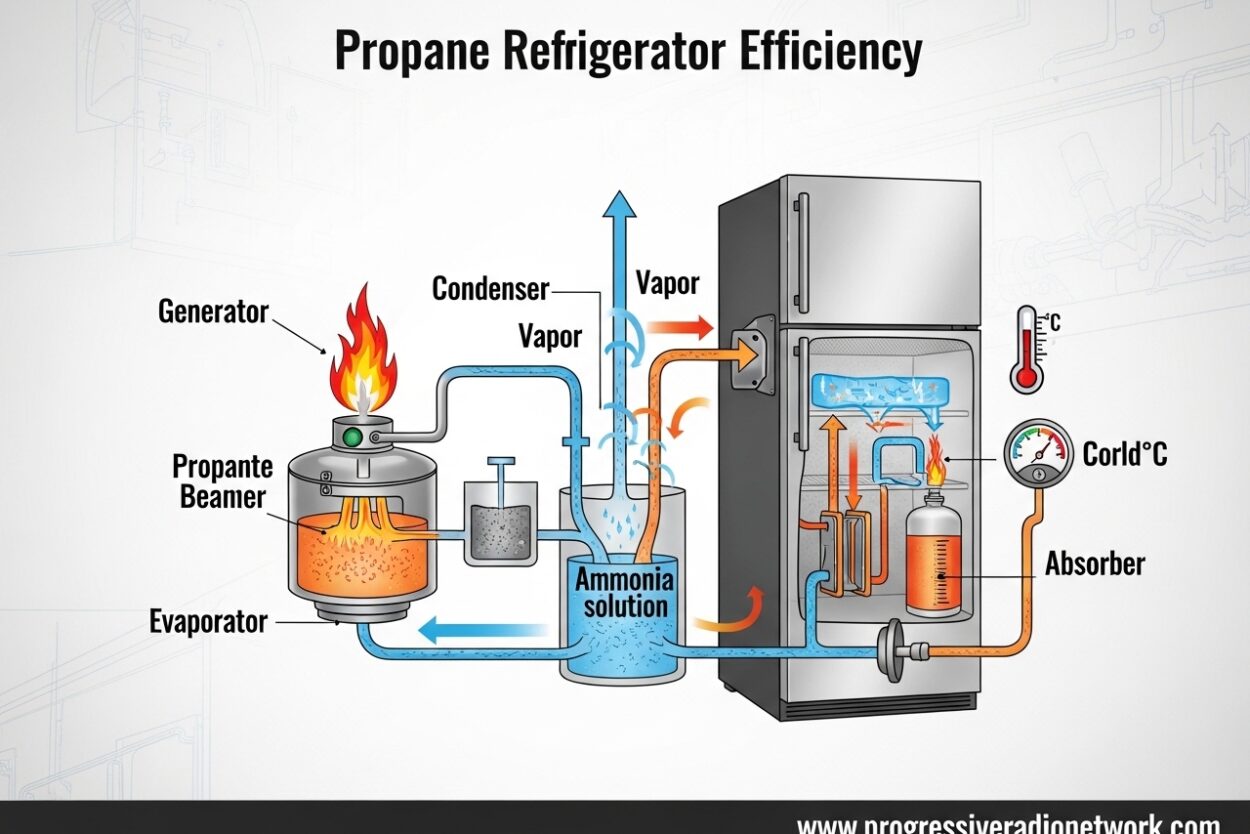
How Propane Refrigerator Efficiency Works: The Absorption Cooling Process
Propane refrigerators operate on a completely different principle than the electric fridge in your kitchen. Instead of a compressor pumping refrigerant, propane refrigerators use absorption cooling technology. This system has no moving parts, which explains their legendary durability and 25+ year lifespan.
Here’s how it works: Propane burns in a burner assembly, heating a generator containing ammonia and water. As the solution heats, ammonia vapor separates and rises into a condenser. The ammonia cools back into liquid, then flows into an evaporator inside the fridge compartment. Hydrogen gas helps the ammonia evaporate rapidly, absorbing heat from the refrigerator interior. The ammonia-hydrogen mixture then cycles back to an absorber, where water recaptures the ammonia and the process repeats.
This closed-loop system is remarkably efficient for off-grid applications. The key advantage is that it requires no electricity to cool—only the heat from burning propane. This makes absorption refrigeration ideal for RVs, cabins, and off-grid homesteads where electrical power is limited or unavailable.
The efficiency comes from the continuous cycle and the fact that propane contains about 91,500 BTUs per gallon. A typical absorption fridge burner uses approximately 1,500-2,500 BTUs per hour, depending on the model and ambient conditions. Understanding this energy balance is the foundation of optimizing propane refrigerator efficiency.
What Factors Affect Propane Refrigerator Efficiency
Several variables impact how much propane your refrigerator consumes. Understanding these factors helps you anticipate usage and optimize performance in different conditions.
Ambient temperature is perhaps the biggest factor. Propane refrigerators work harder in hot environments because the temperature difference between inside and outside is greater. In summer conditions (90°F+), consumption can increase by 30-50% compared to mild weather. Conversely, cooler ambient temperatures actually improve efficiency, as the system doesn’t need to work as hard to maintain internal temperatures.
Level installation is critical for absorption units. Unlike compressor fridges, propane refrigerators must be nearly perfectly level to function properly. Being off-level by even a few degrees can cause the ammonia solution to pool incorrectly, reducing cooling efficiency and increasing propane consumption as the system struggles to maintain temperature.
Ventilation directly affects efficiency. The burner needs adequate airflow to burn propane cleanly and efficiently. Poor ventilation causes incomplete combustion, reducing heat output and increasing consumption. The flue also needs proper clearance to exhaust hot gases—restricted airflow makes the cooling cycle less efficient.
Door seal condition impacts efficiency more than most people realize. Worn or damaged gaskets let cold air escape and warm air enter, forcing your refrigerator to work harder. The door seal should be airtight when closed. A simple test is closing the door on a dollar bill—if it slides out easily, your seals need replacement.
Flame quality indicates combustion efficiency. The burner flame should be a clean blue color. A yellow or orange flame indicates incomplete combustion, which wastes propane and reduces cooling efficiency. This usually means the burner needs cleaning or the propane pressure is too low.
Propane Refrigerator Efficiency: Consumption Rates Explained
Understanding actual consumption rates helps you plan your propane supply for off-grid living. Based on extensive testing and user reports from the off-grid community, here’s what you can expect from a standard propane refrigerator.
A typical absorption refrigerator consumes approximately 1.2-1.5 pounds of propane per day under normal conditions. That’s roughly 0.2-0.25 gallons daily. At this rate, a standard 20-pound propane tank (about 4.6 gallons) will last 13-16 days running continuously. In ideal conditions—moderate temperatures, proper ventilation, and level installation—some users report up to 20 days from a single tank.
For larger tanks, the math scales proportionally. A 30-pound tank typically lasts 20-24 days, while a 40-pound tank can provide 26-32 days of continuous refrigeration. These numbers assume the refrigerator is the only propane appliance. If you’re also running a stove, water heater, or furnace on the same tank, expect shorter durations.
Consumption increases significantly in hot weather. Summer temperatures in the 90s can push daily usage to 2+ pounds, reducing a 20-pound tank’s lifespan to 7-10 days. Winter conditions in mild climates (40-50°F) can extend runtime to 3+ weeks per tank, as the system works less against the temperature differential.
The BTU rating of your specific refrigerator model also matters. Standard RV refrigerators typically have 1,500-2,200 BTU burners, while larger residential propane refrigerators may have 2,500-3,500 BTU burners. Higher BTU burners consume more propane but cool faster and maintain temperature better in extreme conditions.
How to Maximize Propane Refrigerator Efficiency
Getting the most from your propane refrigerator isn’t complicated—it just requires attention to detail and regular maintenance. These proven strategies will help extend your runtime and improve cooling performance.
1. Ensure perfect level installation. Use a bubble level on the refrigerator floor when parking your RV or installing your cabin fridge. Even being off by 2-3 degrees reduces efficiency. Recheck periodically, especially if the unit settles over time.
2. Maintain proper ventilation. Never block exterior vents. Clean the vent areas regularly to remove dust, debris, or insect nests that restrict airflow. If installing indoors, use proper venting to the exterior with adequate intake and exhaust openings.
3. Check door seals regularly. Perform the dollar bill test monthly—close the door on a dollar bill and try to pull it out. If it slides easily, replace the gasket. Also inspect visually for cracks, tears, or compression set where the seal has permanently flattened.
4. Monitor flame color. The burner flame should be a strong blue. Yellow or orange flames indicate dirty burners or low propane pressure. Clean the burner tube with a wire brush annually and check propane regulator pressure if flames persistently appear yellow.
5. Pre-cool before loading. Turn on the refrigerator 6-12 hours before adding food. Adding warm items to a cold fridge is more efficient than trying to cool both the fridge and the food simultaneously. This reduces the initial high-consumption startup period.
6. Limit door openings. Every time you open the door, cold air escapes and warm air enters. Plan ahead—retrieve everything you need in one trip rather than multiple openings. This simple habit can reduce consumption by 10-15%.
7. Don’t overfill. Air circulation is essential for efficient cooling. Leave space between items and don’t block interior vents. A moderately full fridge cools more efficiently than an overstuffed one.
8. Perform annual maintenance. Clean the burner assembly, flue, and cooling unit fins annually. Remove any rust, debris, or insect nests. Check all gas connections for leaks using soapy water—bubbles indicate a leak that needs immediate attention.
Maintenance and Safety for Optimal Propane Refrigerator Efficiency
Regular maintenance ensures your propane refrigerator operates at peak efficiency while remaining safe. Neglected units not only waste propane but can also pose serious safety hazards.
The burner assembly requires annual cleaning. Remove the burner tube and clean it with a soft brush or compressed air. Spider webs and insect nests commonly clog the burner, causing poor combustion and yellow flames. Inspect the orifice for carbon buildup and clean gently with a wooden toothpick—never use metal tools that could damage the precision opening.
The flue needs regular inspection too. Birds love to build nests in warm vent openings, which can block exhaust and create dangerous carbon monoxide buildup. Install wire mesh over exterior vents to prevent nesting while maintaining airflow. Clean any soot or debris from the flue pipe annually.
Carbon monoxide safety is non-negotiable. Always install a CO detector near your propane refrigerator. Check batteries monthly and replace the unit according to manufacturer recommendations—typically every 5-7 years. Never block ventilation in an attempt to conserve heat; proper airflow is essential for both efficiency and safety.
Winter operation presents unique challenges. Below-freezing temperatures can actually improve efficiency as the system works less, but extreme cold (below freezing) can cause the ammonia solution to thicken. If storing in winter, run the refrigerator periodically to keep the solution circulating. Some users report reduced efficiency below 40°F—the cooling unit may need a thermal blanket or insulation in very cold climates.
Knowing when to replace your unit matters too. Absorption refrigerators typically last 20-25 years with proper maintenance. Signs it’s time to replace include declining cooling performance despite proper maintenance, visible rust on the cooling unit, or repeated failures. Sometimes replacement is more cost-effective than repairing an aging unit.
Propane vs Electric vs Solar: Which Offers Better Efficiency?
When planning off-grid refrigeration, you’ll inevitably compare propane to alternatives. Each has advantages depending on your situation, but the efficiency calculations differ significantly.
Propane refrigerators excel in pure off-grid applications where electricity is unavailable or limited. The 1.5 pounds per day consumption rate provides reliable cooling without requiring any electrical infrastructure. For seasonal cabins, hunting lodges, or remote homesteads, propane’s energy density makes it the most practical option. The absence of moving parts also means minimal maintenance and exceptional longevity.
Electric compressor refrigerators are more energy-efficient when electricity is readily available. A typical residential refrigerator uses 1-2 kWh per day, which solar panels can easily generate. However, this requires a substantial solar array, battery bank, and charge controller—thousands of dollars in upfront investment compared to a few hundred for a propane fridge. For RVs with existing electrical systems, 12V compressor fridges are becoming popular because they cool faster and work at any angle.
Solar electric refrigeration offers the lowest operating cost over time—sunlight is free after the initial investment. But the upfront costs are significant: panels, batteries, charge controller, and backup generator for cloudy days. A solar-powered refrigerator system typically costs $3,000-8,000 installed, compared to $800-1,500 for a propane refrigerator. Propane also provides consistent output regardless of weather, whereas solar systems need several days of battery backup for cloudy periods.
For most off-grid applications, propane refrigerators offer the best balance of reliability, simplicity, and reasonable efficiency. The technology is proven, maintenance is minimal, and propane is readily available even in remote areas. The choice ultimately depends on your location, usage patterns, and budget for infrastructure.
FAQ
Do Amish use propane refrigerators?
Yes, many Amish communities use propane refrigerators as their primary cooling method. Propane refrigerators align perfectly with Amish values of off-grid living without electricity. They’re widely used in Amish homes and businesses because they provide reliable refrigeration without requiring connection to the electrical grid.
How long will a 30 lb propane tank run an RV refrigerator?
A 30-pound propane tank will typically run an RV refrigerator for 20-24 days of continuous operation. Under ideal conditions—moderate temperatures around 70°F, proper level installation, and good ventilation—some users report up to 28 days from a single 30-pound tank. In hot summer weather (90°F+), expect shorter duration of approximately 14-18 days as the system works harder to maintain cooling.
How much propane does a propane fridge use per day?
A typical propane refrigerator uses 1.2-1.5 pounds of propane per day under normal operating conditions. This equals approximately 0.2-0.25 gallons daily. Consumption varies based on ambient temperature, refrigerator size, and usage patterns. In hot weather, consumption can increase to 2+ pounds per day, while cooler conditions can reduce usage to around 1 pound daily.
Are propane refrigerators efficient?
Propane refrigerators are highly efficient for their intended purpose—off-grid cooling without electricity. While less energy-efficient than electric compressor refrigerators in terms of energy input versus cooling output, their efficiency shines in off-grid applications where electricity isn’t available. The ability to cool continuously for 10-14 days from a standard 20-pound propane tank demonstrates excellent practical efficiency for remote living situations.
Why is my propane refrigerator not cooling?
The most common reasons for poor cooling are: 1) The unit isn’t level—absorption refrigerators must be perfectly level to function; 2) Yellow flame indicates dirty burner needing cleaning; 3) Poor ventilation restricting airflow; 4) Worn door seals allowing cold air escape; 5) Blocked flue or vent. Start by checking level and flame color, then inspect seals and vents. If these check out and problems persist, the cooling unit may need professional service.
Do propane refrigerators need electricity?
No, propane refrigerators do not need electricity to cool. The absorption cooling system is powered entirely by heat from burning propane. However, many modern propane refrigerators include optional 120V or 12V heating elements for use when electricity is available. These electric heating elements provide an alternative to propane but aren’t required for operation. The cooling mechanism itself remains completely independent of electrical power.
Conclusion
Propane refrigerator efficiency isn’t just about consumption rates—it’s about reliable off-grid living. When properly maintained and operated, an absorption refrigerator provides decades of dependable service with minimal energy input. The key is understanding how the system works and paying attention to the factors that affect performance.
From my research and real-world user experiences, the difference between a poorly maintained and well-optimized propane refrigerator can be 30-40% in propane consumption. That’s the difference between 10 days and 14+ days from a 20-pound tank—significant when you’re living off-grid.
Focus on the fundamentals: keep it level, ensure proper ventilation, maintain clean burners, and check those door seals. These simple steps maximize propane refrigerator efficiency and extend your runtime between tank swaps. The 25-year lifespan of quality absorption units means taking care of your refrigerator pays dividends for decades.
Whether you’re outfitting a remote cabin, upgrading your RV, or planning an off-grid homestead, propane refrigeration remains one of the most practical and efficient solutions available. Understanding and optimizing propane refrigerator efficiency ensures your off-grid cooling remains reliable for years to come.


Leave a Comment