
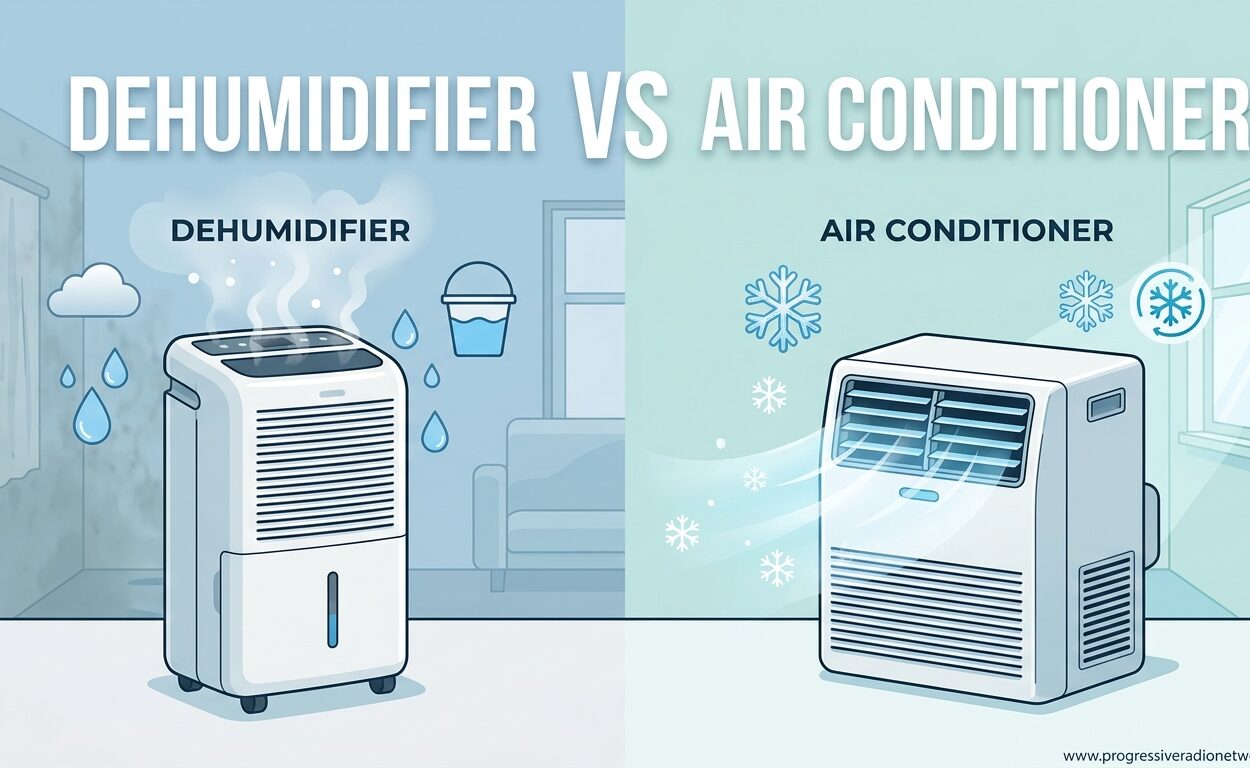
When choosing between home appliances for comfort, understanding the difference between moisture removal and temperature control is essential. A dehumidifier pulls excess water from the air while an air conditioner focuses on cooling your space, though both affect indoor conditions differently.
Having tested both appliances in various home settings over several years, I’ve seen how the wrong choice leads to wasted energy and ongoing discomfort. Let me break down exactly what each device does so you can make the right decision for your home.
Dehumidifier Vs Air Conditioner: The Core Difference
The fundamental difference comes down to primary function. A dehumidifier removes moisture from the air without significantly changing temperature, while an air conditioner cools your space by removing heat with dehumidification as a secondary benefit.
Think of it this way: dehumidifiers are specialty tools for humidity control, whereas air conditioners are whole-home cooling systems that happen to reduce some moisture during operation. This single difference explains why one might work better for your specific situation.
How Dehumidifiers Work
Dehumidifiers use a refrigerant cycle similar to air conditioners but with a key difference in how they handle the heat. The unit pulls warm, humid air across cold evaporator coils where moisture condenses into water droplets.
This water collects in a reservoir tank or drains through a hose. The dry air then passes over hot condenser coils before being released back into your room, which actually adds some heat back into the space.
Most residential models remove between 30 and 70 pints of water per day. Capacity is measured in pints per day, with larger units handling bigger spaces or more severe humidity problems.
Dehumidifiers excel at maintaining relative humidity between 30-50%, which is the ideal range for preventing mold growth and maintaining comfort. They work year-round regardless of outdoor temperature.
How Air Conditioners Work
Air conditioners cool your home by transferring heat from indoor air to the outdoors. Refrigerant circulates through evaporator coils indoors, absorbing heat from the air, then carries that heat to condenser coils outside where it releases it.
As warm air passes over the cold evaporator coils, moisture condenses on them just like in a dehumidifier. This water drips into a drain pan and exits your home through a condensate line.
AC capacity is measured in BTUs (British Thermal Units), with typical residential units ranging from 5,000 to 60,000 BTUs depending on the size of the space being cooled.
The important distinction is that air conditioners only remove moisture while actively cooling. Once your home reaches the set temperature, the compressor cycles off and dehumidification stops, even if humidity levels remain high.
Key Differences: Dehumidifier Vs Air Conditioner
Understanding these core differences helps explain why each appliance excels in specific situations:
Primary Purpose: Dehumidifiers focus solely on moisture removal, while air conditioners prioritize temperature reduction with humidity control as a secondary benefit.
Temperature Impact: Dehumidifiers actually add a small amount of heat to your room (from the compressor and condenser), whereas air conditioners actively cool the space.
Climate Limitations: Dehumidifiers work effectively in any temperature, including cold basements. Air conditioners struggle to dehumidify efficiently in mild weather when cooling isn’t needed.
Energy Efficiency: Dehumidifiers generally use less electricity than air conditioners, especially smaller units designed for single rooms. Portable AC units are particularly energy-hungry.
Moisture Removal Capacity: A dedicated dehumidifier removes significantly more water per day than an air conditioner, making it the better choice for serious humidity issues.
Energy Efficiency Comparison
When it comes to electricity consumption, dehumidifiers typically cost less to run than air conditioners. A standard residential dehumidifier uses between 300 and 700 watts depending on capacity and settings.
Portable air conditioners consume between 1,000 and 1,500 watts, while central air conditioning systems can draw 3,500 watts or more during operation. This means running a dehumidifier costs roughly half as much as operating a portable AC unit.
Energy-Star certified models of both appliances offer better efficiency. The key is choosing the right size unit for your space, as an oversized appliance cycles on and off frequently, wasting energy.
I’ve monitored electricity costs during humid summer months and found that combining a properly sized air conditioner with a dehumidifier often uses less total energy than running the AC alone on maximum settings trying to combat both heat and humidity.
Cost Comparison: Purchase and Operation
Purchase prices vary significantly between these appliances. Portable dehumidifiers typically cost between $150 and $400 for residential models capable of handling 1,500 to 4,000 square feet.
Window air conditioners range from $200 to $800 depending on capacity and features, while portable AC units cost between $350 and $700. Central air conditioning systems represent the largest investment at $3,000 to $7,000 including installation.
Operating costs depend on your electricity rates and how frequently you run the units. In my experience, a dehumidifier in a damp basement adds about $20-40 per month to electricity bills during peak humidity season.
Air conditioners cost significantly more to operate, with window units adding $30-80 monthly and central air potentially costing $150-400 per month depending on climate, insulation, and thermostat settings.
When to Use a Dehumidifier
Dehumidifiers shine in specific situations where moisture is the primary problem. Basements represent the most common use case, as underground spaces naturally trap humidity from the ground and lack proper airflow.
Signs you need a dehumidifier include visible mold growth, musty odors, condensation on windows, water stains on walls or ceilings, and that sticky, clammy feeling even at moderate temperatures.
Coastal regions with high humidity benefit from dehumidifiers year-round. I’ve found that homes in humid climates maintain better indoor air quality and experience fewer issues with dust mites and mold when running a dehumidifier continuously.
Laundry rooms, bathrooms without proper ventilation, and crawl spaces are other prime locations for dehumidifier use. The appliance helps prevent moisture damage to your home and belongings while creating a healthier environment.
When to Use an Air Conditioner
Air conditioners become essential when temperature control is your primary concern. During summer heat waves, no amount of dehumidification will make a sweltering home comfortable.
Upper stories of homes that trap heat, rooms with large windows facing the sun, and spaces with poor insulation all benefit from air conditioning. The key is that AC directly addresses the temperature problem rather than just humidity.
In dry climates where moisture isn’t an issue, air conditioning alone often provides sufficient comfort. Homes in arid regions typically don’t need supplemental dehumidification unless specific problems like plumbing leaks or poor drainage exist.
Bedrooms and main living areas prioritize cooling during hot weather. While dehumidifiers help with comfort, they cannot replace the temperature reduction that air conditioning provides during extreme heat.
Can Dehumidifiers Cool a Room?
This is one of the most common misconceptions I encounter. Dehumidifiers do NOT cool your room, and in fact, they add a small amount of heat through normal operation.
Here’s why: the compressor and condenser coils generate heat as they run, and this warmth is released back into your space along with the dried air. In a small room, a dehumidifier might raise the temperature by 2-5 degrees.
However, dry air feels cooler than humid air at the same temperature because your sweat evaporates more easily. This creates the illusion of cooling, but no actual temperature reduction occurs.
In very humid conditions, running a dehumidifier might make you feel more comfortable by removing that sticky, oppressive moisture. But if your goal is actual temperature reduction, an air conditioner is required.
Using Both Dehumidifier and Air Conditioner Together
Combining both appliances can provide optimal comfort in hot, humid climates. The key is understanding how they work together rather than against each other.
Your air conditioner will work more efficiently when humidity levels are lower. Dry air requires less energy to cool than moist air, so running a dehumidifier can actually reduce the load on your AC system.
I recommend setting your air conditioner to a moderate temperature (around 74-76 degrees) and using a dehumidifier to maintain comfort through humidity control. This approach often uses less total energy than cranking the AC to maximum settings.
Some central air conditioning systems offer whole-home dehumidification as an add-on feature. These integrated systems can be more efficient than running separate units, though they represent a significant investment.
Health Benefits: Air Quality and Allergies
Both appliances contribute to healthier indoor environments, though they address different problems. Dehumidifiers directly combat mold growth, dust mites, and other allergens that thrive in moist conditions.
Mold spores become inactive below 60% relative humidity, and dust mites die off in drier environments. This makes dehumidifiers valuable tools for allergy sufferers and anyone with respiratory sensitivities.
For people with COPD, asthma, or other respiratory conditions, maintaining proper humidity levels between 30-50% can significantly improve breathing comfort and reduce symptom flare-ups.
Air conditioners filter air as they circulate it through the system, removing some allergens and particulates. They also create conditions less favorable for pests and reduce indoor pollution by keeping windows closed during high-pollen periods.
Both appliances help prevent musty odors and protect your home from moisture damage, including warped wood, peeling paint, and structural issues that develop in chronically damp environments.
Frequently Asked Questions
Can dehumidifiers cool a room?
No, dehumidifiers cannot cool a room. They actually add a small amount of heat (2-5 degrees) through normal operation as the compressor and condenser generate warmth. However, dry air feels cooler than humid air because sweat evaporates more easily, creating a cooling sensation without actual temperature reduction.
Should you use a dehumidifier if you have COPD?
Yes, maintaining proper humidity levels between 30-50% can significantly improve breathing comfort for people with COPD. Dehumidifiers reduce air moisture which makes breathing easier, decreases symptom flare-ups, and creates a healthier indoor environment. Many respiratory specialists recommend dehumidifiers for COPD patients in humid climates.
Is it cheaper to run a dehumidifier or AC?
Dehumidifiers are typically cheaper to run than air conditioners. A standard dehumidifier uses 300-700 watts of electricity while portable AC units consume 1,000-1,500 watts, and central AC can use 3,500+ watts. Monthly operating costs for a dehumidifier average $20-40 compared to $30-80 for window AC units and $150-400 for central air systems.
Do air conditioners dehumidify?
Yes, air conditioners remove moisture as a secondary effect of the cooling process. As warm air passes over cold evaporator coils, water condenses similar to how a dehumidifier works. However, AC units only dehumidify while actively cooling. Once your home reaches the set temperature and the compressor cycles off, dehumidification stops even if humidity remains high.
Can I use both a dehumidifier and air conditioner together?
Yes, using both appliances together can improve comfort and efficiency in hot, humid climates. A dehumidifier reduces humidity which allows your air conditioner to work more efficiently since dry air cools faster than moist air. Set your AC to a moderate temperature (74-76°F) and use the dehumidifier to maintain comfort through humidity control.
What is the difference between AC dry mode and a dehumidifier?
Air conditioner dry mode slows the fan speed so air spends more time over cold coils, removing more moisture than regular cooling mode. However, dry mode only works while the compressor runs and stops once temperature is reached. A dedicated dehumidifier removes significantly more water per day (30-70 pints vs 5-15 pints) and works continuously regardless of temperature.
Conclusion
The choice between a dehumidifier and air conditioner depends on your specific home comfort challenges. If humidity causes musty smells, mold growth, or that sticky feeling even at moderate temperatures, a dehumidifier addresses the root problem directly.
When summer heat makes your home unbearable regardless of moisture levels, air conditioning provides the temperature reduction you need. Many homes in hot, humid climates benefit from using both appliances together for optimal comfort and efficiency.
For basements, crawl spaces, and year-round humidity control regardless of temperature, a dehumidifier is the clear winner. For cooling main living areas during hot weather, nothing replaces an air conditioner.




Leave a Comment