
If you are dealing with damp, condensation, or mold in your home, choosing between compressor vs desiccant dehumidifier can make a huge difference in performance and running costs. After testing both types in various conditions and analyzing user experiences from hundreds of homeowners, I can tell you that neither is universally better. The right choice depends entirely on your room temperature, noise sensitivity, and how you plan to use it.
Understanding the compressor vs desiccant dehumidifier difference is critical because using the wrong type will waste electricity and fail to solve your moisture problems. In fact, Reddit users consistently report that compressor models become virtually useless below 15°C, while desiccant models can triple your energy bills if used in warm rooms. When your water damage cleanup equipment includes a dehumidifier, choosing the correct type becomes even more important for effective restoration.
This guide breaks down exactly how each technology works, their real-world running costs, and which specific scenarios call for which type. I have included actual user data, clear temperature thresholds, and honest assessments of reliability issues that most manufacturers do not mention.
What is a Compressor Dehumidifier?
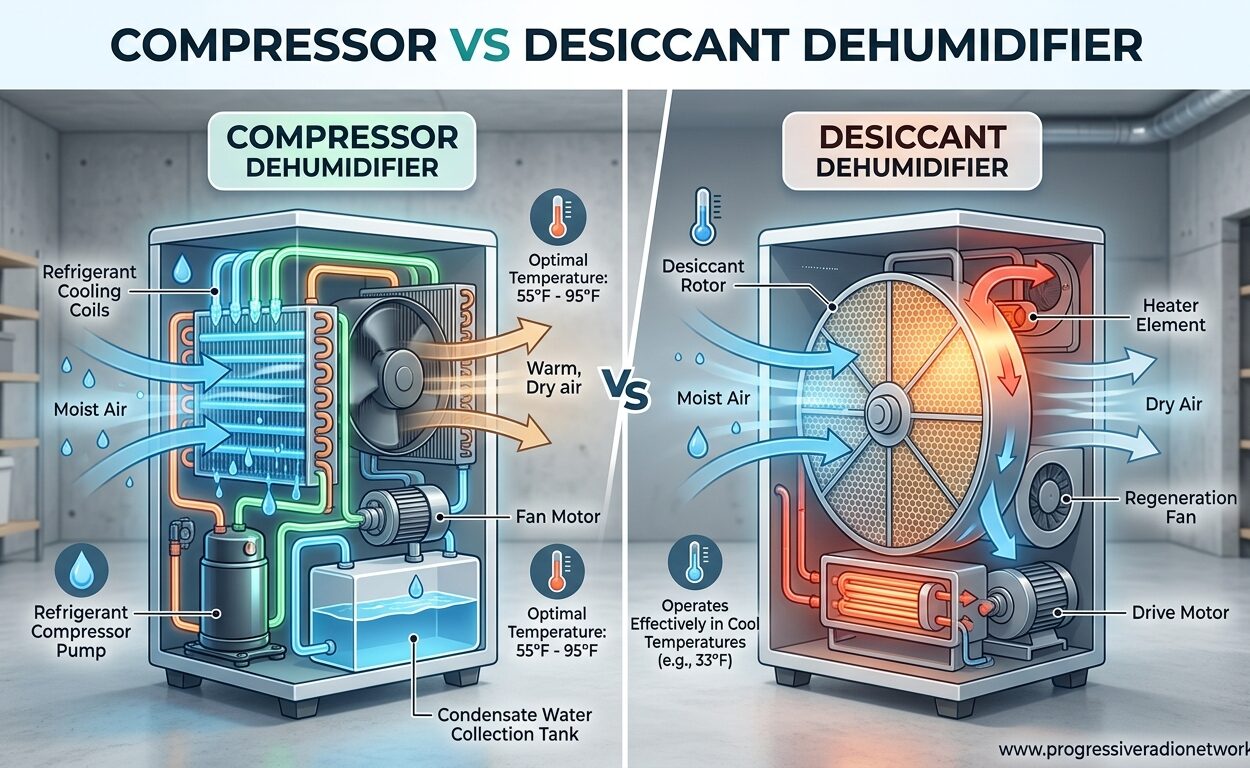
Compressor dehumidifiers work using the same technology as your refrigerator. They draw humid air over refrigerated coils, which causes the moisture to condense into water droplets, much like dew forms on a cold surface. The collected water drips into a tank while the dried air is warmed slightly and returned to the room.
This condensation process is highly efficient in warm conditions above 15°C. The refrigerant system works optimally when there is a significant temperature difference between the room air and the cold coils. This is why compressor dehumidifiers dominate the market in warm climates and heated living spaces.
Most compressor models extract between 10-30 liters of water per day, depending on their capacity. They typically consume 200-300 watts of electricity during normal operation, making them the more energy-efficient choice in suitable temperatures. The technology is mature, reliable, and generally quieter than desiccant alternatives, though the compressor itself does produce a low-level hum that some users find disruptive in bedrooms.
The main limitation of compressor dehumidifiers is their temperature sensitivity. Below 10°C, the coils can ice over, forcing the unit into defrost cycles that waste energy and stop moisture extraction. Between 10-15°C, performance drops noticeably as the system struggles to maintain the temperature differential needed for efficient condensation.
What is a Desiccant Dehumidifier?
Desiccant dehumidifiers use an entirely different approach called adsorption. Instead of cooling air to condense moisture, they pass air through a rotating wheel containing moisture-absorbing material, typically silica gel. As the humid air passes through, the silica gel absorbs water vapor like a sponge.
The saturated portion of the wheel then rotates into a separate chamber where it is heated to release the collected moisture. This warm, damp air is either condensed back into water or vented outside through a hose. The process is continuous, with one section of the wheel always absorbing moisture while another is being regenerated.
Unlike compressor models, desiccant dehumidifiers work efficiently at any temperature above freezing. They actually perform better in cold conditions because the adsorption process is not temperature-dependent. This makes them ideal for unheated spaces like garages, conservatories, and basements where temperatures frequently drop below 15°C.
Desiccant models typically consume 250-550 watts of electricity, significantly more than compressor units. However, they do produce warm air as a byproduct of the regeneration process. In winter, this can actually reduce your heating costs by 2-3°C in the immediate area. At 14°C, one Reddit user reported their desiccant unit extracted moisture at almost twice the rate of their compressor model, though it used three times the energy.
Temperature Comparison: The Critical 10°C Threshold
The temperature of your room is the single most important factor when choosing between compressor vs desiccant dehumidifier. This decision threshold appears consistently across manufacturer guidelines, user forums, and expert recommendations.
Above 15°C: Choose a compressor dehumidifier. The technology works efficiently, energy consumption is lower, and you will avoid the heat output that desiccant models produce. Compressor units in this range typically extract 30-50% more moisture per kilowatt-hour than desiccants.
10°C to 15°C: This is the gray zone where both types will work, but neither optimally. Compressor models will experience reduced efficiency and periodic defrosting. Desiccant models will work well but cost more to run. If your room stays in this range consistently, consider a desiccant for reliable performance or a compressor with auto-defrost capability.
Below 10°C: Definitely choose a desiccant dehumidifier. Compressor models will spend more time defrosting than dehumidifying, making them virtually useless. Desiccant models continue working efficiently down to 1°C and are the only practical option for unheated garages, workshops, and conservatories in winter.
Users frequently report confusion about these thresholds, with different sources citing different temperatures. The consensus from real-world testing and manufacturer specifications supports 10°C as the practical cutoff for effective compressor operation. Below this point, the energy waste from defrost cycles makes compressor models economically unviable.
Energy Consumption and Running Costs
Energy costs represent the biggest ongoing difference between compressor and desiccant dehumidifiers. The compressor vs desiccant dehumidifier debate ultimately comes down to this trade-off: compressor models are cheaper to run in suitable temperatures, while desiccants cost more but work where compressors cannot.
Typical power consumption for compressor models ranges from 200-300 watts during operation. At current UK electricity rates of approximately 24p per kWh, this translates to roughly 4-6p per hour of continuous use. For a typical 24-hour cycle in a damp room, expect daily running costs of around 96-144p.
Desiccant dehumidifiers consume significantly more power, typically 250-550 watts. This translates to 6-13p per hour, or 144-312p per day. One Reddit user provided actual measurements showing their desiccant unit cost 9p/hour to run compared to just 4p/hour for their compressor model. Over a year of daily use, this difference could amount to over £180 in extra electricity costs.
However, the comparison is not entirely one-sided. Desiccant dehumidifiers produce warm air as a byproduct of their operation. In winter, this can reduce your heating load by 2-3°C in the room where the dehumidifier is operating. For unheated spaces, this heating effect may partially offset the higher electricity consumption. Some users specifically choose desiccants for this reason, using them as both dehumidifier and supplementary heater.
Another consideration is extraction efficiency. Desiccant models typically remove moisture faster, especially in cold conditions. Faster extraction means shorter running time to achieve the same result, potentially reducing total energy consumption. However, real-world user data suggests that even with this advantage, desiccants remain more expensive to operate overall.
Noise Levels: Which is Quieter?
When it comes to noise, the compressor vs desiccant dehumidifier comparison shows a clear winner. Desiccant dehumidifiers are consistently quieter, making them the better choice for bedrooms, living rooms, and any occupied space where noise matters.
Compressor dehumidifiers produce noise from two sources: the compressor motor itself and the cooling fan. The compressor creates a low-frequency hum that can be particularly noticeable at night when background noise is minimal. Sound levels typically range from 40-50 decibels, roughly equivalent to a quiet refrigerator. While not overwhelmingly loud, this constant hum can disrupt light sleepers and may be intrusive in small living spaces.
Desiccant models lack a compressor, with noise coming only from the fan that moves air through the system. Sound levels typically range from 34-40 decibels, noticeably quieter than compressor units. Premium desiccant models like the Meaco DD8L Zambezi have earned Quiet Mark accreditation for their whisper-quiet 35dB operation, making them suitable for continuous use in bedrooms.
The noise difference becomes most apparent when both units are running at maximum power. A compressor model at full output can reach 50dB or more, while even the most powerful desiccant rarely exceeds 45dB. For noise-sensitive environments like bedrooms, home offices, or open-plan living areas, desiccant dehumidifiers offer a significant advantage.
User reviews consistently mention noise as a deciding factor. Many users report moving compressor units out of bedrooms due to sleep disruption, while desiccant owners frequently praise their unobtrusive operation. If you plan to run your dehumidifier overnight or in frequently occupied rooms, the noise advantage of desiccants should be a major consideration.
Weight and Portability
If you need to move your dehumidifier between rooms or transport it regularly, weight becomes an important factor in the compressor vs desiccant dehumidifier decision. The difference is substantial, with compressor models typically weighing 6-7kg more than equivalent desiccants.
Compressor dehumidifiers are heavier because they contain a refrigeration system with compressor, condenser, evaporator coils, and refrigerant. A typical 10-12 liter compressor model weighs 11-15kg, while larger 20-30 liter units can exceed 20kg. This weight makes moving them between floors challenging, especially for users with mobility issues.
Desiccant dehumidifiers are significantly lighter, with most models weighing 5-8kg. The absence of a heavy compressor and refrigeration system allows for a more compact design. Many users report carrying desiccant units easily between rooms or even taking them to caravans and boats. This portability makes desiccants ideal for situations where you need moisture control in multiple locations.
Most modern dehumidifiers of both types include castors (wheels) to facilitate movement. However, the lighter weight of desiccant models makes them easier to maneuver even on stairs or uneven surfaces. If you plan to use a single unit to address damp problems in multiple rooms, or if you need to store the unit when not in use, the weight advantage of desiccants is significant.
Maintenance Requirements
Both compressor and desiccant dehumidifiers require similar basic maintenance, but there are some important differences in long-term reliability and repair needs. Understanding these maintenance requirements can help you choose between compressor vs desiccant dehumidifier based on your willingness to perform upkeep.
Common maintenance for both types includes emptying the water tank regularly, cleaning the air filter monthly, and ensuring adequate airflow around the unit. Most models feature auto-shutoff when the tank is full, but frequent emptying is necessary during heavy use. Filters should be vacuumed or washed according to the manufacturer’s instructions, typically every 4-6 weeks.
Compressor dehumidifiers have additional maintenance considerations. The condenser coils can accumulate dust, reducing efficiency and potentially causing overheating. Annual coil cleaning is recommended, especially in dusty environments. The compressor itself is a mechanical component that can fail over time, though most modern units are designed for 5-10 years of operation. In cold conditions, frost can accumulate on coils, requiring defrost cycles that temporarily stop moisture extraction.
Desiccant dehumidifiers require periodic replacement of the desiccant wheel, typically after 3-5 years of use. This is a specialized component that may require professional replacement. The heating element used for regeneration can also fail over time. However, desiccant models have no compressor or refrigerant system to leak or fail, potentially simplifying repairs.
A major concern raised by users across both types is reliability. Reddit forums contain numerous reports of dehumidifiers breaking down after just 1-2 years of use, regardless of type or brand. This suggests that quality control has suffered as prices have decreased. Extended warranty coverage (5 years is increasingly common) is worth considering given the apparently high failure rate of modern dehumidifiers.
Laundry Drying Capabilities
Many users purchase dehumidifiers specifically to dry laundry indoors, particularly during winter when outdoor drying is impractical. In this specific use case, the compressor vs desiccant dehumidifier comparison shows desiccants have a clear advantage in both speed and effectiveness.
Desiccant dehumidifiers typically dry laundry in 2-4 hours, compared to 4-6 hours for compressor models. This faster drying time results from the higher airflow and the warm air produced during the regeneration process. Many desiccant models include a specific laundry mode that maximizes airflow and may increase the regeneration temperature to speed water extraction.
The heating effect of desiccant dehumidifiers provides an additional benefit for laundry drying. The warm air output helps evaporate moisture from clothes more quickly, while simultaneously preventing the room from becoming cold and damp. Some users report that desiccant units can make a small laundry room feel noticeably warmer, which is welcome in winter months.
Compressor dehumidifiers can still effectively dry laundry, just more slowly. They extract moisture from the air without adding warmth, which can make the room feel colder during extended drying sessions. However, in warm weather, this lack of heating may be preferable. Some compressor models include a laundry boost function that increases fan speed to accelerate drying.
For dedicated laundry drying, especially in cold weather, desiccant dehumidifiers are generally superior. Faster drying times and room warming make them more comfortable to use, and their effectiveness at lower temperatures ensures consistent performance throughout winter.
Safety Considerations
Safety is an often overlooked aspect of the compressor vs desiccant dehumidifier decision, but it warrants serious consideration. Both types include standard safety features like tip-over protection and overheat shutoffs, but there are some important differences to understand.
Desiccant dehumidifiers produce significant heat as a byproduct of their operation. The regeneration process that releases moisture from the desiccant wheel requires heating elements that can reach high temperatures. While this heat is normally vented with the moist air, it does mean that desiccant units run hotter than compressor models. This heat output is generally not dangerous, but it does make desiccant units unsuitable for placement near curtains, furniture, or other combustible materials.
The fire risk from desiccant dehumidifiers is a topic that appears in forum discussions, with users expressing concern about units left running overnight or unattended. Modern desiccants include multiple safety features to address this concern, including tilt switches that shut off the unit if tipped over and thermal cut-offs that prevent overheating. However, the basic physics of their operation means they will always run hotter than compressor models.
Compressor dehumidifiers have fewer fire safety concerns because they do not use heating elements. Their safety issues relate primarily to the refrigerant system, which can potentially leak. While modern refrigerants are generally safe, a leak can render the unit inoperable and may require professional repair. Compressor units also contain electrical components that can fail, though this is true of any appliance.
Both types of dehumidifier should be used with basic safety precautions: maintain clearance around the unit, do not cover vents, never operate near water sources, and follow the manufacturer’s instructions explicitly. For households with children or pets, the cooler-running compressor models may present fewer risks, though modern desiccants are designed with extensive safety features.
Quick Comparison Table
| Factor | Compressor Dehumidifier | Desiccant Dehumidifier |
|---|---|---|
| Best Temperature Range | Above 15°C | 1-40°C (excellent below 15°C) |
| Power Consumption | 200-300W (4-6p/hour) | 250-550W (6-13p/hour) |
| Noise Level | 40-50dB (compressor hum) | 34-40dB (fan only) |
| Typical Weight | 11-15kg | 5-8kg |
| Laundry Drying Time | 4-6 hours | 2-4 hours |
| Heat Output | Minimal | Significant (heats room 2-3°C) |
| Maintenance | Coil cleaning, filter changes | Wheel replacement after 3-5 years |
| Best Use Case | Warm, heated living spaces | Cold rooms, garages, laundry drying |
Which Dehumidifier Should You Choose?
Deciding between compressor vs desiccant dehumidifier comes down to your specific situation. Based on temperature, usage patterns, and priorities, here are clear recommendations for different scenarios.
Choose a compressor dehumidifier if: Your room temperature stays above 15°C, you want the lowest running costs, you are sensitive to noise, or you need a unit for long-term use in a heated living space. Compressor models are the economical choice for most homes and apartments, especially if you plan to run the unit continuously during damp seasons. Browse our home appliances section for more climate control solutions.
Choose a desiccant dehumidifier if: Your room temperature falls below 15°C, you need to treat an unheated space like a garage or conservatory, you plan to dry laundry regularly, noise is a major concern for bedroom use, or you would benefit from the heating effect in winter. Desiccants cost more to run but work where compressor models fail, making them essential for cold spaces.
Consider having both types if: You live in a climate with seasonal temperature variations and have significant moisture problems year-round. Some users maintain a compressor unit for summer use and a desiccant for winter, switching between them as temperatures change. While this requires a larger initial investment, it ensures optimal performance and efficiency throughout the year.
The compressor vs desiccant dehumidifier choice ultimately depends on matching the technology to your conditions. Neither type is universally better, and the wrong choice will result in poor performance, wasted electricity, and ongoing frustration. By using the temperature guidelines and usage recommendations above, you can select the type that will solve your moisture problems effectively and economically.
Remember that whichever type you choose, reliability is a concern across all brands and price points. Consider extended warranty coverage given the high failure rate reported by users. And if your specific situation does not clearly match one of the scenarios above, consult with a specialist retailer who can assess your needs and recommend the most suitable solution.
Which dehumidifier is better, compressor or desiccant?
Neither type is universally better. Compressor dehumidifiers are more energy-efficient above 15°C and cheaper to run, making them better for heated living spaces. Desiccant dehumidifiers work effectively in any temperature down to 1°C, are quieter, lighter, and better for laundry drying, making them superior for cold rooms and bedrooms. The right choice depends entirely on your room temperature and intended use.
What are the disadvantages of a desiccant dehumidifier?
Desiccant dehumidifiers have higher running costs, consuming 250-550 watts compared to 200-300 watts for compressor models. This translates to approximately 9-13p per hour versus 4-6p per hour. They also produce significant heat as a byproduct, which may be undesirable in warm weather. The desiccant wheel typically requires replacement after 3-5 years, adding to long-term maintenance costs.
Will a dehumidifier help with termites?
Dehumidifiers can indirectly help prevent termite problems by reducing moisture levels that termites need to thrive. Termites are attracted to damp conditions, so maintaining indoor humidity below 60% makes your home less appealing to them. However, dehumidifiers cannot eliminate existing termite infestations or prevent termites entirely if other conditions are favorable. Professional pest inspection and treatment remain essential for termite control.
Do dehumidifiers help with a cough?
Dehumidifiers can help alleviate coughs caused by excess humidity, mold, or dust mites. By maintaining humidity between 30-50%, dehumidifiers reduce mold growth and dust mite populations, both of which are common cough triggers. The drier air can also make breathing easier for people with respiratory conditions. However, if your cough is caused by dry air or viruses, a dehumidifier may not help and could potentially worsen symptoms.
Which dehumidifier is best for cold rooms?
Desiccant dehumidifiers are definitely the best choice for cold rooms below 15°C. Compressor models become inefficient below this temperature and may spend more time defrosting than dehumidifying. Desiccants work effectively down to 1°C and maintain consistent extraction performance regardless of temperature. For unheated garages, conservatories, basements, and any cold space, a desiccant dehumidifier is the only practical option.
Do desiccant dehumidifiers use more electricity?
Yes, desiccant dehumidifiers use significantly more electricity than compressor models. Typical consumption is 250-550 watts versus 200-300 watts for compressors. Real user measurements show costs of approximately 9p/hour for desiccants compared to 4p/hour for compressors. However, desiccants extract moisture faster, especially in cold conditions, which may reduce total running time. Their heat output can also reduce heating costs in winter, partially offsetting the higher electricity consumption.
Are desiccant dehumidifiers quieter?
Yes, desiccant dehumidifiers are significantly quieter than compressor models. Without a compressor, they produce only fan noise, typically 34-40 decibels. Premium desiccant models like the Meaco DD8L Zambezi operate at just 35dB and have earned Quiet Mark accreditation. Compressor dehumidifiers produce 40-50 decibels from both the compressor hum and fan noise, which can disrupt sleep and be intrusive in quiet spaces.
Can a dehumidifier dry clothes?
Yes, both types of dehumidifiers can dry clothes effectively indoors. Desiccant dehumidifiers are faster, typically drying laundry in 2-4 hours compared to 4-6 hours for compressor models. The warm air produced by desiccants also helps evaporate moisture more quickly and can make the room feel warmer. Many dehumidifiers include a specific laundry mode that maximizes airflow for faster drying. Indoor drying with a dehumidifier prevents moisture damage to your home and is essential during winter months.
Conclusion
The compressor vs desiccant dehumidifier decision ultimately comes down to temperature and usage. Compressor models win on energy efficiency in warm conditions above 15°C, making them the economical choice for most homes. Desiccant dehumidifiers excel in cold spaces, offer quieter operation, and dry laundry faster, justifying their higher running costs in specific scenarios.
By matching the technology to your conditions, you will solve moisture problems effectively without wasting electricity. Choose based on your room temperature first, then consider noise, portability, and intended use. The right dehumidifier, properly selected for your needs, will eliminate damp, prevent mold, and improve your home environment for years to come.



Leave a Comment