
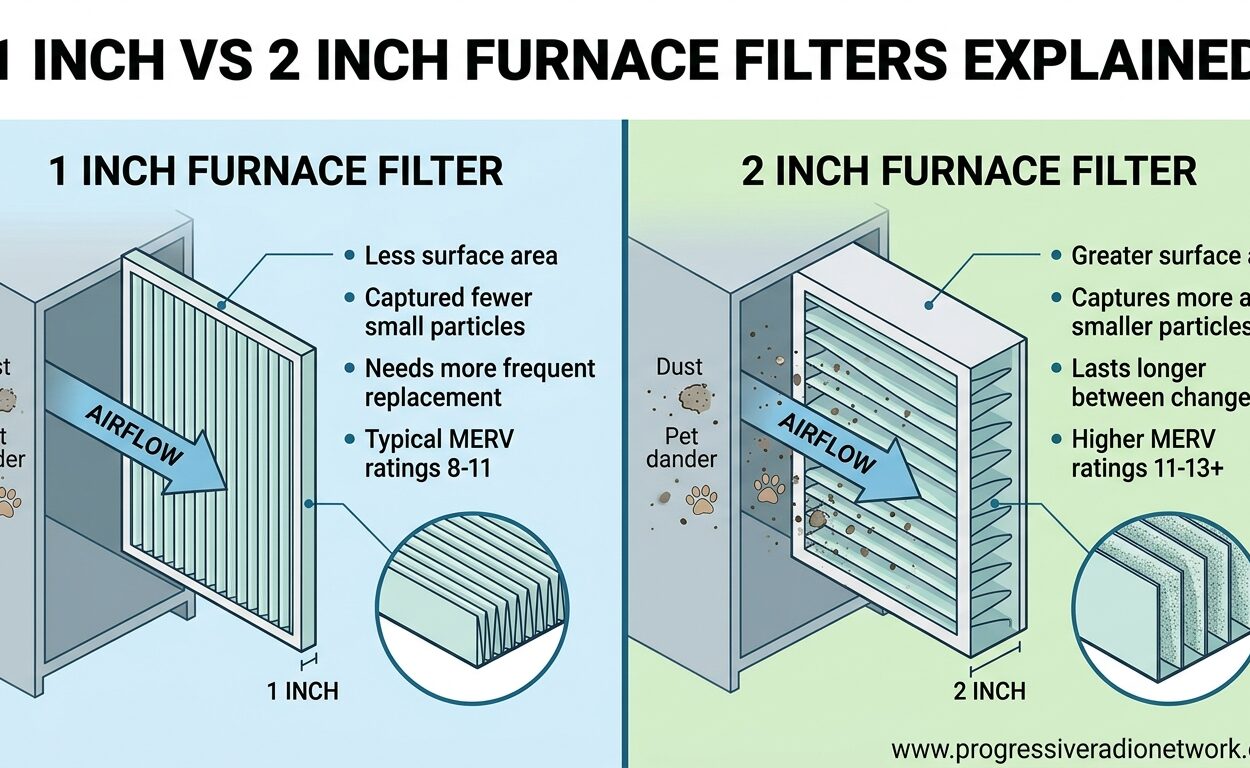
Are 2-inch furnace filters better than 1-inch? Yes, 2-inch filters perform better in most cases due to their larger surface area for capturing contaminants and longer lifespan between replacements. The added thickness provides more filtration media, which means better particle capture without restricting airflow as much as thinner filters.
Choosing between filter thicknesses affects your HVAC system’s efficiency, indoor air quality, and maintenance costs. I’ve compared dozens of furnace filters over the years, and the thickness difference creates significant real-world impacts you’ll notice in your monthly energy bills and air quality.
This guide explains everything you need to know about 1 inch vs 2 inch furnace filters so you can make the right choice for your home and system.
Understanding Furnace Filter Thickness: Why It Matters
Furnace filter thickness refers to the depth of the filter from front to back. Standard residential systems use 1-inch thick filters, while 2-inch and 4-inch options are becoming more common in newer installations.
The thickness directly impacts surface area – a 2-inch filter has roughly double the filtration media of a 1-inch filter with the same height and width dimensions. This increased surface area is crucial because it allows more air to pass through while still capturing particles effectively.
Thicker filters hold more dust and debris before clogging, which means they maintain better airflow for longer periods. When a filter gets dirty, your HVAC system has to work harder to pull air through, increasing energy consumption and wear on components like the blower motor.
Think of it like a sponge – a thin sponge gets saturated quickly and stops absorbing, while a thicker sponge can hold much more before reaching capacity. The same principle applies to your furnace filter.
Most homeowners don’t realize that filter thickness matters until they experience the benefits of upgrading. The difference in performance between 1 inch and 2 inch furnace filters becomes immediately apparent in reduced maintenance frequency and improved air quality.
1 Inch vs 2 Inch Furnace Filters: Lifespan Comparison
The most noticeable difference between these filter types is how long they last before needing replacement. 1-inch filters typically require monthly changes, while 2-inch filters can last 3-6 months depending on your household conditions.
This dramatic difference in lifespan comes down to capacity. A 1-inch filter clogs much faster because it has less surface area to trap particles. Once the filter media is saturated with dust, it starts restricting airflow and becomes less effective at filtration.
Several factors affect how long your filters will last regardless of thickness:
– Pets in the home: Pet dander and hair clog filters faster, potentially reducing lifespan by 50%
– Smoking or cooking: These activities introduce fine particles that accumulate quickly
– Climate and air quality: Dusty environments or areas with poor outdoor air quality shorten filter life
– System runtime: HVAC systems running continuously will dirty filters faster
– Filter quality: Higher MERV ratings capture more particles but clog more quickly
I’ve seen 1-inch filters in homes with multiple pets and dogs needing replacement every 2-3 weeks, while the same home with 2-inch filters might only need changes every 2-3 months. The extended lifespan means fewer trips to the store and less waste going to landfills.
From an environmental standpoint, using fewer filters per year significantly reduces plastic waste. A typical home using 1-inch filters might discard 12-24 filters annually, while switching to 2-inch filters could cut that to 2-4 filters per year.
Filtration Efficiency and MERV Ratings Explained
MERV ratings measure a filter’s ability to capture particles of different sizes. MERV stands for Minimum Efficiency Reporting Value, and the scale runs from 1-20. Higher numbers indicate better filtration but potentially more airflow restriction.
Here’s what you need to know about MERV ratings and furnace filter thickness:
– MERV 1-4: Basic fiberglass filters, capture large particles (>10 microns), minimal airflow restriction
– MERV 5-8: Standard pleated filters, capture particles 3-10 microns, good balance of filtration and airflow
– MERV 9-12: High-quality residential filters, capture particles 1-3 microns, excellent for most homes
– MERV 13-16: Hospital-grade filters, capture particles 0.3-1 micron, may require system modifications
2-inch filters are better suited for higher MERV ratings because the additional thickness compensates for the increased airflow restriction. A 2-inch MERV 11 filter often flows as freely as a 1-inch MERV 8 filter while capturing significantly more particles.
Particle capture differences become significant at the microscopic level. MERV 8 filters capture about 90% of particles 3-10 microns in size, while MERV 11 filters catch over 95% of particles 1-3 microns. This includes common allergens like mold spores, pet dander, and fine dust that pass through lower-rated filters.
The increased thickness of 2-inch filters allows them to support higher MERV ratings without sacrificing airflow. This is why professional HVAC technicians often recommend 2-inch or 4-inch filters for homeowners with allergies or respiratory concerns.
Airflow Performance: How Thickness Affects Your HVAC System
Airflow restriction is one of the most important factors in filter selection. When air cannot flow freely through your system, several problems occur: reduced heating and cooling efficiency, increased energy bills, and potential damage to system components.
Counterintuitively, thicker filters often provide BETTER airflow than thin filters because they clog more slowly. A dirty 1-inch filter can restrict airflow by 50% or more, while a clean 2-inch filter maintains near-normal airflow even after months of use.
The physics behind this involves static pressure – the resistance to airflow within your ductwork. Your HVAC system is designed to operate within a specific static pressure range. When that pressure increases due to a clogged filter, the blower motor has to work harder, potentially overheating and failing prematurely.
Professional HVAC forums consistently report that 2-inch filters reduce strain on blower motors and compressors. The larger surface area means air can pass through with less resistance, which translates to lower energy consumption and longer equipment life.
Real-world testing shows that homes using 2-inch filters often see 10-15% reduction in energy costs compared to those using 1-inch filters with comparable MERV ratings. The savings come from both improved airflow and reduced frequency of system operation due to better temperature control.
Price Comparison: 1 Inch vs 2 Inch Furnace Filters
The upfront cost difference between 1-inch and 2-inch filters is significant. 1-inch filters typically cost $3-15 each depending on MERV rating, while 2-inch filters range from $12-30 each.
However, the cost-per-month calculation changes the picture completely. Let’s break down the math:
– 1-inch filter changed monthly: $5-15 per month = $60-180 per year
– 2-inch filter changed quarterly: $12-30 every 3 months = $48-120 per year
Despite the higher per-unit cost, 2-inch filters often cost less annually because they last 3-6 times longer. The break-even point typically occurs within 6-12 months, making them the better long-term investment.
Additional savings come from reduced energy consumption and fewer potential HVAC repairs. A system operating with proper airflow requires less energy to maintain temperature settings, and reduced strain on components extends their lifespan.
Consider also the time savings – changing filters 12 times per year versus 2-4 times adds up to significant effort over years of homeownership. Many 2-inch filter users report forgetting when they last changed the filter because it happens so infrequently.
HVAC System Compatibility: Can You Use 2 Inch Filters?
Most residential HVAC systems come standard with 1-inch filter slots because manufacturers prioritize compatibility and cost. This doesn’t mean your system cannot use thicker filters, but it does require checking your specific setup.
Check your owner’s manual or examine your current filter slot to determine compatibility. Some systems have filter tracks that can accommodate different thicknesses, while others require modification or replacement of the filter housing.
Modification options include:
– Installing a filter track extension to accommodate thicker filters
– Replacing the filter housing with one designed for 2-inch filters
– Purchasing a compatible 2-inch filter system that fits your existing ductwork
Consult with a professional HVAC technician before making modifications to your system. They can assess whether your system can handle the increased filter size and recommend appropriate solutions.
Never attempt to force a thicker filter into a slot that doesn’t accommodate it properly. Gaps around the filter allow unfiltered air to bypass the filtration media, reducing effectiveness and potentially drawing in contaminants that should be filtered out.
Manufacturer specifications exist for a reason – they ensure proper airflow and system protection. While upgrading to 2-inch filters is generally beneficial, it should be done correctly rather than through workarounds that compromise your system.
When to Choose 1 Inch Furnace Filters
1-inch filters remain the right choice for certain situations. If you’re on a tight budget and cannot afford the upfront cost of thicker filters, 1-inch options provide basic filtration at minimal expense.
Older HVAC systems with limited filter slot compatibility may only accept 1-inch filters without expensive modifications. In these cases, sticking with the manufacturer’s recommendation ensures proper system operation.
Rental properties or situations where maintenance responsibility is unclear might benefit from 1-inch filters due to their widespread availability and lower replacement cost. Tenants and landlords can both easily source and replace standard 1-inch filters.
Homes with minimal air quality concerns – no pets, no allergy sufferers, relatively clean environment – may not benefit significantly from the upgraded filtration of 2-inch filters. Basic 1-inch pleated filters with MERV 8 ratings provide adequate protection for system components.
If you’re diligent about monthly maintenance and willing to commit to regular filter changes, 1-inch filters can perform adequately when kept clean. The key is never letting them become severely clogged, as this negates any cost savings through increased energy consumption and potential system damage.
When to Choose 2 Inch Furnace Filters
2-inch filters are the superior choice for most homeowners, especially those with specific air quality needs. If anyone in your household suffers from allergies, asthma, or other respiratory conditions, the improved filtration of 2-inch filters can provide noticeable symptom relief.
Pet owners benefit tremendously from 2-inch filters due to their increased capacity for capturing pet dander and hair. The longer lifespan means less frequent changes despite the additional particle load from pets.
Homes in dusty climates, near construction sites, or in areas with poor outdoor air quality see significant improvements with 2-inch filters. The increased dust-holding capacity prevents rapid clogging that would otherwise restrict airflow in challenging environments.
New construction or recently renovated homes often have significant airborne particles from drywall dust, sawdust, and other construction materials. 2-inch filters handle this initial particle load more effectively, reducing the need for extremely frequent changes during the settling period.
Energy-conscious homeowners who want to minimize long-term costs will find 2-inch filters the better investment. The combination of fewer filter purchases, reduced energy consumption, and potential HVAC repair avoidance makes them the financially smart choice over time.
Installation and Maintenance Tips
Proper installation is crucial regardless of filter thickness. Always install filters with the airflow arrow pointing toward the furnace or air handler. This direction indicates which side of the filter should face the incoming air flow.
The correct orientation ensures that the filter media captures particles efficiently without restricting airflow more than necessary. Installing filters backward can reduce effectiveness by up to 50% and may cause premature clogging.
Check your filters monthly regardless of expected lifespan. Visual inspection helps you identify when replacement is needed based on actual condition rather than arbitrary time intervals. Hold the filter up to light – if you cannot see through it, it’s time for a replacement.
Signs that your filter needs changing include:
– Visible dust buildup on the filter surface
– Reduced airflow from vents
– Increased energy bills
– More dust settling on furniture
– Allergy symptoms worsening despite medication
Mark the installation date on your filter frame with a permanent marker. This simple habit helps you track filter life and ensures you don’t forget when to change them, especially important for 2-inch filters with their longer replacement intervals.
Always measure your existing filter before purchasing replacements. Even small dimensional differences can cause gaps that allow unfiltered air to bypass the filter. Use the exact measurements printed on your current filter’s frame for the best fit.
Are 2-inch furnace filters better than 1-inch?
Yes, 2-inch filters are better in most cases due to their larger surface area for capturing contaminants and longer lifespan. The added thickness provides more filtration media without restricting airflow, resulting in better particle capture and reduced maintenance frequency.
Does the thickness of a furnace filter matter?
Filter thickness matters significantly because it affects surface area, dust-holding capacity, and airflow performance. Thicker filters have more media to capture particles and maintain better airflow for longer periods, reducing strain on your HVAC system.
Can I use a 2-inch filter instead of 1-inch?
You can only use a 2-inch filter if your HVAC system’s filter slot accommodates that thickness. Check your owner’s manual or consult an HVAC technician before switching thicknesses, as modifications may be required for compatibility.
Do furnace filters have to be the exact size?
Yes, furnace filters must be the exact size for your system. Even small dimensional differences can create gaps allowing unfiltered air to bypass the filter. Use the exact measurements printed on your current filter’s frame when purchasing replacements.
Is a bigger furnace filter better?
Bigger filters are generally better because they offer more surface area for filtration and last longer. However, the filter must match your system’s specifications. A thicker filter that doesn’t fit properly will perform poorly despite its larger size.
What happens if you wait too long to change air filter?
Waiting too long to change your air filter causes restricted airflow, reduced HVAC efficiency, higher energy bills, and potential system damage. Severely clogged filters can overheat the blower motor and compressor, leading to expensive repairs or premature system failure.
Can a furnace filter be too thick?
A filter can be too thick if your system’s filter slot cannot accommodate it. However, if properly compatible, thicker filters generally perform better. The key is matching filter thickness to your system’s design rather than choosing arbitrarily thick filters.
How long does a 2 inch furnace filter last?
A 2-inch furnace filter typically lasts 3-6 months depending on household conditions. Factors like pets, smoking, climate, and system runtime affect lifespan. Always check filters monthly and replace when visibly dirty regardless of the expected timeframe.
Conclusion
The choice between 1 inch vs 2 inch furnace filters comes down to system compatibility, household needs, and long-term thinking. 2-inch filters offer superior performance, longer lifespan, and better overall value for most homeowners despite their higher upfront cost.
If your system can accommodate thicker filters and you’re looking for improved air quality, reduced maintenance, and long-term savings, 2-inch filters are the clear winner. Their increased surface area provides better filtration without restricting airflow, protecting both your HVAC system and your family’s health.
For homes with standard 1-inch filter slots, the cost and effort of modification may not justify upgrading unless specific air quality concerns exist. In these cases, high-quality 1-inch pleated filters with appropriate MERV ratings, when changed regularly, provide adequate protection for most situations.
The most important factor regardless of filter thickness is regular maintenance. Even the best 2-inch filter will fail if left unchanged for too long. Check your filter monthly, replace it when dirty, and your HVAC system will reward you with efficient operation and cleaner air for years to come.
Choosing the right furnace filter thickness is an investment in your home’s air quality and your HVAC system’s longevity. Understanding the differences between 1 inch vs 2 inch furnace filters empowers you to make the best decision for your specific needs.




Leave a Comment