
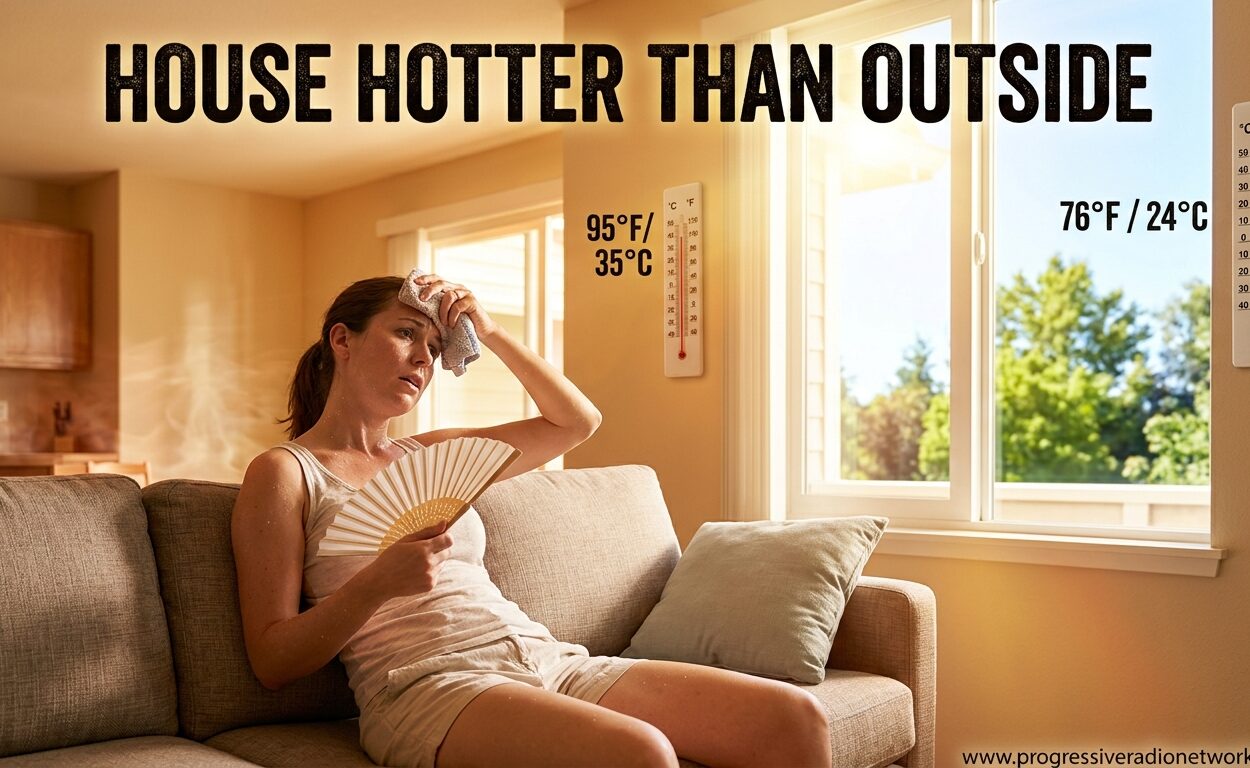
You step outside expecting relief, but the air feels surprisingly cooler. This scenario confuses countless homeowners who find their house hotter than outside temperatures. It seems counterintuitive—shouldn’t indoor air be more comfortable? Yet this phenomenon affects millions of homes, especially during summer months and older buildings. Understanding why your home becomes an oven while outdoor temperatures feel pleasant can help you fix the problem and lower those energy bills.
Why Is My House Hotter Than Outside?
Your house becomes hotter than outside due to several factors working together. Sunlight streams through windows, heating surfaces inside. Those surfaces radiate warmth long after the sun moves. Your insulation, designed to keep heat inside during winter, now traps it. Without proper ventilation, this heat accumulates until your indoor temperature exceeds the outdoor reading on your thermometer.
The greenhouse effect plays a major role. Just like a car parked in the sun, your home allows solar radiation in through glass but traps the resulting heat. This explains why south and west-facing rooms feel the worst. The sun’s energy enters easily but cannot escape as efficiently, creating a thermal buildup that continues even after sunset.
Heat also enters through conduction. Your walls and roof absorb direct sunlight, transferring that warmth inward. Without adequate insulation in these areas, the thermal barrier breaks down. Your attic can reach temperatures exceeding 130°F on hot days, and that heat inevitably finds its way into your living spaces below.
Poor Insulation
Insulation works both ways—it keeps conditioned air inside and outdoor temperatures outside. When insulation degrades, settles, or was never properly installed, your home loses this thermal protection. Heat from your attic pushes through the ceiling into your rooms. Wall insulation that has settled over years creates gaps where heat transfers freely.
Older homes especially suffer from insufficient insulation. Building standards from decades ago required minimal insulation compared to today’s energy codes. If your home was built before 1990, chances are it lacks adequate insulation in attics, walls, and crawl spaces. Adding insulation to these areas often provides the most dramatic improvement in indoor comfort.
Attic insulation deserves special attention. As the primary point of heat entry, an under-insulated attic allows tremendous heat transfer. The Department of Energy recommends R-38 to R-49 insulation levels for most attics—roughly 12 to 19 inches of fiberglass batts. Many homes have half this amount or less.
Heat Gain Through Windows
Windows represent the weakest point in your home’s thermal envelope. Single-pane windows offer almost no resistance to heat transfer. Even double-pane windows with clear glass allow significant solar radiation through. This solar heat gain accounts for up to 30% of cooling costs in many homes.
The Greenhouse Effect in Your Home
The greenhouse effect works like this: sunlight passes through glass as shortwave radiation. When it strikes surfaces inside—floors, furniture, walls—this energy converts to longwave heat radiation. Glass cannot easily transmit longwave radiation back out, so the heat remains trapped inside. This explains why rooms with large windows feel significantly warmer even with blinds drawn.
Window orientation matters tremendously. South-facing windows receive the most consistent sun exposure throughout the day. West-facing windows catch intense afternoon and evening sun when temperatures peak. East-facing rooms warm quickly in the morning. North-facing windows generally contribute the least to heat gain but still allow some solar radiation through.
Low-emissivity window films can dramatically reduce this effect. These treatments reflect solar radiation while still allowing visible light through. Exterior shading options like awnings or solar screens work even better by blocking sunlight before it reaches the glass.
Airflow and Ventilation Issues
Stagnant air feels warmer than moving air at the same temperature. This explains why a 75°F room feels comfortable with a breeze but stuffy without air movement. When airflow is restricted, heat cannot escape or distribute properly. Hot spots develop, especially in rooms with closed doors or blocked vents.
Closed rooms create particular problems. Each time you close a door, you interrupt the natural airflow pattern your home was designed for. Return air vents cannot pull air from closed rooms, causing pressure imbalances. Hot air accumulates in these spaces while your AC system struggles to compensate.
Attic ventilation plays a surprisingly important role. Without proper intake and exhaust vents, your attic becomes a heat reservoir. Ridge vents, soffit vents, and attic fans help release this accumulated heat. A well-ventilated attic can be 30-40°F cooler than a poorly ventilated one, dramatically reducing heat transfer to living spaces below.
Understanding Radiant Heat
The temperature on your thermostat tells only part of the story. Air temperature differs significantly from how warm your body perceives the environment. This distinction explains why 75°F can feel pleasant in one room and miserable in another.
What Is Mean Radiant Temperature?
Mean radiant temperature refers to the average temperature of all surfaces surrounding you. Your body constantly exchanges heat with these surfaces through radiation. When walls, ceilings, and floors are hot, they radiate warmth toward you. This radiant heat makes you feel warmer than the air temperature alone would suggest.
Think about standing near a brick wall that has baked in the sun all day. The air might be 80°F, but you feel significantly warmer because that wall radiates heat toward your body. The same principle applies indoors. When your home’s surfaces absorb heat throughout the day, they continue radiating warmth long after the sun sets.
Operative temperature combines air temperature and radiant temperature to describe perceived comfort. If your air conditioner cools the air to 72°F but your walls radiate at 85°F, your body experiences something closer to 78°F. This explains why your home feels hotter than the thermostat reading.
When Your HVAC System Is the Problem
Sometimes the issue lies with your cooling system itself. An undersized air conditioner cannot keep up with heat gain during the hottest days. Dirty air filters restrict airflow, reducing efficiency and cooling capacity. Leaky ductwork loses conditioned air before it reaches your rooms, especially in unconditioned spaces like attics or crawl spaces.
Thermostat placement affects performance too. A thermostat located in direct sunlight, near heat-producing appliances, or in an unusually cool spot will misread actual home conditions. Your AC system then runs too little or too much, never achieving proper temperature balance throughout your home.
Refrigerant problems cause poor cooling performance. Low refrigerant levels often indicate a leak that requires professional repair. Without proper refrigerant charge, your AC system cannot remove heat effectively regardless of how long it runs.
Why It Happens More in Summer
Summer creates perfect conditions for indoor heat accumulation. Longer daylight hours mean more time for solar radiation to enter your home. Higher sun angles increase direct exposure through windows. The intensity of solar radiation peaks during summer months, delivering more heat energy per square foot.
Heat accumulates throughout the day. Each hour of sun exposure adds thermal energy to your home’s surfaces. By late afternoon, these surfaces have absorbed tremendous heat that continues radiating inward. Even after sunset, your home contains stored heat that maintains elevated indoor temperatures.
Nighttime cooling provides little relief without proper ventilation. While outdoor temperatures drop after dark, your home’s stored heat maintains indoor warmth. Without adequate airflow to exchange this hot indoor air with cooler outdoor air, temperatures remain elevated throughout the night.
Practical Solutions to Cool Your Home
Start with simple, immediate fixes. Close blinds and curtains on sun-facing windows during peak sunlight hours. Use light-colored window treatments that reflect rather than absorb heat. Run ceiling fans counterclockwise to create cooling airflow. Set your thermostat a few degrees higher and use fans for comfort—each degree above 78 saves roughly 3% on cooling costs.
Weekend projects can make significant improvements. Apply window film to treat sun-facing windows. Install weatherstripping around doors and windows to seal air leaks. Add attic insulation if current levels are below recommended amounts. Clean your AC coils and replace air filters monthly during cooling season.
For longer-term solutions, consider professional upgrades. Energy-efficient windows with low-E coatings dramatically reduce solar heat gain. A properly sized AC system ensures adequate cooling capacity. Duct sealing and insulation prevent conditioned air loss. Solar screens or exterior shading provide the most effective window protection.
When to call a professional: if your AC runs constantly but cannot cool below 80°F, if you notice significant temperature differences between rooms, if your energy bills have increased unexpectedly, or if your system makes unusual sounds. These symptoms indicate problems that require professional diagnosis and repair.
Warning Signs Your Home Heat Is Serious
Indoor temperatures exceeding 90°F pose health risks, especially for vulnerable individuals. If your home cannot maintain temperatures below 85°F even at night, this indicates serious problems with insulation, ventilation, or cooling capacity. Persistent temperature differences of more than 5°F between rooms suggest airflow or ductwork issues requiring professional attention.
Signs of heat exhaustion include dizziness, nausea, rapid heartbeat, and confusion. If anyone in your home experiences these symptoms, move them to a cooler location immediately and seek medical attention if symptoms worsen or persist.
FAQ
How cool should my house be if it’s 110 outside?
When outdoor temperatures reach 110°F, your air conditioner should maintain indoor temperatures 20-25 degrees cooler, ideally around 85-90°F. Systems sized for extreme heat can achieve greater differentials, but expecting more than a 30-degree difference strains most residential equipment. Focus on airflow and dehumidification at these extreme temperatures.
Does having the AC on 72 instead of 70 make it cheaper?
Yes, running your AC at 72°F instead of 70°F saves approximately 6-9% on cooling costs. Each degree increase above 78°F saves roughly 3-5%. The savings come from reduced runtime and less stress on your system. Consider using fans to maintain comfort at higher thermostat settings.
What should my thermostat be set at in October?
In October, thermostat settings depend on your climate. In warmer regions, set AC to 78-80°F. In areas with cool nights, open windows instead of running AC. In colder regions, you may need heating at 68-70°F. The transition season offers opportunities to minimize HVAC use by taking advantage of natural temperature changes.
Is 77 too hot for a house?
77°F falls within the normal range for indoor temperatures during summer months. Most people find 76-78°F comfortable with appropriate airflow. However, perceived comfort depends on humidity levels and radiant heat from surfaces. If 77°F feels uncomfortably warm, check humidity levels and ensure adequate air circulation.
Why is my house hotter than outside at night?
Your house feels hotter at night because building materials absorb and store heat throughout the day. After sunset, these surfaces continue releasing stored heat inward while outdoor temperatures cool. Without proper ventilation to exchange this warm indoor air with cooler outdoor air, temperatures remain elevated until the stored heat dissipates.
Conclusion
Finding your house hotter than outside feels frustrating and uncomfortable, but the causes are usually identifiable and solvable. Start with simple fixes like managing window treatments and improving airflow. Address insulation issues in attics and walls. Consider professional help for HVAC problems or major upgrades. Most homeowners see significant improvement with targeted efforts rather than wholesale renovations. Your home should be a refuge from summer heat—not a solar oven that makes you dread walking through the front door.


Leave a Comment