
When our team replaced a 3-ton unit on a 1,200-square-foot home last summer, the homeowner couldn’t figure out why the new house felt clammy instead of comfortable. The previous owner had oversized the AC, and the new owners inherited the humidity problems that came with it. If you are comparing a 2 ton vs 3 ton AC, the wrong choice can cost you thousands in energy bills and leave you sweating through sticky summers.
Homeowners on HVAC forums report the same frustration: contractors give conflicting quotes for the same house. One recommends a 2-ton unit, another insists on 3 tons. The confusion is real, and it usually happens because contractors use different rules of thumb or do not account for your insulation quality.
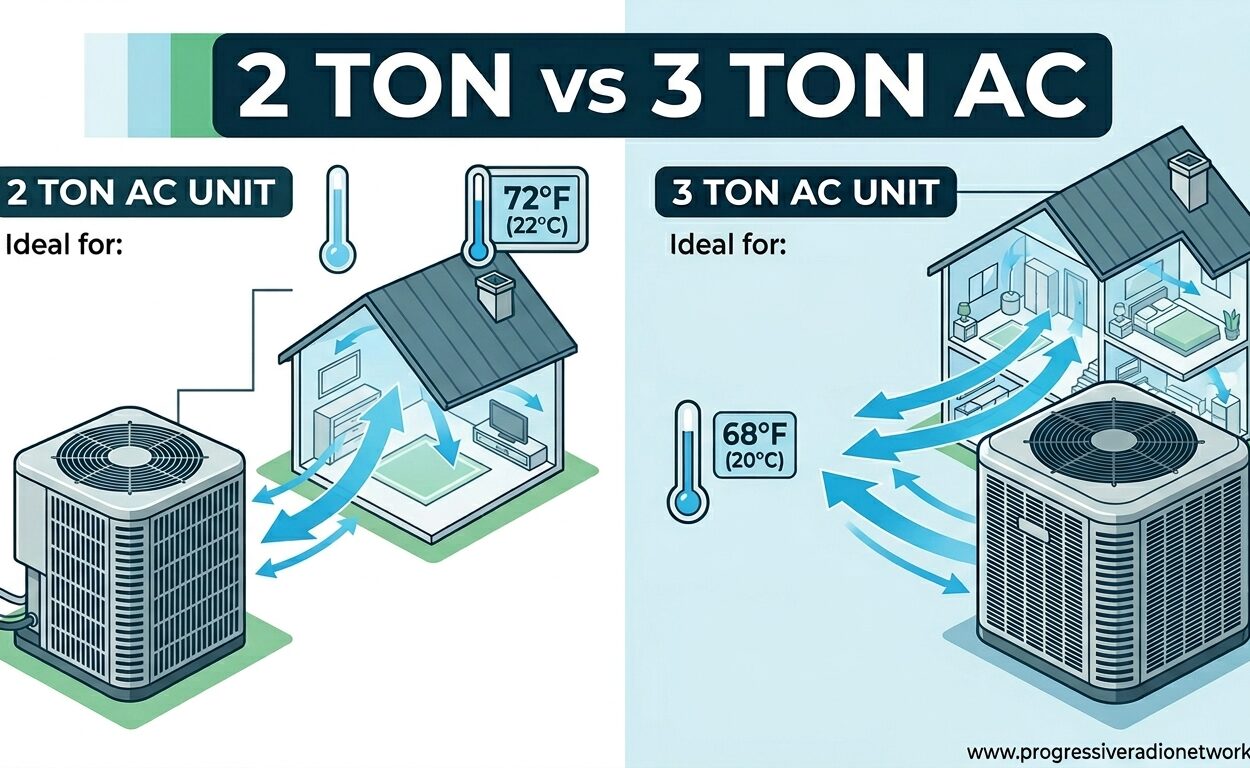
A 2-ton AC removes 24,000 BTU of heat per hour. A 3-ton AC removes 36,000 BTU per hour, which is 50% more cooling capacity.
In this guide, we will break down exactly what tonnage means, which home sizes each unit covers, and why bigger is not always better. By the end, you will know how to calculate the right size for your space and avoid the short-cycling headaches that plague so many homeowners.
2 Ton vs 3 Ton AC: The Difference Is 24,000 vs 36,000 BTU of Cooling Power
In the HVAC world, a ton does not measure weight. It measures how much heat an air conditioner can remove from your home in one hour. One ton of cooling equals 12,000 British Thermal Units, or BTU.
Think of BTU as a unit of energy. A single BTU is the amount of heat needed to raise one pound of water by one degree Fahrenheit. Your AC works in reverse, pulling that heat out of your indoor air and dumping it outside.
One ton of cooling comes from the old ice-harvesting days. A ton of ice melting over 24 hours absorbs 288,000 BTU of heat. Divide that by 24 hours, and you get 12,000 BTU per hour. That is where the term comes from, and it is still the standard today.
So a 2-ton AC unit removes 24,000 BTU per hour. A 3-ton unit removes 36,000 BTU per hour. That 12,000 BTU difference is what separates a system meant for a small home from one built for a larger space.
A 3-Ton AC Produces 50% More Cooling Power Than a 2-Ton Unit
The core difference between these two sizes is raw cooling capacity. A 3-ton unit can move 50% more heat than a 2-ton unit, which directly affects how quickly it can lower the temperature in your home and how large a space it can serve.
| Specification | 2-Ton AC | 3-Ton AC |
|---|---|---|
| Cooling Capacity | 24,000 BTU/hour | 36,000 BTU/hour |
| Typical Wattage | 1,800 – 2,400 watts | 2,700 – 3,600 watts |
| Typical Amperage | 15 – 20 amps | 20 – 30 amps |
| Refrigerant Volume | 4 – 6 lbs | 6 – 9 lbs |
That 50% jump is not a minor upgrade. It is the difference between a system that comfortably cools a 1,500-square-foot ranch and one that struggles to keep up with a 2,000-square-foot home.
A 2-Ton AC Cools 900 to 1,500 Square Feet, While a 3-Ton AC Cools 1,500 to 2,100 Square Feet
The rule of thumb in the HVAC industry is that one ton of cooling handles roughly 600 square feet of living space. That guideline gives you a starting point, but climate and construction quality can shift the number by 200 square feet in either direction.
| AC Size | Moderate Climate | Hot Climate | Max Range |
|---|---|---|---|
| 2-Ton AC | 1,000 – 1,500 sq ft | 900 – 1,200 sq ft | 900 – 1,500 sq ft |
| 3-Ton AC | 1,500 – 2,100 sq ft | 1,300 – 1,800 sq ft | 1,300 – 2,100 sq ft |
In mild climates like the Pacific Northwest, a 2-ton unit might stretch to cover 1,500 square feet without breaking a sweat. In Phoenix or Houston, that same unit could struggle with anything over 1,000 square feet because the outdoor temperature stays high for hours on end.
Older homes built before 1980 often have 2×4 walls with minimal insulation, which pushes them toward the lower end of the range. New construction with 2×6 walls, spray foam, and low-E windows can stretch a 2-ton unit to cover 1,600 square feet in a moderate climate.
Choose a 2-Ton AC for Homes Under 1,500 Square Feet With Good Insulation
A 2-ton AC is the right fit for smaller homes and well-sealed spaces. Here are the situations where a 2-ton unit shines:
- Your home is 900 to 1,500 square feet.
- You have modern insulation in the attic and walls.
- You live in a moderate climate with fewer than 20 days above 95 degrees.
- Your ceilings are standard 8-foot height.
- Your windows are double-pane and shaded.
- You have a single-story layout with no garage conversions.
- You are replacing an old unit that already cooled the home adequately.
Contractors sometimes push larger units because they sound more powerful, but our team has seen 2-ton systems keep 1,400-square-foot homes at 72 degrees even during 100-degree heat waves. The secret is the home envelope, not the compressor size.
Garage conversions are a common trap. A 400-square-foot bedroom above a garage adds heat load from the unconditioned space below. Even if your main home is 1,200 square feet, that garage conversion might push you from 2 tons to 2.5 tons.
Choose a 3-Ton AC for Homes Between 1,500 and 2,100 Square Feet or Hot Climates
A 3-ton AC makes sense when you have more space to cool or tougher conditions to fight. Consider a 3-ton unit if:
- Your home is 1,500 to 2,100 square feet.
- You live in a hot climate with 30 or more days above 95 degrees.
- Your home has poor insulation or single-pane windows.
- Your ceilings are 9 feet or higher.
- You have an open floor plan with fewer walls to block airflow.
- You have a two-story home with a single HVAC system.
- Your home has a south-facing exposure with little shade.
I talked to a homeowner in Dallas who upgraded from a 2.5-ton to a 3-ton unit after adding a 400-square-foot sunroom. The old system ran 18 hours a day and still could not reach 75 degrees. The 3-ton unit brought the temperature down in 45 minutes and cycled normally after that.
Sunrooms with glass walls are another factor. A 200-square-foot sunroom with single-pane windows can add the heat load of an extra 400 square feet. If you added a sunroom recently and your old 2-ton unit is struggling, a 3-ton replacement is probably the right call.
A 3-Ton AC Consumes About 50% More Electricity Than a 2-Ton Unit
Electricity use is the hidden cost that adds up over a decade. A typical 2-ton AC draws around 1,800 to 2,400 watts when running, while a 3-ton unit pulls 2,700 to 3,600 watts. That difference translates directly into your monthly utility bill.
SEER rating changes the math. A 16 SEER 2-ton unit might cost $450 per year to run in a moderate climate, while a 14 SEER 3-ton unit could cost $850 per year in the same region. Jumping to an 18 SEER 3-ton unit could drop that annual cost to $680, which means the higher upfront price pays for itself in about 5 years.
Variable-speed compressors change the efficiency picture. A 3-ton unit with a variable-speed compressor can throttle down to 1.5-ton capacity on mild days, which saves energy. A basic single-stage 3-ton unit runs at full blast every time it starts, which is less efficient.
| Climate Zone | 2-Ton Annual Cost | 3-Ton Annual Cost | Hours/Year |
|---|---|---|---|
| Moderate (Seattle, Denver) | $350 – $500 | $550 – $800 | 600 – 900 |
| Warm (Atlanta, Charlotte) | $500 – $700 | $800 – $1,100 | 900 – 1,200 |
| Hot (Phoenix, Houston) | $700 – $950 | $1,100 – $1,500 | 1,400 – 1,800 |
These numbers assume 1,000 cooling hours per year. If you live in Florida or Arizona, expect 1,400 to 1,800 hours, which pushes costs up by 40% to 80%.
A 3-Ton AC Costs 15% to 25% More to Purchase and Install Than a 2-Ton Unit
Equipment price is only part of the story. A 2-ton split-system AC typically costs $2,800 to $4,200 for the outdoor condenser and indoor coil. A 3-ton unit runs $3,400 to $5,000 for similar equipment. The gap widens when you factor in installation.
Installation costs vary by region, but expect $3,000 to $6,000 for a 2-ton replacement and $3,500 to $7,000 for a 3-ton replacement. If your ductwork needs resizing for the larger unit, add $800 to $2,000 for duct modifications.
If you are converting from a 2-ton to a 3-ton unit, your electrical panel might need an upgrade. A 3-ton unit typically requires a 30-amp breaker, while some 2-ton units run on a 20-amp breaker. If your panel is full, add $500 to $1,500 for an electrician.
| Cost Category | 2-Ton AC | 3-Ton AC |
|---|---|---|
| Equipment Only | $2,800 – $4,200 | $3,400 – $5,000 |
| Installation (Typical) | $3,000 – $6,000 | $3,500 – $7,000 |
| Total Project Cost | $5,800 – $10,200 | $6,900 – $12,000 |
These prices include labor, permits, and basic electrical work. If you need a new thermostat, refrigerant line set, or pad, add $300 to $800 more.
Oversizing Causes Short-Cycling and Leaves Your Home Feeling Clammy
This is the mistake we see most often. Homeowners think a bigger unit will cool faster, so they size up. The problem is that an oversized AC blasts cold air, hits the thermostat setpoint in 10 minutes, and shuts off. It never runs long enough to remove humidity.
Some homeowners intentionally oversize because they think it will cool the house faster after being away. It does cool faster, but that is the problem. The blast of cold air satisfies the thermostat before the dehumidification cycle finishes. You come home to a cold, damp house that feels worse than a slightly warmer, dry house.
That leads to short-cycling. The compressor starts and stops every 8 to 12 minutes, which wears out the motor, raises your electric bill, and leaves the indoor air at 65 degrees but 65% relative humidity.
It feels clammy. It feels sticky. It is the exact opposite of comfort.
HVAC pros call this the sensible heat vs latent heat problem. Sensible heat is the temperature you feel on a thermometer. Latent heat is the moisture hiding in the air. An AC needs 15 to 20 minutes of continuous runtime to pull latent heat out through the condensate drain. If your 3-ton unit on a 1,200-square-foot home shuts off after 8 minutes, the latent heat stays put.
Over time, high humidity can promote mold growth on drywall and around windows. I have inspected homes where the oversized AC kept the temperature at 70 degrees but the humidity stayed above 60%. That is a recipe for respiratory issues and property damage.
Undersizing Forces Your AC to Run Constantly and Shortens Its Lifespan
An undersized AC is the opposite problem, but just as expensive. A 2-ton unit trying to cool a 2,000-square-foot home in Atlanta will run 22 hours a day during July. It might never reach your set temperature of 72 degrees, so it just keeps spinning the electric meter.
In our experience, undersizing is more common in older neighborhoods where homes have been expanded over time. A 1,200-square-foot home from 1960 might have a 2-ton unit that worked fine. Add a 400-square-foot addition in the 1990s, and suddenly the same unit is undersized by 20%.
Constant running creates three problems. First, your energy bill spikes because the compressor never gets a break. Second, the wear and tear on motors and capacitors accelerates, which means you will replace parts sooner.
Third, the indoor coil stays wet all day, which increases the risk of microbial growth.
A properly sized unit should cycle 2 to 3 times per hour, with each cycle lasting 15 to 20 minutes. If your AC runs for 50 minutes, shuts off for 5 minutes, then starts again, it is undersized. That is not normal operation, and it is not something a thermostat adjustment can fix.
A 3-Ton AC Needs 1,200 CFM of Airflow, While a 2-Ton Unit Needs About 800 CFM
Cooling capacity is useless without the right airflow. CFM, or cubic feet per minute, measures how much air your duct system moves. A 2-ton AC needs roughly 800 CFM, while a 3-ton unit needs 1,200 CFM. That is a 50% increase in airflow demand.
If your existing ducts are sized for 800 CFM and you install a 3-ton unit without upgrading them, the system will suffer from high static pressure. The blower motor strains, noise increases, and the air coming out of your vents feels weak. Some rooms will get plenty of air while others starve.
Flexible ductwork is common in attics, but it degrades over time. A 15-year-old flex duct might have 30% less airflow than when it was new. If you are upgrading from a 2-ton to a 3-ton unit, you should replace any flex duct older than 10 years rather than trying to force more air through it.
| Component | 2-Ton Requirement | 3-Ton Requirement |
|---|---|---|
| Main Trunk (Rectangular) | 10″ x 10″ or 12″ x 8″ | 12″ x 12″ or 14″ x 10″ |
| Branch Lines (Round) | 6″ diameter | 7″ or 8″ diameter |
| Return Air Duct | 14″ x 8″ or 16″ x 6″ | 16″ x 10″ or 18″ x 8″ |
| Total CFM | 800 CFM | 1,200 CFM |
Before upgrading to a larger unit, ask your contractor to perform a static pressure test. If the reading is above 0.5 inches of water column, you need ductwork modifications before you can safely install a 3-ton system.
Climate, Insulation, and Ceiling Height Can Shift Your Sizing Needs by Half a Ton
The square-footage rule is a rough estimate. Real-world sizing depends on how much heat enters your home and how hard your AC must work to remove it. Here are the factors that push you up or down by half a ton:
Climate zone. Hot-humid climates like Florida need more tonnage per square foot than dry climates like Colorado. A 1,500-square-foot home in Miami might need 3 tons, while the same home in Denver gets by with 2.5.
Insulation quality. R-30 attic insulation versus R-13 can change your load by 2,000 to 4,000 BTU. That is the difference between a 2-ton and a 2.5-ton unit.
Ceiling height. Every foot above 8 feet adds about 12% more volume to cool. A 10-foot ceiling turns a 1,500-square-foot home into the equivalent of 1,800 square feet.
Window orientation. South-facing windows with no shade can add 3,000 to 5,000 BTU of heat gain. East-facing windows are less punishing, but west-facing windows catch the afternoon sun at the hottest time of day.
Open floor plans. Fewer walls mean air mixes more easily, which can help a slightly smaller unit. But it also means there is more volume to cool with fewer barriers.
Two-story homes. Heat rises, so the upstairs often needs more cooling than the downstairs. A single 3-ton unit for a 1,800-square-foot two-story home might work, but zoning or a separate upstairs system often delivers better comfort.
Kitchen heat. Kitchens with gas stoves add heat load. A busy kitchen during a dinner party can add 2,000 to 4,000 BTU of heat. It is not enough to change your tonnage by itself, but it is one of the reasons a 3-ton unit might make sense for a 1,600-square-foot home with an open-concept kitchen and living room.
Short-Cycling, Constant Running, and High Humidity Are Signs Your AC Is the Wrong Size
You do not need a Manual J report to know something is wrong. Your home tells you every day. Here are the warning signs:
- Your AC turns on and off every 8 to 12 minutes. This is short-cycling, and it almost always means oversizing.
- Your AC runs for 45 minutes or more, shuts off for 5 minutes, then starts again. This is classic undersizing.
- Your thermostat says 72 degrees but the air feels sticky. This is oversizing failing to remove latent heat.
- Some rooms are freezing while others are warm. This can mean duct issues, but it can also mean the unit is too large and shuts off before air circulates evenly.
- Your electric bill is 30% higher than neighbors with similar homes. Both oversizing and undersizing waste energy.
- You hear the compressor start 40 or more times per day. Every start cycle adds mechanical stress and uses more power than a steady run.
Listen to your compressor. A normal startup sounds like a low hum that ramps up over 5 seconds. If you hear a loud clunk every time it starts, the short-cycling from an oversized unit is hammering the compressor. That mechanical stress is expensive.
If you see two or more of these signs, call a licensed HVAC contractor for a load calculation. Do not guess based on square footage alone.
Divide Your Square Footage by 600 for a Quick Tonnage Estimate
Before you call a contractor, you can do a rough calculation yourself. Take your home’s square footage and divide by 600. That gives you a baseline tonnage.
For example, a 1,200-square-foot home divided by 600 equals 2 tons. A 1,800-square-foot home divided by 600 equals 3 tons. If your home has 9-foot ceilings, poor insulation, or a hot climate, add 0.5 tons. If it has excellent insulation and mild summers, subtract 0.5 tons.
Here is a quick formula:
Base tonnage = Square footage divided by 600
Add 0.5 ton for hot climate (30+ days above 95 degrees). Add 0.5 ton for poor insulation or single-pane windows. Add 0.5 ton for ceilings over 9 feet.
Add 0.5 ton for heavy sun exposure with no shade. Subtract 0.5 ton for excellent insulation and tight envelope. Subtract 0.5 ton for mild climate with few hot days.
Worked example: A 1,500-square-foot home in Phoenix with standard insulation and 8-foot ceilings.
1,500 divided by 600 = 2.5 tons
Hot climate: +0.5 ton
Final recommendation: 3 tons
Worked example: A 1,500-square-foot home in Seattle with great insulation and shaded windows.
1,500 divided by 600 = 2.5 tons
Mild climate: -0.5 ton
Final recommendation: 2 tons
Some online calculators ask for wall color and roof type. Dark roofs absorb more heat than light roofs, but the difference is usually less than 1,000 BTU for a typical home. Do not overthink it. Focus on the big three: square footage, insulation, and climate.
These quick formulas are useful for budgeting, but they are not precise. A Manual J load calculation measures your home’s exact heat gain by analyzing wall area, window types, insulation levels, and local climate data. The $200 to $400 you spend on a Manual J can save you $2,000 to $5,000 in equipment and energy costs over the life of the unit.
New Refrigerant Standards in 2026 Do Not Change How You Calculate Tonnage
This change began in 2025 for most residential systems. As of September 2026, the HVAC industry is well into its phase-out of R-410A refrigerant in favor of lower-GWP alternatives like R-32 and R-454B.
R-32 refrigerant operates at slightly higher pressures, which means manufacturers have redesigned compressors and coils. However, the cooling capacity measured in BTU and tons remains exactly the same. A 2-ton R-32 unit still removes 24,000 BTU per hour, just like a 2-ton R-410A unit.
R-454B is a blended refrigerant that manufacturers like Carrier and Trane are adopting. It has a lower flammability rating than R-32, which makes it easier to handle. Both refrigerants work with the same tonnage ratings, so your 2-ton vs 3-ton decision stays the same regardless of which refrigerant your new unit uses.
What does change is serviceability. If you buy a new R-32 system in 2026, your old R-410A tools and recovery equipment will not work. Technicians need new gauges and charging hoses. For homeowners, this means nothing for tonnage decisions, but it does mean you should stick with the same refrigerant type if you are only replacing the outdoor condenser and not the indoor coil.
Frequently Asked Questions
How many sq ft will a 2 ton AC unit cool?
A 2-ton AC unit will cool between 900 and 1,500 square feet under normal conditions. In hot climates or homes with poor insulation, expect the lower end of that range. In mild climates with excellent insulation, a 2-ton unit can stretch to cover 1,500 square feet comfortably.
Is a 3 ton AC too big for 1500 square feet?
A 3-ton AC is generally too big for 1,500 square feet unless the home has poor insulation, high ceilings, or is located in a very hot climate. In most cases, a 2.5-ton unit is the better fit for 1,500 square feet. An oversized 3-ton unit on 1,500 square feet will short-cycle and leave the home feeling humid.
What is the $5000 rule for HVAC?
The $5000 rule is a rough guideline for deciding whether to repair or replace an HVAC system. Multiply the age of your unit by the repair cost. If the total exceeds $5,000, replacement is usually the better financial choice. For example, a 12-year-old unit needing a $500 repair scores 12 times 500, which equals $6,000, so you should replace it.
Which AC is better for allergies?
The size of your AC does not directly affect allergies, but humidity control does. A properly sized unit that runs 15 to 20 minutes per cycle removes more humidity, which reduces dust mites and mold spores. An oversized unit that short-cycles leaves humidity high, which can worsen allergy symptoms. For allergy relief, focus on correct sizing and a high-quality air filter with a MERV rating of 11 or higher.
The Right Tonnage Saves Money, Comfort, and Your AC’s Lifespan
Choosing between a 2 ton vs 3 ton AC is not about buying the biggest unit you can afford. It is about matching 24,000 or 36,000 BTU of cooling capacity to the exact heat load of your home. A 2-ton unit handles 900 to 1,500 square feet in most conditions. A 3-ton unit covers 1,500 to 2,100 square feet, but only if your ductwork and insulation can support it.
For most homeowners, the decision comes down to one question: is my home between 900 and 1,500 square feet, or between 1,500 and 2,100 square feet? If you are right at 1,500 square feet, the other factors decide it. Good insulation and a mild climate mean 2 tons. Hot summers and old windows mean 3 tons.
Bigger is not better. Oversizing leads to short-cycling, humidity, and mold. Undersizing leads to constant running, high bills, and premature failure. The sweet spot is a properly sized unit that runs 15 to 20 minutes per cycle, 2 to 3 times per hour, while pulling humidity down to 45% to 55% relative humidity.
Start with the square-footage formula, then call a licensed contractor for a Manual J load calculation. That one step protects your comfort and your wallet for the next 15 years.





Leave a Comment