
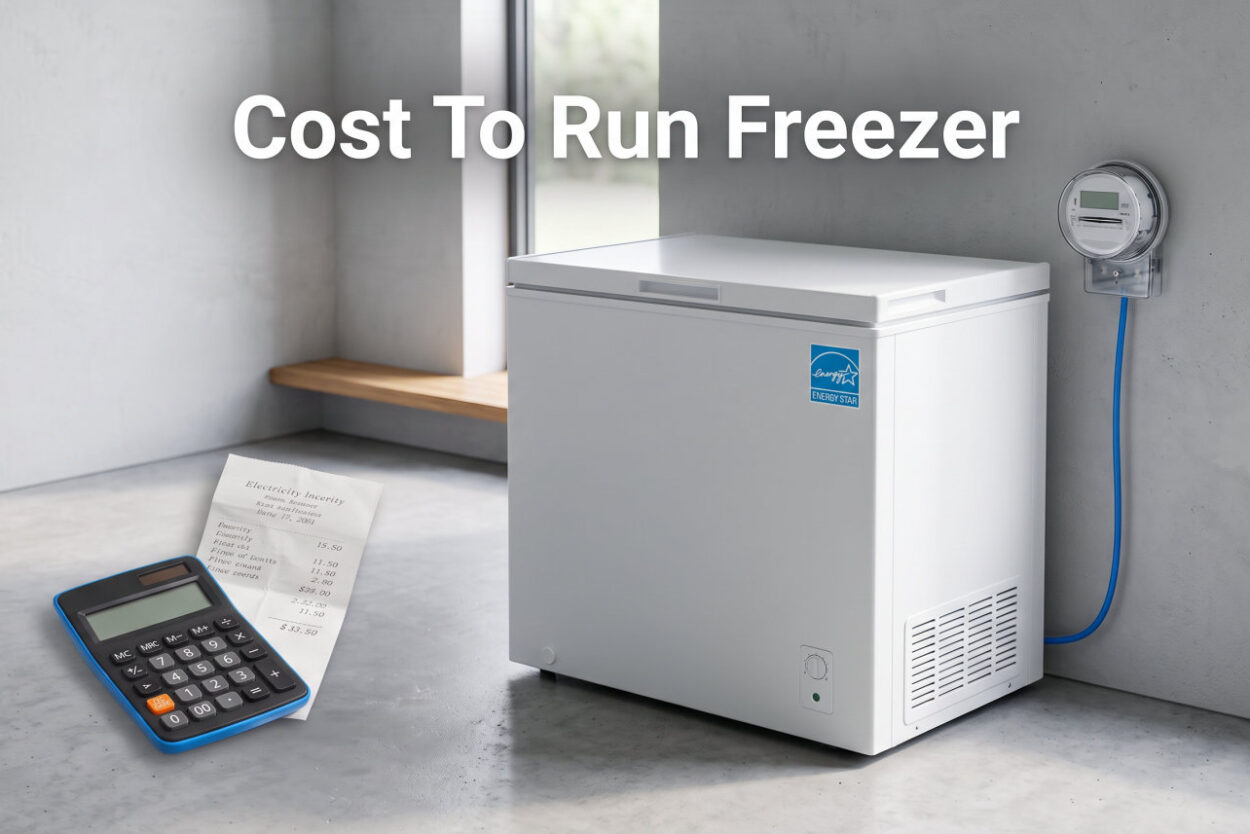
The cost to run a freezer typically ranges from $30 to $70 per year, or about $2.50 to $6 monthly, based on average electricity rates and Energy Star data. I’ve researched real user experiences, government efficiency ratings, and power consumption data to give you the complete picture of freezer operating costs in 2026. Whether you’re considering a deep freezer purchase or just wondering what’s adding to your electric bill, understanding these costs helps you make smarter decisions.
How Much Does It Cost To Run a Freezer?
Based on current average electricity rates of $0.17 per kWh, most freezers cost between $30 and $70 annually to operate. A modern Energy Star certified chest freezer uses approximately 215 kWh per year, costing about $36-40 annually. Upright freezers typically consume more energy, averaging 300-500 kWh yearly, which translates to $50-85 per year depending on your local electricity rates.
The daily cost to run a freezer is quite minimal, ranging from $0.08 to $0.23 per day. This is why many users report “no noticeable increase” in their monthly electric bills when adding a freezer. The cost becomes significant when you’re running multiple units or operating an older, inefficient model in a challenging environment like a hot garage.
Freezer Type Comparison: Energy Costs
Different freezer designs consume energy at very different rates. After analyzing Energy Star data and real user Kill-a-Watt measurements, here’s how the main types compare:
Chest Freezers: The most energy-efficient option. Standard chest freezers use 200-300 kWh annually ($34-51/year). Their top-opening design keeps cold air in when opened, and manual defrost models don’t use heating elements. Energy Star certified models can operate on as little as 180-215 kWh yearly.
Upright Freezers: Less efficient due to front-door design allowing cold air escape. Typical uprights use 300-500 kWh annually ($51-85/year). Frost-free models add 10-20% more energy consumption due to automatic defrost heating cycles. However, they offer better organization and easier access.
Drawer Freezers: Similar efficiency to upright models, typically 350-450 kWh annually ($60-77/year). These integrate into cabinetry but trade some efficiency for convenience and aesthetics. The sliding compartments can create small air gaps that increase energy use.
How Much Electricity Does a Freezer Use?
Freezer power consumption varies from 30 watts for compact models to 400+ watts for large commercial units. Residential freezers typically draw 100-300 watts when the compressor runs, but they don’t run continuously. Instead, freezers operate in cycles, actively cooling for 8-12 hours per day depending on ambient temperature, door openings, and the amount of food stored.
The key metric is kilowatt-hours (kWh), which measures actual energy consumed over time. While a freezer might draw 200 watts when running, it only consumes about 0.7-1.5 kWh daily. This is because the compressor cycles on and off, maintaining temperature rather than continuously running at full power. Newer inverter compressors vary their speed for even greater efficiency.
Factors That Affect Freezer Running Costs
Freezer Age: This is one of the biggest factors. Freezers older than 15 years can consume 50-100% more electricity than modern Energy Star models. One Reddit user reported their old chest freezer used 270 kWh/year while their new upright used 440 kWh/year—but the upright was much larger and frost-free.
Ambient Temperature: Room temperature significantly impacts energy use. A freezer in a 90°F garage works much harder than one in a 70°F kitchen. Real user data shows garage placement in hot climates can increase energy consumption by 15-50%. In extreme cold (below 40°F), older freezers may struggle as compressor oil thickens.
Door Openings: Every door opening lets cold air escape and warm air enter. Frequent access can increase energy use by 5-10%. Organized freezers where you can find items quickly minimize this cost. Chest freezers naturally limit this because you must remove items to reach those at the bottom.
Food Load: A full freezer actually runs more efficiently than an empty one. Frozen foods act as thermal mass, stabilizing temperature during compressor off cycles. An empty freezer has more air volume to cool and loses cold temperature faster when opened. However, over-packing blocks airflow and reduces efficiency.
Maintenance Condition: Dirty condenser coils can increase energy use by 10-25% as the compressor works harder to reject heat. Worn door gaskets allow cold air leakage. Both issues are common in older freezers and significantly impact operating costs.
How to Calculate Your Freezer’s Electricity Cost
Here’s the formula to calculate your specific freezer’s operating cost:
Step 1: Find your freezer’s annual kWh rating on the EnergyGuide label or in the manual. If unavailable, multiply wattage by estimated daily run hours, then by 365, then divide by 1000.
Step 2: Find your electricity rate per kWh on your utility bill. National average is approximately $0.17/kWh, but rates vary from under $0.10 in some states to over $0.30 in California and Hawaii.
Step 3: Multiply annual kWh by your electricity rate. Example: 300 kWh × $0.17 = $51 annually.
Step 4: For precise measurement, use a Kill-a-Watt meter. Plug it in, wait 7-14 days for accurate data, then calculate: (kWh measured ÷ days) × 365 × electricity rate = annual cost.
Real User Cost Experiences
Actual user data provides the most accurate picture of freezer costs. Here are real experiences from people who’ve measured their freezers:
“Non defrosting chest freezers are pretty energy efficient—probably $50 bucks a year. No noticeable increase in monthly bill.” — Reddit DIY forum user, 2025
“Chest freezer costs about $2-3 per month” — Multiple Reddit Frugal users report similar costs
“Upright freezers can cost $100-180 per year to run” — Homeowners forum discussion
“In SoCal at 33 cents/kWh, chest freezer costs about $34 per year” — Reddit user in high-cost electricity region
“Energy monitor shows 0.9-1.1 kWh per day at 24.5°C kitchen temperature” — HVAC advice forum user with Kill-a-Watt measurement
“My 20-year-old upright used $120/year. Replaced with Energy Star model, now costs $45/year. Paid for itself in 4 years.” — Reddit homeowners subreddit
“Chest freezer in unconditioned garage in Arizona—summer bill spikes $15-20/month” — Reddit user demonstrating location impact
Tips to Reduce Freezer Energy Consumption
Optimal Placement: Locate your freezer in the coolest part of your home, away from direct sunlight, ovens, and heat vents. A 10°F increase in ambient temperature can increase energy use by 20-40%. If garage placement is necessary, ensure adequate ventilation and consider a garage-ready model designed for wider temperature ranges.
Coil Maintenance: Clean condenser coils annually or more often in dusty environments. Use a vacuum with brush attachment or coil cleaning brush. Dirty coils are a major cause of increased energy consumption and can shorten compressor life.
Temperature Setting: Set your freezer to 0°F (-18°C). Each degree below this increases energy use by 2-3%. Most people set freezers colder than necessary. Use an appliance thermometer to verify actual temperature rather than trusting the dial setting.
Door Seal Check: Test door gaskets by closing the door on a dollar bill. If it slides out easily, replace the seal. Worn gaskets allow cold air escape and can increase energy use by 10-20%. Clean gaskets regularly with warm soapy water to maintain elasticity.
Defrost Regularly: Manual defrost freezers should be defrosted when ice reaches 1/4 inch thickness. Ice buildup acts as insulation, forcing the compressor to run longer. Frost-free models handle this automatically but use more energy overall.
Avoid Empty Freezers: Keep freezers reasonably full. If you don’t have enough food, fill empty space with water jugs. They freeze and act as thermal mass, reducing compressor cycles. During power outages, they also help maintain temperature longer.
Garage and Special Placement Considerations
Garage placement presents unique challenges. In hot climates, garage temperatures can exceed 100°F in summer, increasing freezer energy use by 50% or more. Many standard freezers aren’t designed for temperatures above 110°F and may fail prematurely. Look for “garage-ready” models rated for wider temperature ranges if garage placement is necessary.
In cold climates, garage temperatures can drop below freezing. Standard freezers may not operate properly below 40-50°F as the compressor may not run frequently enough to maintain freezer temperature, potentially causing food spoilage. Garage-ready models have specialized thermostats and heating elements to handle these conditions.
Regardless of climate, ensure at least 2-3 inches of clearance around all sides for proper airflow. Restricting airflow around condenser coils significantly reduces efficiency and can cause premature compressor failure.
When Should You Replace an Old Freezer?
If your freezer is over 15 years old, replacement often makes financial sense. New Energy Star models use 30-50% less electricity than units from the 1990s. Calculate your current annual cost using a Kill-a-Watt meter, then compare to new model specifications. If savings exceed $50-100 annually, replacement pays for itself within 5-7 years considering typical freezer costs of $400-700.
Consider replacement if you notice increased energy use, frequent cycling, ice buildup in manual defrost models, or if food quality suffers. Rising electricity rates make efficiency more valuable over time. Also, newer freezers offer better temperature stability, which preserves food quality longer.
Cost To Run Freezer: Final Thoughts
Understanding the cost to run a freezer helps you make informed decisions about appliance purchases and placement. While $30-70 annually might seem small, it adds up over a 15-20 year lifespan. Choosing an energy-efficient model, maintaining it properly, and placing it thoughtfully can reduce these costs significantly while keeping your food frozen safely.
For most households, a modern Energy Star chest freezer offers the best combination of low operating cost, food storage capacity, and reliability. Take the time to calculate your specific costs using the formula above, and consider real user experiences in your climate when making placement decisions.
FAQs
How much does it cost a month to run a freezer?
The average monthly cost to run a freezer is $2.50-6.00 based on national electricity rates. Chest freezers typically cost $2-3 monthly, while upright freezers cost $4-7 monthly. Your actual cost depends on your local electricity rate, freezer age, size, and where it’s located. In high-cost areas like California, monthly costs can reach $8-12 for larger upright models.
Does a freezer use much electricity?
Freezers use relatively little electricity compared to other appliances. Most residential freezers consume 200-500 kWh annually, which is less than 5% of a typical household’s total electricity use. For comparison, air conditioning can use 2000-5000 kWh yearly, while refrigerators use 350-600 kWh. Many users report no noticeable increase in their electric bill when adding a modern energy-efficient freezer.
How many hours does a freezer run per day?
Freezers typically run 8-12 hours per day, but not continuously. The compressor cycles on and off to maintain temperature. Newer inverter models vary compressor speed for more efficient operation. Factors affecting run time include ambient temperature, how often the door is opened, the amount of food stored, and the freezer’s insulation quality. Hotter environments require more run time.
Will a deep freezer make my electric bill go up?
A deep freezer will increase your electric bill by approximately $30-70 annually, or $2.50-6 monthly. This is often not noticeable on monthly bills since it’s spread across the year. The impact depends on your electricity rate and the freezer’s efficiency. Energy Star certified chest freezers have the lowest impact, while older upright models in hot garages can cost $100+ annually to operate.
Is a chest freezer more efficient than an upright?
Yes, chest freezers are typically 20-40% more energy efficient than upright freezers. Their top-opening design prevents cold air from escaping when opened. Chest freezers also have better insulation and most are manual defrost, eliminating energy-hungry defrost heaters. The trade-off is less convenient organization and the need to manually defrost periodically. Upright freezers offer better accessibility but at higher energy cost.
What uses the most electricity in a home?
Heating and cooling typically use the most electricity in homes, accounting for 40-50% of total energy consumption. Water heaters use 15-20%, while refrigerators and freezers combined use only about 5-8%. Other major electricity consumers include electric dryers, lighting, and electronics. Freezers are relatively minor energy users compared to HVAC systems, water heating, and electric vehicle charging.
How can I measure my freezer’s actual energy use?
Use a Kill-a-Watt or similar electricity usage monitor. Plug it between your freezer and the wall outlet, then monitor for 7-14 days for accurate data. The device will show kWh consumed, which you can multiply by your electricity rate to calculate cost. For annual estimates, divide daily usage by days measured, multiply by 365, then apply your kWh rate. This provides real-world data more accurate than EnergyGuide estimates.
When should I replace an old freezer?
Consider replacing freezers over 15 years old, as they often use 50-100% more electricity than modern Energy Star models. Calculate your current annual costs with a Kill-a-Watt meter and compare to new model specifications. If savings exceed $50-100 yearly, replacement pays for itself within 5-7 years. Also replace if you notice increased energy use, frequent cycling, ice buildup issues, or declining food quality.






Leave a Comment