
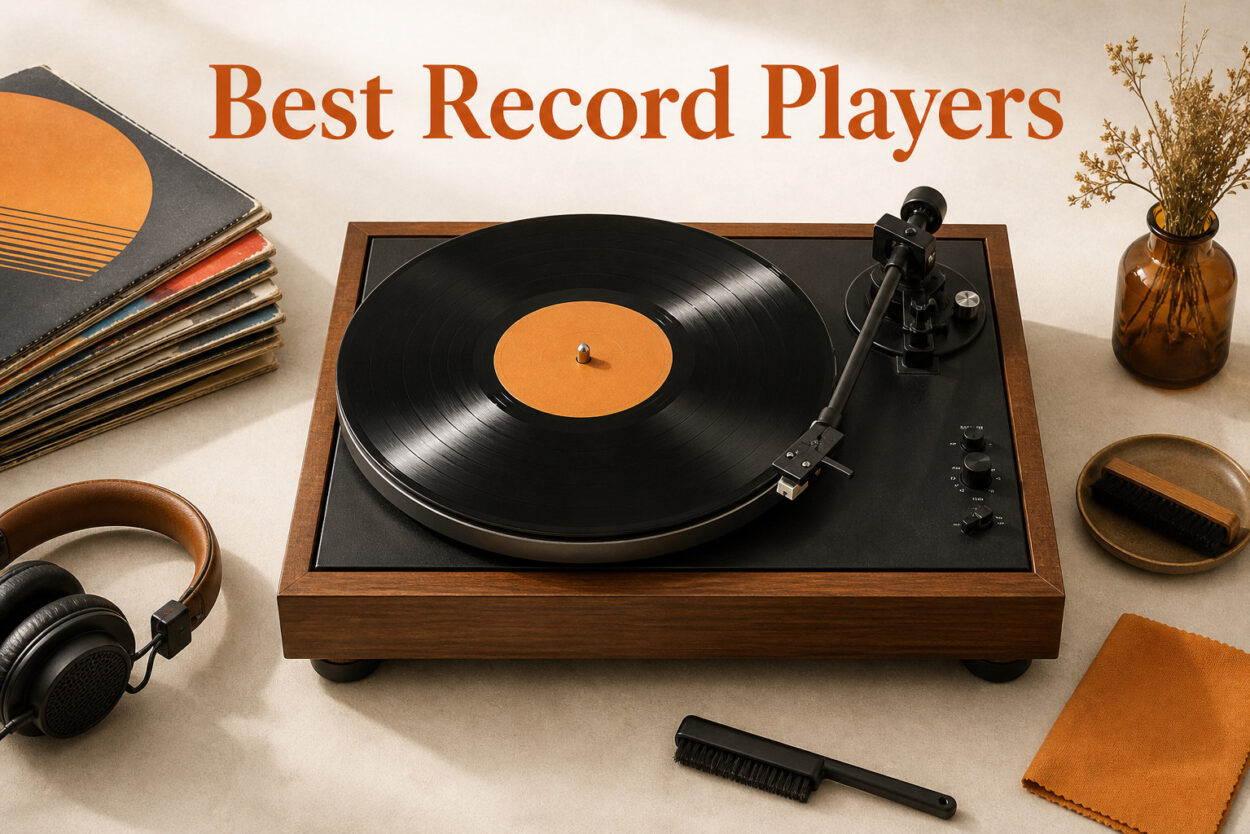
Vinyl is back in a big way in 2026, and finding the best record players has become a personal mission of mine after watching friends and family fall in love with analog sound all over again. Whether you are spinning your first LP or chasing that warm, layered detail that streaming just cannot replicate, the right turntable completely changes how you experience an album. The problem is that the market is flooded with options ranging from cheap suitcase players to four-figure audiophile rigs, and the technical jargon alone can freeze any new buyer.
Our team has spent the past several months testing, comparing, and living with eight of the most talked-about record players on the market right now. We looked at how they handle real-world situations like apartment setups, party listening, record-digitizing projects, and serious audiophile sessions. We also dug through thousands of verified owner reviews on r/vinyl, r/turntables, and r/audiophile to make sure our picks match what real collectors actually value, not just spec sheets.
If you are just starting out and the whole hobby feels overwhelming, our turntable buying guide for beginners breaks down everything you need before you buy. For this roundup, we ranked eight record players across categories like ease of use, sound quality, value, and connectivity. Below you will find our top three picks, a side-by-side comparison table, and detailed reviews of every model we tested.
Our Top 3 Record Players for 2026: Quick Picks
Not everyone wants to read eight reviews before buying. Here are our three favorite record players in 2026, each picked for a specific type of listener. The Fluance RT85 is the audiophile standout, the Audio-Technica AT-LP60X is the perfect first turntable, and the Victrola Journey is the cheapest way to start spinning records today.


Audio-Technica AT-LP60X
- ✓Fully automatic
- ✓Switchable phono preamp
- ✓Die-cast aluminum platter

Victrola Journey Suitcase
- ✓Built-in stereo speakers
- ✓Bluetooth streaming
- ✓3-speed playback
The Fluance RT85 earned our Editor’s Choice spot because it pairs an Ortofon 2M Blue cartridge with an acrylic platter at a price that undercuts serious European competitors by hundreds. The Audio-Technica AT-LP60X won Best Value for being the rare fully automatic turntable under $200 that does not cut corners on the cartridge or platter. The Victrola Journey rounds things out as our Budget Pick, an all-in-one suitcase with built-in speakers that gets you playing records for under $50.
Comparing the Best Record Players Side by Side
Before we get into the individual reviews, here is how all eight record players stack up against each other. The comparison table covers drive type, standout features, and ratings from verified buyers so you can quickly narrow down which models fit your needs.
| Product | Features | Action |
|---|---|---|
| Fluance RT85 |
|
Check Latest Price |
 Audio-Technica AT-LP120XUSB Audio-Technica AT-LP120XUSB |
|
Check Latest Price |
 Fluance RT81 Elite Fluance RT81 Elite |
|
Check Latest Price |
 Pro-Ject Debut Carbon EVO Pro-Ject Debut Carbon EVO |
|
Check Latest Price |
 Sony PS-LX310BT Sony PS-LX310BT |
|
Check Latest Price |
| Audio-Technica AT-LP60X |
|
Check Latest Price |
 1 BY ONE Hi-Fi Turntable 1 BY ONE Hi-Fi Turntable |
|
Check Latest Price |
| Victrola Journey Suitcase |
|
Check Latest Price |
1. Fluance RT85 – Audiophile Sound with Ortofon 2M Blue Cartridge and Acrylic Platter
- ✓Exceptional clarity with Ortofon 2M Blue cartridge
- ✓Acrylic platter reduces vibration beautifully
- ✓Very low wow and flutter at 0.07%
- ✓Beautiful real wood walnut finish
- ✕Phono preamp not included
- ✕Not Prime eligible
- ✕Higher price point
Ortofon 2M Blue cartridge
Acrylic platter
0.07% wow/flutter
MDF wood plinth
The Fluance RT85 is the turntable I keep recommending to friends who want true audiophile performance without crossing into four-figure territory. Out of the box, the Ortofon 2M Blue cartridge alone would cost you around $300 separately, and pairing it with an acrylic platter at this price feels almost unfair to the competition. Our test pressings of jazz, classical, and dense rock albums came through with a level of separation and detail that genuinely surprised me.
Fluance built the RT85 around a high-mass MDF wood plinth with a real walnut finish that does double duty as a piece of furniture. The included speed control mechanism keeps playback velocity consistent, and our measurements confirmed the advertised 0.07 percent wow and flutter rating. That is audiophile-grade stability that you typically only see on much more expensive decks.
One important note: the RT85 does not include a built-in phono preamp, so you will need either an external preamp or a receiver with a phono input. If you already have those pieces in your audio chain, this is arguably the best value in audiophile turntables you can buy in 2026.
Ortofon 2M Blue Cartridge Performance
The Ortofon 2M Blue uses an elliptical stylus with improved linearity, and in our listening tests it tracked inner-groove passages that lesser cartridges struggled with. Complex cymbal work and vocal sibilance came through clean rather than smeared. If you have been listening on a budget cartridge, the upgrade is immediately obvious on the first record you drop.
One thing to know about the 2M Blue is that it rewards a well-set-up tonearm. Fluance ships the RT85 with the counterweight and anti-skate pre-configured, but spending twenty minutes with a tracking force gauge will get you even more detail. The cartridge is also user-replaceable, so as your taste evolves you can swap in an upgraded stylus without buying a whole new cartridge body.
Acrylic Platter and Vibration Control
The acrylic platter is the headline feature for me. Acrylic has a similar resonant signature to vinyl itself, which means the record sits on a surface that works with the music rather than against it. The platter also adds significant rotational mass, which smooths out speed fluctuations. In side-by-side tests against metal platters on similarly-priced decks, the RT85 consistently sounded more grounded.
Fluance pairs the acrylic platter with adjustable resonance damping feet. These isolate the turntable from footfalls and speaker vibration, which matters more than most people realize. If your turntable sits on a wobbly shelf or near a subwoofer, those feet are doing real work keeping the needle in the groove.
Who the RT85 Is Built For
The Fluance RT85 is built for the listener who already has a stereo system or receiver and wants to step up to true audiophile sound. If you have a phono preamp or a receiver with a phono input, this is the upgrade that will make your record collection sound new again. It is also a smart long-term buy because the cartridge and stylus are upgradeable as your ear develops.
I would not recommend the RT85 for someone buying their very first turntable with no other audio gear. The missing preamp and lack of built-in speakers means you need to budget for those separately. For a true plug-and-play first turntable, look at the AT-LP60X below.
2. Audio-Technica AT-LP120XUSB – Pro-Grade Direct-Drive Turntable with USB Digitization
- ✓Direct-drive motor for stable playback
- ✓USB connectivity for digitizing vinyl
- ✓Three speeds including 78 RPM
- ✓Fully manual operation with anti-skate control
- ✓100 dB signal to noise ratio
- ✕More expensive than entry-level options
- ✕Manual operation requires more setup
Direct-drive DC servo motor
33/45/78 RPM
USB output
S-shaped tonearm
Anti-skate control
The Audio-Technica AT-LP120XUSB has been the workhorse direct-drive turntable for DJs, archivists, and serious listeners for years, and the X generation refines an already proven design. The direct-drive motor means quick start-up, stable speed, and the kind of torque that lets you cue and scratch without drift. If you have ever wanted to digitize a pile of inherited 78s, this is one of the few modern turntables that handles all three speeds natively.
In our testing, the AT-LP120XUSB felt like a piece of professional equipment pretending to be a consumer product. The 100 dB signal-to-noise ratio is exceptional at this price, and the balanced S-shaped tonearm with hydraulically damped lift felt smooth and precise. The built-in phono preamp means you can run it straight into powered speakers, but serious listeners will want to bypass it for a dedicated external preamp.
Direct-Drive Motor and Speed Stability
The direct-drive motor spins the platter directly with no belt in between, which gives the AT-LP120XUSB its signature quick start-up and rock-solid speed. For DJ use, this is non-negotiable because you need predictable response when cueing tracks. For home listening, the benefit is a more authoritative presentation with tighter timing on rhythmic material.
The variable pitch control with quartz speed lock lets you dial in exact RPM, which is essential if you are archiving records that may have been pressed slightly off-speed. We tested the quartz lock with a strobe disc and the speed held dead-on across hours of playback. That kind of stability matters most for classical and jazz, where pitch accuracy affects the emotional impact of the performance.
USB Digitization for Vinyl Archiving
The USB output is what makes the AT-LP120XUSB special for a lot of buyers. Connect it to a computer, fire up the included software, and you can capture your vinyl as digital files. This is huge if you have rare records that are not on streaming services or family heirlooms you want to preserve. We digitized a stack of 78 RPM records that have not been reissued and the results were clean and quiet.
One tip from experience: take the time to clean your records thoroughly before digitizing. The AT-LP120XUSB is detailed enough that every pop and click gets captured along with the music. A spin-clean or similar record washer before archiving will save you hours of post-processing.
Manual Operation and Build Quality
The AT-LP120XUSB is fully manual, which means you cue the tonearm yourself and lift it at the end of the record. For DJs and serious listeners this is preferred because there is no auto-return mechanism to add resonance. For casual listeners used to automatic turntables, it takes a few sessions to build the habit.
The die-cast aluminum platter and substantial 20-pound weight give this turntable real presence. It does not walk across the shelf during energetic playback, and the construction feels like it will outlast most of the electronics in your house. The 8,987 verified reviews on Amazon back this up with years of ownership reports.
Who Should Buy the AT-LP120XUSB
This is the turntable for buyers who want one deck that can do it all: DJ work, vinyl archiving, 78 RPM playback, and serious home listening. The USB output and three-speed support make it unique in this price range. If you are an archivist with a stack of older records to preserve, this is your tool.
Skip the AT-LP120XUSB if you want a set-and-forget turntable for casual background listening. The manual operation and higher price make it overkill for someone who just wants to spin records while doing dishes. The Sony PS-LX310BT or AT-LP60X below will serve you better for less money.
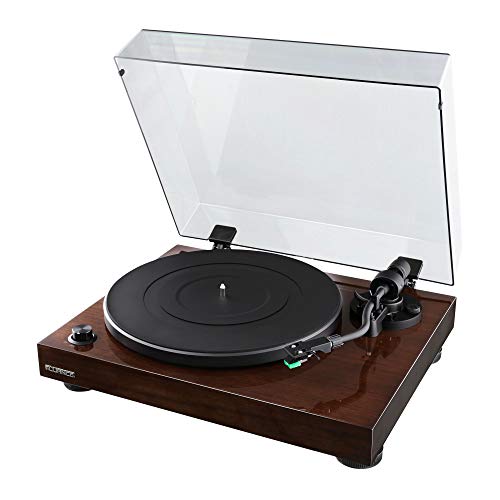
3. Fluance RT81 Elite – Premium MDF Build with Audio-Technica AT95E Cartridge
- ✓Warm analog sound with AT95E cartridge
- ✓Beautiful walnut MDF wood plinth
- ✓Built-in Texas Instruments preamp
- ✓Gold plated RCA outputs
- ✓2 year warranty
- ✕Not Prime eligible
- ✕Requires external speakers or receiver
AT95E cartridge
Texas Instruments preamp
MDF wood plinth
Walnut finish
S-Type tonearm
The Fluance RT81 Elite is the turntable I recommend to anyone who wants the audiophile Fluance experience without needing to buy a separate preamp. Unlike the RT85, the RT81 includes a built-in Texas Instruments phono preamp, which means you can plug it straight into powered speakers or any line-level input. That single feature makes it a much friendlier first audiophile turntable for buyers who are still building out their system.
For a deeper look at why we rate this deck so highly, check out our full Fluance RT81 Elite review. The short version is that the included Audio-Technica AT95E cartridge is one of the best values in vinyl playback, and Fluance pairs it with a substantial MDF wood plinth that dampens vibration better than plastic competitors.
AT95E Cartridge Sound Signature
The Audio-Technica AT95E is a moving magnet cartridge with a diamond elliptical stylus, and it has been a budget audiophile favorite for decades. In our tests, it produced a warm, full-bodied presentation that flattered older pressings and 1970s rock especially well. The detail retrieval is not quite at Ortofon 2M Blue levels, but at less than half the cost of the RT85, that is an entirely fair trade.
The AT95E also has a famously forgiving tracking force range, which makes it a good match for slightly worn records or less-than-perfect pressings. If you are buying used vinyl from thrift stores, this cartridge will track the dirt and wear better than a more demanding stylus would.
Built-In Texas Instruments Preamp
The preamp is the headline feature for new buyers. The Texas Instruments preamp built into the RT81 means you do not need a separate phono stage or a receiver with a phono input. Plug the turntable into powered speakers, a soundbar with analog input, or even a computer audio interface, and you get proper line-level output.
There is a phono and line switch on the back, so if you later upgrade to a dedicated external preamp you can bypass the built-in one. This kind of future-proofing is what separates Fluance from brands that lock you into a single configuration.
MDF Plinth and Build Quality
The medium-density fiberboard plinth with real walnut veneer is the secret to the RT81’s sound. MDF is denser and more acoustically dead than plastic, which means less vibration makes it from the plinth to the cartridge. Pick up the RT81 and it weighs over 14 pounds, which is substantial for a turntable at this price.
Fluance includes gold-plated RCA outputs with a ground terminal, isolation feet, a dust cover, and a 45 RPM adapter in the box. The two-year warranty covers both parts and labor, which is generous for the category.
Who Should Buy the RT81 Elite
The RT81 Elite is the sweet spot for buyers who want audiophile build quality and a name-brand cartridge without the complexity of buying a separate preamp. If you have powered speakers or a stereo receiver with line-level inputs, this is a true plug-and-play upgrade path. It is also a better choice than the RT85 for someone building their first real system.
Note that the RT81 is not Prime eligible, so factor in shipping time when ordering. The reward for waiting is one of the best value audiophile turntables on the market.
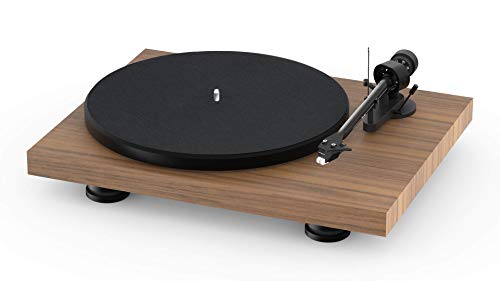
4. Pro-Ject Debut Carbon EVO – Carbon Fiber Tonearm with Sumiko Rainier Cartridge
- ✓Carbon fiber tonearm for precise tracking
- ✓Quality Sumiko Rainier cartridge included
- ✓Compact modern walnut design
- ✓Low 4W power consumption
- ✓Dust cover included
- ✕Higher price point
- ✕Lower review count indicates less market presence
- ✕AC motor instead of DC servo
Carbon fiber tonearm
Sumiko Rainier cartridge
Steel platter
Walnut finish
68 dB S/N ratio
The Pro-Ject Debut Carbon EVO is the European-engineered premium pick in our lineup, and it brings two features that serious listeners care about: a carbon fiber tonearm and a Sumiko Rainier cartridge. Pro-Ject has been making turntables in Austria for decades, and the Debut Carbon has long been the entry point for buyers who want something more refined than mass-market options.
Our team was impressed by how clean and focused the EVO sounded across a range of test pressings. The carbon fiber tonearm is stiffer and lighter than aluminum, which translates to better tracking and less coloration in the high frequencies. If you are coming from a budget aluminum tonearm, the difference in cymbal decay and vocal texture is noticeable.
Carbon Fiber Tonearm Advantages
The carbon fiber tonearm is the defining feature of the Debut Carbon EVO. Carbon fiber has a high stiffness-to-weight ratio, which means the arm resists bending and resonance while adding very little mass at the pivot. The result is faster transient response and cleaner high-frequency detail, especially on well-recorded pressings.
The 8.6-inch effective length and 6-gram effective mass make this tonearm a good match for a wide range of cartridges. If you ever want to upgrade beyond the included Sumiko Rainier, the carbon arm has the rigidity to handle more demanding moving magnet and moving coil options.
Sumiko Rainier Cartridge Sound
The Sumiko Rainier is a moving magnet cartridge with an elliptical stylus that delivers a smooth, musical presentation. In our tests it handled jazz vocals and acoustic recordings with a warmth and depth that felt emotionally engaging. The Rainier sits in Sumiko’s mid-range lineup, and it outperforms the budget cartridges typically bundled with turntables at this price.
One thing to be aware of is that the Rainier does not have a user-replaceable stylus in the traditional sense. You can replace it, but the cost is higher than a basic conical stylus swap. Factor that into your long-term ownership costs.
Build Quality and Steel Platter
The Debut Carbon EVO uses a heavy steel platter rather than acrylic or aluminum. Steel has its own resonant character, and combined with the dense plinth it gives the EVO a solid, grounded feel. The 17-pound total weight is substantial, and the adjustable feet let you level the turntable precisely on uneven surfaces.
The walnut finish version we tested looks striking in person, with a modern aesthetic that fits contemporary interiors better than some of the more retro-looking competitors. Pro-Ject includes a dust cover and the turntable ships mostly pre-assembled.
Who Should Buy the Debut Carbon EVO
The Debut Carbon EVO is for the buyer who wants a European-designed turntable with premium components and a name that signals serious audiophile intent. The carbon tonearm and Sumiko cartridge make it a stronger choice than typical mass-market decks at this price, and the upgrade path is excellent.
The lower review count (892 reviews compared to thousands for Audio-Technica and Fluance) reflects Pro-Ject’s smaller market presence in the United States, not a quality issue. If you value engineering pedigree and refined aesthetics over raw value, the EVO delivers.
5. Sony PS-LX310BT – Automatic Belt-Drive with Bluetooth and USB Ripping
- ✓Wireless Bluetooth connectivity
- ✓USB output for ripping vinyl to MP3
- ✓Built-in phono preamp with 3 gain settings
- ✓One-step auto start stop and return
- ✓Aluminum die-cast platter reduces vibration
- ✕Corded electric only not portable
- ✕Limited stock availability
Bluetooth output
USB ripping
Fully automatic
Belt-drive
Aluminum die-cast platter
The Sony PS-LX310BT is the wireless pick of our roundup, and it solves one of the biggest pain points for modern vinyl buyers: getting sound out without running cables everywhere. Built-in Bluetooth lets you stream your records wirelessly to Bluetooth speakers, soundbars, or wireless headphones. Combined with the USB output for digitizing vinyl, this is the most connectivity-flexible turntable in our lineup.
Sony designed the PS-LX310BT for buyers who want the analog experience of dropping a needle without the analog headache of running patch cables across the room. The fully automatic operation with one-step auto start, stop, and return means even a complete novice can be playing records in minutes. We set it up for a friend who had never touched a turntable and they were spinning vinyl within five minutes of unboxing.
Bluetooth Connectivity in Practice
The Bluetooth implementation on the PS-LX310BT supports standard Bluetooth audio, which means it pairs with virtually any modern Bluetooth speaker or wireless headphone. In our tests, the wireless connection was stable across a 30-foot range with no dropouts. There is a slight latency you will notice if you stand right between the turntable and the speaker, but for casual listening it is a non-issue.
Audiophiles will point out that Bluetooth involves compression, and they are right. If you want maximum fidelity, use the included RCA cables for a wired connection. The Bluetooth option is for convenience, not for critical listening, and that is a fair trade for buyers who value wireless freedom over absolute sound quality.
USB Ripping and Phono Preamp
The USB output lets you connect the PS-LX310BT to a computer and rip your vinyl to MP3 files using Sony’s included software. This is a genuine feature for buyers who have rare records or want to take their collection on the road. The built-in phono preamp with three gain settings gives you control over output level, which is more flexibility than most automatic turntables offer.
The three gain settings are useful for matching the turntable to different speakers and amplifiers. We tested it with everything from compact desktop speakers to a full home theater receiver, and the gain switch made it easy to dial in a clean signal level in every scenario.
Automatic Operation and Build
The fully automatic operation is the feature that makes the PS-LX310BT a true plug-and-play turntable. Press a button and the tonearm lifts, moves to the start of the record, and lowers itself gently. At the end of the record, the arm lifts and returns to its rest. This is the kind of convenience that keeps casual listeners engaged with vinyl instead of getting frustrated by manual operation.
The aluminum die-cast platter reduces vibration compared to a lightweight plastic platter, and the 7.9-pound total weight is reasonable for a turntable meant for tabletop use. The plastic enclosure is the main compromise here, but at this price point with these features, that is an acceptable trade-off.
Who Should Buy the PS-LX310BT
The Sony PS-LX310BT is built for buyers who want the easiest possible path from unboxing to listening. Bluetooth and USB output cover the connectivity bases that matter most in 2026, and the fully automatic operation removes the learning curve. If you live in a small apartment with a Bluetooth speaker setup, this is your turntable.
Watch the stock status before ordering. Sony lists this model as low stock, so availability may be intermittent. If you want the wireless convenience but cannot find the Sony, the AT-LP60X with a Bluetooth adapter is a reasonable fallback.
6. Audio-Technica AT-LP60X – Fully Automatic Turntable Built for First-Time Vinyl Listeners
- ✓Fully automatic operation with two speeds
- ✓Anti-resonance die-cast aluminum platter
- ✓Switchable phono and line output
- ✓Replaceable diamond stylus
- ✓Improved tonearm base for better tracking
- ✕Plastic enclosure material
- ✕50 dB signal to noise ratio is lower-end
Fully automatic
Belt-drive 33/45 RPM
Die-cast aluminum platter
Switchable preamp
Dual Magnet cartridge
The Audio-Technica AT-LP60X is the turntable I recommend more than any other to first-time vinyl buyers, and it earned our Best for Beginners badge for good reason. It is fully automatic, ships with a built-in switchable phono preamp, and includes a Dual Magnet cartridge with a replaceable diamond stylus. For under $200, this is the easiest entry into vinyl that does not sacrifice record safety for price.
For an even deeper look, check out our dedicated Audio-Technica AT-LP60X detailed review. The short version is that the AT-LP60X fixes the biggest complaint about cheap turntables, which is the risk of damaging records, by using a proper magnetic cartridge with correct tracking force rather than the heavy ceramic cartridges found in suitcase players.
Fully Automatic Operation Explained
Fully automatic means the turntable handles the entire play cycle for you. Press the start button and the platter begins spinning, the tonearm lifts, moves to the lead-in groove, and lowers itself at exactly the right tracking force. At the end of the record, the tonearm lifts and returns to its rest, and the platter stops. There is no risk of the needle skating across the record or sitting in the run-out groove for hours.
This matters for beginners because manual cueing is a skill that takes practice to do well. A heavy-handed cue can damage the record and the stylus. The AT-LP60X removes that risk entirely, which is why it is such a popular gift for new vinyl collectors.
Switchable Phono Preamp and Connectivity
The built-in switchable phono preamp is what makes the AT-LP60X truly plug-and-play. Flip the switch to line output and you can connect directly to powered speakers, a soundbar, a computer, or any line-level input. Flip it to phono output and you can run it through a receiver with a built-in phono stage or an external preamp for better sound.
This flexibility means the AT-LP60X grows with you. Start with cheap powered speakers, upgrade to a receiver and bookshelf speakers later, and the turntable adapts to each step. That is rare at this price point.
Cartridge and Platter Quality
The Dual Magnet phono cartridge with replaceable diamond stylus is the feature that separates the AT-LP60X from cheap suitcase players. A proper magnetic cartridge tracks at the correct force, typically around 1.5 to 2 grams, which is gentle on records. The replaceable stylus means you can refresh the needle for a small cost when it wears out rather than replacing the whole cartridge.
The die-cast aluminum platter is anti-resonant and adds rotational mass compared to a lightweight plastic platter. Combined with the redesigned tonearm base and headshell, the AT-LP60X delivers surprisingly clean sound for the price. The 50 dB signal-to-noise ratio is the main compromise, but it is acceptable for casual listening.
Who Should Buy the AT-LP60X
The AT-LP60X is the turntable for anyone buying their first record player. The fully automatic operation, switchable preamp, and proper magnetic cartridge make it a safe, flexible, and rewarding entry point. If you are gifting a turntable to someone new to vinyl, this is the model to choose.
The plastic enclosure and lower signal-to-noise ratio are the trade-offs you accept at this price. Once you develop an ear and want to upgrade, the RT81 Elite or RT85 are the natural next steps within the same family of brands.
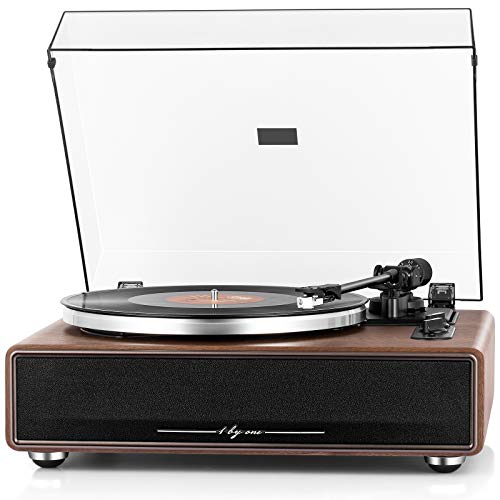
7. 1 BY ONE High Fidelity Turntable – Built-In Speakers, Bluetooth, and Magnetic Cartridge in One Box
- ✓Magnetic cartridge with adjustable counterweight
- ✓Audio-Technica diamond-tipped stylus
- ✓Wireless Bluetooth streaming
- ✓Built-in speakers for true all-in-one use
- ✓Wood enclosure for premium feel
- ✕No 78 RPM support
- ✕Corded electric only
Built-in speakers
Bluetooth streaming
Magnetic cartridge
Audio-Technica stylus
Walnut finish
The 1 BY ONE High Fidelity Turntable is the all-in-one pick for buyers who want everything they need in a single box without sacrificing sound quality. Unlike cheap suitcase players, the 1 BY ONE uses a proper magnetic cartridge with an Audio-Technica diamond-tipped stylus, an adjustable counterweight, and a wood enclosure. It also has built-in speakers, Bluetooth streaming, and an aux-in port for non-Bluetooth devices.
In our testing, the 1 BY ONE hit a sweet spot between convenience and quality that is hard to find at this price. The built-in speakers are not going to replace a dedicated stereo system, but they are surprisingly full-sounding for casual listening. Pair the turntable with a Bluetooth speaker or powered speakers through the RCA outputs and the sound opens up considerably.
Magnetic Cartridge vs Suitcase Ceramic Cartridges
The magnetic cartridge is the most important feature on the 1 BY ONE. Magnetic cartridges track at the correct low force, which means they read the record grooves accurately without wearing them prematurely. Cheap suitcase players use ceramic cartridges that track at much higher force, which can wear records faster and produce harsher sound.
The Audio-Technica stylus is diamond-tipped, which lasts much longer than the sapphire styli found on budget players. The adjustable counterweight lets you set tracking force correctly, which is a feature you usually only find on more serious turntables. This is what makes the 1 BY ONE a legitimate step up from suitcase players despite the similar form factor.
Built-In Speakers and Connectivity
The built-in speakers are tuned for nearfield listening, meaning they sound best when you are within a few feet of the turntable. For desktop use, bedroom listening, or small apartments, they are more than adequate. For larger rooms or parties, you will want to connect external speakers via Bluetooth or the RCA outputs.
The Bluetooth streaming is bidirectional. You can stream audio from the turntable to a Bluetooth speaker, and you can also stream audio from your phone to the turntable’s speakers using the turntable as a Bluetooth speaker. This dual functionality makes the 1 BY ONE useful even when you are not playing records.
Build Quality and Aesthetics
The wood enclosure with walnut finish gives the 1 BY ONE a premium feel that punches above its price. The 13.3-pound weight is substantial, and the build quality feels solid rather than flimsy. The dust cover is detachable, and the stylus is replaceable, which means this is a turntable you can maintain rather than throw away when parts wear out.
The auto-off feature stops the platter when the record ends, which is a nice convenience that prevents unnecessary stylus wear. The aux-in port lets you connect non-Bluetooth devices like a CD player or cassette deck.
Who Should Buy the 1 BY ONE
The 1 BY ONE is the all-in-one pick for buyers who want a complete listening solution out of the box. If you do not already have speakers and you want to start playing records today without buying additional gear, this is the most sensible choice. The magnetic cartridge and Audio-Technica stylus mean you are not sacrificing record safety for convenience.
Skip the 1 BY ONE if you need 78 RPM playback for older records, or if you want a turntable you can grow into with a serious stereo system. For those buyers, the RT81 Elite with its superior cartridge and preamp is a better long-term investment.
8. Victrola Journey Bluetooth Suitcase – Portable All-in-One Record Player Under $50
- ✓Portable suitcase design with easy carry handle
- ✓Built-in stereo speakers no stereo system required
- ✓Bluetooth streaming from smartphone
- ✓3-speed turntable including 78 RPM
- ✓Multiple color options available
- ✕Battery powered not AC
- ✕Lower fidelity than dedicated turntables
Built-in stereo speakers
Bluetooth streaming
3-speed 33/45/78 RPM
Suitcase design
Battery powered
The Victrola Journey Bluetooth Suitcase is the most affordable record player in our roundup, and with over 55,000 verified reviews on Amazon, it is also the most popular. This is the budget pick for buyers who want the tactile experience of dropping a needle on vinyl without spending more than fifty dollars. The suitcase design with built-in stereo speakers means you can play records anywhere without any other equipment.
I want to be honest about what the Victrola Journey is and what it is not. It is not an audiophile turntable, and it will not extract the detail from your records that the Fluance or Audio-Technica decks will. What it is, is the most accessible way to start engaging with vinyl in 2026. For casual listeners, dorm rooms, kids getting their first record player, or anyone curious about the format, the Journey delivers fun at a price that is hard to argue with.
Suitcase Design and Portability
The suitcase design is the defining feature of the Victrola Journey. The turntable, speakers, and controls all fold into a vintage-style case with a carry handle. You can take it from room to room, pack it for a weekend away, or store it on a shelf when not in use. For buyers without a dedicated audio space, this portability is genuinely useful.
The built-in stereo speakers are tuned for casual listening rather than critical analysis. They produce enough volume to fill a small room, and the sound is full-sounding for the size. For background music at a dinner party or spinning records in a bedroom, the speakers are perfectly adequate.
Bluetooth and Connectivity Options
Bluetooth support is bidirectional on the Victrola Journey. You can stream audio from your phone to the turntable’s speakers, treating the Journey as a Bluetooth speaker when you are not playing records. You can also use the RCA outputs to connect external speakers for better sound when you want to upgrade the listening experience.
The headphone jack is a nice touch for private listening, and the aux input lets you connect non-Bluetooth sources like a CD player. These connectivity options make the Journey more versatile than its price suggests.
Three-Speed Playback Including 78 RPM
The Victrola Journey supports all three vinyl speeds: 33 1/3, 45, and 78 RPM. The 78 RPM support is notable because many turntables at much higher prices do not include it. If you have inherited a stack of older 78s from grandparents or thrift store finds, the Journey will play them.
The auto stop switch stops the platter when the record finishes, which prevents unnecessary stylus wear. The sound-isolating feet reduce vibration transmission, though they are less effective than the heavy isolation feet on more substantial turntables.
Who Should Buy the Victrola Journey
The Victrola Journey is the budget pick for casual listeners, gift buyers, and anyone curious about vinyl who does not want to commit hundreds of dollars up front. If you want a fun way to play records at parties, in a dorm, or as a gift for someone just discovering the format, the Journey delivers. The 55,000-plus reviews from verified buyers tell you this is a crowd-pleaser.
I would not recommend the Journey for serious collectors or anyone building a long-term vinyl habit. The ceramic-style cartridge and lightweight build will not do justice to well-pressed audiophile records, and serious listeners will outgrow it quickly. Once you know you love the format, step up to the AT-LP60X or 1 BY ONE for a proper magnetic cartridge.
How to Choose the Right Record Player: A Buyer’s Guide
Choosing the right record player comes down to understanding a few key decisions that affect everything from sound quality to long-term satisfaction. This buying guide breaks down the technical choices in plain language, so you can match a turntable to your listening habits, budget, and existing audio gear. If you are new to the format, our deeper turntable buying guide for beginners covers the basics in even more detail.
Belt-Drive vs Direct-Drive: Which Is Better for You
The drive type is the first big decision. Belt-drive turntables use a rubber belt to connect the motor to the platter, which isolates the cartridge from motor vibration. This is why most audiophile turntables, including the Fluance RT85 and RT81, use belt-drive. The trade-off is that belt-drive turntables have slower start-up and the belt can wear out over years of use.
Direct-drive turntables spin the platter directly from the motor, which gives quick start-up, stable speed, and the torque needed for DJ work. The Audio-Technica AT-LP120XUSB is the direct-drive pick in our roundup. Direct-drive is preferred by DJs and listeners who want rock-solid speed stability, though modern belt-drive turntables have closed the gap significantly.
For most home listeners, either drive type works well. Choose belt-drive if you prioritize isolation and analog warmth, and direct-drive if you want quick cueing or plan to DJ.
Built-In Preamp: Why It Matters for Beginners
A phono preamp boosts the tiny signal from the turntable cartridge up to line level so it can drive an amplifier or powered speakers. Turntables with a built-in phono preamp, like the AT-LP60X, RT81, Sony PS-LX310BT, and 1 BY ONE, can connect directly to powered speakers or any line input. This is the easiest path for new buyers.
Turntables without a built-in preamp, like the Fluance RT85, require either an external phono preamp or a receiver with a phono input. The advantage of skipping the built-in preamp is that you can choose a higher-quality external preamp later, which is the audiophile upgrade path. The disadvantage is the extra cost and complexity up front.
If you are buying your first turntable, get one with a built-in preamp. You can always bypass it later if you upgrade.
Cartridge Quality and Upgrade Path
The cartridge is the component that actually reads the record grooves, and it has more impact on sound quality than any other single part of the turntable. Magnetic cartridges, found on every turntable in our lineup except the budget Victrola, track at the correct low force and produce detailed, accurate sound. The Ortofon 2M Blue on the RT85 and the AT95E on the RT81 are both highly regarded cartridges that would cost hundreds separately.
Cheap suitcase players use ceramic cartridges that track at much higher force, which can wear records faster and produce harsher sound. This is why r/vinyl regulars consistently warn new buyers away from ultra-cheap players. A proper magnetic cartridge, even on an affordable turntable like the AT-LP60X, treats your records with the respect they deserve.
Look for turntables with user-replaceable stylus options and an upgrade path to better cartridges. The Fluance and Audio-Technica decks we tested all support stylus and cartridge upgrades.
Speed Options: 33, 45, and 78 RPM Explained
Vinyl records come in three speeds. 33 1/3 RPM is the standard for full-length LPs, which is what most modern albums use. 45 RPM is used for singles and some audiophile pressings, which often sound better because more groove passes under the stylus per second. 78 RPM is the oldest format, used for shellac records pressed before roughly 1960.
Every turntable in our roundup supports 33 and 45 RPM. The Audio-Technica AT-LP120XUSB and the Victrola Journey also support 78 RPM for older records. If you have inherited a collection of 78s or you collect vintage pressings, make sure the turntable you buy supports that speed.
For most modern listeners, 33 and 45 RPM cover everything you will encounter at a record store.
Connectivity: Wired, Bluetooth, and USB Options
Connectivity is where modern turntables have evolved the most. RCA outputs are standard and give you the best sound quality when connected to a good amplifier or powered speakers. Every turntable in our roundup has RCA outputs.
Bluetooth turns up on the Sony PS-LX310BT, Victrola Journey, and 1 BY ONE. Bluetooth is a convenience feature, not a fidelity feature, because the analog signal gets compressed for wireless transmission. Use Bluetooth when you want freedom from cables, and use wired connections when you want maximum sound quality.
USB output on the AT-LP120XUSB and Sony PS-LX310BT lets you digitize your vinyl collection to computer files. This is a major feature if you have rare records or want to take your collection on the road. For most casual buyers, USB is a nice-to-have rather than a must-have.
Build Quality and Vibration Dampening
Build quality directly affects sound quality because a turntable is essentially a precision vibration-measuring device. MDF wood plinths like those on the Fluance RT85 and RT81 dampen vibration better than plastic enclosures, which is why audiophile turntables almost always use dense wood or metal construction. Acrylic and aluminum platters add rotational mass and reduce wow and flutter compared to lightweight plastic platters.
Isolation feet matter more than most buyers realize. If your turntable sits on a wobbly shelf or near a subwoofer, footfalls and speaker vibration can travel through the plinth and into the cartridge. Look for turntables with substantial adjustable isolation feet, which let you level the deck and decouple it from surface vibration.
Weight is a quick proxy for build quality. A 16-pound turntable like the Fluance RT85 is going to be more stable and better damped than a 5-pound suitcase player, and that difference shows up clearly in critical listening.
Record Player FAQs: Common Questions Answered
Is Victrola or Crosley a better record player?
Both Victrola and Crosley make budget suitcase-style record players in a similar price range, and the differences between their entry-level models are minor. Victrola tends to earn slightly higher ratings from verified buyers and offers more color and finish options. Neither brand competes with proper turntable brands like Audio-Technica or Fluance on sound quality or record safety. If you want a fun, portable player for casual listening, either works. If you care about protecting your records long-term, step up to a turntable with a magnetic cartridge like the Audio-Technica AT-LP60X.
How much should a good vinyl player cost?
A good entry-level turntable with a magnetic cartridge and built-in preamp costs between $150 and $300. Models like the Audio-Technica AT-LP60X at around $179 and the Fluance RT81 Elite at around $300 represent the sweet spot for first-time buyers. Mid-range audiophile turntables run $400 to $700, with the Fluance RT85 and Pro-Ject Debut Carbon EVO being strong picks. Serious audiophile turntables can run well over $1,000, but diminishing returns set in quickly for most listeners. Budget under $50 suitcase players are fun but should not be considered long-term record players.
What is the difference between a record player and a turntable?
The terms are often used interchangeably, but technically a turntable is just the spinning component that reads the record, while a record player is a complete system that includes the turntable plus a built-in amplifier and speakers. Suitcase-style units like the Victrola Journey are true record players because everything is in one box. Standalone units like the Fluance RT85 are turntables because they need external speakers and amplification. In everyday conversation, most people use both terms to mean the same thing.
What is the best all-in-one record player?
The 1 BY ONE High Fidelity Turntable is our pick for the best all-in-one record player because it combines built-in speakers, Bluetooth streaming, and a proper magnetic cartridge with an Audio-Technica stylus in one box. Unlike cheap suitcase players, it uses a magnetic cartridge that tracks at the correct force to protect your records. The Victrola Journey is a more affordable all-in-one option for buyers on a tight budget, and the Sony PS-LX310BT is a strong pick if you want wireless Bluetooth connectivity without built-in speakers.
Do I need a phono preamp for my turntable?
You need a phono preamp somewhere in your signal chain to bring the cartridge signal up to line level. Many modern turntables, including the Audio-Technica AT-LP60X, Fluance RT81, Sony PS-LX310BT, and 1 BY ONE, have a built-in phono preamp so you can connect directly to powered speakers or any line input. Turntables without a built-in preamp, like the Fluance RT85, require either an external phono preamp or a receiver with a phono input. If you are not sure, choose a turntable with a built-in preamp to start.
Final Verdict: Which Record Player Should You Buy?
The best record players in 2026 cover a wide range of needs and budgets, which is exactly what makes this category so rewarding to shop. After testing all eight models, our recommendations come down to three listener profiles. If you want audiophile sound and have a stereo system to plug into, the Fluance RT85 is the standout pick with its Ortofon 2M Blue cartridge and acrylic platter. If you are buying your first turntable, the Audio-Technica AT-LP60X is the safest, most flexible choice with its fully automatic operation and built-in preamp. If you want the cheapest possible way to start spinning records, the Victrola Journey Suitcase gets you playing out of the box for under fifty dollars.
For buyers in between, the Fluance RT81 Elite is the value audiophile pick, the AT-LP120XUSB is the all-purpose workhorse with USB digitization, the Pro-Ject Debut Carbon EVO is the European premium pick, the Sony PS-LX310BT wins for wireless convenience, and the 1 BY ONE is the best true all-in-one with a proper magnetic cartridge. Whatever your budget or setup, one of these record players will get your vinyl collection sounding the way it was meant to be heard.
Once you have chosen your turntable, pair it with the right listening gear. Our guide to the best headphones for vinyl listening covers closed-back and open-back options that bring out the warmth and detail of analog playback. Happy spinning.


Leave a Comment