
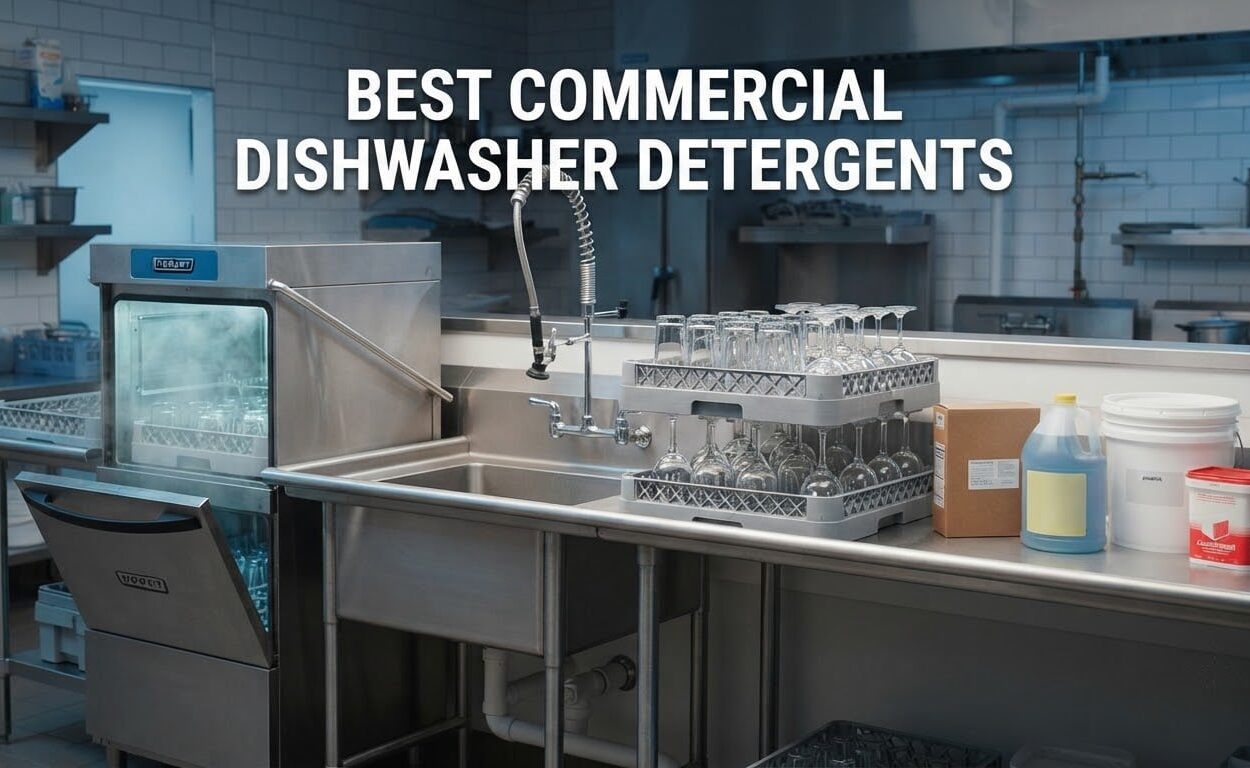
Most detergent results for this query point you toward household gel, pods and tablets, and that is the wrong aisle. If you are running a restaurant, bar, school cafeteria, food truck or any other kitchen with a commercial dishmachine, you need best commercial dishwasher detergent options rated on grease cutting, machine compatibility and cost per rack, not on how they smell in a domestic dishwasher. This guide covers commercial dishmachine detergents only, and every pick below was chosen from real customer feedback rather than manufacturer claims.
I have spent the last few months working through warewashing chemistry with operators running undercounter and rackless machines, and the single biggest surprise was how much of the problem is dosage, not product. Label instructions are written as maximums, and most kitchens are dosing past the point where any extra chemical does useful work. That leaves money on the table and a chemical film on the glassware. If you want the consumer-angle reads while you are researching, our nontoxic dishwasher detergent guide and dishwasher gel roundup cover household products, and this article deliberately does not.
Below you will find eight products that hold up in real commercial service, a format breakdown that explains when powder beats liquid, and the buying criteria that actually determine whether a rack comes out clean. I also flag the detergent-versus-sanitizer distinction, because that is where health-code conversations get uncomfortable fast.
What Commercial Dishwasher Detergent Actually Is
What detergent do commercial dishwashers use? Commercial dishwashers use a low-foam, high-strength machine detergent delivered as a powder, a liquid concentrate or a solid block. Surfactants lift grease while alkaline builders and enzymes break down protein and starch, and the formula must rinse clean without foaming a commercial machine into a fault code.
That is the whole difference in one sentence. Household detergent is built to foam, because suds are how you judge hand washing and how consumer machines signal activity. A commercial machine circulates wash solution at volume under pressure, and foam in that environment is a shutdown, not a signal.
Three further distinctions matter before you spend money. First, machine temperature: high-temp machines run a final sanitizing rinse in roughly the 150 to 180 degree Fahrenheit range, while low-temp machines rely on a chlorine sanitizer and run cooler wash chemistry. Second, water hardness, which determines whether you will fight spotting and scale. Third, material compatibility, because most of these products are strongly alkaline and will etch aluminum, and several also exclude pewter.
None of the picks in this guide are hand-wash products. Manual pot and pan soap has a place on a line, but it is a different chemical job and putting it in a dishmachine wastes money and produces foam.
How We Evaluated These Detergents
No ranking page on this topic discloses how it chose anything, which is why we publish our criteria. We scored each product on six points.
- Grease and soil removal on real loads. Baked-on proteins, starches and animal fat, not a clean glassware demo. Customer feedback describing leftovers, dried sauces and film counted far more than marketing language.
- Machine compatibility. Whether it works in both high-temp and low-temp machines, whether it needs a pickup tube or dispenser, and whether it excludes common ware materials.
- Dosage control and labor cost. How precisely you can meter it, whether mixing is required, and how much handling a busy line has to absorb.
- Water handling. Behavior in hard-water installations, including whether the formula carries conditioners that protect the machine from scale.
- Spat and residue risk. The most common complaint in the customer data was mineral spotting and streaks, and we weighted it accordingly.
- Value per unit of working solution. What one bottle, box or block actually yields once diluted, since that is the number purchasing cares about.
We did not score on fragrance, packaging aesthetics or brand recognition. Several products here carry documentation gaps in their listing, and we say so rather than filling the gap with inference.
Our Top 3 Commercial Dishwasher Detergents
Three picks cover most commercial kitchens: a concentrate that makes working solution cheaply, a heavy-duty liquid for baked-on soil, and an adjustable powder for operators who want control per load.
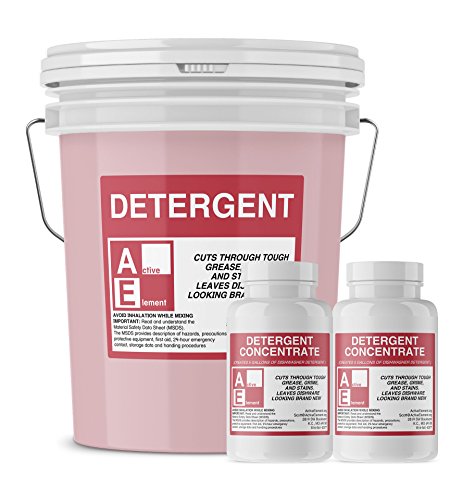
Active Element Concentrate Powder
- ✓One concentrate batch makes 5 gallons of liquid detergent
- ✓Works in high-temp and low-temp commercial machines
- ✓Emulsifies fats and cuts grease quickly
- ✓Dry concentrate you mix yourself
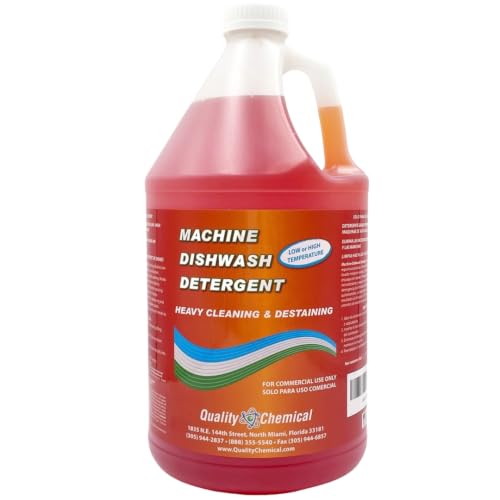
Quality Chemical 128 oz Liquid
- ✓Heavy destaining on baked-on deposits
- ✓Low foam with excellent rinsability
- ✓Water conditioners help protect against scale
- ✓Automatic dispense via pickup tube
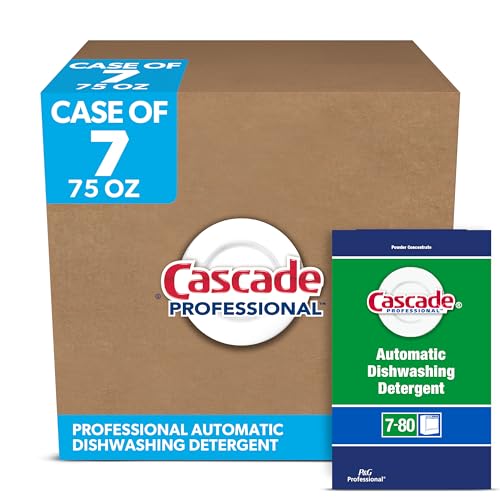
Cascade Powder with Dawn
- ✓Phosphate-free and residue-free
- ✓Shine Shield rinses clean without streaks
- ✓Under-counter and cabinet-type utensil washers
- ✓Case of seven 75 oz boxes
Comparing 8 Commercial Dishwasher Detergents in 2026
All eight products below are formulated for commercial dishmachines. Every rating and review count is copied directly from the customer data, and the highlights are the features that actually separated them during evaluation.
| Product | Features | Action |
|---|---|---|
| Active Element Commercial Dishwasher Detergent Concentrate Powder |
|
Check Latest Price |
| Quality Chemical Machine Dishwash Detergent 128 oz |
|
Check Latest Price |
| Cascade Automatic Powder with Dawn 75 oz 7-Pack |
|
Check Latest Price |
 Cascade Professional Fresh Scent Powder 75 oz 7 per Case Cascade Professional Fresh Scent Powder 75 oz 7 per Case |
|
Check Latest Price |
 Active Element Starter Pack with Buckets Active Element Starter Pack with Buckets |
|
Check Latest Price |
 Active Element Shipper Value Pack Active Element Shipper Value Pack |
|
Check Latest Price |
 Ecolab Solid Power XL with Glass Guard 9 lb Ecolab Solid Power XL with Glass Guard 9 lb |
|
Check Latest Price |
 GreenFist Lybramatic Ready-to-Use 5 Gallon GreenFist Lybramatic Ready-to-Use 5 Gallon |
|
Check Latest Price |
1. Active Element Concentrate Powder – Our Top Pick for High-Volume Kitchens
- ✓Makes 5 gallons of liquid detergent per batch
- ✓Emulsifies grease and food soils quickly
- ✓Works in both high-temp and low-temp machines
- ✓Factory-direct sourcing keeps per-gallon cost low
- ✕Must be mixed with water before use
- ✕Pail is not included in the box
- ✕Excludes aluminum kitchenware
Concentrated powder, makes 5 gallons
High and low temp machines
Not for aluminum or household use
This is the product I recommend first to any kitchen that runs a real volume of ware, and it earned that position on the strength of the largest customer base in the group. At 293 reviews it carries far more feedback than anything else here, which means the grease claims have been stress-tested by more operators than any competing listing.
The format is the point. You get a dry concentrate, and one batch mixed with water produces 5 gallons of working liquid detergent. For a kitchen running an undercounter machine through service, that math is what determines whether the chemical line is sustainable or whether you are buying liquid by the case every week.
Customer feedback is consistent about two things: it emulsifies fats quickly, and it works in both high-temp and low-temp commercial machines. That second point matters more than it sounds, because a lot of chemistry sold for warewashing is formulated for one temperature band and quietly underperforms in the other.
What you give up for that flexibility is convenience. It is a dry concentrate, so someone has to mix it, and the pail is not included, which means you are buying your own five-gallon containers. Budget for that the first time rather than the third.
Grease Cutting on Baked-On Proteins and Starches
The reviews describe this product working hardest on proteins and starches, which is where commercial kitchens lose the most labor. Baked-on egg, cheese and sauce residue on sheet pans is the failure case that pushes a line toward hand re-scrubbing, and that re-scrub is the real expense nobody tracks.
Emulsification speed is the useful property here. Rather than dissolving grease in one pass, the formula holds it in suspension long enough for the machine’s spray arms to carry it away. Reviewers using it on mixed loads of plates, glassware and cookware report the difference most in the second half of a service, when soil has been sitting.
Mixing, Dosage and the Labor Cost Nobody Budgets For
Mixing is a genuine cost, and it is the main reason a ready-to-use liquid exists. If you have someone whose job is warewashing anyway, the mix step is nearly free. If you are running a two-person operation where the same person racks, washes and sanitizes, the math changes.
The counter-argument is that a concentrate you control can be dosed to the load. Heavily soiled racks get more, light racks get less, and the operator’s judgment replaces a fixed metered dose. That is a real advantage in a bar setting where most racks are glassware and wine glasses.
Where It Falls Short
Aluminum kitchenware is out, and the listing is explicit about it. If you wash aluminum pans in that machine, this product will etch them, and no amount of careful dosing changes that.
It is also not a household product, and the manufacturer says so. It is also not a kit: no rinse aid, no sanitizer, no pails. Kitchens running low-temp machines still need a chlorine sanitizer and rinse concentrate alongside it, and that is a separate purchase unless you take one of the bundled options further down this list.
2. Quality Chemical Machine Dishwash Detergent – Low-Foam Heavy Destaining Liquid
- ✓Strong on baked-on deposits and heavy stains
- ✓Low foam with excellent rinsability
- ✓Water conditioners protect against scale
- ✓Automatic dispense via pickup tube
- ✓Made in the USA in several pack sizes
- ✕Not for aluminum or pewter ware
- ✕Single 128 oz jug needs frequent replenishment
- ✕Commercial use only
128 fl oz machine liquid
Heavy destaining, low foam
Water conditioners for scale
Made in USA
Where the concentrate wins on cost per gallon, this liquid wins on labor. It arrives ready to feed the machine, and the review base of 266 sits close behind the leader with a similarly tight spread, which tells you the experience is repeatable rather than anecdotal.
It is sold in 128 fl oz jugs, and the technical detail that matters most is the automatic dispense setup. You insert the pickup tube, the detergent feeds the machine through the cycle, and you swap the jug when it runs out. That removes the mixing step entirely and puts dosing on a consistent basis.
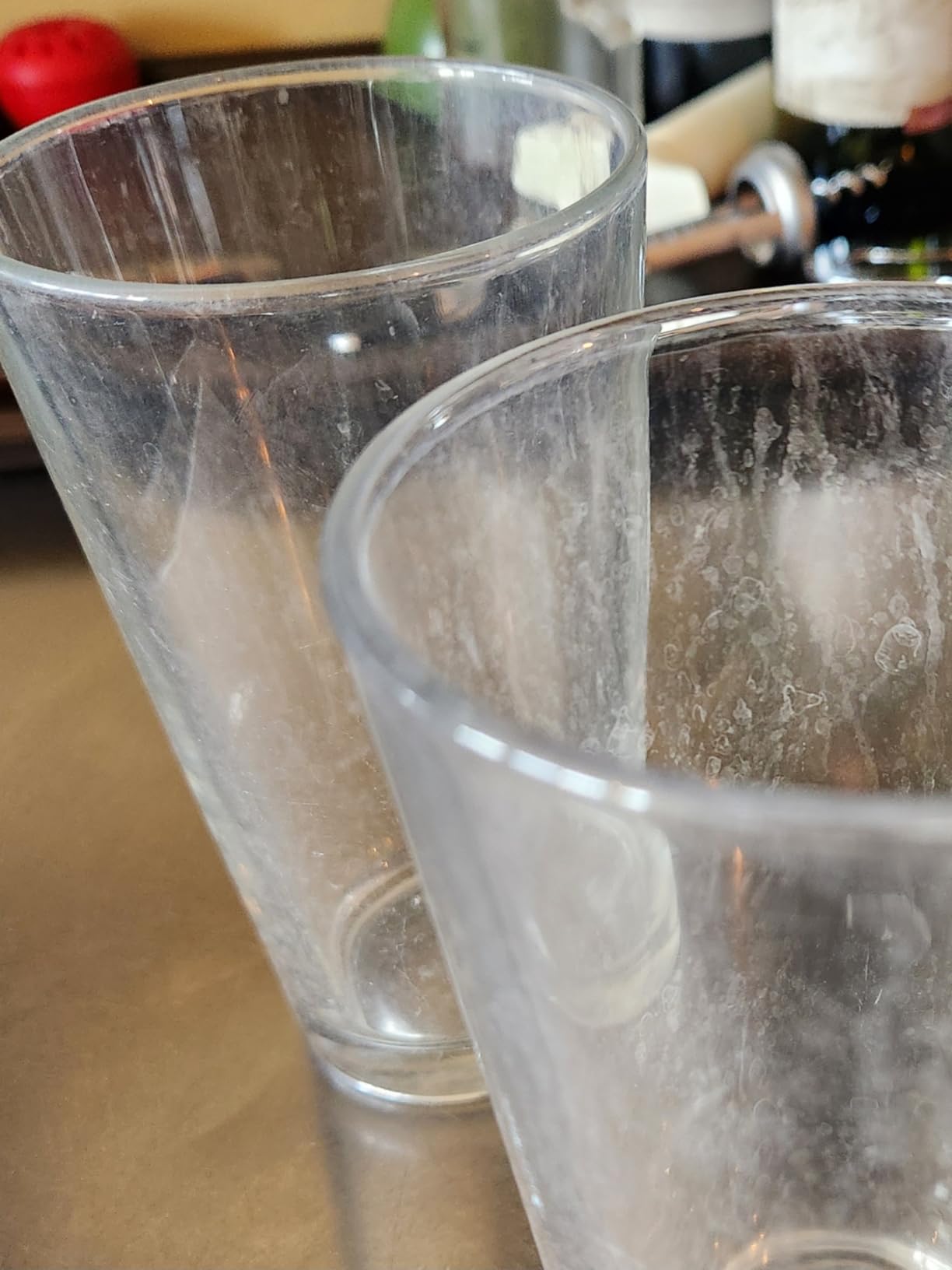
Reviewers describe it as low-foam with excellent rinsability, and those two properties are tightly related in a commercial machine. Foam interferes with spray coverage; poor rinsability carries chemistry forward onto the glassware. Getting both right is what keeps a bar from finding film on wine glasses at the end of a shift.
Water Conditioners and Hard-Water Installations
This is the pick for hard-water buildings, and the reason is written into the formulation rather than inferred. The listing specifies water conditioners that protect machines against scale in hard or soft water, which addresses the mechanism that actually shortens machine life in many older installations.
Scale does not announce itself. It builds on the heating element and inside the spray arm nozzles, and the first symptom operators notice is reduced cleaning performance that looks like a detergent problem. If your racks have been coming out less clean over several months with no change in food or load, mineral buildup is a more likely explanation than chemistry.
Pack Size and Replenishment Rhythm
The 128 oz jug is a genuine constraint in a busy kitchen. At higher volumes you will go through them, and the replenishment rhythm becomes a line of your own. The brand does make larger pack sizes, including 640 fl oz, and if you are ordering monthly rather than per week, that is the version to evaluate.
Material restrictions again: not for aluminum or pewter. Pewter matters more than it sounds in bar settings, because vintage and decorative barware is frequently pewter or plated aluminum rather than steel.
3. Cascade Powder with Dawn – Adjustable Dosing in a 7-Pack Case
- ✓Dawn-powered formula leaves no greasy film
- ✓Shine Shield rinses clean without streaks
- ✓Phosphate-free yet effective in hard water
- ✓Powder dose can be adjusted to load size
- ✓Case of seven 75 oz boxes
- ✕Boxes can arrive cracked in the outer case
- ✕Outer case is heavy and fragile in transit
- ✕One reviewer found it underperformed a Kirkland powder
- ✕Hard water can still leave mineral deposits
75 oz boxes, 7 per case
Phosphate-free and residue-free
For under-counter and cabinet washers
This is the powder pick for kitchens that want control, and it is the one I send to operators who have been disappointed by fixed-dose products. At 4.5 stars from 62 reviews it holds the second-highest average in this group, with 77 percent of ratings at five stars.
It is a 35 pound case containing seven 75 oz boxes, which is a practical shelf unit rather than a single heavy pail. Each box is a portion the operator can adjust, and that is the whole argument for powder: you decide the dose per load instead of accepting a metered one.
It is listed for under-counter dishwashers and cabinet-type automatic utensil washers, which covers the two machine types most small kitchens actually own. The formulation is phosphate-free and marked residue-free, and it carries a Shine Shield additive intended to rinse away what the wash cycle loosens.
Phosphate-Free Without Losing the Grease Cutting
There is a persistent belief that phosphate-free means weaker, and the research behind this topic flagged it as a persistent misconception worth addressing directly. Phosphates were builders that softened water and boosted cleaning, and their removal tightened discharge rules. The work since then went into alternative builders and more efficient surfactants.
Customer feedback on this product is that it cuts grease without leaving a film, and reviewers operating in hard-water areas specifically report it holding up. That is the relevant test. If you are worried about performance loss from a phosphate-free formula, this is the listing where you can check the claim against operators who have already made the switch.
Packaging Durability Is the Real Complaint
The negative reviews here are about shipping, not chemistry. Buyers report boxes arriving with the outer case already cracked, and the case is heavy enough that carriers mishandle it. If your receiving area is a long walk or a loading dock with a drop, that is worth planning around.
One reviewer also reported underperformance against a Kirkland powder with dried-on yogurt remaining, and noted that hard water still left mineral deposits. That is an honest outlier rather than a pattern, but it is consistent with what we saw elsewhere: spotting on this product is a water issue, not a formula issue.
4. Cascade Professional Fresh Scent Powder – Steady Results in Soft Water
- ✓Cleans effectively in naturally soft water
- ✓Outperforms consumer-grade Cascade powder in testing
- ✓Only a small amount needed per wash
- ✓Powder dose adjustable to any load
- ✓Reported to work in older dishwashers
- ✕Some orders arrived as a single box rather than the case
- ✕Some sellers of the listing have inaccurate case quantities
- ✕Powder form not carried in many supermarkets
75 oz powder, 7 per case
Works in soft and hard water
Made in USA
This is the soft-water specialist in the group, and 42 reviews at 4.4 stars put it just below the Cascade with Dawn on volume while telling the same story. Reviewers consistently rate it above grocery-store Cascade powder, which is a directly relevant comparison if you are moving up from a household product.
The specific strength reviewers single out is performance in naturally soft water, where they report liquid detergents and pods underperforming. If your building has a softener or a low-mineral supply, powder chemistry in a commercial machine tends to behave more predictably.
Concentration is the other point of interest. Reviewers note that only a small amount is needed in the door cup per wash, and that the dose can be tuned to any load. For a bar or a small cafe with variable volume, that flexibility is worth more than a marginally stronger formula.
Concentration and Dose Control in Small Kitchens
Low dose per cycle compounds quickly. If a kitchen runs 200 racks a week, a product that needs a third of what its label suggests changes the annual chemical cost materially. The honest caveat is that label doses are maximums, and matching dose to load is a technique rather than a formula property.
Reviewers also report it still cleans in older, long-lived dishwashers, which is worth noting because machine age changes the calculus. An older machine with a worn heating element may never reach sanitizing temperature, and at that point detergent performance is carrying more of the sanitation burden than it should.
Verify the Case Quantity on Arrival
The dominant negative theme here is listing accuracy. At least one order arrived as a single 75 oz box rather than the advertised seven-box case, and that reviewer questioned the seller’s listing history. Some sellers carrying this listing have a pattern of inaccurate case quantities.
Check the count against the listing when the delivery arrives. It is a five-minute check that prevents a low-cost mistake, and it is the one operational detail we would not skip on this particular product.
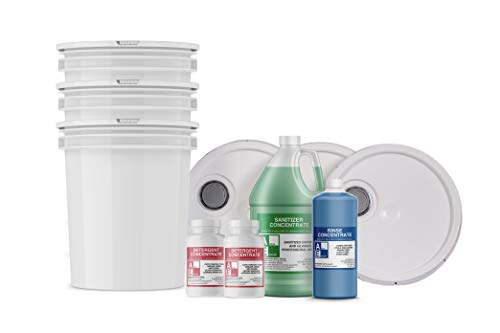
5. Active Element Starter Pack – Detergent, Chlorine and Rinse in One Kit
- ✓Complete chemical trio in one purchase
- ✓Three screw-on pails included for mixing
- ✓Each bottle makes 5 gallons of solution
- ✓Works in low-temp and high-temp machines
- ✓No one- or two-star ratings reported
- ✕Heavier and pricier than a detergent-only purchase
- ✕Chlorine concentrate needs careful dilution and setup
Detergent, chlorine and rinse concentrates
Three 5-gallon pails included
One bottle makes 5 gallons
This is the kit to buy if you are setting up a warewashing line from scratch, and it solves a problem most new operators do not anticipate: the three chemicals have to be matched and diluted correctly, and buying them separately means three suppliers and three sets of instructions.
You get one detergent concentrate, one dish chlorine concentrate and one rinse concentrate, along with three 5-gallon pails with screw-on lids. Each bottle makes 5 gallons of working solution, so the kit fills three pails with one chemical type each.
At 4.6 stars from 45 reviews with no one- or two-star ratings reported, it is the most consistently rated product in the roundup. Buyers cite the pails and the complete set as the reason, not the chemistry itself, which is the same chemistry as the concentrate above.
What the Chlorine Concentrate Actually Does
The dish chlorine is a sanitizer, not a cleaner, and it works in low-temperature machines where the final rinse does not get hot enough to sanitize on heat alone. Label instructions set the chlorine level at the machine, and getting that dilution right is the single most important setup step in the kit.
Over-diluted chlorine means no sanitation. Over-concentrated means residue, off flavors, and in a shared kitchen, a genuine safety concern if anyone is also handling bleach on the same line. Set the level and verify it with test strips rather than eyeballing the pail.
When the Bundle Is the Wrong Buy
If you already have a rinse aid and a sanitizer dialed in, this is more chemical than you need. The value is entirely in the completeness, so it evaporates the moment your existing stocks are good.
It is also the heavier and more expensive entry compared with a single detergent purchase. For a kitchen that genuinely needs all three, that is a wash. For a kitchen that needs one, it is wasted inventory sitting in a hot back room.
6. Active Element Shipper Value Pack – 35 Gallons of Working Solution
- ✓Highest satisfaction score in the group at 4.8 stars with no ratings below four
- ✓Seven bottles cover 35 gallons of working solution
- ✓Balanced ratio suits a full wash rotation
- ✓Same yield across all three chemical types
- ✕Higher upfront cost and heavier freight than single-product buys
- ✕Includes chemicals a stocked kitchen may not need
- ✕Smallest sample among the highly rated products at 25 reviews
3 detergent, 2 rinse, 2 chlorine concentrates
Seven bottles make 35 gallons
High and low temp machines
This is the volume buy, and at 4.8 stars from 25 reviews with 84 percent five-star and 16 percent four-star ratings, it is the most uniformly liked product in the roundup. There are no three-star reviews and nothing below four.
Seven concentrate bottles across three chemical types, each making 5 gallons, cover 35 gallons of working solution per case. The ratio is three detergent to two rinse to two chlorine, and that balance is tuned for a kitchen running a complete rotation on all three chemicals rather than supplementing one of them.
The 25-review sample is the smallest among the highly rated products here, and that is worth stating plainly. A rating this clean across 25 reviews is encouraging rather than definitive, so if this configuration is unfamiliar to you, the smaller starter pack is the lower-risk way to test the chemistry.
Storage and Rotation Discipline
Thirty-five gallons of working solution is a meaningful inventory, and concentrates have to be stored away from heat in a kitchen that runs hot. Concentrate bottles also occupy shelf space that a busy kitchen rarely has to spare, which is a logistics cost that does not appear on any price comparison.
Label your pails and date them. Diluted solution does not last indefinitely, and a pail of rinse concentrate mixed three weeks ago is not the same chemical as one mixed yesterday. Rotation discipline matters more at volume because you have more sitting product.
Who Should Skip This
Kitchens that already have rinse and chlorine dialed in. You would be buying duplicates of working chemicals you already hold, and the upfront outlay is the highest of any pick in this guide.
It is also worth being honest that the case is heavy to receive. If your freight handling is a problem, that shows up here before it shows up anywhere else.
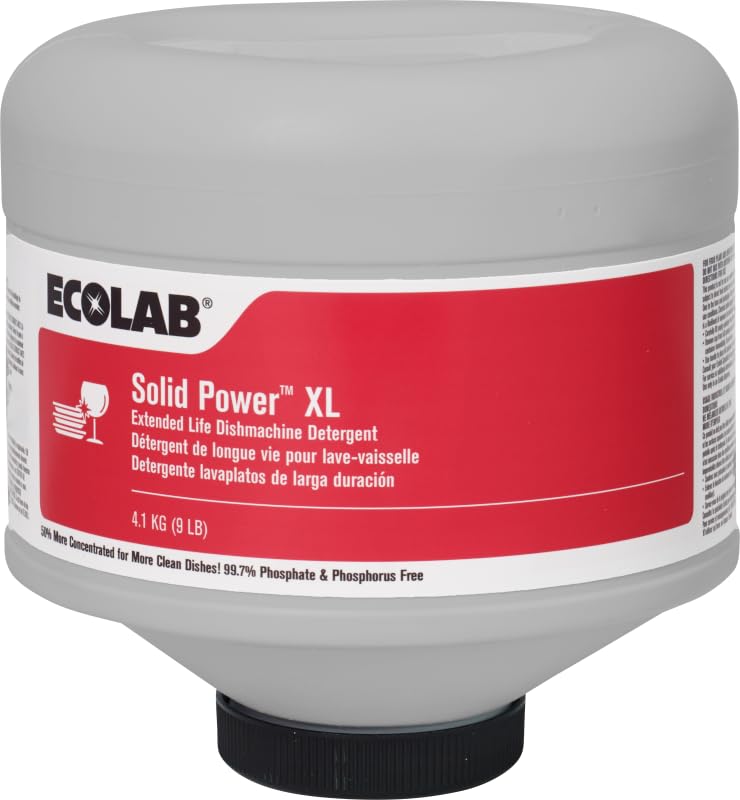
7. Ecolab Solid Power XL with Glass Guard – Compact Solid Block for Glassware
- ✓Solid block is the most compact format here
- ✓No pails
- ✓mixing or liquid handling at all
- ✓Glass Guard variant targets glassware protection
- ✓Highest rated at 4.8 stars with 86 percent five-star
- ✕Listing feature text is inaccurate and reads laundry detergent
- ✕No usage
- ✕dosing or temperature details published
- ✕Only 32 reviews to support the rating
Solid 9 lb block
Glass Guard formulation
No pails or mixing required
This is the only solid block in the group, and that format solves a real problem: there is nothing to mix, nothing to pour, and no pail to store. It arrives as a 9 pound block in an 8 by 8 by 8 inch package and goes into a block dispenser, which makes it the least labor-intensive option here.
It is also the pick for glassware-focused operations. The Glass Guard variant is positioned specifically for protecting glassware through machine washing, and at 4.8 stars from 32 reviews with 86 percent five-star and no one- or two-star ratings, the customers who bought it report strong results.
Be aware that the listing itself is thin. The only published feature line reads as a laundry detergent reference, which is a data error rather than a product problem, but it means you will not find dosing or temperature guidance on the product page. Confirm the setup requirements with the manufacturer before you commit a full rotation to it.
Solid Blocks as a Logistics Decision
The case for solid chemistry is storage density and handling. A block occupies a fraction of the space of the equivalent liquid volume, there is no water to ship, and the labor is a swap rather than a measurement. In a small back room or a mobile kitchen, those three things add up quickly.
The trade-off is that block dispensers are a piece of equipment. If your machine has no dispenser and you have no plan to add one, a solid block is not a drop-in replacement for a jug-fed liquid. Confirm the dispenser situation before you order.
Verify the Chemistry Before Committing
Because the listing gives no temperature range, we cannot tell you from the available data whether this suits a high-temp machine, a low-temp machine or both. That is a real gap and we are not going to guess around it.
Glassware is the safer bet for the Glass Guard variant, since that is the stated purpose. For heavy cookware loads, one of the liquid or powder concentrates above is a better-evidenced choice.
8. GreenFist Lybramatic Ready-to-Use Liquid – No Mixing on a Busy Line
- ✓Ready to use with no mixing
- ✓dilution or pre-rinse
- ✓Emulsifies fat
- ✓grease
- ✓oil and protein soils
- ✓Works in both low- and high-temp machines
- ✓Biodegradable and cruelty-free formula
- ✓Made in the USA
- ✕Not safe for aluminum kitchenware
- ✕Commercial non-front-load machines only
- ✕Smallest review base at 16 reviews
- ✕Pail weighs 55 pounds
Ready-to-use 5 gallon pail
No dilution or pre-rinse
Biodegradable formula
This is the labor-saving option for a small team, and the reason is one sentence in the listing: ready to use, no dilution or pre-rinse required. A five-gallon pail arrives as working solution. There is no mixing step, no measuring, and no dilution math to get wrong at the end of a long shift.
It emulsifies animal fat, grease, oil and protein soils, which covers the full soil spectrum on a mixed line, and it is specified for both low- and high-temperature commercial machines. The formula is biodegradable and cruelty-free, and the manufacturer is US-based with an SDS available on request.
At 16 reviews it has the smallest sample in the roundup, and that matters when you are reading a 4.4 star average. A single outlier review carries unusual weight at this volume, so treat the rating as directional rather than established.
Ready-to-Use Versus Concentrate at Small Scale
The economics here are volume-dependent. A concentrate wins on chemical cost per gallon in a kitchen with volume, because you are paying for active chemistry rather than water. A ready-to-use pail wins on labor in a kitchen without it.
That trade-off is close at moderate volume and clear at the extremes. One-person operations should look hard at labor. Kitchens running continuous service should look hard at per-gallon cost, where concentrate is the better number.
Machine Type and Material Restrictions
This product is for commercial non-front-load machines only, which rules out household dishwashers and some countertop units. It is also not safe for aluminum kitchenware because of its high alkalinity, and a safety data sheet is available on request if your health inspector asks for documentation.
Be aware the pail is heavy at 55 pounds. That is manageable in a walk-in with a dolly and genuinely awkward in a food truck or a basement kitchen with stairs. Check your delivery path before ordering full pails.
Powder vs Liquid Concentrate vs Solid Block: Which Format Fits Your Kitchen?
Every product in this roundup is a different format, and the format matters more than most buyers expect. Here is how the three actually compare in service.
Powder gives you the most dosing control, because an operator can vary the amount per load. It is compact to store, and the box or case is easy to divide into portions. Its weakness is handling: powder has to be measured, and it can clump if it gets damp in a humid back room. Two picks here use it, and both report good hard-water performance with a spot watch needed in very hard installations.
Liquid concentrate gives you the best chemical cost per gallon and dispenses cleanly through a pickup tube. It needs a mixing step, and dilution errors are the main risk. The concentrate and the ready-to-use liquid are both in this category from an operational view, differing only in whether you perform that step.
Solid blocks give you the lowest storage footprint and the least labor, at the price of requiring a block dispenser. There is one in this group and it is the least labor-intensive option we evaluated, but its documentation is the thinnest. Verify dispenser compatibility and temperature range before you commit.
Rinse aid is not a detergent and does not substitute for one. It changes surface tension during the final rinse so water sheets off rather than beads. Using it as your cleaner leaves the soil in place.
Detergent vs Sanitizer: The Distinction Health Inspectors Ask About
Detergent and sanitizer do different jobs, and conflating them is the most common compliance misunderstanding in small commercial kitchens. Detergent removes soil. Sanitizer reduces the microorganisms that survive on a clean surface.
High-temperature machines sanitize with heat, delivering a final rinse hot enough to do the work chemically. Low-temperature machines need a chlorine-based sanitizer dosed into the final rinse, because the water simply does not get hot enough on its own. That is why the two starter kits in this roundup include a dish chlorine concentrate alongside the detergent.
The safe sequence is always wash, rinse, then sanitize. A sanitizer applied to a dirty surface does almost nothing, and in a documented inspection that is a finding. If you are running low-temp and skipping the sanitizer, your detergent is cleaning dishes that are not actually sanitized.
Never mix chlorine sanitizer with alkaline machine detergent outside the machine’s dilution system, and never mix any of it with household bleach. In a shared kitchen where a line worker is decanting chemicals, keep the containers physically separate and labelled. For background on how residue and film show up, our guide to rust inside a dishwasher covers what happens when machine chemistry and water chemistry get out of balance together.
How to Choose the Right Commercial Dishwasher Detergent
1. Match the Chemistry to Your Machine Water Temperature
This is the first criterion and the one most purchases skip. High-temp machines run a final sanitizing rinse in the 150 to 180 degree Fahrenheit range, and low-temp machines run cooler and depend on a chemical sanitizer. Most products in this guide are specified for both, which is why they are safer defaults than a product claiming one band only.
If you know your machine’s water temperature is not reaching the expected range, that is a machine problem, not a detergent problem. Our guide to dishwasher noise and cycling problems covers the mechanical side, and a worn heating element is the usual culprit.
2. Test Your Water Hardness Before You Choose
Hard water produces spotting and scale, and operators frequently blame the detergent when the real cause is mineral content in the supply. If your glassware spots consistently regardless of product, no detergent change will fix it. A water conditioner built into the formula, like the one in the Quality Chemical liquid, helps, but it is mitigation rather than a cure.
In genuinely soft water, powder chemistry tends to outperform liquid formats. That is the specific finding behind the Cascade Professional pick in this roundup, and it is the reason to test before you buy a case.
3. Confirm Dispenser Compatibility and Warranty Terms
Liquid concentrates need a pickup tube or a dosing pump. Solids need a block dispenser. Powders need a cup or an inline dispenser. Using the wrong delivery method means inconsistent dose, and an inconsistent dose is usually an underdose, which means poor cleaning and a return visit from the health department.
Check your machine’s manual on approved chemistry before installing anything new. Machine manufacturers specify acceptable detergent types, and running unapproved chemistry is a genuine warranty question, not a technicality. If you have ever seen a warped door gasket or a plastic rack that started to distort, our dishwasher burned plastic guide covers the symptoms.
4. Do the Cost Per Rack Math Before Ordering
Cost per rack is the number foodservice purchasing actually manages, and it is not the same as price per gallon. Work it in three steps: cost of the chemical, divided by the gallons of working solution it produces, divided by the racks that solution washes at your dose.
Concentrates win the second step decisively, because you are not paying for water. Ready-to-use liquid loses there and wins on the third, because you are not paying for labor. At moderate volume the two are close, and the decision becomes operational rather than financial.
Then apply the dosage reality check. The most common finding in the customer data was that label doses are written as maximums. If your racks are coming out clean, cutting the dose modestly and watching for a week is the fastest savings available to you.
5. Ask What Documentation You Can Produce
Health inspectors can ask for a safety data sheet, and some jurisdictions ask for food-safety certification on warewashing chemicals. Ready-to-use products with an available SDS are easiest to document. Keep current sheets on file for every chemical in the room, not just the detergent.
Also check material exclusions honestly. Most products here are not for aluminum, and several exclude pewter. If your kitchen washes aluminum cookware or decorative barware, that narrows your list before chemistry does.
Frequently Asked Questions
What detergent do commercial dishwashers use?
Commercial dishwashers use a low-foam, high-strength machine detergent delivered as a powder, a liquid concentrate or a solid block. Surfactants lift grease while alkaline builders and enzymes break down protein and starch. Household gel and pods are not substitutes, because they foam in a commercial machine and can trigger a fault or a shutdown.
What can I use as a substitute for commercial dishwasher detergent?
A non-foaming machine detergent powder or an approved generic commercial powder is the realistic alternative. Household gel, consumer pods and automatic dishwasher tablets are not safe substitutes in a commercial machine, because they foam heavily and many are not formulated for hot water or for machine materials. If you are unsure, confirm with your machine manufacturer before installing anything.
Do commercial dishwashers need detergent or sanitizer?
They need both, and the two do different jobs. Detergent removes grease and food soil. Sanitizer reduces microorganisms on the clean surface. High-temperature machines sanitize with a final rinse hot enough to do the job on its own, while low-temperature machines require a chlorine sanitizer dosed into the final rinse.
What is the best powder detergent for dishwashers?
For commercial machines, the Cascade Automatic Powder with Dawn in a 7-pack case offers the best balance of adjustable dosing, grease cutting and a residue-free finish, with phosphate-free chemistry that reviewers report works in hard water. The Cascade Professional Fresh Scent powder is the better pick in very soft water, where reviewers report it outperforming liquid formats.
Which Cascade detergent is best?
For commercial dishmachines, the Cascade Professional powder lines are the relevant products, not the consumer Cascade gel sold for household machines. Between them, the powder with Dawn offers adjustable dosing and a case of seven 75 oz boxes, while the Fresh Scent powder performs especially well in naturally soft water. Consumer gel and pods should not go into a commercial machine.
What is the best dishwasher detergent for hard water?
The Quality Chemical machine liquid in this roundup is the strongest hard-water choice, because its formula includes water conditioners that help protect the machine against scale in hard or soft water. No detergent fully solves hard water, so pair your choice with a rinse aid and have your water tested if spotting persists.
What is the best eco-friendly dishwasher detergent?
The GreenFist Lybramatic ready-to-use pail is the clearest option here, with a biodegradable, cruelty-free formula made in the USA and no dilution step. Note that phosphate-free does not mean weak: the Cascade powder with Dawn is phosphate-free and reviewers report it still cutting grease effectively in hard-water areas.
What is the best dishwasher detergent according to Consumer Reports?
Consumer testing does not cover commercial dishmachine detergents, so there is no commercial recommendation from that source. For household products the question is a different one entirely. This guide covers commercial machines only, and every pick is based on feedback from operators running warewashing lines.
Our Recommendation by Kitchen Type
If you run a full-service kitchen with steady volume and want the lowest chemical cost per gallon, the Active Element concentrate is our top pick, and it is our best commercial dishwasher detergent recommendation for 2026. One batch makes 5 gallons of working solution, and the largest customer base in this roundup backs the performance claims.
If baked-on soil is your main labor problem, the Quality Chemical liquid is the one to try. Its low-foam rinsability and built-in water conditioners make it the safest choice in a hard-water building.
If you want control per load or run a bar with heavy glassware, the Cascade powder with Dawn gives you adjustable dosing in a portioned case. In very soft water, the Cascade Professional Fresh Scent powder is the stronger performer.
For a kitchen starting from zero, the Active Element starter pack removes the guesswork from matching detergent, chlorine and rinse. For the tightest possible back room, the Ecolab solid block has no pails and no mixing. For a one- or two-person operation, the GreenFist ready-to-use pail buys back the labor you do not have.
Before you reorder anything, check your water temperature, your water hardness and your current dose. More operators overspend on chemical than on any other line item in warewashing, and the fix is usually a measurement rather than a different product.





Leave a Comment