
Finding the best semi modular synthesizers means balancing sound character, patching depth, and how much you actually want to wrestle with cables before making music. After spending months patching, sequencing, and comparing the most talked-about desktop and keyboard synths in this category, our team narrowed the field to seven instruments that genuinely earn their place in a studio.
A semi-modular synthesizer sits between a fixed-architecture synth and a full Eurorack wall. It ships pre-wired so you can play it immediately, but every important connection runs through a patch bay that lets you override, reroute, or extend the signal path with cables. That combination of instant gratification and creative flexibility is why producers, sound designers, and live performers keep gravitating toward these instruments.
This guide covers everything from Moog’s warm ladder-filter classics to Make Noise’s West Coast thinking and Behringer’s value-packed dual-oscillator powerhouse. Whether you are chasing your first analog synth, expanding an existing Eurorack system, or looking for a sound design sandbox, these are the semi-modular synths we would actually spend our own money on in 2026.
Our Top 3 Tested Semi-Modular Synthesizers for 2026
We tested every synth in this guide hands-on, and three instruments stood out immediately. The Moog Grandmother delivers the most complete package with its keyboard, spring reverb, and classic Moog filter. The Behringer Neutron offers the most analog synth for the least money, and the Make Noise 0-Coast is the best entry point into West Coast synthesis philosophy.
If you want a deeper look at the Grandmother specifically, check out our detailed Moog Grandmother review for a full breakdown of its sound engine and patching workflow.
Comparing the Market’s Best Semi Modular Synthesizers in 2026
Before getting into individual reviews, here is a side-by-side breakdown of all seven synths we tested. Use this table to quickly compare patch points, oscillator count, filter type, and form factor across the full lineup.
| Product | Features | Action |
|---|---|---|
 Moog Grandmother Moog Grandmother |
|
Check Latest Price |
 Behringer Neutron Behringer Neutron |
|
Check Latest Price |
 Moog Mother-32 Moog Mother-32 |
|
Check Latest Price |
 Korg MS-20 Mini Korg MS-20 Mini |
|
Check Latest Price |
 Arturia MiniBrute 2 Arturia MiniBrute 2 |
|
Check Latest Price |
| Make Noise 0-Coast |
|
Check Latest Price |
 Moog DFAM Moog DFAM |
|
Check Latest Price |
1. Moog Grandmother – The Most Complete Semi-Modular Keyboard Experience
- ✓Warm Moog ladder filter with classic vintage character
- ✓Built-in spring reverb adds lush organic ambience
- ✓41 patch points for deep modular exploration
- ✓Velocity-sensing keyboard feels expressive and musical
- ✓Compatible with Mother-32 DFAM and Eurorack systems
- ✕Heaviest unit in this lineup
- ✕Only 1 year manufacturer warranty
- ✕Not Prime eligible
32 velocity keys
Spring reverb tank
41 patch points
2 analog oscillators
256-note sequencer
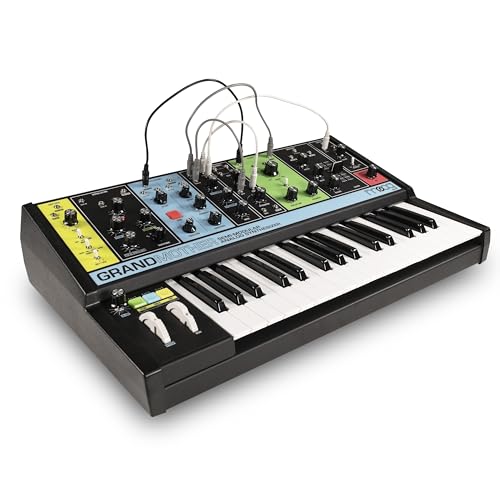
The Moog Grandmother is the synth I keep coming back to when I want something that sounds incredible the moment I turn it on. You plug it in, hit a key, and that warm Moog ladder filter wraps around the oscillators like a blanket. No patching, no menu diving, just instant analog tone that feels alive.
What sold me on the Grandmother over cheaper desktop options is the integration. The 32 velocity-sensing keys, the spring reverb tank, and the arpeggiator all work together as a complete instrument. You can gig with this synth, record it direct, and never feel like you are missing anything.
Then the patch bay opens up. Forty-one patch points give you access to every major signal node, and the spring reverb can process external audio too. I have run drum machines through that reverb tank and gotten textures no plugin has ever replicated.
Sound Engine and Oscillator Character
Two analog oscillators with selectable waveforms sit at the heart of the Grandmother, plus a white noise generator for percussion and texture. The oscillators track well across the keyboard and stay stable through long sessions, something older Moog designs sometimes struggled with.
The ladder filter is where the magic happens. It has that signature Moog warmth with a smooth cutoff sweep that never sounds harsh even at high resonance. Push it hard and the filter distorts musically, giving bass patches a growl that cuts through any mix.
Spring Reverb and Sequencing Workflow
The built-in analog spring reverb tank is genuinely special. It adds a physical, metallic ambience that digital reverbs approximate but never truly match. I use it subtly on bass lines and crank it for drone work, and both approaches sound fantastic.
The 256-note sequencer stores three sequence files, which is enough for live performance without feeling overwhelming. The arpeggiator syncs to MIDI clock, and the whole instrument responds to MIDI over USB or 5-pin DIN, making integration with any DAW straightforward.
Modular Integration and Patching Depth
Forty-one patch points make the Grandmother one of the most patchable synths in this guide. You can route oscillator audio into the filter, modulate the reverb with an LFO, or process external gear through the spring tank. The patch bay uses standard 3.5mm jacks, so it plays nicely with Eurorack gear and other Moog semi-modulars.
I have paired the Grandmother with a Mother-32 and DFAM, and the three instruments talk to each other beautifully. The Grandmother becomes the melodic center, the Mother-32 handles sequencing, and the DFAM drives percussion. That trio is one of the most satisfying modular ecosystems you can build.
Who Should Buy the Grandmother
This is the synth for players who want a complete instrument with a keyboard, not just a desktop module. If you perform live, if you love the Moog sound, and if you want a synth that grows with your modular ambitions, the Grandmother is the clearest recommendation in this guide.
Skip it if you are on a strict budget or if you need something portable. At over 16 pounds, this is a desktop-class instrument that stays put.
2. Behringer Neutron – Maximum Analog Synth for the Money
- ✓Paraphonic design plays two notes sharing one filter and envelope
- ✓Dual 3340 analog oscillators for thick detuned tones
- ✓Five blendable waveforms per oscillator for sound variety
- ✓Plays immediately without any patching required
- ✓Three year manufacturer warranty is class-leading
- ✕Filter resonance is limited compared to Moog designs
- ✕Quality control can be inconsistent between units
Paraphonic dual 3340 VCOs
5 blendable waveforms
Pure analog signal path
Semi-modular with default routings
3 year warranty
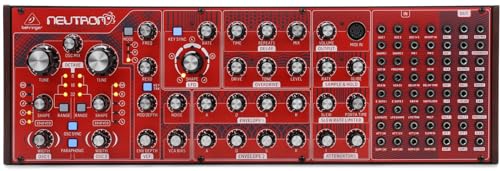
The Behringer Neutron is the synth that gets recommended more than any other on synthesizer forums, and after living with one for weeks I understand why. It gives you a dual-oscillator analog synth with a deep patch bay and paraphonic playability for less than what most competitors charge for a single-oscillator module.
The Neutron uses the classic Curtis 3340 oscillator chip, the same chip found in legendary synths like the Prophet 5 and OB-Xa. Those two VCOs form the backbone of a sound that runs the gamut from warm pads to aggressive bass to squelchy leads.
Reddit users consistently call the Neutron the best bang-for-buck entry into analog synthesis, and I agree. It is the synth I would hand to someone who wants to learn subtractive synthesis and patching without spending premium money.
Paraphonic Playability and Oscillator Design
Unlike a traditional monosynth, the Neutron is paraphonic, meaning both oscillators can play different notes simultaneously through a shared filter and envelope. This unlocks two-note chords and intervals that monophonic synths simply cannot produce.
Each oscillator blends continuously between five waveform shapes: tone mod, pulse, sawtooth, triangle, and sine. That blend control is more flexible than a simple waveform switch, letting you morph between tonal characters in real time.
Patch Bay and Modulation Routing
The patch bay on the Neutron exposes the internal signal flow for rerouting and external control. You can hard sync the oscillators, route the LFO to filter cutoff, or pull audio out for external processing. The default routings work without any cables, so beginners can start playing immediately and add patching later.
I found the modulation options surprisingly deep for the price. The Neutron includes multiple envelope generators, an LFO, and sample and hold, giving you enough tools to create evolving, animated patches that keep revealing new sounds over time.
Build Quality and Long-Term Ownership
The Neutron is built around a metal chassis with bass wood side panels, and it feels solid on a desk or in a rack. At under five pounds, it is easy to move between studio and live setups. Behringer backs it with a three-year warranty, which is longer coverage than Moog or Korg offer on their synths.
The main drawback is quality control consistency. Most units perform flawlessly, but a small percentage of owners report minor tuning or calibration issues out of the box. Behringer’s warranty covers these, but it is worth buying from a retailer with a solid return policy.
Who Should Buy the Neutron
This is the best semi-modular synth for anyone who wants maximum analog sound per dollar. If you are new to synthesis and want to learn patching without a huge investment, or if you want a second analog voice to complement a pricier synth, the Neutron is the obvious choice.
It is also the best starting point for modular exploration. The patch bay vocabulary translates directly to Eurorack, so everything you learn on the Neutron applies when you eventually expand.
3. Moog Mother-32 – The Eurorack Standard Bearer
- ✓Authentic raw Moog analog sound from a single VCO
- ✓32-note step sequencer with 64 stored sequences
- ✓60HP Eurorack format fits standard modular cases
- ✓Expandable by chaining multiple Mother-32 units
- ✓External audio input runs through the ladder filter
- ✕Single oscillator limits harmonic richness
- ✕Only 1 year manufacturer warranty
60HP Eurorack format
Single analog VCO with noise
Moog ladder filter
32-step sequencer
Tabletop or rack mountable
The Moog Mother-32 is the synth that made Eurorack accessible to people who never considered modular before. It ships as a tabletop unit, but slide it into a Eurorack case and it becomes the foundation of a full modular system. That dual identity is why it remains one of the best-selling semi-modular synths ever made.
With a single analog VCO and the classic Moog ladder filter, the Mother-32 delivers that unmistakable warm, fat, vintage Moog tone. It is not the most complex synth on paper, but the sound quality is undeniable, and the patch bay gives you far more modulation depth than the front panel suggests.
Forum users frequently recommend the Mother-32 alongside the DFAM as a complementary pair, and that pairing is genuinely powerful. The Mother-32 handles melodies and bass while the DFAM drives percussion, and both share the same 60HP Eurorack footprint.
Sound Engine and the Moog Ladder Filter
The Mother-32 uses a single analog voltage-controlled oscillator with a white noise generator, feeding into the beloved Moog ladder filter. That filter is the star of the show. It has a creamy, musical character that makes even simple patches sound expensive.
An external audio input lets you run any sound source through the ladder filter. I have processed drum loops, guitar, and vocal samples through it, and everything comes out sounding warmer and more cohesive.
The 32-Step Sequencer and Performance Features
The onboard 32-note step sequencer is one of the best sequencers on any semi-modular synth in this price range. It stores up to 64 sequences and offers two performance modes, giving you enough pattern storage for live sets without relying on a computer.
The sequencer sends CV and gate signals through the patch bay, so you can use it to drive other modular gear. This turns the Mother-32 into a control hub for a growing Eurorack system, not just a standalone voice.
Eurorack Integration and Expandability
At 60HP, the Mother-32 fits standard Eurorack cases and runs on typical Eurorack power. The patch bay exposes every internal signal, so integrating it with other modules is straightforward. Moog designed it to chain with additional Mother-32 units, letting you build a polyphonic system one voice at a time.
For modular-curious producers, the Mother-32 is the safest investment in this guide. Even if you never build a full Eurorack system, it works perfectly as a tabletop synth. And if you do go modular, it slots right in without compromise.
Who Should Buy the Mother-32
This is the synth for anyone who sees modular synthesis in their future. The Eurorack compatibility, the sequencer, and the Moog sound make it a foundation piece that will never become obsolete in your rig.
It is also ideal for producers who want one analog voice with genuine Moog character. If you only ever buy one semi-modular, the Mother-32 is arguably the safest long-term choice.
4. Korg MS-20 Mini – The Iconic Filter Legend
- ✓Iconic self-oscillating high-pass and low-pass filters with distinctive distortion
- ✓External signal processor for processing any audio source
- ✓Flexible patching system enables deep modular routing
- ✓USB MIDI plus traditional 5-pin DIN for controller flexibility
- ✓Decades of legendary sound design heritage
- ✕Not Prime eligible
- ✕Heavy at nearly 11 pounds
- ✕Patch bay uses non-standard voltage conventions
Self-oscillating HP and LP filters
External signal processor
USB and 5-pin MIDI
Flexible patching system
Classic MS-20 sound
The Korg MS-20 Mini is a faithful recreation of the 1978 classic that defined aggressive analog synthesis. Its filters are legendary for their ability to self-oscillate and distort, producing the screaming, snarling sounds that defined punk, industrial, and electronic music for decades.
This is not a polite synth. The MS-20 Mini sounds raw and edgy from the first note, with a filter character that no other manufacturer has successfully replicated. If you have heard the MS-20 on classic records and wanted that exact sound, this is the only way to get it without tracking down an original.
The MS-20 Mini includes both USB MIDI and 5-pin DIN connectivity, making it easy to integrate with modern controllers and DAWs. The flexible patching system opens up deep modular routing for sound designers willing to learn its unique workflow.
The Dual Filter System and Distortion Character
The MS-20 Mini features separate high-pass and low-pass filters, each capable of self-oscillation. Running audio through both filters in series creates a distinctive distortion and resonance character that has become the synth’s signature sound.
I have spent hours just tweaking the filter cutoff and resonance knobs on this synth. The way the filters interact and distort is unlike anything else in this guide. It is the filter sound producers reach for when they want aggression and character, not smoothness.
External Signal Processor and Patching
The external signal processor, or ESP, lets you route any audio source through the MS-20’s filters and modulation circuitry. Plug in a guitar, a vocal, or a drum loop, and the MS-20 transforms it into something completely new. This feature alone justifies the synth for sound designers.
The patching system uses a different voltage standard than Eurorack, which forum users frequently note. It works beautifully on its own, but integrating it with a Eurorack system requires careful voltage level matching. For standalone use, this is not an issue at all.
Build, Connectivity, and Playability
The MS-20 Mini is built with a plastic body that keeps weight manageable despite its large footprint. USB MIDI and 5-pin DIN ports give you flexible controller options, and the synth responds well to both keyboard and external sequencer input.
The front panel layout mirrors the original MS-20, with every control exposed as a knob or switch. There is no menu diving, no hidden parameters, and no digital screens. Everything is right there in front of you, which makes the synth incredibly fast to program once you learn the layout.
Who Should Buy the MS-20 Mini
This is the synth for producers who want the iconic MS-20 filter sound and character. If aggressive, raw, distorted analog tone is your aesthetic, nothing else in this guide comes close.
It is also a fantastic choice for sound designers who want to process external audio. The ESP turns the MS-20 into a creative effects processor as much as a synthesizer.
5. Arturia MiniBrute 2 – The Patching Powerhouse Keyboard
- ✓Dual analog VCOs create rich thick detuned tones
- ✓Steiner Parker filter offers four modes for tonal variety
- ✓48-point patchbay is the deepest in this guide
- ✓25-key keyboard with aftertouch for expressive playing
- ✓Built-in step sequencer for composing patterns
- ✕Heaviest unit at nearly 14 pounds
- ✕Lower community rating than competitors
- ✕Not Prime eligible
25-key with aftertouch
Dual VCOs and dual LFOs
Steiner Parker 4-mode filter
48-point CV and gate patchbay
Built-in step sequencer
The Arturia MiniBrute 2 takes the original MiniBrute concept and adds a massive patch bay, turning a great analog keyboard synth into a serious semi-modular instrument. With 48 patch points, dual oscillators, and a four-mode Steiner Parker filter, it offers more patching depth than anything else in this guide.
The 25-key keyboard includes aftertouch, which is rare at this price point and adds a level of expression that desktop-only synths cannot match. Combined with the built-in step sequencer, the MiniBrute 2 functions as a complete production and performance instrument.
Arturia designed the MiniBrute 2 to bridge the gap between traditional keyboard synths and Eurorack modular. The 48-point patchbay exposes nearly every internal signal, and the synth ships with a generous set of patch cables to get you started immediately.
Dual Oscillator Sound and Steiner Parker Filter
Two analog VCOs give the MiniBrute 2 a thicker, richer sound than single-oscillator competitors. Detuning the oscillators slightly creates a lush chorus effect, and hard syncing them produces complex harmonic textures that single-VCO synths cannot generate.
The Steiner Parker filter is the other standout feature. It offers low-pass, high-pass, band-pass, and notch modes in a single filter, giving you four distinct tonal characters from one control section. Each mode has its own personality, from smooth and warm to aggressive and biting.
The 48-Point Patchbay Explained
Forty-eight patch points is more than any other synth in this guide. Every CV source, gate signal, audio output, and modulation input is exposed for rerouting. This means you can create signal paths that the designers never intended, which is exactly what makes patching fun.
Two LFOs and two envelope generators (one ADSR, one AD) provide extensive modulation sources. I have built patches on the MiniBrute 2 that evolve continuously for minutes without repeating, all driven by internal modulation routing through the patch bay.
Keyboard Aftertouch and Sequencer Workflow
The 25-key keyboard includes aftertouch, letting you add vibrato, filter sweeps, or any other modulation by pressing harder on held notes. This transforms the playing experience compared to desktop synths that require a separate controller keyboard.
The built-in step sequencer lets you compose patterns directly on the instrument. Combined with the patch bay, you can create sequences that modulate themselves as they play, producing evolving textures that feel alive.
Who Should Buy the MiniBrute 2
This is the synth for players who want a keyboard instrument with serious patching depth. If the Mother-32 or Neutron feel too limited and you want maximum patch points in a single unit, the MiniBrute 2 delivers more routing options than anything else here.
It is also ideal for producers who want aftertouch expression without buying a separate controller. The MiniBrute 2 is a complete instrument that rewards deep exploration.
6. Make Noise 0-Coast – West Coast Synthesis in a Compact Desktop
- ✓Compact steel desktop build feels premium
- ✓Excellent MIDI to CV conversion for integrating controllers
- ✓13 patch sources and 14 destinations offer deep routing
- ✓Eurorack compatible signal levels for modular integration
- ✓Dual-mode arpeggiator adds performance options
- ✕Limited stock availability
- ✕No Prime shipping
- ✕West Coast workflow has a learning curve
West Coast synthesis design
13 sources and 14 destinations
MIDI to CV conversion
Dual-mode arpeggiator
Eurorack compatible signals
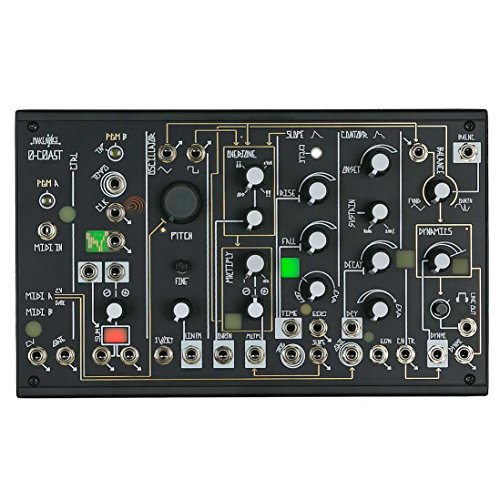
The Make Noise 0-Coast is the synth that introduces producers to West Coast synthesis philosophy without requiring a full modular system. Instead of the subtractive East Coast approach used by Moog and Korg, the 0-Coast uses wavefolding, dynamics, and complex timbral modulation to create sounds from scratch.
This is a different way of thinking about synthesis, and it produces sounds that subtractive synths simply cannot generate. The 0-Coast excels at metallic, bell-like tones, evolving drones, and textural sound design that fills a unique sonic space.
Despite its compact size, the 0-Coast packs 13 patch sources and 14 destinations into a steel desktop enclosure. It is fully Eurorack compatible, making it an ideal bridge between the desktop synth world and full modular systems.
West Coast Synthesis and Wavefolding
The 0-Coast uses a wavefolder instead of a traditional filter as its primary timbral shaping tool. Wavefolding adds harmonics to a simple waveform, transforming a sine wave into a rich, complex sound full of overtones. This is the opposite of subtractive synthesis, where you start with a harmonically rich wave and filter it down.
The result is a sound palette that feels metallic, organic, and otherworldly. I have used the 0-Coast for ambient textures, sound effects, and lead sounds that cut through a mix in ways no other synth in this guide can replicate.
MIDI Integration and Arpeggiator
Two channels of MIDI to CV conversion let you control the 0-Coast from any MIDI keyboard or DAW. The conversion is clean and responsive, with no noticeable latency. A dual-mode arpeggiator synced to MIDI clock adds performance capabilities.
The MIDI to CV conversion also makes the 0-Coast an excellent interface for controlling other modular gear. Plug a MIDI keyboard into the 0-Coast, and its CV outputs can drive Eurorack oscillators and filters directly.
Eurorack Compatibility and Expansion
The 0-Coast outputs Eurorack-compatible signal levels, so patching it into a modular system requires no attenuation or level matching. The 13 sources and 14 destinations cover all the essential patching points for integrating with other modules.
For producers considering a move to full modular, the 0-Coast is the ideal starting point. It teaches West Coast synthesis concepts, provides MIDI integration, and works as part of a larger system indefinitely.
Who Should Buy the 0-Coast
This is the synth for sound designers and experimental producers who want sounds no subtractive synth can produce. If ambient, drone, or textural music is your focus, the 0-Coast is unmatched in this guide.
It is also the best choice for modular-curious producers who want a Eurorack-compatible entry point. The 0-Coast teaches patching and West Coast concepts while functioning as a permanent part of any future modular system.
7. Moog DFAM – The Analog Percussion Powerhouse
- ✓Dedicated percussion voicing creates unique drum and synth percussion sounds
- ✓Moog ladder filter delivers warm punchy analog tone
- ✓8-step sequencer designed for rhythmic pattern creation
- ✓24-point patch bay for modular integration and sound design
- ✓60HP Eurorack format pairs perfectly with Mother-32
- ✕Not Prime eligible
- ✕Specialized focus limits melodic use
- ✕Limited stock availability
Dedicated percussion synthesizer
Dual analog VCOs
Moog ladder filter
8-step sequencer
24-point patch bay
60HP Eurorack
The Moog DFAM, or Drummer From Another Mother, is a dedicated percussion synthesizer that brings the Moog analog sound to the rhythmic side of your productions. It is not a general-purpose synth, but within its specialty, it is one of the most inspiring instruments in this guide.
With two analog VCOs, a white noise generator, and the Moog ladder filter, the DFAM produces everything from punchy kicks to metallic snares to evolving textural percussion. The dedicated 8-step sequencer is built specifically for rhythmic pattern creation, making the DFAM feel like a complete drum machine engine in a single module.
Forum users consistently recommend pairing the DFAM with the Mother-32, and that combination is genuinely magical. The Mother-32 handles melodies and bass while the DFAM drives the rhythm, and both share the same 60HP Eurorack format and Moog patch bay vocabulary.
Percussion Sound Design and the Ladder Filter
The DFAM uses two VCOs and a white noise generator as its sound sources, feeding into the Moog ladder filter. This architecture excels at percussive sounds because the filter can shape both tonal and noise elements simultaneously.
I have programmed kicks that shake the floor, snares that cut through any mix, and hi-hats with realistic decay on the DFAM. The analog signal path gives every sound a weight and presence that software drum plugins struggle to match.
The 8-Step Sequencer and Performance Workflow
The dedicated 8-step sequencer is the heart of the DFAM experience. Each step can have its own timbral settings, letting you create evolving patterns where every hit sounds slightly different. The sequencer runs independently, so the DFAM can generate rhythms while you focus on other instruments.
The step controls include dedicated knobs for pitch, decay, and other parameters per step. This per-step programmability makes the DFAM feel less like a drum machine and more like a compositional tool for rhythm.
Patch Bay and Modular Integration
The 24-point patch bay exposes the DFAM’s internal signals for modular integration and creative rerouting. You can modulate individual step parameters, trigger the sequencer from external CV sources, or process the DFAM’s audio through external filters and effects.
Like the Mother-32, the DFAM fits standard 60HP Eurorack cases and runs on Eurorack power. It is expandable with other Moog semi-modulars including the Labyrinth, Spectravox, and Subharmonicon, letting you build a complete Moog modular ecosystem.
Who Should Buy the DFAM
This is the synth for producers who want analog percussion that no plugin or sample pack can replicate. If rhythm is central to your music, the DFAM transforms how you think about drum and percussion sound design.
It pairs perfectly with the Mother-32 for producers building a Moog modular system, and it works standalone as a rhythmic sound design tool. Skip it if you only want melodic synthesis, but if drums matter to your music, the DFAM is essential.
How to Choose the Best Semi-Modular Synthesizer for Your Setup
Choosing the right semi-modular synthesizer depends on your experience level, your musical goals, and whether you see modular synthesis in your future. This buying guide breaks down the decisions that actually matter when comparing these instruments.
Semi-Modular vs Fully Modular: What is the Difference?
A semi-modular synthesizer ships with pre-wired internal connections, so it produces sound the moment you turn it on. A fully modular system requires you to patch every connection manually before any sound comes out. Semi-modular instruments like the Mother-32 and Grandmother give you immediate playability while still offering a patch bay for creative rerouting.
For beginners, this distinction matters enormously. Semi-modular synths teach synthesis concepts without requiring you to understand signal flow before making a single sound. You can start playing immediately and gradually explore patching as your confidence grows.
East Coast vs West Coast Synthesis
East Coast synthesis, used by Moog and Korg, starts with harmonically rich waveforms and shapes them by subtracting frequencies with a filter. It is intuitive, melodic, and produces the warm tones most people associate with analog synths. The Grandmother, Mother-32, Neutron, and MS-20 all follow this approach.
West Coast synthesis, pioneered by Don Buchla and embodied by the Make Noise 0-Coast, builds complex sounds from simple waveforms using wavefolding and timbral modulation. It produces metallic, bell-like, and textural sounds that subtractive synthesis cannot generate. Both approaches are valid, and many producers eventually want both.
Patch Bay Depth and Eurorack Compatibility
The number of patch points determines how much creative rerouting you can do. The Arturia MiniBrute 2 leads with 48 points, followed by the Grandmother at 41 and the Neutron with its extensive modulation routing. More patch points mean more sonic possibilities, but also a steeper learning curve.
Eurorack compatibility determines whether your synth integrates with a future modular system. The Mother-32, DFAM, and 0-Coast all use standard Eurorack signal levels and formats, making them ideal foundation pieces for modular expansion. The MS-20 Mini uses different voltage conventions and requires careful integration.
Filter Type and Sonic Character
The filter defines a synth’s sonic personality more than any other component. The Moog ladder filter on the Grandmother, Mother-32, and DFAM is warm, smooth, and musical. The Korg MS-20 filter is aggressive, distorted, and capable of self-oscillation. The Steiner Parker filter on the MiniBrute 2 offers four modes for maximum versatility.
Listen to sound demos before deciding. Filter character is subjective, and the right choice depends entirely on the music you make. There is no objectively best filter, only the filter that fits your aesthetic.
Keyboard vs Desktop Form Factor
The Grandmother and MiniBrute 2 include built-in keyboards, making them complete performance instruments. Desktop synths like the Neutron, Mother-32, 0-Coast, and DFAM require a separate MIDI controller for keyboard input. Desktop formats save space and cost, but keyboards offer a more immediate playing experience.
If you perform live or want to play melodies expressively, a keyboard synth like the Grandmother is worth the extra investment. If you sequence everything from a DAW or already own a quality controller keyboard, a desktop synth gives you more synth for the money.
Sequencer and Performance Features
Onboard sequencers let you create patterns without a computer. The Mother-32 offers a 32-step sequencer with 64 stored patterns, the DFAM has a dedicated 8-step percussion sequencer, and the MiniBrute 2 includes a step sequencer with aftertouch control. The Grandmother includes a 256-note sequencer for longer compositions.
For live performance, onboard sequencers free you from laptop dependency. For studio work, they provide creative inspiration by generating patterns you might not program manually.
Skill Level Recommendations
For complete beginners, the Behringer Neutron and Moog Mother-32 are the most approachable entry points. Both play immediately without patching and teach synthesis fundamentals at a comfortable pace. The Neutron offers more sound for less money, while the Mother-32 provides the Eurorack upgrade path.
For intermediate producers ready for patching depth, the MiniBrute 2 and Grandmother offer the most creative routing options. The 48-point patchbay on the MiniBrute 2 is a sound designer’s playground, while the Grandmother delivers premium Moog sound with serious patching capability.
For advanced sound designers and modular builders, the Make Noise 0-Coast opens up West Coast synthesis territory. Its wavefolding architecture and Eurorack compatibility make it a permanent addition to any serious modular system.
FAQs
What is the best semi-modular synth for beginners?
The Behringer Neutron is the best semi-modular synth for beginners because it plays immediately without any patching, offers dual analog oscillators for rich sound, and costs significantly less than premium alternatives. The Moog Mother-32 is another excellent beginner choice thanks to its intuitive layout, onboard sequencer, and Eurorack upgrade path.
What is the difference between semi-modular and fully modular synthesizers?
A semi-modular synthesizer has pre-wired internal connections that produce sound immediately, while also offering a patch bay to override or reroute those connections. A fully modular synthesizer requires you to manually patch every connection before any sound is produced, making it more flexible but harder to operate.
Can semi-modular synthesizers work with Eurorack systems?
Yes, many semi-modular synthesizers work with Eurorack systems. The Moog Mother-32, Moog DFAM, and Make Noise 0-Coast all use standard Eurorack signal levels and fit in 60HP Eurorack cases. The Korg MS-20 Mini uses different voltage conventions and requires careful level matching for Eurorack integration.
Which semi-modular synth has the best value for money?
The Behringer Neutron offers the best value for money with dual Curtis 3340 analog oscillators, paraphonic playability, and a deep patch bay at the lowest price in this guide. Forum users on Reddit and GearSpace consistently recommend the Neutron as the best bang-for-buck semi-modular synthesizer available.
Do semi-modular synthesizers need patch cables to make sound?
No, semi-modular synthesizers do not need patch cables to make sound. They ship with normalized internal routings that produce sound immediately. Patch cables are optional and used to override or extend those internal connections for more creative sound design possibilities.
Final Thoughts on the Best Semi Modular Synthesizers in 2026
If you prioritize a complete instrument with a keyboard and the classic Moog sound, the Grandmother is the clearest choice. If you need maximum analog synth for your money, the Behringer Neutron delivers unmatched value. And if you want the foundation of a future Eurorack system, the Moog Mother-32 and Make Noise 0-Coast are both outstanding long-term investments.
For percussion-focused producers, the DFAM is essential. For aggressive filter character, the MS-20 Mini has no equal. And for the deepest patching experience in a keyboard instrument, the MiniBrute 2 offers 48 patch points of creative potential. Any of these synths will transform how you think about sound design.
The best semi modular synthesizer is the one that matches your musical goals and grows with your skills. Start with the instrument that excites you most, and let the patch bay teach you the rest. For more synth coverage, explore our Korg Modwave review to see how a digital wavetable synth compares to these analog instruments.






Leave a Comment