
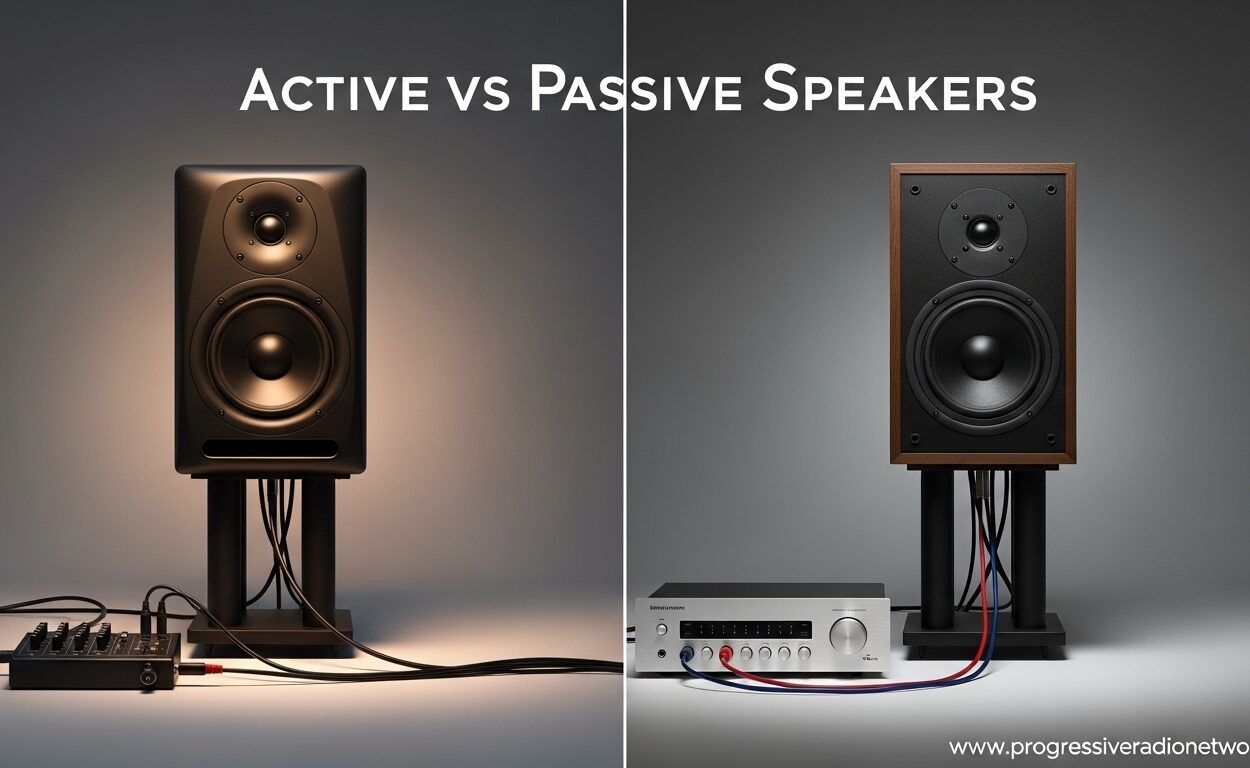
Choosing between active and passive speakers is one of the first decisions you’ll face when building an audio system in 2026. Unlike active speakers, passive speakers do not have an amplifier built into them. This single difference fundamentally changes how you set up your system, what components you need, and how much flexibility you have for future upgrades.
Our team at Progressive Radio Network has tested hundreds of speaker setups over the years. We’ve heard the confusion firsthand from readers trying to understand why some speakers plug straight into the wall while others need a separate box full of electronics. This guide breaks down everything you need to know about active vs passive speakers without the technical jargon that usually clouds this topic.
Whether you’re setting up a vinyl listening corner, building a home theater, or just want better sound for your computer, understanding this distinction will save you money and frustration. Check out our speaker reviews after reading this guide to find specific recommendations for your setup.
What Are Active Speakers?
Active speakers have built-in amplification. Each speaker contains its own power amplifier, crossover network, and sometimes even digital signal processing right inside the cabinet. You simply plug them into a power outlet, connect your audio source, and they work.
The signal path in an active speaker is straightforward. Your phone, computer, or turntable sends a line-level signal (a low-voltage audio signal) directly to the speaker. The built-in amplifier boosts this signal to drive the speaker drivers. Because the amplifier is matched specifically to the drivers by the manufacturer, active speakers often deliver optimized performance out of the box.
Active speakers come in many forms. Studio monitors like the JBL 306P Mk2 are classic examples of active speakers designed for accurate sound reproduction. Wireless smart speakers such as Sonos products are also active speakers, adding streaming capabilities to the built-in amplification concept. Even compact computer speakers typically use active designs for convenience.
How Active Speakers Work
Inside an active speaker, the signal flows from your source to a built-in preamplifier stage. This preamp handles volume control and sometimes tone adjustments. The signal then passes to a crossover network that splits frequencies between the tweeter (highs) and woofer (lows). Each driver gets its own dedicated amplifier channel in true bi-amped active designs.
This integrated approach eliminates the guesswork of matching amplifiers to speakers. The manufacturer has already done the engineering to ensure the amplifier’s power output, impedance characteristics, and frequency response perfectly suit the drivers. You get a system that is essentially plug-and-play.
What Are Passive Speakers?
Passive speakers lack built-in amplification. They contain only the speaker drivers and a passive crossover network inside the cabinet. To make them produce sound, you must connect them to an external power amplifier or receiver using speaker cables.
The signal path for passive speakers involves more components. Your audio source connects to a preamplifier (for volume control), which feeds a power amplifier (which boosts the signal to speaker level). The amplified signal travels through speaker cables to your passive speakers. The passive crossover inside the speaker then splits the frequencies between drivers.
Passive bookshelf speakers like the Klipsch R-41M represent the traditional hi-fi approach. Floorstanding speakers, center channels for home theaters, and most in-wall speakers also use passive designs. This approach has dominated home audio for decades because it offers flexibility and upgrade potential.
Understanding Impedance and Matching
Impedance is a specification you’ll see on passive speakers, typically rated at 4, 6, or 8 ohms. Think of impedance as the electrical resistance the speaker presents to the amplifier. Your amplifier must be capable of driving that load without strain.
Matching a passive speaker to an amplifier requires checking that the amplifier’s power rating and impedance handling suit the speaker’s specifications. Most modern amplifiers handle 8-ohm and 4-ohm speakers fine, but this matching process adds complexity. Get it wrong and you risk underpowering your speakers (weak sound) or potentially damaging the amplifier (if the impedance is too low).
Active vs Passive Speakers: Key Differences at a Glance
| Feature | Active Speakers | Passive Speakers |
|---|---|---|
| Amplifier | Built-in | External required |
| Power Connection | Each speaker plugs into wall | Amplifier plugs in, speakers connect to amp |
| Setup Complexity | Minimal – plug and play | Moderate – component matching needed |
| Upgrade Path | Limited – replace entire unit | Flexible – upgrade amp or speakers separately |
| Cable Requirements | Power cable + audio cable | Speaker cables + interconnects + power for amp |
| Space Requirements | Speakers only | Speakers + amplifier/receiver |
| System Cost | All-in-one pricing | Separate component costs add up |
| Sound Optimization | Manufacturer-tuned | Depends on amp matching and room |
Signal Path Complexity
The signal path differs significantly between the two types. Active speakers receive line-level signals (about 1-2 volts) and amplify internally. Passive speakers receive speaker-level signals (much higher voltage) from an external amplifier. This distinction matters for cable quality and connection types.
With active speakers, you typically use RCA cables, 3.5mm connections, or XLR cables to carry the line-level signal. These connections are less susceptible to interference over short distances. For passive speakers, you need thicker speaker cables capable of carrying higher current from the amplifier. Poor-quality speaker cables can degrade sound quality in passive systems.
Crossover Differences
Active speakers often use active crossovers that process the signal before amplification. This approach is more efficient and allows precise tuning. Passive speakers use passive crossovers after amplification, which can waste some power as heat and offer less tuning flexibility.
Some high-end passive systems support bi-amping or bi-wiring, where you use separate amplifiers for tweeters and woofers. This adds complexity but can improve performance. Active speakers achieve similar benefits by default since they typically have dedicated amplifiers for each driver.
Pros and Cons: Which Speaker Type Wins?
Active Speaker Advantages
Active speakers offer unbeatable convenience. You buy them, plug them in, and enjoy music immediately. There is no research phase about amplifier compatibility or worrying about impedance matching. This simplicity makes active speakers perfect for beginners.
The integrated design often delivers better price-to-performance at entry and mid-level price points. Manufacturers can optimize the amplifier and drivers to work together perfectly. You’re not paying for separate enclosures, power supplies, and markup on multiple components.
Active speakers typically include modern features like Bluetooth, Wi-Fi streaming, and app control. These conveniences are harder to add to traditional passive setups without extra components.
Active Speaker Disadvantages
The biggest drawback is limited upgrade flexibility. When you want better sound, you must replace the entire speaker rather than just upgrading the amplifier. This closed system approach frustrates audiophiles who enjoy mixing and matching components.
Active speakers are harder to repair when they break. If the internal amplifier fails, you often need specialized service. With passive speakers, you simply replace the external amplifier. Active speakers also become obsolete faster as streaming technology advances.
You’re locked into the manufacturer’s sound signature. If you want to change how your system sounds, you cannot simply swap amplifiers to experiment with different sonic characteristics.
Passive Speaker Advantages
Passive speakers excel in flexibility. You can upgrade your amplifier separately from your speakers, spreading costs over time. Want more power? Buy a bigger amp. Want different sound characteristics? Try a different amplifier brand. This modularity extends system lifespan indefinitely.
The used market heavily favors passive speakers. Quality passive speakers from decades ago still perform excellently with modern amplifiers. You can build an outstanding system by buying used speakers and pairing them with a new or used amplifier. Active speakers depreciate faster and become harder to repair as they age.
Pure audio performance at the high end still favors passive designs for many enthusiasts. Separate components allow exotic amplifier designs, tube amplifiers, and custom configurations impossible with active speakers. Floorstanding passive speakers can achieve scale and dynamics that compact active speakers struggle to match.
Passive Speaker Disadvantages
Setup complexity is the primary barrier. You must understand enough about impedance, power ratings, and sensitivity to match components properly. This learning curve intimidates beginners.
The total system cost often exceeds comparable active speaker systems. By the time you buy speakers, an amplifier, cables, and possibly a preamp, you’ve spent significantly more than an all-in-one active solution would cost.
Passive systems require more space. The amplifier or receiver needs shelf space, and you must manage cables between components. Active speakers minimize clutter by putting everything in the speaker cabinet.
Which Is Better: Active or Passive Speakers?
The answer depends entirely on your priorities, budget, and use case. Neither technology is inherently superior. Both can deliver excellent sound quality when implemented well.
For Vinyl and Turntable Setups
Vinyl enthusiasts face a specific consideration. Turntables need a phono preamp to boost their signal to line level. Many active speakers lack phono inputs, requiring you to buy a separate phono preamp. Some active speakers include phono stages, but these are less common.
Passive setups with a traditional receiver or integrated amplifier typically include phono inputs. This integration makes passive speakers slightly more convenient for vinyl newcomers. However, if your active speakers have the right inputs or you don’t mind a small phono preamp box, active speakers work fine for records.
For Home Theater
Passive speakers dominate home theater for good reason. A receiver acts as the hub for multiple sources (Blu-ray, streaming, game consoles), provides surround sound processing, and powers multiple speakers from one box. Running five or more active speakers would require five power outlets and complex source splitting.
That said, soundbars and active surround systems are increasingly popular for smaller spaces. These simplify home theater but sacrifice the upgrade path and customization that passive systems offer.
For Desktop and Computer Audio
Active speakers win decisively for desktop use. Computer speakers, studio monitors, and compact active bookshelf speakers minimize cable clutter and fit limited desk space. You don’t want an amplifier box taking up room beside your monitor.
Studio monitors deserve special mention. These active speakers are designed for accurate, uncolored sound reproduction. They represent some of the best value in audio, offering professional-grade performance at consumer prices precisely because the active design eliminates markup on separate components.
The Verdict by Category
For beginners seeking simplicity: Active speakers win. You get great sound with minimal research and setup hassle.
For value hunters on a budget: Active speakers generally provide better sound per dollar at entry-level prices. However, used passive speakers paired with a budget amplifier can compete.
For enthusiasts wanting maximum performance: Passive speakers offer the highest ceiling. High-end separates can achieve performance levels impossible in integrated active designs.
For upgraders and tweakers: Passive speakers win. The ability to swap components keeps your system evolving.
Frequently Asked Questions
Is it better to have active or passive speakers?
Neither is universally better. Active speakers excel in convenience, value, and simplicity. Passive speakers offer more flexibility, upgrade potential, and appeal to enthusiasts who enjoy component matching. Your choice should depend on your priorities: choose active for plug-and-play simplicity, choose passive if you want to build and upgrade a system over time.
What is the 83% rule for speakers?
The 83% rule suggests setting your amplifier volume to about 83% of maximum and controlling final volume from your source device. This keeps the amplifier in its optimal power range with sufficient headroom for dynamic peaks, reducing distortion while maintaining enough volume for most listening.
Is a 40 watt speaker louder than a 20 watt speaker?
Not necessarily. Wattage indicates power capacity, not volume directly. Speaker sensitivity (measured in dB at 1 watt) matters more for perceived loudness. A high-sensitivity 20-watt speaker can play louder than a low-sensitivity 40-watt speaker. Room size and listening distance also affect how loud a speaker sounds.
What are the disadvantages of active speakers?
Active speakers limit upgrade options since you cannot separately upgrade the amplifier. They are harder to repair if internal electronics fail. Technology becomes obsolete faster as streaming standards evolve. You’re locked into the manufacturer’s sound tuning with no ability to change amplification character. Finally, each speaker needs its own power outlet, potentially limiting placement options.
Conclusion
The difference between active and passive speakers comes down to where the amplification happens. Active speakers include everything you need in one box. Passive speakers give you flexibility at the cost of added complexity.
In 2026, both technologies offer excellent options across all price ranges. Beginners and those valuing convenience should start with active speakers. They deliver impressive sound without the learning curve. Enthusiasts who view audio as a hobby will likely prefer passive speakers for their unlimited upgrade paths and customization potential.
Whatever you choose, understanding this fundamental distinction helps you shop smarter and build a system that truly fits your needs. The best speaker is ultimately the one that gets you listening to more music.




Leave a Comment