
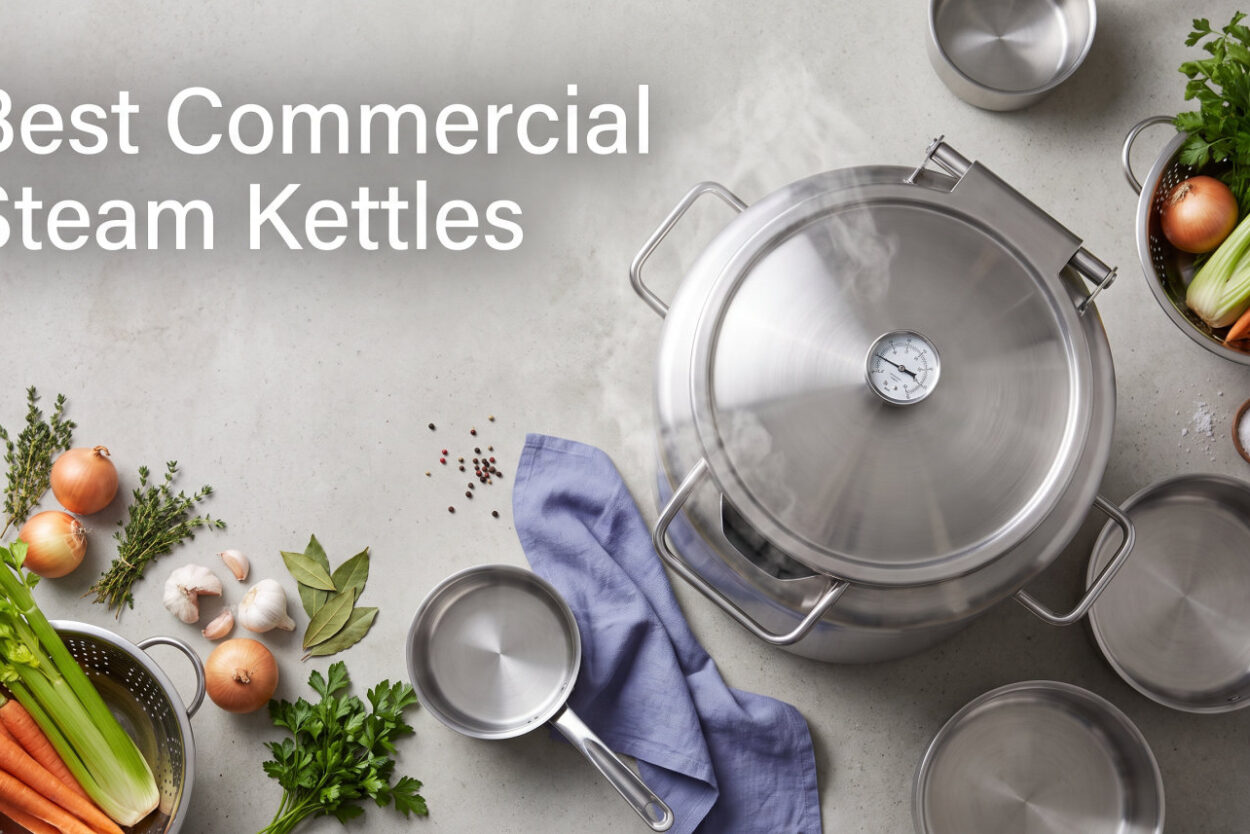
If you operate a busy restaurant, school cafeteria, hospital kitchen, or catering commissary, you already know that the right commercial steam kettle can make or break your batch cooking operation. After researching the market and analyzing what makes a kitchen run smoothly, we put together this 2026 guide to help food service operators choose equipment that genuinely fits their menu and workflow. The leading names dominating the space include Cleveland, Vulcan, Crown Steam, Groen, Market Forge, and Southbend, with prices ranging from roughly $3,685 for compact table-top units up to $43,583 for high-capacity floor models.
Commercial steam kettles are a serious investment, and getting the size, energy source, or tilting style wrong can cost you tens of thousands in wasted capacity or unusable equipment. That is exactly why we wrote this guide rather than a generic ranked list. Every kitchen has different batch volumes, utility hookups, and product transfer needs, and the “best” kettle is the one matched to your specific cooking rhythm. If you have ever dealt with a kettle that overheats, fails to drain, or refuses to cycle properly, you will also want to bookmark our troubleshooting guide for kettles for the maintenance side of ownership.
Throughout this guide, we walk you through how steam kettles actually work, the difference between direct steam and self-contained models, how to size your kettle properly, and the features that matter most for soups, stocks, sauces, and high-volume batch cooking. We also cover maintenance realities and industry-specific recommendations that most equipment dealers gloss over.
What Is a Commercial Steam Kettle?
A commercial steam kettle is a piece of restaurant cooking equipment that uses steam trapped between an inner cooking vessel and an outer jacket to heat food uniformly. The steam jacket completely surrounds the product, eliminating the hot spots and scorching that plague stock pots on open burners. This is why professional kitchens rely on steam jacketed kettles for soups, chowders, stocks, broths, sauces, gravies, beans, grains, and any liquid-based recipe that demands gentle, consistent heat.
The mechanics are straightforward but powerful. Steam enters the space between the inner and outer walls, condenses against the cooler inner surface, and transfers its latent heat to the food inside. Because steam condenses at a steady 212 degrees Fahrenheit at atmospheric pressure, your soup base or béchamel sauce heats evenly across the entire contact area rather than getting blasted from the bottom. Our research turned up chef community discussions on r/KitchenConfidential where operators described steam kettles as “awesome to cook in” precisely because of this consistency.
For batch cooking operations, this uniform heat transfer translates directly into labor savings. A 40-gallon steam kettle can produce 320 servings of soup in a single run, freeing your stovetop burners for saute work, griddle items, and finishing touches. Compared to tilting skillets or braising pans, kettles excel specifically at liquid-heavy recipes where volume matters more than surface area.
Types of Commercial Steam Kettles
All commercial steam kettles fall into two fundamental categories based on where the steam comes from: direct steam kettles and self-contained steam kettles. Understanding the difference is the single most important decision in your buying process, because it dictates your utility requirements, installation costs, and ongoing maintenance burden.
Direct Steam Kettles
Direct steam kettles connect to an external boiler that supplies steam through a building’s steam distribution system. The kettle itself does not generate steam; it receives steam from a central source, typically a facility boiler already running for dishwashers, steam tables, or heating. This makes direct steam kettles popular in institutions like hospitals, universities, and prisons where a central boiler plant already exists.
The main advantage is operational cost. Once the steam infrastructure is in place, each additional direct steam kettle adds very little to your utility bill compared to running individual gas or electric units. Direct steam kettles also tend to be the most energy-efficient choice at scale, which is why you will see 80, 100, and 150-gallon direct steam floor kettles in central commissaries and large institutional kitchens.
The trade-off is complexity. Direct steam kettles require steam supply lines, condensate return lines, pressure regulators, and traps. Forum discussions on r/KitchenConfidential flagged condensate buildup in direct steam lines as a recurring pain point, requiring frequent cleaning and proper trap maintenance. If your facility does not already have a boiler rated for the load, adding one can cost more than the kettle itself.
Self-Contained Steam Kettles
Self-contained steam kettles generate their own steam inside the jacket using either a gas burner or electric heating element. There is no need for an external boiler, steam lines, or condensate return. You connect the kettle to gas, electric, or both, fill the jacket with water once, and the built-in heating system maintains the steam pressure.
This makes self-contained kettles the standard choice for restaurants, cafes, catering kitchens, and most independent food service operations. They install faster, require less specialized plumbing, and can be moved if you change locations. Gas self-contained kettles typically use atmospheric or power burners and deliver high BTU output for fast heat-up. Electric self-contained models run quieter and are easier to vent, making them popular in display kitchens and food trucks.
The trade-off is utility cost per batch. Self-contained kettles convert gas or electricity into steam at the unit, so every kettle adds to your metered usage. For a single 40-gallon unit running daily soup service, this is rarely a dealbreaker. For a commissary running six 80-gallon kettles, direct steam almost always wins on operating cost.
Direct Steam vs Self-Contained at a Glance
Choose direct steam if your facility already has a boiler plant, you plan to run multiple large kettles, and you have staff qualified to maintain steam traps and condensate lines. Choose self-contained if you have one or two kettles, want simpler installation, or operate in a leased space where running new steam lines is not feasible. The self-contained category is where most restaurant buyers land.
Tilting vs Stationary Steam Kettles
Once you have decided on direct steam or self-contained, the next decision is how you want to get food out of the kettle. Tilting kettles pivot on a trunnion to pour product into a receiving container, while stationary kettles stay fixed and empty through a draw-off valve at the bottom. This choice shapes your workflow, staffing, and even your menu flexibility.
Tilting Steam Kettles
Tilting kettles rotate the entire inner vessel forward, letting you pour soup, sauce, or stock into Cambro containers, steam table pans, or a filling line. This is the preferred choice for kitchens that batch-cook multiple products, change menus frequently, or need to transfer thick items like chili, stew, or oatmeal that would clog a draw-off valve.
Reddit users in r/KitchenConfidential who have worked with multiple kettle types consistently favor tilting models for daily operations. One operator with seven jacketed steam kettles noted that tilts are their favorite because of how easily product transfers out, even for chunky soups. Manual tilt mechanisms use a hand wheel, which works fine for smaller kettles up to about 40 gallons.
For larger kettles, powered tilt becomes essential. A 60-gallon batch of soup can weigh over 500 pounds, and manually cranking that load is brutal on kitchen staff. Powered tilt uses an electric motor to rotate the kettle smoothly, which protects workers, prevents spills, and speeds up service. If you are buying anything above 40 gallons, budget for powered tilt.
Stationary Steam Kettles
Stationary kettles stay in a fixed position and empty through a draw-off valve (also called a tangent valve) at the lowest point of the inner vessel. This is the choice for high-volume operations running the same product repeatedly, like a sauce plant, soup commissary, or institutional kitchen producing one stock recipe all day.
Stationary kettles cost less than tilting models of equivalent capacity because the tilt mechanism is the most expensive component. They also have fewer moving parts, which means lower maintenance over the 7 to 10 year service life typical of commercial steam kettles. Draw-off valves work best for relatively thin liquids. If your recipe includes large chunks of vegetables, meat, or pasta, expect clogs.
For institutional buyers running dedicated soup or sauce lines, stationary kettles paired with a pump or transfer system are the most cost-effective path. For everyone else, the workflow flexibility of a tilting kettle justifies the extra cost.
How to Choose the Right Steam Kettle Capacity
Capacity is where buyers most commonly make mistakes. Commercial steam kettles range from 5-gallon tabletop models up to 150-gallon floor units, and the right size depends entirely on your batch cooking strategy, not on how much physical space you have. Buying too small means running constant batches. Buying too large means wasted energy heating empty jacket space.
Understanding the Capacity Range
Tabletop kettles in the 5 to 20 gallon range suit cafes, small restaurants, and prep kitchens producing sauces, gravies, or small soup batches. A 10-gallon kettle yields roughly 80 servings of finished soup, which covers most independent restaurants. Floor kettles from 20 to 40 gallons handle full-service restaurants, banquet halls, and medium institutional kitchens.
Above 40 gallons, you enter institutional territory. A 40-gallon steam kettle produces around 320 servings of soup in one batch. Schools, hospitals, prisons, and central commissaries typically select 60, 80, 100, or 150-gallon kettles. The largest unit we encountered in forum research was a 250-gallon Vulcan steam jacketed floor kettle running in a high-volume ramen shop.
Calculate Based on Batch Strategy, Not Wishful Thinking
The most common mistake is buying a kettle sized for peak demand. If your busiest day needs 100 gallons of soup but your average day needs 30, a 100-gallon kettle runs mostly empty, wasting steam and extending heat-up times. A smarter approach is to size for your typical daily batch volume and run two batches on peak days.
Work backwards from servings. Take your average daily servings, multiply by portion size (8 ounces for soup, 4 ounces for sauce), convert to gallons (128 ounces per gallon), and add 20 percent headroom for foam and expansion. A restaurant serving 150 bowls of soup daily at 8 ounces each needs about 9.4 gallons, which rounds up to a 15-gallon kettle with comfortable margin.
Industry-Specific Sizing Guidance
Full-service restaurants typically land between 20 and 40 gallons, depending on menu breadth and seat count. Quick-service operations running a single daily soup often do well with a 10 or 15-gallon tabletop kettle. Schools and hospitals producing institutional volumes usually need 60 gallons or larger, often running multiple kettles in parallel.
Catering and commissary operations should size for their largest event batch plus growth headroom. Breweries and beverage producers represent a special case. Steam kettles are standard in commercial brewing due to scale requirements, and these operations often spec 80-gallon or larger direct steam kettles for wort boiling.
Energy Source Comparison: Gas, Electric, or Direct Steam
Choosing between gas, electric, and direct steam comes down to your existing utilities, ventilation capacity, and operating cost tolerance. Each option has distinct strengths, and the right answer depends as much on your building as on your menu.
Gas Steam Kettles
Gas self-contained kettles use natural gas or propane burners to heat water in the jacket and generate steam. They offer high BTU output, fast recovery times, and generally lower operating costs in regions where gas is cheaper than electricity. Most gas models are floor-mounted and range from 40,000 to over 200,000 BTU depending on capacity.
The main requirement is ventilation. Gas kettles produce combustion exhaust, so you need a Type I hood, proper gas line sizing, and adequate make-up air. If your kitchen already has a hood over the cooking line, this is straightforward. If you are adding a kettle to a prep area without existing ventilation, the hood installation can exceed the cost of the kettle.
Electric Steam Kettles
Electric self-contained kettles use heating elements immersed in the jacket water, producing steam without combustion. They run quieter, require no exhaust hood, and install with just an electrical connection and water supply. This makes them ideal for display kitchens, food trucks, cafes, and any operation where adding gas venting is impractical.
Electric kettles typically cost more to operate per batch than gas, since electricity rates per BTU tend to exceed gas rates. They also have slower recovery times on very large batches. For smaller operations where the ventilation savings offset the higher utility cost, electric is often the right call.
Direct Steam Kettles
As covered earlier, direct steam kettles receive steam from an external boiler. From an energy source standpoint, direct steam is the most efficient option at scale because one central boiler serves multiple pieces of equipment. The trade-off is the upfront infrastructure cost and the need for qualified maintenance on steam traps, regulators, and condensate return lines.
If your building already has steam service, direct steam is almost always the right energy source for kettles above 40 gallons. If you would need to install a boiler from scratch, run the math carefully. A dedicated boiler for one kettle rarely pays off.
Key Buying Considerations for 2026
Beyond the major decisions of steam source, tilt style, capacity, and energy type, several finer points separate a kettle that runs for a decade from one that frustrates you daily. Pay attention to these details during your purchase.
Jacket Type: 2/3 Jacket vs Full Jacket
The steam jacket can cover either two-thirds of the inner vessel or the full surface area. A 2/3 jacket leaves the upper portion of the inner vessel unheated, which is fine for most soup and stock work. A full jacket wraps steam around the entire cooking surface, providing more even heat on larger batches and faster recovery. Full jackets cost more but are worth it for operations running back-to-back batches.
Construction Materials
Most commercial steam kettles use 304 stainless steel for both the inner vessel and outer jacket. This is the standard for food contact and resists corrosion from acidic foods like tomato sauce. Lower-cost kettles sometimes use 430 stainless or chrome-plated steel for the outer jacket, which is acceptable but less durable in humid kitchens. Insulated outer jackets reduce heat loss and protect staff from burns.
Controls and Safety Features
Look for solid-state thermostats, pressure gauges, low-water cutoffs, pressure relief valves, and timers. Thermostatic controls maintain a set temperature automatically, which prevents scorching delicate sauces. Low-water cutoffs shut down the heat source if jacket water drops too low, protecting the element or burner from damage. Pressure relief valves are non-negotiable safety equipment on any pressurized steam vessel.
For tilting kettles, the tilt lock mechanism matters. Manual tilt kettles should have a positive locking hand wheel that holds position securely under load. Powered tilt systems should include an emergency stop and a manual override in case of motor failure. Our forum research repeatedly flagged heavy kettles being difficult to tilt manually as a real-world complaint.
Industry-Specific Use Cases
No competitor we reviewed breaks down recommendations by industry, so here is the breakdown most buyers actually need. Restaurants should prioritize tilting self-contained kettles in the 20 to 40 gallon range, gas or electric depending on ventilation. Hospitals and healthcare facilities typically need stainless direct steam kettles of 60 gallons or larger, integrated with central boiler plant and paired with stationary draw-off for thin liquids.
Schools and institutional kitchens usually spec multiple stationary direct steam kettles in the 40 to 100 gallon range for daily soup, sauce, and side dish production. Catering operations benefit from portable or tilting self-contained kettles they can deploy at off-site events. Breweries and beverage producers should look at large direct steam kettles with full jackets and precise temperature control for wort and product heating.
Common Steam Kettle Problems and Maintenance
Owning a commercial steam kettle means committing to a maintenance routine. Forum discussions and chef community feedback point to several recurring issues that proper care can prevent. Condensate buildup in direct steam lines is the most common complaint, and it requires regular cleaning of steam traps and condensate return paths.
Self-contained kettles need periodic inspection of jacket water level, heating elements, and pressure relief valves. Scale buildup in the jacket reduces heat transfer efficiency and shortens element life, so use treated water and follow the manufacturer’s descaling schedule. Tilting mechanisms need lubrication on the trunnion bearings and inspection of the tilt lock.
With proper maintenance, commercial steam kettles deliver 7 to 10 years of service life, sometimes longer in institutional settings with dedicated maintenance staff. Skip the routine and you will face premature element failure, leaking jackets, and inconsistent cooking temperatures that wreck your recipes.
FAQs
What is the best kettle on the market?
The best commercial steam kettle depends on your operation. Cleveland, Vulcan, Groen, Crown Steam, Market Forge, and Southbend all produce reliable models. For restaurants, a tilting self-contained gas or electric kettle in the 20 to 40 gallon range is the most popular choice. For institutions, direct steam stationary kettles from Vulcan or Cleveland in 60 to 100 gallon capacities are standard.
What are common steam kettle problems?
Common steam kettle problems include condensate buildup in direct steam lines, scale accumulation in the jacket water, leaking draw-off valves, sluggish tilting mechanisms on manual models, and inconsistent temperature from faulty thermostats or low-water cutoffs. Regular descaling, trap cleaning, trunnion lubrication, and valve inspection prevent most issues and extend service life beyond 7 years.
Which kettle brand is best?
Cleveland and Vulcan are widely regarded as the top commercial steam kettle brands for durability and service network coverage. Groen offers strong value in self-contained models. Crown Steam and Market Forge are respected for institutional direct steam kettles. Southbend rounds out the major brands. The best brand is the one with reliable local service technicians and parts availability in your region.
What size steam kettle do I need for my restaurant?
Most full-service restaurants need a 20 to 40 gallon steam kettle. Calculate your daily servings multiplied by portion size, convert to gallons, and add 20 percent headroom. A restaurant serving 150 bowls of soup daily at 8 ounces each needs roughly a 15-gallon kettle. Catering operations and high-volume restaurants should size up to 40 gallons. Schools, hospitals, and commissaries typically need 60 gallons or larger.
Conclusion
Choosing the best commercial steam kettles for your kitchen comes down to matching equipment to your actual cooking rhythm. If you run an independent restaurant producing multiple soup and sauce recipes daily, a tilting self-contained gas or electric kettle in the 20 to 40 gallon range from Cleveland, Vulcan, or Groen will serve you well. If you operate an institutional kitchen with an existing boiler plant, direct steam stationary kettles in the 60 to 100 gallon range deliver the lowest cost per batch.
For catering and off-site operations, prioritize portability and powered tilt. For breweries and beverage production, large direct steam kettles with full jackets handle the volumes you need. Whatever you choose, invest in proper maintenance and you will get a decade or more of reliable service from quality commercial steam kettles in 2026 and beyond.

Leave a Comment