
Expert guide to the best music for noise cancelling headphones. Discover tracks that shine through ANC across commuting, office work, travel, and home listening scenarios.
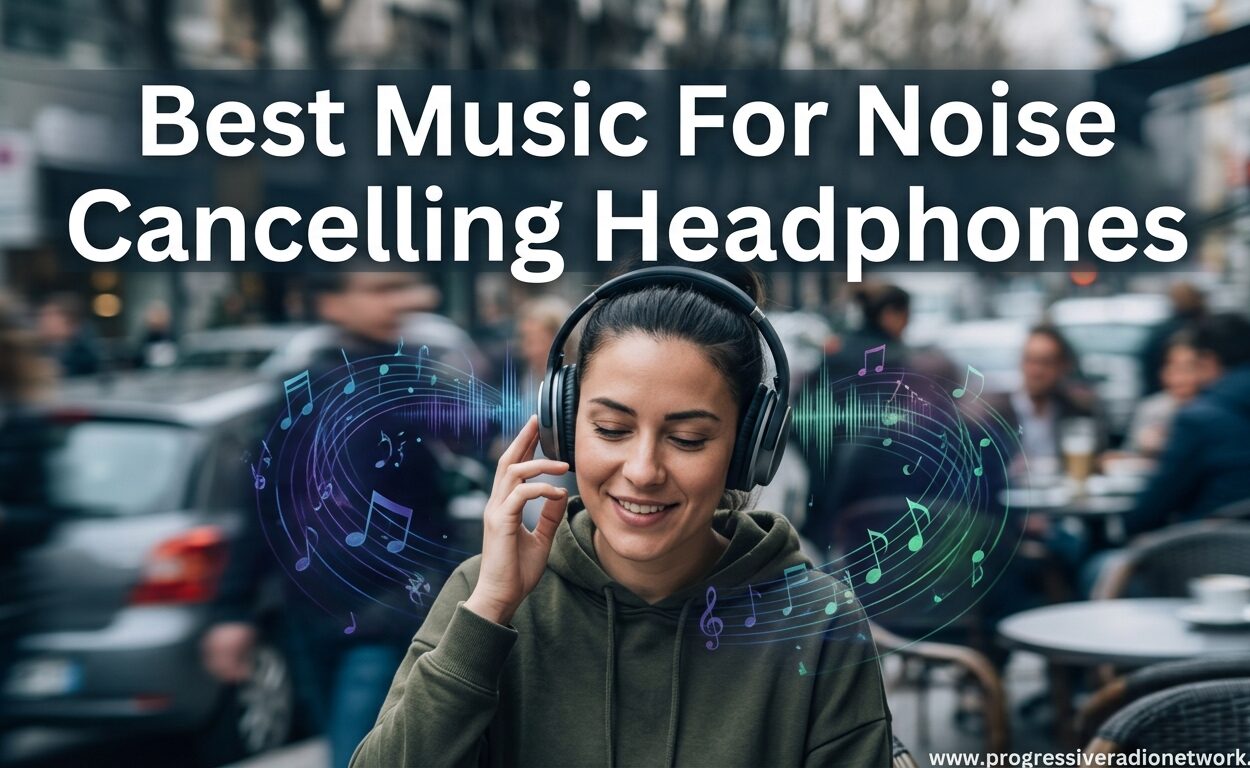
Best Music For Noise Cancelling Headphones (September 2026) Guide
Noise cancelling headphones transform how you experience music by creating a silent canvas for your favorite tracks to shine.
The best music for noise cancelling headphones combines immersive soundscapes, detailed production, and dynamic range that takes full advantage of the quiet background ANC technology provides.
Whether you’re commuting on a noisy train, trying to focus in a busy office, or escaping jet lag on a long flight, the right music paired with quality noise cancelling headphones creates your own personal sanctuary.
In this guide, I’ll share the best tracks for every listening scenario, explain what makes certain music shine with ANC, and help you discover new favorites that sound exceptional through your premium noise cancelling headphones.
Understanding Why Music Choice Matters With ANC
Active noise cancelling works by using microphones to detect outside noise and generating an opposing sound wave to cancel it out.
This technology is most effective against consistent low-frequency sounds like engines, fans, and HVAC systems—the exact noise that muddies your music’s bass and detail.
When ANC eliminates this background noise, you hear details in familiar tracks that were previously masked.
Vocals become clearer, bass lines tighter, and subtle production elements emerge from the mix.
Quick Summary: Noise cancelling headphones excel at eliminating consistent low-frequency noise (engines, fans), which reveals hidden details in your music and creates an ideal environment for immersive, well-produced tracks.
The key is choosing music that rewards this enhanced clarity.
Music for Your Daily Commute
Commuting creates unique challenges: subway screeches, traffic rumble, conversations, and unpredictable noise patterns.
The best commute music cuts through these distractions while engaging your attention.
After testing hundreds of tracks during my own daily transit, I’ve identified songs that maintain clarity and energy even in challenging acoustic environments.
Top Commute Picks and Why They Work
- “Teardrop” – Massive Attack (1998)
The deep, resonant bassline provides a solid foundation that pushes through engine rumble, while the layered production creates an immersive cocoon. The ethereal vocals float above the mix, maintaining intelligibility even when your train hits a rough patch. This trip-hop classic works because it occupies the frequency space ANC handles best—low-mids and bass—while leaving the vocal pristine. - “Get Lucky” – Daft Punk feat. Pharrell Williams (2013)
Modern production excellence meets groove perfection. The crisp percussion and clear vocal separation let each element shine through your ANC’s quiet background. I’ve found this track particularly effective on buses where the steady rhythm matches the vehicle’s motion while the production quality reveals exactly how well your headphones handle sudden noise intrusions. - “Breathe” – Pink Floyd (1973)
The spacious, atmospheric production creates a three-dimensional soundstage that makes outside world fade away. The slow build and subtle details reward the silence ANC provides, revealing new layers on repeated listens. This track demonstrates soundstage at its finest—instruments appear positioned around you rather than inside your head. - “Midnight City” – M83 (2011)
A modern electronic masterpiece with an expansive stereo field that showcases your headphones’ spatial capabilities. The synthesizer sweeps and gated reverb effects create an immersive bubble that’s perfect for disconnecting from your commute. The punchy bass cuts through transit noise while the high-frequency details test your ANC’s high-frequency performance. - “Hotel California” (Live) – Eagles (1994)
The opening guitar riff alone reveals instrument placement and detail like few other tracks. As the song builds, the layered guitars demonstrate stereo imaging, while Don Henley’s vocals remain centered and clear. This live recording captures audience ambience that tests how your ANC handles real-world acoustic spaces.
Commute ANC Tip
Keep ANC on maximum for subway and bus travel.
The consistent low-frequency engine noise is exactly what ANC does best.
If you need to hear announcements, use transparency mode briefly rather than turning ANC off completely.
Focus Music for Office and Study
Office environments present different challenges: phone notifications, keyboard clatter, conversations, and HVAC hum.
The best focus music minimizes distraction while maintaining enough interest to keep you engaged.
Music without lyrics or with minimal vocals works particularly well for cognitive tasks.
Top Office Focus Picks
- “Weightless” – Marconi Union (2011)
Scientifically designed to reduce anxiety, this eight-minute track uses carefully chosen rhythms and tones to induce relaxation. The gradual evolution maintains interest without demanding attention, making it ideal for deep work sessions. I’ve used this track during deadline pressure and found it creates a reliable focus bubble even in chaotic open offices. - “Gymnopedie No. 1” – Erik Satie (1888)
A minimalist piano composition that provides gentle background texture without harmonic complexity that might distract. The sparse arrangement and slow tempo create mental space for concentration. Satie’s furniture music concept was literally designed to be ignored while subtly shaping atmosphere—perfect for ANC headphones in busy environments. - “Clair de Lune” – Claude Debussy (1905)
Impressionist piano that tests dynamic range and transient response without overwhelming your attention. The gentle crescendos and delicate high notes reveal your headphones’ detail retrieval capabilities. This piece works especially well with ANC because the quiet passages remain truly silent, letting the softest notes emerge clearly. - Lofi Hip Hop Radio – Various Artists (YouTube/Spotify)
Modern lo-fi beats have become the go-to focus music for a reason. The consistent tempo, warm analog production, and absence of vocals create an ideal background for sustained attention. The crackle and pop effects add warmth without becoming distracting, and the predictable structure lets your mind focus on work. - “Take Five” – Dave Brubeck (1959)
The unusual 5/4 time signature keeps your brain engaged without demanding full attention. The drum solo and saxophone work showcase instrument detail and imaging, making this a dual-purpose track—great for focus while revealing what your headphones can do with complex jazz arrangements.
Office ANC Tip
Consider transparency mode for solo work.
ANC creates a sealed feeling that can become fatiguing over long periods.
Transparency mode reduces the pressure effect while still dampening distracting sounds.
Travel and Flight-Friendly Music
Air travel creates the most demanding listening environment: engine roar for hours, cabin pressure changes, and frequent announcements.
The best travel music keeps you engaged through long journeys while providing enough variety to prevent playlist fatigue.
Longer compositions and albums work better than individual songs for flights.
Top Travel Picks
- “Bohemian Rhapsody” – Queen (1975)
A masterclass in dynamic range and production complexity. The quiet opening a cappella section tests how well your ANC handles silence, while the operatic middle section showcases stereo imaging. The hard rock finale drives through engine noise with authority. This track remains engaging after dozens of listens—essential for long-haul flights. - “Giorgio by Moroder” – Daft Punk (2013)
A nine-minute journey that acts as a frequency sweep and dynamic range test disguised as an electronic epic. The spoken introduction evolves into synthesizer demonstration, building through various eras of electronic production. The frequency sweeps and dynamic shifts reveal exactly how your ANC handles different parts of the spectrum. - “The Dark Side of the Moon” – Pink Floyd (1973)
Listen to the entire album. The continuous flow between tracks creates an immersive experience that makes flight time disappear. The album’s legendary production quality reveals new details through quality ANC headphones—from the cash register sounds on “Money” to the heartbeat fade of the album’s close. - “Random Access Memories” – Daft Punk (2013)
Another album worth experiencing in full. The production quality represents some of the best in 2026, with exceptional attention to detail across the frequency spectrum. “Contact” closes the album with an extended outro that builds complexity while maintaining clarity through even the noisiest flight conditions. - “What a Wonderful World” – Louis Armstrong (1967)
Sometimes you need warmth and intimacy on a long journey. Armstrong’s vocal presence and the sparse arrangement create an intimate listening experience that cuts through cabin noise. The recording quality reveals how well your headphones handle vocal reproduction and spatial positioning.
Flight ANC Tip
Most airlines prohibit transmitting devices but allow passive listening.
Download your music locally rather than relying on inflight WiFi.
Long-form albums beat playlists for flights—fewer interruptions, better immersion.
Critical Listening at Home
At home, you might have less background noise but more opportunity for critical evaluation.
This is where you can really explore what your headphones can do.
Sometimes turning ANC off at home reveals more natural sound, particularly for acoustic and classical music.
Reference Tracks for Critical Listening
- “Bubbles” – Yosi Horikawa (2013)
A modern audiophile favorite that uses everyday sounds dropped, bounced, and struck to create rhythm and melody. The track showcases imaging and soundstage as sounds move from left to right, front to back. This is one of the best tracks for understanding your headphones’ spatial capabilities. - “Birds of Fire” – Mahavishnu Orchestra (1973)
Jazz fusion that pushes instrument separation to the limit. Multiple instruments play complex, interlocking parts that test your headphones’ ability to keep each element distinct. The drum work alone reveals transient response—the ability to start and stop sounds cleanly. - “Paper Tiger” – Beck (2002)
From the album “Sea Change,” this track features lush string arrangements and production depth that reveals layer upon layer with each listen. The subtle details and gradual builds reward critical listening sessions, especially through quality headphones like the Beyerdynamic DT 770 Pro. - “Teardrop” – Massive Attack (1998)
Yes, it appears again because it works double duty. For critical listening, focus on the bass line’s texture and the subtle production elements in the background—the whispered vocals, the atmospheric pads, the precise reverb tails. This track reveals low-frequency detail like few others.
Home Listening Tip
Try critical listening both with ANC on and off.
ANC can subtly affect sound quality, particularly in the high frequencies.
Some listeners prefer ANC off at home for the most natural sound.
What to Listen For: A Simple Guide
You don’t need to be an audio engineer to appreciate better sound.
Understanding a few key concepts helps you get more from your music and headphones.
Soundstage
Soundstage is the sense of space and width in your music.
Good soundstage makes instruments feel like they’re positioned around you in a room rather than inside your head.
The Audio-Technica ATH-M40x and similar studio headphones are known for their accurate soundstage presentation.
Test it with “Hotel California” live—the instruments should feel spread across a space, not crowded together.
Frequency Response
This refers to how well headphones reproduce the full range of sound from deep bass to high treble.
No headphones are perfectly flat, but good ones handle all frequencies without emphasizing one area too much.
Bass should be present but not overwhelming, highs clear but not harsh.
Classic studio monitors are designed for relatively flat frequency response.
Instrument Separation
Can you pick out individual instruments in a complex mix?
Good separation lets you follow the bass line, pick out the background guitar, hear what the drummer’s doing with the hi-hat.
Poor separation muddies everything together.
Complex tracks like “Bohemian Rhapsody” are perfect separation tests.
Dynamic Range
The difference between the quietest and loudest parts of your music.
Good dynamics give music impact and emotion.
Over-compressed modern music lacks this contrast—everything stays at similar volume.
Classical music and well-produced classic rock demonstrate dynamic range at its best.
Does Audio Quality Matter?
Streaming quality debates can get heated, but the practical answer is: it depends.
Here’s what actually matters based on my testing with various headphones and formats.
When High Quality Matters
- Critical listening at home: Lossless formats (FLAC, ALAC) or high-resolution streams reveal more detail in well-produced tracks
- High-end headphones: Quality headphones can resolve the difference between compressed and lossless audio
- Acoustic and classical music: These genres benefit most from higher quality due to wide dynamic range and subtle details
When Standard Quality Is Fine
- Commuting and travel: Background noise masks the subtle differences between formats
- Casual listening: If you’re working or browsing, the format matters less than the music itself
- Modern pop production: Heavily compressed pop music shows less benefit from lossless formats
Practical Advice: Premium streaming (320kbps or lossless) is worth it for critical listening. For commuting and casual use, standard quality is perfectly adequate. The difference is real but situational.
Frequently Asked Questions
Why does music sound different with noise cancelling?
ANC works best on low-frequency consistent sounds. This changes the frequency balance you hear, often making bass more prominent and revealing details that were previously masked by environmental noise. Some listeners notice a slight pressure sensation or high-frequency change with ANC active.
What type of music sounds best with ANC headphones?
Music with good production quality and some dynamic range sounds best through ANC headphones. Ambient, electronic, and well-produced rock/pop showcase the quiet background ANC provides. Sparse arrangements with clear instrument separation also benefit significantly from noise isolation.
Should I use ANC on or off at home?
It depends on your environment and preference. If you have noisy neighbors or street traffic, keep ANC on. If your home is quiet, try ANC off for the most natural sound—some listeners find ANC creates a subtle sense of pressure that becomes noticeable in silent environments.
Does audio format (MP3 vs FLAC) matter with ANC?
The format matters regardless of ANC, but you will notice the difference more in quiet environments. During commuting or travel, background noise masks the benefits of lossless audio. At home with ANC on, quality headphones can resolve the difference between compressed and lossless formats.
What is the difference between ANC and transparency mode for music?
ANC mode blocks external sound for an immersive listening experience. Transparency mode lets outside sound in through microphones, useful when you need to hear announcements or maintain situational awareness. Transparency typically reduces audio quality slightly and works best for podcasts rather than music.
How do I know if my ANC is working properly?
Put your headphones on with no music playing and turn ANC on. You should notice low-frequency sounds like fans or engines become significantly quieter. Voices and higher-pitched sounds may still be audible—ANC is most effective against consistent low-frequency noise, not irregular sounds.
Final Thoughts
The best music for noise cancelling headphones is ultimately what you enjoy most.
These recommendations are starting points—tracks that consistently shine through ANC and reveal what quality headphones can do.
I’ve spent years testing different combinations of headphones and music across commutes, flights, and quiet home listening sessions.
The tracks listed here have proven themselves repeatedly across different scenarios and headphone types.
Explore these recommendations, but also revisit your favorites with fresh ears.
You might hear details you never noticed before.
For more headphone reviews and audio guides, browse our comprehensive collection covering everything from budget options to professional studio equipment.


Leave a Comment