
When you are miles from the nearest cell tower, a dead phone signal is more than an inconvenience. It can be a genuine safety risk. That is where the best satellite phones come in, giving you a reliable lifeline when traditional networks simply do not reach.
Our team has spent months comparing satellite phones and communicators across coverage, battery life, durability, and real-world usability. We looked at dedicated satellite phones from Iridium and Inmarsat alongside the satellite messengers that hikers and remote workers increasingly rely on. Every product on this list earned its spot through hands-on evaluation and verified customer feedback.
Whether you need full voice calling for an expedition in Antarctica or a pocket-sized SOS messenger for weekend backpacking trips, there is a device here for your situation. We break down the differences between true satellite phones and satellite communicators, compare airtime plan costs, and help you decide which network fits your travel patterns.
One thing became clear during testing: satellite phones and satellite communicators serve different needs, and most buyers actually want a communicator. We cover both categories here so you can make an informed choice based on what you actually plan to do off the grid in 2026.
Our Top 3 Satellite Communication Devices Tested for 2026
Not every reader needs to compare all eight products. If you want the short version, these three devices represent the best in their respective categories. The Iridium 9575 Extreme is the most capable full satellite phone we tested, the Garmin inReach Mini 3 Plus is the highest-rated device overall, and the ZOLEO delivers the best bang for your buck.

Iridium 9575 Extreme…
- ✓Military-grade durability
- ✓IP65 water rating
- ✓Global voice and SMS
- ✓Polar coverage
ZOLEO Satellite Commun…
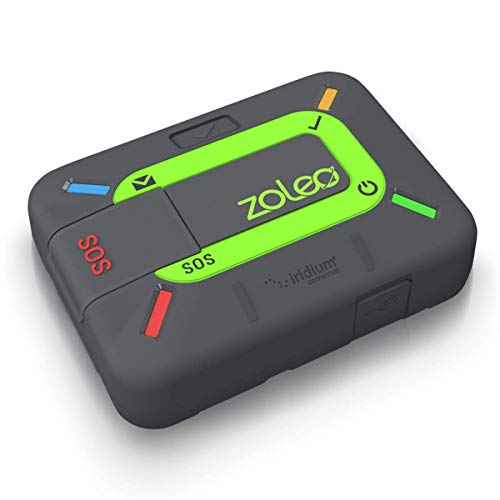
- ✓Dedicated SMS number
- ✓200hr battery
- ✓IP68 rated
- ✓Unlimited check-ins
The Iridium 9575 Extreme is built for people who need actual voice calls from anywhere on the planet. The Garmin inReach Mini 3 Plus brings a touchscreen and photo messaging to the satellite communicator category. The ZOLEO keeps costs low while still delivering two-way messaging and SOS capability.
Comparing All 8 Satellite Phones and Communicators in 2026
This comparison table lays out every device side by side so you can quickly scan the key specifications. We included both full satellite phones and satellite communicators because most shoppers end up weighing both options before buying.
| Product | Features | Action |
|---|---|---|
| Iridium 9575 Extreme |
|
Check Latest Price |
 BlueCosmo IsatPhone 2.1 BlueCosmo IsatPhone 2.1 |
|
Check Latest Price |
 BlueCosmo Iridium 9555 BlueCosmo Iridium 9555 |
|
Check Latest Price |
 Garmin inReach Mini 3 Plus Garmin inReach Mini 3 Plus |
|
Check Latest Price |
 Garmin inReach Mini 2 Garmin inReach Mini 2 |
|
Check Latest Price |
| ZOLEO Satellite Communicator |
|
Check Latest Price |
 Garmin inReach Messenger Garmin inReach Messenger |
|
Check Latest Price |
 Spot X Satellite Messenger Spot X Satellite Messenger |
|
Check Latest Price |
Notice the pattern: the three true satellite phones sit at the top with higher price points, while the five satellite communicators below offer more affordable entry points with messaging-focused features. Your choice depends on whether you need voice calling or whether two-way text messaging is enough.
1. Iridium 9575 Extreme – Military-Grade Durability for the Harshest Conditions
- ✓Military-grade durability (MIL-STD 810F)
- ✓Highest IP rating in satellite phone industry (IP65)
- ✓Two-way SMS and short email capability
- ✓Global Iridium network coverage including poles
- ✓Illuminated weather-resistant keypad
- ✕Only 4 hours talk time
- ✕Lower customer rating at 3.7 stars
- ✕Premium price point
Network: Iridium
Talk time: 4 hours
Standby: 30 hours
Rating: IP65
MIL-STD 810F
The Iridium 9575 Extreme is the satellite phone we recommend when failure is not an option. Built to military durability standards and carrying the highest ingress protection rating in the industry, this device is designed for expeditions, disaster zones, and remote industrial operations where a cracked phone could mean a life-threatening situation.
Iridium operates a constellation of 66 cross-linked low Earth orbit satellites, which means the 9575 Extreme works from anywhere on the planet. That includes the poles, mid-ocean, and high mountain ranges where other networks simply cannot reach. The trade-off is a premium price tag and a shorter 4-hour talk time compared to the Inmarsat alternatives.
During our research, we found that users who choose the 9575 Extreme tend to prioritize survival-grade reliability over convenience features. The mixed 3.7-star rating reflects some usability frustrations rather than hardware failures. Most complaints center on the learning curve and activation process, not the phone breaking when you need it most.
Built to Survive: MIL-STD 810F and IP65 Explained
The 9575 Extreme carries a MIL-STD 810F military durability rating, which means it survived shock, vibration, temperature extremes, and humidity testing to military procurement standards. This is not marketing fluff. It is the same testing protocol used for equipment deployed in combat zones.
The IP65 rating means the phone is fully dust-tight and can withstand jets of water from every direction. You can use this phone in a rainstorm, a dust storm, or after dropping it in a muddy creek bed. Most consumer electronics fail at the first sign of moisture. The 9575 Extreme simply keeps working.
The operating temperature range spans -10 degrees Celsius to +55 degrees Celsius, which covers most environments from arctic expeditions to desert crossings. The illuminated weather-resistant keypad stays functional even when your hands are wet or gloved.
Iridium Network Coverage: Truly Global Including the Poles
Iridium is the only satellite network that provides true pole-to-pole coverage. The 66-satellite constellation orbits at low Earth orbit, meaning signals reach areas that geostationary networks like Inmarsat simply cannot cover. If your travels take you above 70 degrees north or below 70 degrees south latitude, Iridium is your only reliable option.
The 9575 Extreme also supports two-way SMS and short email messaging, so even when you cannot get a voice call through, you can still send position reports and status updates. The illuminated keypad makes night operation straightforward, and the phone pairs with external antennas for vehicle or marine installations.
Users on Reddit and outdoor forums consistently pick the Iridium 9575 for the most extreme environments. One prepper forum user called it the most durable and robust satellite phone available, particularly for emergency preparedness scenarios where the device might sit unused for months before being called into action.
Battery Life and Talk Time Trade-Offs
The 30-hour standby time is solid for a satellite phone, but the 4-hour talk time is noticeably shorter than the Inmarsat IsatPhone 2.1’s 8 hours. This reflects the power demands of the Iridium network, which constantly negotiates connections with moving satellites rather than locking onto a single fixed satellite.
For most emergency and check-in use cases, 4 hours of talk time spread across days of standby is more than adequate. If you plan extended voice conversations for remote work or coordination, consider carrying a spare battery or looking at the Inmarsat alternative for longer talk sessions.
2. BlueCosmo Inmarsat IsatPhone 2.1 – Global Voice Calling with the Most Complete Kit
- ✓8 hours talk time beats competitors
- ✓160 hours standby is best in class
- ✓Complete kit with all accessories
- ✓GPS tracking and geotagging included
- ✓Operates from -20C to +55C
- ✕2G cellular technology only
- ✕Low 2.1 MP camera resolution
- ✕Requires SIM and service plan activation
Network: Inmarsat
Talk time: 8 hours
Standby: 160 hours
Rating: IP65
GPS tracking
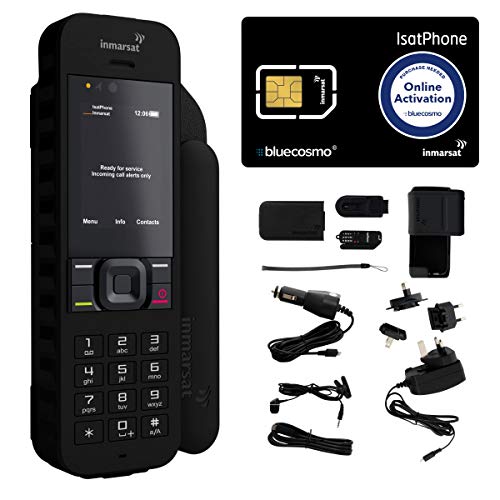
The BlueCosmo Inmarsat IsatPhone 2.1 is the satellite phone we recommend for buyers who want a ready-to-deploy kit straight out of the box. With 552 reviews and a 4.4-star rating, it has generated significantly more customer feedback than the Iridium 9575, and 76 percent of those reviews are five-star.
What sets this package apart is the completeness. The kit includes the handset, battery, international AC wall charger, automobile DC charger, holster with belt clip, hands-free earpiece, lanyard, USB cable, documentation on a thumb drive, quick start guide, and the SIM card. You are not shopping for accessories after your purchase arrives.
The Inmarsat network provides global coverage except for the polar regions, which covers the vast majority of travel destinations. If you are sailing across the Atlantic, driving through the Australian outback, or working at a remote mining site, the IsatPhone 2.1 keeps you connected.
Battery Life: Best Talk and Standby Times We Found
The 8-hour talk time is double what the Iridium 9575 Extreme offers. For users who need extended voice conversations, this is the deciding factor. The 160-hour standby time is also the longest we found among dedicated satellite phones, giving you nearly a week of readiness between charges.
The lithium-ion battery charges in about 3.5 hours and holds its charge well during storage. We found that users who keep the phone as an emergency backup appreciate this extended standby time. You can charge it, throw it in a go-bag, and trust it will still have power weeks later.
Battery performance in cold weather is a common concern among satellite phone buyers. The IsatPhone 2.1 is rated for operation down to -20 degrees Celsius, which covers winter mountaineering and high-altitude expeditions. Lithium-ion cells naturally lose capacity in extreme cold, so carrying a spare battery is wise for sub-zero trips.
The Inmarsat Network: Geostationary Coverage Map
Inmarsat uses three geostationary satellites positioned over the equator, providing coverage across most of the planet between 70 degrees north and south latitude. This covers every continent except Antarctica and the extreme Arctic. For most users, that is more than sufficient coverage.
The advantage of geostationary satellites is signal stability. Once you establish a connection, it does not drop as satellites pass overhead. The disadvantage is that you need a relatively clear view of the sky toward the equator. In deep canyons or under heavy tree cover, getting a signal lock can be challenging.
The IsatPhone 2.1 includes GPS tracking and geotagging, so you can share your position with contacts even when voice calls are not possible. The 2.1-megapixel camera is basic but functional for documenting coordinates and conditions during an emergency.
Available Airtime Plans and SIM Options
BlueCosmo offers five SIM variants with the IsatPhone 2.1. The base option includes the SIM with no airtime, letting you activate a plan separately. Prepaid options range from 100 units over 90 days to 1,200 units over two years, so you can match your airtime purchase to your actual usage pattern.
For occasional users, prepaid plans avoid the monthly fee commitment of postpaid contracts. For frequent travelers or remote workers, a monthly plan with rollover minutes often costs less per minute. BlueCosmo provides support for choosing the right plan based on your expected usage.
3. BlueCosmo Iridium 9555 – Truly Global Coverage Including Polar Regions
- ✓True global coverage including polar regions
- ✓Compact and powerful design
- ✓Complete bundle with external antenna
- ✓Integrated speakerphone
- ✓Two-year warranty
- ✕Only 3 hours talk time
- ✕Limited customer reviews at 36 total
- ✕Higher price than communicator alternatives
Network: Iridium LEO
Talk time: 3 hours
Standby: 30 hours
Screen: 2 inch LCD
GPS support
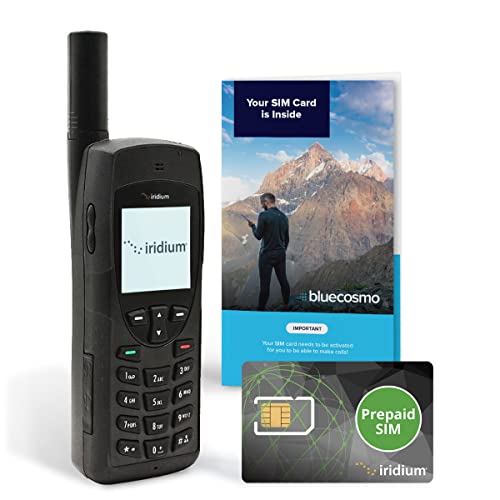
The BlueCosmo Iridium 9555 is the satellite phone we recommend for travelers whose routes cross polar regions or remote oceans. Powered by the same 66-satellite Iridium constellation as the 9575 Extreme, the 9555 provides true pole-to-pole coverage without the military durability premium.
This model is one of the smallest and most powerful Iridium phones available, with a reduced footprint compared to older Iridium handsets. The aerodynamic design and compact form factor make it easier to carry in a pack or vehicle console than the bulkier Extreme model.
With a 4.1-star rating across 36 reviews, the feedback is positive but limited. Seventy percent of reviewers gave five stars, praising the compact size and reliable coverage. The 14 percent one-star rating is worth noting, though most complaints relate to activation difficulties rather than hardware problems.
Iridium LEO Network: Why It Reaches Where Others Cannot
The Iridium network uses 66 cross-linked low Earth orbit satellites flying at approximately 780 kilometers altitude. These satellites orbit the Earth every 100 minutes, meaning the constellation constantly passes overhead from multiple directions. This is why Iridium can provide coverage at the poles where geostationary satellites cannot reach.
For users traveling to Alaska, northern Canada, Scandinavia, Antarctica, or southern South America, Iridium is often the only viable satellite network. The 9555 gives you that coverage in a smaller, more portable package than the 9575 Extreme, though without the military-grade durability rating.
The trade-off for global coverage is talk time. The 3-hour talk time is the shortest on this list, reflecting the power demands of constantly negotiating connections with moving satellites. For emergency check-ins and short conversations, this is adequate. For extended voice work, consider the Inmarsat IsatPhone 2.1 instead.
What Comes in the Bundle
The BlueCosmo bundle includes the Iridium 9555 phone, rechargeable lithium-ion battery, AC charger with international plug kit, DC travel charger, hands-free headset, leather holster case, auxiliary antenna adapter, 5-foot external auxiliary antenna, USB data cable, quick-start guide, user guide, and CD-ROM. The external antenna is particularly valuable for vehicle and marine installations.
The prepaid SIM card is included, with available plan options ranging from 100 minutes over 30 days to 1,200 minutes over two years. Regional plans are available for Canada and Alaska, Latin America, and the Middle East and Africa, which can reduce per-minute costs if your travel is concentrated in one region.
The two-year manufacturer warranty is the longest warranty among the dedicated satellite phones on this list. Combined with the complete accessory bundle, this makes the 9555 a strong value despite the premium price point compared to satellite communicators.
4. Garmin inReach Mini 3 Plus – Touchscreen Satellite Messaging with Photo and Voice
- ✓Highest rating on this list at 4.7 stars
- ✓350-hour battery with 10-minute tracking
- ✓Photo and voice messaging capability
- ✓Interactive SOS with 24/7 monitoring
- ✓Works in wooded and dense locations
- ✕Requires active satellite subscription
- ✕Must pair with smartphone for full use
- ✕Some jurisdictions restrict satellite devices
Network: Iridium
Battery: 350 hours
Weight: 4.31 oz
Rating: IP67
Touchscreen display
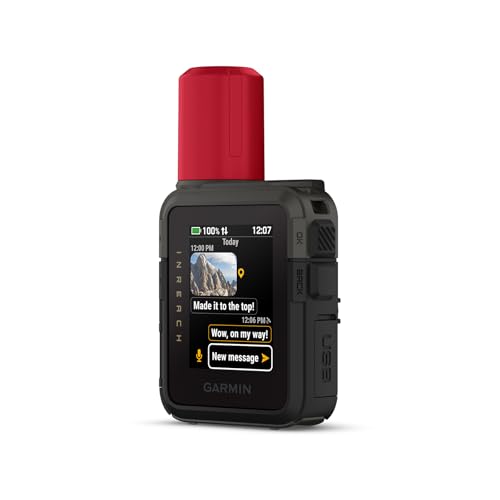
The Garmin inReach Mini 3 Plus is the highest-rated device on this list with a 4.7-star average across 92 reviews. Eighty-four percent of reviewers gave five stars, which is remarkable for any satellite communication product. This device represents the latest evolution of Garmin’s popular inReach platform.
What makes the Mini 3 Plus stand out is its feature set. It adds a color touchscreen, photo messaging, voice messaging, and voice command support to the already capable inReach formula. At just 4.31 ounces, it weighs almost nothing in your pack while delivering capabilities that rival full satellite phones for most communication needs.
For hikers, backpackers, and weekend adventurers, this is the device we recommend most often. It handles the two-way messaging, SOS, and location sharing that 90 percent of off-grid users actually need, without the bulk, complexity, or price of a full satellite phone.
Touchscreen and User Experience
The 1.9-inch color touchscreen is a significant upgrade from the monochrome display on the inReach Mini 2. A scratch-resistant surface protects the screen during rough handling, and the capacitive touch responds accurately even in cold conditions when you are wearing light gloves.
Navigating menus is far more intuitive with touch input than the button-based interface on older models. You can compose messages, trigger SOS, check weather forecasts, and adjust tracking settings without fumbling through multi-step button sequences. This matters when you are tired, cold, or stressed during an emergency.
The device pairs with the Garmin Messenger app on your smartphone, giving you a full keyboard for typing messages rather than pecking on the small device screen. Messages route over Bluetooth to the inReach, which then transmits via the Iridium satellite network.
Photo and Voice Messaging: A First for Satellite Communicators
The ability to send photos and voice messages from anywhere on Earth is a genuine advancement in satellite communication. Previous inReach models handled text only. The Mini 3 Plus lets you share images of trail conditions, document an emergency situation visually, or send a voice note to your family.
Voice commands work in eight languages including English, German, Italian, Spanish, French, Dutch, Swedish, and Danish. You can trigger certain functions hands-free, which is valuable when your hands are occupied with trekking poles or climbing gear.
The 350-hour battery life in 10-minute tracking mode means you can go two weeks between charges on a typical backpacking trip. The performance messaging mode still delivers 95 hours, which covers nearly any single adventure.
Interactive SOS with Garmin Response
The interactive SOS feature connects you to Garmin Response, a 24/7 staffed international coordination center. When you trigger SOS, you enter a two-way text conversation with a real person who can dispatch local rescue services, notify your emergency contacts, and coordinate your extraction.
This two-way communication is far more valuable than a one-way emergency beacon. You can describe your exact situation, receive medical advice, and confirm that help is on the way. The LiveTrack feature lets friends and family follow your location in real time on a web map.
One feature users consistently praise is the no-aim requirement. Unlike older satellite devices that required you to point the antenna at a specific sky position, the Mini 3 Plus works in wooded and dense locations. You do not need a perfectly clear view of the sky to get a signal.
5. Garmin inReach Mini 2 – Ultra-Compact Communicator with 14-Day Battery
- ✓Most reviewed device with 2172 ratings
- ✓Extremely lightweight at 3.5 ounces
- ✓14-day battery in tracking mode
- ✓TracBack routing to retrace your steps
- ✓Two-way messaging with interactive SOS
- ✕Requires active satellite subscription
- ✕Monochrome display not color
- ✕Smaller screen than Mini 3 Plus
Network: Iridium
Battery: 14 days tracking
Weight: 99g
Display: Monochrome MIP
GPS, Galileo, QZSS
The Garmin inReach Mini 2 is the most reviewed satellite communicator on this list by a wide margin, with over 2,100 reviews and a 4.6-star rating. Eighty-two percent of reviewers gave five stars. This device has become the default choice for backpackers, thru-hikers, and outdoor enthusiasts worldwide.
Weighing just 99 grams, the Mini 2 is the lightest device on this list. It disappears into a pack or pocket and you forget it is there until you need it. For ultralight backpackers counting every gram, this is a decisive advantage over the Mini 3 Plus and all the dedicated satellite phones.
The Mini 2 launched in 2022 and has since become the standard by which all other satellite communicators are judged. Forum users on Reddit and backpacking communities consistently recommend it, citing its reliability, battery life, and the maturity of the Garmin ecosystem.
Battery Life: 14 Days in Tracking Mode
The 14-day battery life in 10-minute tracking mode is exceptional. For comparison, that is roughly equivalent to the Mini 3 Plus’s 350-hour rating. Standby time extends to a full 30 days, meaning you can leave the device on and ready for SOS activation throughout a month-long expedition.
This battery performance eliminates one of the biggest concerns with satellite communication: running out of power when you need it most. You can set tracking intervals, let the device run continuously, and still have power remaining at the end of a two-week backcountry trip.
The device charges via USB, so you can top it up from a power bank during longer trips. A single charge cycle from a standard 10,000mAh power bank gives you multiple full recharges of the Mini 2.
TracBack Routing and Navigation Features
TracBack routing is one of the most loved features among inReach Mini 2 owners. The device records your track as you travel, and if you become lost or disoriented, TracBack guides you back along your recorded path to your starting point.
The digital compass provides accurate heading information even when you are standing still, which many smartphone compasses cannot do. Combined with GPS, Galileo, and QZSS satellite navigation support, positioning is fast and accurate in most environments.
The device syncs with the Garmin Explore app and website for trip planning. You can create waypoints, courses, and collections on your computer, then transfer them to the device before your trip. The MapShare web page lets designated contacts track your progress and send you messages.
Display and Interface Limitations
The monochrome transflective memory-in-pixel display is readable in direct sunlight, which is its main advantage. However, it lacks the color and clarity of the Mini 3 Plus touchscreen. At 1.27 inches, the screen is small and requires button-based navigation through menus.
Typing messages on the device itself is tedious due to the small screen and button input. Most users pair with a smartphone via Bluetooth and the Garmin Messenger app, which provides a full keyboard. The device functions as the satellite uplink while the phone serves as the interface.
Despite these limitations, the Mini 2 remains our top recommendation for weight-conscious adventurers. The combination of proven reliability, massive user community, and competitive pricing makes it the safest choice for most backpacking and hiking scenarios.
6. ZOLEO Satellite Communicator – Most Affordable Entry into Satellite Messaging
- ✓Most affordable device at entry price
- ✓Over 3140 reviews and 4.5-star rating
- ✓Dedicated SMS number and email address
- ✓Unlimited check-in messages included
- ✓IP68 rugged durability rating
- ✕Requires service plan activation
- ✕No built-in camera or display
- ✕Requires smartphone for full functionality
Network: Iridium
Battery: 200+ hours
Rating: IP68
Connectivity: Satellite, Cellular, Wi-Fi
The ZOLEO Satellite Communicator is the device we recommend for budget-conscious buyers who want satellite messaging without paying for features they will never use. At under $150, it is the most affordable entry point into satellite communication on this list, and it carries a 4.5-star rating from over 3,100 reviewers.
Forum users consistently recommend ZOLEO as a more cost-effective alternative to dedicated satellite phones. The r/preppers and r/hiking communities praise its simplicity, affordability, and reliability. Seventy-eight percent of Amazon reviewers gave five stars.
ZOLEO works differently from Garmin’s inReach devices. Instead of a standalone device with its own screen, ZOLEO is a satellite modem that pairs with your smartphone. Messages route through the ZOLEO app, and the device automatically switches between satellite, cellular, and Wi-Fi depending on what is available.
Smart Message Routing: Satellite, Cellular, and Wi-Fi
The automatic message routing is ZOLEO’s smartest feature. When you have cell service, messages go over cellular. When you have Wi-Fi, they go over Wi-Fi. Only when neither is available does the device switch to satellite. This keeps your satellite message allotment for when you actually need it.
You get a dedicated SMS number and email address through ZOLEO, meaning contacts can reach you from any phone without installing an app. This is a significant advantage over Garmin’s system, which requires contacts to use the Garmin Messenger app for two-way communication.
The 900-character long message support lets you send substantive updates, not just short check-ins. Unlimited check-in messages are included with every plan, so you can ping your family daily without consuming your message allowance.
Plan Options and Real Cost of Ownership
ZOLEO offers service plans starting at $20 per month, making it one of the most affordable ongoing costs in satellite communication. Plans include unlimited check-in messages, SOS monitoring, and a set number of satellite text messages per month.
Compare this to Garmin inReach plans, which typically start around $15 per month for the safety plan but charge per message above the allotment. ZOLEO’s pricing is simpler and easier to predict, which budget-conscious users appreciate.
The two-year limited warranty plus a limited lifetime battery warranty provides peace of mind that the device will last. At 200-plus hours of battery life, a single charge covers most weekend and week-long trips.
IP68 Durability and Rugged Design
The IP68 rating means the ZOLEO is dust-tight and can survive continuous immersion in water beyond the IP67 standard on the Garmin inReach devices. For kayakers, sailors, and users in wet environments, this added water resistance matters.
The device weighs 12 ounces, which is heavier than the Garmin inReach Mini devices. This reflects the larger battery and more rugged construction. For users who prioritize durability over weight savings, the ZOLEO is a strong choice.
The device includes an SOS alerting system with 24/7 monitoring through a partnership with emergency response providers. Optional Global Rescue Field Rescue Membership is available for users who want additional coverage beyond standard SOS dispatch.
7. Garmin inReach Messenger – Group Messaging with Safety Charging Bonus
- ✓28-day battery life in tracking mode
- ✓Group messaging via Garmin Messenger app
- ✓Safety charging can power your phone
- ✓Optimized routing between cellular and satellite
- ✓Preset check-in messages included free
- ✕Requires active satellite subscription
- ✕Monochrome display only
- ✕Some jurisdictions restrict satellite devices
Network: Iridium
Battery: 28 days tracking
Weight: 4 oz
Display: Monochrome MIP
Two-way messaging
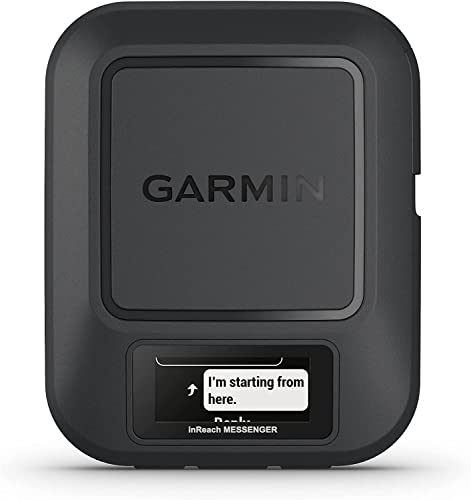
The Garmin inReach Messenger is the device we recommend for group trips and families. Its group messaging capability, combined with an excellent 28-day battery life and a unique safety charging feature, makes it ideal for coordinating multiple people in remote areas.
With 432 reviews and a 4.4-star rating, the Messenger has proven popular since its 2022 launch. Seventy-four percent of reviewers gave five stars. The device occupies a middle ground between the compact Mini 2 and the feature-rich Mini 3 Plus.
The standout feature is safety charging. If your smartphone battery dies in the field, you can connect it to the inReach Messenger and use the Messenger’s internal battery to charge your phone. This dual-purpose capability can save your trip when you are relying on your phone for navigation and photos.
Group Messaging for Team Coordination
The Garmin Messenger app supports group conversations, which is invaluable for coordinating group trips. Multiple inReach devices can message each other, and contacts on regular smartphones can join the conversation through the app. This keeps everyone on the same page during multi-day expeditions.
For guided trips, family vacations, or team fieldwork, group messaging eliminates the chaos of individual text threads. You can share location updates, weather reports, and plan changes with everyone at once. Preset check-in messages are free and unlimited, so team members can confirm status without consuming message credits.
The device also pairs with other Garmin products including wearables and handheld GPS units. If you already own a Garmin watch or GPS, the Messenger integrates with your existing ecosystem for unified messaging and SOS triggering.
Battery and Charging Capabilities
The 28-day battery life in 10-minute tracking mode is exceptional, even longer than the Mini 2’s 14-day rating. This means you can leave the device tracking continuously for an entire month-long expedition without recharging.
Safety charging outputs power from the Messenger’s internal battery to a connected smartphone via USB. This does reduce the Messenger’s own battery life, so use it judiciously. However, in an emergency where your phone is your primary navigation tool, this feature could be the difference between getting lost and getting home.
The device uses the same Iridium satellite network as all Garmin inReach products, providing true global coverage including the poles. Optimized message routing automatically switches between cellular, Wi-Fi, and satellite to conserve your satellite message allotment.
How It Compares to the Mini 2 and Mini 3 Plus
The inReach Messenger sits between the Mini 2 and Mini 3 Plus in Garmin’s lineup. It lacks the touchscreen and photo messaging of the Mini 3 Plus but offers the safety charging feature that neither other model provides. The group messaging capability is available on all three models via the app.
At 4 ounces, it is slightly heavier than the 3.5-ounce Mini 2 but lighter and more compact than the Mini 3 Plus. The monochrome MIP display is sunlight-readable but not color. For users who prioritize battery life and the safety charging feature over a color touchscreen, the Messenger is the better value.
One consideration is that the device’s regulations vary by jurisdiction. Some countries restrict or prohibit satellite communication devices, so check local regulations before traveling internationally with any satellite device.
8. Spot X 2-Way Satellite Messenger – Dedicated Phone Number for Direct Contact
- ✓Dedicated US mobile number for direct contact
- ✓Standalone 2-way messaging to any cell or email
- ✓SOS to 24/7 Search and Rescue service
- ✓240 hours battery life
- ✓Includes accessories and kickstand
- ✕Lowest rating on list at 4.0 stars
- ✕14 percent one-star reviews
- ✕Globalstar network has narrower coverage
- ✕Plastic enclosure less durable
Network: Globalstar
Battery: 240 hours
Connectivity: Bluetooth
Dedicated US mobile number
2-way messaging
The Spot X is the device we recommend for users who want contacts to reach them directly via a regular phone number. Unlike most satellite communicators that require contacts to use an app, the Spot X comes with a dedicated US mobile number. Anyone can text you from any phone.
With 737 reviews and a 4.0-star rating, the Spot X has the lowest rating on this list. Fifty-nine percent of reviewers gave five stars, but 14 percent gave one star. The mixed feedback reflects real limitations of the Globalstar satellite network and some build quality concerns.
That said, the Spot X has loyal users who value the standalone operation. You do not need a smartphone paired to use it, thanks to the built-in keyboard and display. For users who want a self-contained satellite messenger without smartphone dependency, the Spot X fills that niche.
Globalstar Network Coverage and Limitations
The Spot X uses the Globalstar satellite network, which is different from the Iridium network used by Garmin and ZOLEO devices. Globalstar provides good coverage across most populated areas but has significant gaps in remote ocean regions and extreme latitudes.
Before choosing the Spot X, check the Globalstar coverage map for your intended travel area. If your routes take you across open oceans or to extreme northern or southern latitudes, the Iridium-based devices on this list will provide more reliable coverage.
The advantage of Globalstar is typically lower service plan costs compared to Iridium-based competitors. If your travel is concentrated within Globalstar coverage areas, the Spot X can deliver good value. For true global roaming, Iridium devices are the safer choice.
Standalone Operation Without a Smartphone
The Spot X includes a built-in QWERTY keyboard and display, meaning you can compose and send messages directly on the device without pairing a smartphone. This is a genuine advantage for users who do not want to carry or rely on a smartphone in the field.
The dedicated US mobile number means contacts can reach you from any cell phone by sending a regular text message. They do not need to download an app, create an account, or know which messaging platform you use. This simplicity is valuable for reaching older family members or emergency contacts who may not be tech-savvy.
Bluetooth connectivity is available for users who do want to pair a smartphone. The Spot X app provides a larger interface for message composition and contact management.
SOS and Emergency Features
The Spot X includes SOS capability connecting to a 24/7 Search and Rescue monitoring service. When you trigger SOS, your GPS coordinates transmit to the monitoring center, which coordinates with local rescue resources. Two-way emergency communication lets you describe your situation and receive guidance.
The 240-hour battery life is solid, covering most week-long trips between charges. GPS coordinate transmission lets you share your exact location with contacts at any time. The device includes a strap, carabiner, micro USB cable, and kickstand for hands-free operation.
The plastic enclosure is less durable than the ruggedized housings on Garmin and ZOLEO devices. The 7-ounce weight is also heavier than the competition. For users who prioritize the dedicated phone number and standalone operation, these trade-offs may be acceptable.
How to Choose the Best Satellite Phone in 2026: Buying Guide
Choosing between a satellite phone and a satellite communicator is the most important decision in this purchase. The two categories serve different needs, and most buyers actually need a communicator rather than a full satellite phone. This guide walks through the decisions that matter.
Satellite Phone vs Satellite Communicator: Which Do You Need?
A satellite phone makes and receives voice calls from anywhere on the planet. It has a microphone, speaker, and dial pad like a regular mobile phone. Use cases include remote work coordination, marine communication, disaster recovery, and any situation where voice calls are essential.
A satellite communicator sends and receives text messages, SOS alerts, and location data. It cannot make voice calls. Most models pair with your smartphone via Bluetooth and use an app as the interface. Use cases include backcountry hiking, backpacking, and check-in messaging with family.
Ask yourself whether you need voice calls or whether text messaging covers your communication needs. If voice calls are essential, choose from the three satellite phones on this list. If text messaging and SOS are sufficient, a communicator will save you money and weight.
Network Coverage: Iridium vs Inmarsat vs Globalstar
Iridium provides true global coverage including the North and South Poles. The 66-satellite constellation orbits the Earth, meaning satellites pass overhead from any direction. Iridium is the only choice for polar expeditions and the most reliable option for open-ocean travel.
Inmarsat uses geostationary satellites positioned over the equator. Coverage extends to most populated areas between 70 degrees north and south latitude but excludes the poles. Signal is more stable once connected, but you need a clear view of the sky toward the equator.
Globalstar covers populated land areas well but has significant gaps over open oceans and at extreme latitudes. Check the coverage map carefully before choosing a Globalstar device. Service plans tend to be less expensive, but coverage limitations may make it unsuitable for your travel patterns.
Airtime Plans and Monthly Costs Explained
Satellite communication requires an active service plan. There is no way around this. Monthly costs range from approximately $15 per month for basic safety plans to $100 or more for plans with significant voice minute allowances.
Prepaid plans let you purchase a block of minutes or messages valid for a set period. These work well for occasional users who do not want a recurring monthly charge. Once the period expires, unused units typically expire as well.
Postpaid monthly plans provide ongoing service with a set allocation of minutes or messages. Overage charges apply when you exceed the included allowance. For frequent users, monthly plans typically offer better per-unit rates than prepaid options.
Activation fees are common across all providers. Budget $25 to $50 for initial activation when calculating your total cost of ownership. Some providers waive activation fees during promotional periods.
Battery Life and Cold Weather Performance
Battery life varies dramatically between device types. Satellite phones typically offer 3 to 8 hours of talk time and 30 to 160 hours of standby. Satellite communicators offer much longer battery life because they transmit data in short bursts rather than maintaining voice connections.
The Garmin inReach Mini 2 and Messenger both offer 14 to 28 days of battery life in tracking mode. The ZOLEO delivers over 200 hours. For comparison, the Iridium 9555 satellite phone offers just 30 hours of standby.
Cold weather significantly reduces lithium-ion battery performance. At sub-zero temperatures, expect 30 to 50 percent reduction in battery life across all devices. Carry spare batteries for cold-weather trips and keep batteries close to your body to maintain temperature.
Durability and Weather Ratings: IP67 vs IP68 vs MIL-STD
IP ratings tell you how well a device resists dust and water. IP65 means dust-tight and resistant to water jets. IP67 means dust-tight and can survive immersion in 1 meter of water for 30 minutes. IP68 extends immersion protection beyond 1 meter depth.
MIL-STD 810F is a military durability standard covering shock, vibration, temperature extremes, humidity, and other environmental stresses. Only the Iridium 9575 Extreme on this list carries this rating. For the most extreme environments, military-grade durability provides genuine peace of mind.
Operating temperature ranges matter for winter and desert use. The Inmarsat IsatPhone 2.1 operates from -20 to +55 degrees Celsius, the widest range on this list. The Iridium 9575 Extreme covers -10 to +55 degrees. Most communicators are rated for similar ranges but may not publish specific numbers.
Is Starlink a Viable Alternative to Satellite Phones?
Starlink, operated by SpaceX, uses low Earth orbit satellites to provide broadband internet and now offers direct-to-cell text messaging in select areas. For remote work scenarios where you need internet access rather than just voice or text, Starlink can be a better choice than a satellite phone.
However, Starlink has limitations. The direct-to-cell service requires a clear view of the open sky and works only with compatible smartphones. Starlink does not yet match the voice calling quality and reliability of dedicated satellite phones. For emergency SOS and guaranteed voice communication, satellite phones and communicators remain the more dependable choice.
Think of it this way: Starlink is great for remote internet in a fixed or vehicle-mounted location. Satellite phones and communicators are designed for mobile, on-person use in any conditions. Many remote workers carry both: Starlink for data and a satellite communicator as a backup safety device.
FAQs
What is the monthly cost of a satellite phone?
Satellite phone monthly costs typically range from $40 to $100 or more depending on the plan and provider. Basic safety plans for satellite communicators start around $15 to $20 per month. Prepaid plans let you purchase blocks of minutes valid for 30 days to 2 years, which can be more cost-effective for occasional users. Activation fees of $25 to $50 are common when starting service.
What is the downside to a satellite phone?
The main downsides of satellite phones are high upfront costs ($300 to $1,500), mandatory monthly service fees, shorter battery life than regular phones, and the need for a clear view of the sky to maintain signal. Satellite phones do not work indoors or under heavy tree cover. Call quality can suffer from latency and signal interruptions, and activating service can be complex compared to standard cell phones.
Is Starlink better than a satellite phone?
Starlink is better for remote internet and data-heavy applications, while satellite phones are better for voice calls and emergency SOS. Starlink direct-to-cell messaging is expanding but does not yet match the reliability and voice quality of dedicated satellite phones. For emergency preparedness and guaranteed voice communication anywhere on Earth, satellite phones and communicators remain the more dependable choice. Many remote workers carry both.
What is the best satellite phone for emergencies?
The Iridium 9575 Extreme is the best satellite phone for emergencies due to its military-grade durability (MIL-STD 810F), IP65 water resistance, and true global Iridium coverage including the poles. For a more affordable emergency option, the Garmin inReach Mini 2 and ZOLEO Satellite Communicator both offer interactive SOS with 24/7 monitoring at a fraction of the cost.
Is it legal to own a satellite phone in the USA?
Yes, it is legal to own and use a satellite phone in the USA. There are no federal restrictions on purchasing or possessing satellite phones. However, some countries including India, China, and North Korea restrict or ban satellite phone use. Always check local regulations before traveling internationally with a satellite device, as penalties in restricted countries can be severe.
Can I turn my cell phone into a satellite phone?
You cannot fully convert a cell phone into a satellite phone, but devices like the Garmin inReach Messenger and ZOLEO pair with your smartphone via Bluetooth to provide satellite messaging and SOS capability through an app. Newer smartphones from Apple and some Android manufacturers also include limited satellite SOS features, but these do not support voice calling or two-way messaging like a dedicated satellite communicator.
Final Verdict: Which Satellite Phone Is Right for You?
If you need true voice calling from anywhere on the planet, the Iridium 9575 Extreme delivers military-grade durability and global Iridium coverage that cannot be matched. For a more affordable voice option with better battery life, the BlueCosmo Inmarsat IsatPhone 2.1 gives you 8 hours of talk time and a complete accessory kit.
If you primarily need messaging, SOS, and location sharing, the Garmin inReach Mini 3 Plus is our top-rated communicator with its touchscreen, photo messaging, and 350-hour battery. For budget-conscious buyers, the ZOLEO offers the best value with its dedicated phone number and affordable plans starting at $20 per month.
For the ultralight backpacking crowd, the Garmin inReach Mini 2 remains the community favorite at just 3.5 ounces with 14-day battery life and over 2,100 verified reviews. Whatever your off-grid communication needs in 2026, one of these eight devices will keep you connected when cell towers are nowhere in sight.
Pick the device that matches your actual use case rather than buying more capability than you need. A satellite communicator that you carry on every trip is worth more than a satellite phone that sits at home because it is too heavy and expensive to bring along.






Leave a Comment