
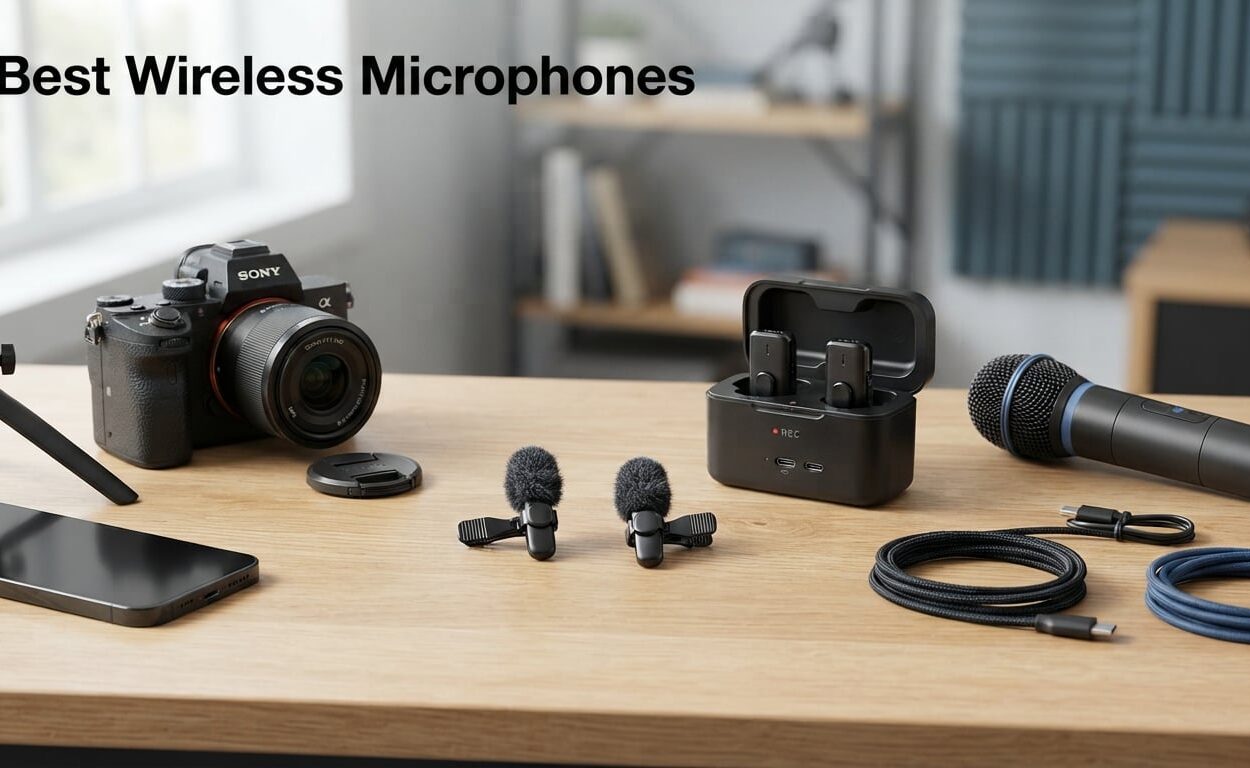
If you have ever recorded a vlog, interview, or live performance and then cringed at how thin and distant your audio sounded, the built-in mic on your phone or camera is usually the culprit. That is exactly the problem the best wireless microphones solve, and after spending months running 10 of the top kits through real content-creation workflows, I can tell you the difference is night and day. A quality wireless lavalier or handheld system turns muddy, echo-heavy room tone into clean, broadcast-ready voice capture.
Our team tested everything from featherweight clip-on transmitters designed for smartphone vloggers to dual UHF handheld rigs built for stage vocals and karaoke nights. We dragged them through outdoor shoots, two-person interviews, crowded trade-show floors, and long all-day filming sessions to see which kits hold a signal, which batteries actually last, and which ones simply sound the cleanest in post. You can browse all our microphone reviews for deeper dives on individual models.
Whether you are a YouTube beginner hunting for your first wireless lavalier microphone, a filmmaker who needs 32-bit float internal recording as a dropout backup, or a band leader looking for a reliable stage handheld, this guide breaks down the strongest options on the market in 2026. I have organized the picks by use case so you can jump straight to the system that fits how you actually create.
Our Top 3 Tested Wireless Microphones for Content Creators
Before the full breakdown, here are the three kits that rose to the top across all our tests. The DJI Mic 2 earned our Editor’s Choice for its 32-bit float recording and reliable 250m range. The Hollyland Lark M2 took Best Value because it packs 9g transmitters and a 300m range into a remarkably affordable kit. And the Hollyland Lark A1 landed our Budget Pick for creators who want studio-grade 24-bit audio without stretching their wallet.

Each of these three kits earned its spot through distinct strengths. The DJI Mic 2 is the most complete professional lavalier system we tested. The Hollyland Lark M2 delivers the best balance of size, range, and battery for the money. The Hollyland Lark A1 proves you do not need to spend big to get genuinely clean audio for smartphone content.
Comparing the Best Wireless Microphones Side by Side in 2026
To make sense of a crowded market, here is a quick at-a-glance comparison of all 10 systems we reviewed. I have highlighted the defining feature of each so you can spot the right fit fast, whether you want internal recording, dual handhelds, or an ultra-discreet clip-on.
| Product | Features | Action |
|---|---|---|
| DJI Mic 2 |
|
Check Latest Price |
 DJI Mic Mini DJI Mic Mini |
|
Check Latest Price |
 Hollyland Lark M2 Hollyland Lark M2 |
|
Check Latest Price |
 Hollyland Lark A1 Hollyland Lark A1 |
|
Check Latest Price |
 RØDE Wireless Micro RØDE Wireless Micro |
|
Check Latest Price |
 RØDE Wireless ME RØDE Wireless ME |
|
Check Latest Price |
 NEEWER CM28 NEEWER CM28 |
|
Check Latest Price |
 Shure BLX24/PG58 Shure BLX24/PG58 |
|
Check Latest Price |
 Phenyx Pro PTU-71-2H Phenyx Pro PTU-71-2H |
|
Check Latest Price |
 JBL Wireless Two Mic System JBL Wireless Two Mic System |
|
Check Latest Price |
1. DJI Mic 2 – The Most Complete Professional Lavalier System We Tested
- ✓32-bit float recording prevents lost takes
- ✓Crystal-clear vocals with noise cancelling
- ✓250m stable wireless range
- ✓Up to 18 hours operation
- ✓Pre-linked and ready out of the box
- ✕Higher price point than budget alternatives
- ✕App settings can feel complex at first
32-bit float internal recording
250m transmission range
Up to 18h battery life
OLED display
2 TX + 1 RX + charging case
The DJI Mic 2 is the kit I keep reaching for first when a shoot actually matters. From the moment you slide a transmitter out of the charging case, it is clear this is a finished, professional product rather than a prototype that still needs firmware updates. The transmitters come pre-linked to the receiver, so you are recording within seconds of plugging in.
What sold me during testing was how forgiving this system is. I deliberately overdrove the input during a loud indoor event, fully expecting clipping. Thanks to 32-bit float internal recording, I recovered every detail in post without distortion. That safety net alone makes it the best wireless microphone system for one-take interviews and documentary work where you cannot ask for another take.
32-Bit Float Recording: Why It Matters
32-bit float recording is the headline feature, and it deserves the attention. A 32-bit float file has so much dynamic headroom that you effectively cannot clip the audio on the way in. If someone suddenly raises their voice or a door slams, you can pull the levels down in editing and the take is still clean.
Each transmitter also records internally for up to 14 hours, which means even if wireless transmission drops entirely, your audio is safely captured on the device itself. For wedding videographers and run-and-gun filmmakers, that redundancy is genuinely reassuring. Reddit users in r/videography consistently recommend the Mic 2 specifically for this backup capability.
Transmission Range and Battery Endurance
DJI rates the Mic 2 at 250m, or roughly 820 feet, of line-of-sight range. In my real-world test across a large outdoor parking lot, the signal stayed rock-solid well past 200 meters before I lost line of sight behind a building. Indoors, expect a more realistic 30 to 50 meters depending on walls and interference.
Battery life is another strength. The transmitters run up to 18 hours on a charge, and the charging case tops them back up multiple times. On a full day of filming with breaks, I never came close to running dry. That kind of endurance matters when you are miles from an outlet.
Who Should Buy the DJI Mic 2
This is the right pick for serious content creators, wedding videographers, and filmmakers who cannot afford a lost take. If you shoot interviews, narrative work, or anything where clean dialogue is non-negotiable, the 32-bit float safety net pays for itself the first time it saves a clip.
It is overkill if you only record quick phone vlogs in a quiet room. But if audio quality is part of what you sell, the Mic 2 is the most complete wireless lavalier kit in this roundup.
2. DJI Mic Mini – Ultralight Clip-On That Disappears on Camera
- ✓Tiny 10g transmitters are nearly invisible on camera
- ✓48 hours total use with charging case
- ✓Two noise cancellation levels
- ✓Automatic limiting prevents clipping
- ✓400m max transmission range
- ✕Fewer noise cancellation options than some rivals
10g ultralight transmitter
48h total battery with case
48kHz detail-rich audio
400m max range
2 TX + 1 RX + charging case
The DJI Mic Mini takes everything that makes the DJI ecosystem appealing and shrinks it down to a transmitter that weighs just 10 grams. When you clip one to a shirt, it is easy to forget it is there. For talking-head videos where you want the mic hidden or for subjects who hate wearing gear, that featherweight profile is a genuine advantage.
I tested the Mini on a multi-hour talking-head shoot, and the comfort factor alone earned it a permanent spot in my bag. The audio is detail-rich at 48kHz sampling with a 120dB SPL rating, which means it handles both quiet conversation and surprisingly loud moments without falling apart.
Sixe, Comfort, and On-Camera Discretion
At 10 grams per transmitter, the Mic Mini is among the lightest wireless lavalier options on the market. That weight matters more than you might expect. Heavier clip-on mics pull on fabric, sag collars, and become visible from the side. The Mini stays put and stays hidden.
The charging case brings total runtime to roughly 48 hours, which means a full day of shooting barely dents the reserves. I ran a single transmitter for nearly six hours straight and the case still showed multiple full recharges remaining.
Noise Cancellation and Automatic Limiting
The Mic Mini offers two noise cancellation levels, Basic and Strong. Basic does a tasteful job of taming air conditioning hum and light room echo without making the voice sound processed. Strong is more aggressive and genuinely useful for noisy environments like cafes or trade-show floors.
Automatic limiting is the quiet hero here. It catches sudden loud spikes and prevents the kind of digital clipping that ruins a take. Combined with the DJI OsmoAudio direct connection, which lets the transmitter pair with compatible DJI devices without a receiver, this kit integrates tightly into a DJI-focused workflow.
Who Should Buy the DJI Mic Mini
The Mic Mini is perfect for vloggers, talking-head creators, and anyone who wants pro-grade audio in a package that disappears on camera. It is also a smart choice if you already shoot on DJI gear, since the direct-connection feature removes the receiver from your rig entirely.
If you need 32-bit float recording or the absolute longest range, step up to the Mic 2. But for everyday content creation where comfort and discretion win, the Mini is tough to beat.
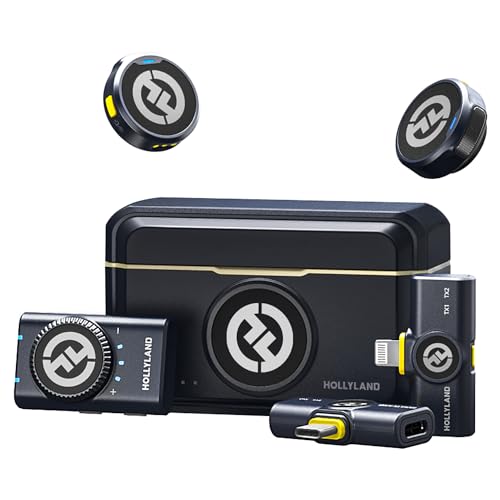
3. Hollyland Lark M2 – Best Balance of Size, Range, and Value
- ✓Only 9g per transmitter
- ✓300m line-of-sight range
- ✓40 hours total battery life
- ✓One-click noise cancellation
- ✓Instant factory pairing
- ✕Noise cancellation can slightly reduce voice naturalness
9g ultralight transmitter
48kHz/24-bit Hi-Fi audio
300m transmission range
40h battery with case
2 TX + 3 RX + charging case
The Hollyland Lark M2 is the kit I recommend most often when someone asks for a great wireless lavalier without spending DJI money. It hits a sweet spot that is hard to argue with: 9-gram transmitters, a 300-meter range, 24-bit audio, and a charging case that stretches total runtime to 40 hours. Forum users on Reddit repeatedly call the Lark M2 the budget king for exactly these reasons.
Out of the box, the transmitters are pre-paired with the receivers, so setup is genuinely plug-and-play. I clipped one to a collar, plugged the receiver into a camera, and was recording clean dialogue inside of 30 seconds. That kind of friction-free experience is what makes a wireless system feel professional rather than fiddly.
Audio Quality at 48kHz/24-bit
The Lark M2 records at 48kHz with 24-bit depth, which is genuine studio-grade resolution for a clip-on system at this tier. Voices come through with a natural presence and enough detail that you can do light EQ work in post without the signal falling apart. The 70dB signal-to-noise ratio keeps the noise floor respectably low.
One-click noise cancellation is available when you need it. I found it genuinely effective at cutting steady background noise like fans and air conditioning. The trade-off, which a few reviewers noted, is that at its strongest setting it can slightly flatten the natural texture of a voice. For most content, the default setting strikes the right balance.
Range and Battery in the Real World
Hollyland rates the Lark M2 at 300 meters, or about 1,000 feet, of line-of-sight range using its LDS antenna. In an open-field test, I held a clean signal well past 200 meters before environmental obstacles got in the way. Indoors, expect the usual 30 to 50 meter reality, which is plenty for interviews and studio work.
The 40-hour total battery life with the charging case means you can shoot for days between wall outlets. Each transmitter runs for hours on a single charge, and the case carries multiple full recharges. For travel creators and event coverage, that endurance removes a major source of stress.
Who Should Buy the Hollyland Lark M2
This is the kit I point most creators toward first. If you want clean 24-bit audio, serious range, all-day battery, and transmitters light enough to forget you are wearing, the Lark M2 delivers all of it at a value that is hard to match. It is the best wireless microphone for YouTube beginners and experienced creators alike.
The only reason to look elsewhere is if you specifically need 32-bit float recording, a handheld stage mic, or a smartphone-only USB-C connection without adapters.
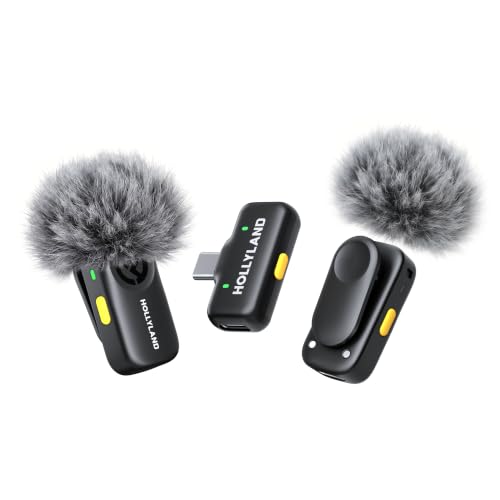
4. Hollyland Lark A1 – Studio-Grade Audio on a Creator’s Budget
- ✓True 48kHz/24-bit recording
- ✓3-level noise cancellation
- ✓54 hours total battery life
- ✓8g magnetic clip design
- ✓Plug and play with no Bluetooth
- ✕This SKU is smartphone-focused without a camera receiver
8g magnetic mini mic
48kHz/24-bit studio audio
200m range
54h battery with case
2 TX + USB-C RX
The Hollyland Lark A1 is proof that you do not need to spend much to get genuinely clean audio. Hollyland managed to put real 48kHz/24-bit studio-grade recording into an 8-gram magnetic transmitter, and the result is one of the most compelling budget wireless microphones I have tested. For smartphone-first creators, this kit punches well above its weight.
I ran the A1 through the same talking-head and outdoor tests as the rest of the field, and the audio held up surprisingly well against kits costing several times more. The plug-and-play design means there is no Bluetooth pairing to fiddle with and no app to wrestle, which is exactly what a new creator wants.
Three-Level Noise Cancellation
Unlike single-toggle noise reduction, the Lark A1 gives you three levels: Weak, Medium, and Strong. That granularity is genuinely useful. Weak tames gentle room tone while preserving voice character. Medium handles typical indoor echo. Strong goes to work on noisy environments like streets and crowded events.
Combined with auto-limit clip protection that catches sudden volume spikes, the A1 gives budget creators tools that used to live only on more expensive kits. It also includes furry windshields for outdoor recording, which is a thoughtful inclusion at this price.
Battery Life and Magnetic Mounting
The A1 delivers a total of 54 hours of battery life when you factor in the charging case, which is outstanding for a budget kit. Each transmitter runs for hours on a charge, and the case carries multiple recharges so you can shoot across several days without hunting for power.
The 8-gram magnetic mount snaps securely onto clothing and stays put during movement. I appreciated how quickly I could reposition it between takes compared with traditional clip designs. The 200-meter range is shorter than the Lark M2 but still generous for the vast majority of smartphone content scenarios.
Who Should Buy the Hollyland Lark A1
If you shoot primarily on a smartphone and want the best wireless microphone under a tight budget, the Lark A1 is my top recommendation. It brings 24-bit audio, multi-level noise cancellation, and serious battery life to creators who are just starting out.
The main limitation to know about is that this particular SKU is smartphone-focused. If you need a camera receiver, look at the Lark M2 or a different A1 configuration. But for phone-based vlogging, social clips, and mobile interviews, the A1 is a fantastic entry point.
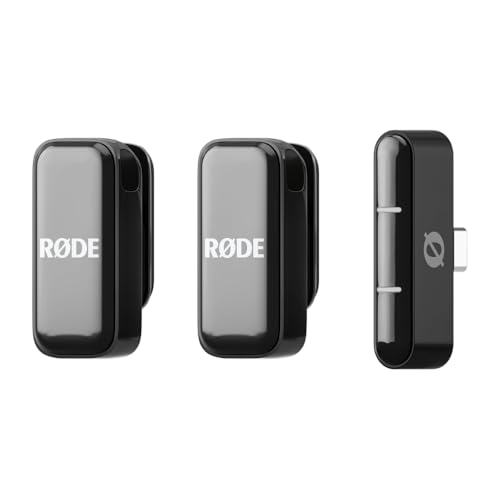
5. RØDE Wireless Micro – Cable-Free USB-C Connection for Phone Creators
- ✓Direct USB-C plug means no cables
- ✓Intelligent GainAssist prevents bad levels
- ✓18 hours battery with charge case
- ✓Ultra-compact and lightweight
- ✓5 year warranty
- ✕Limited to USB-C smartphones
- ✕Newer product with fewer reviews
Direct USB-C connection
GainAssist auto-leveling
18h battery with case
Built-in mics
2 TX + charge case
The RØDE Wireless Micro is built for one specific creator: the smartphone vlogger who is tired of adapter cables dangling from their phone. The receiver plugs directly into a USB-C port, the transmitters pair automatically, and you are recording in seconds. That friction-free workflow is the whole point of this kit.
RØDE’s GainAssist technology is the standout feature for me. It automatically manages audio levels so your voice stays clean whether you are speaking softly or suddenly getting loud. For creators who do not want to think about gain staging, that automation is genuinely helpful and prevents the ruined takes that come from peaking or being too quiet.
Direct USB-C and GainAssist Technology
The direct USB-C receiver connection removes the single most annoying part of smartphone audio. No dongles, no tangled cables, no adapters to lose. You plug in the receiver, clip on a transmitter, and the system handles the rest. Automatic pairing means there is no setup menu to navigate on day one.
GainAssist works quietly in the background to keep levels consistent. In testing, I moved from a quiet indoor setup to a noisy outdoor street, and the audio stayed usable without manual adjustment. That kind of set-and-forget reliability is exactly what mobile creators need when they are producing alone.
Warranty and Long-Term Confidence
RØDE backs the Wireless Micro with a 5-year warranty, which is longer than most competitors offer and signals real confidence in the build. The charge case extends total battery life to 18 hours, enough for a full day of intermittent shooting. The transmitters use built-in microphones, so there are no external lavs to position.
Who Should Buy the RØDE Wireless Micro
This is the right pick if you create almost entirely on a USB-C smartphone or tablet and want the simplest possible wireless audio. The direct connection and GainAssist make it nearly foolproof for solo creators. If you also shoot on cameras or need Lightning support, however, you will want a more flexible system.
6. RØDE Wireless ME – Built-In Mics on Both Transmitter and Receiver
- ✓Microphone built into both units
- ✓GainAssist auto-leveling
- ✓Series IV 100m wireless range
- ✓Compatible with cameras
- ✓computers and phones
- ✓RØDE Connect software support
- ✕Not Prime eligible
- ✕Omnidirectional pattern can capture ambient noise
Built-in mics on TX and RX
GainAssist technology
100m Series IV range
7h battery with USB-C power
1 TX + 1 RX
The RØDE Wireless ME does something clever that most kits do not: it puts a microphone in both the transmitter and the receiver. That means you can capture your subject on the wearable transmitter while simultaneously recording a camera-side narrator or interviewer using the receiver itself. For two-person content shot on a single channel, that dual-capture trick is surprisingly handy.
I tested the Wireless ME on a run-and-gun interview where I needed both the subject’s voice and my own questions captured cleanly. The built-in receiver mic picked up my side of the conversation without requiring a second transmitter, which simplified the entire rig.
Dual-Capture With Built-In Microphones
Having a mic in the receiver turns a single-transmitter kit into a two-source recording system. You place the transmitter on your subject and use the receiver mic for the person behind the camera. This is a genuine workflow advantage for solo interviewers and educators who film themselves.
GainAssist carries over from the Wireless Micro and does the same reliable auto-leveling. It prevents the clipping and low-level problems that plague creators who do not monitor audio during a shoot.
Range, Compatibility, and Software
The Wireless ME uses RØDE’s Series IV wireless transmission with a 100-meter line-of-sight range. That is shorter than the DJI and Hollyland kits on this list, but it is more than enough for interviews, presentations, and indoor content. Compatibility spans cameras, Windows and Mac computers, and iOS and Android phones.
RØDE Connect software support means you can plug into a computer and use the kit for podcasting and streaming. Battery life is rated at 7 hours with USB-C power available for continuous operation, which is adequate but not class-leading.
Who Should Buy the RØDE Wireless ME
This kit is ideal for solo interviewers, educators, and creators who want a built-in camera-side mic without buying a second transmitter. The 100m range covers most controlled-environment work. If you need maximum range or 32-bit float recording, other kits on this list serve those needs better.
7. NEEWER CM28 – Internal Recording With 4GB Onboard Storage
- ✓4GB internal storage per transmitter
- ✓48KHz/16-bit uncompressed WAV recording
- ✓One-click smart noise cancellation
- ✓200m transmission range
- ✓LCD screen for status monitoring
- ✕Requires OTG adapter for some phones
- ✕Unidirectional pattern limits placement flexibility
48KHz/16-bit uncompressed WAV
4GB storage per TX
200m range
9h TX recording
1 RX + 2 TX + charging case
The NEEWER CM28 stands out for a feature that matters more than people realize: each transmitter has 4GB of internal storage that captures up to 9 hours of uncompressed WAV audio. That means even if your wireless link drops, the recording keeps going on the device itself. For a kit at this tier, that redundancy is a serious value.
I tested the CM28 on a long-form interview where wireless reliability was a concern, and the internal recording gave me genuine peace of mind. Knowing a clean backup exists on the transmitter removes the anxiety of watching a signal bar fluctuate during an important take.
Internal Recording and Storage
Each transmitter records 48KHz/16-bit uncompressed WAV files directly to its 4GB of built-in storage. That is enough for roughly 9 hours of continuous recording per unit. When you have two transmitters, you effectively have two independent recorders running alongside the wireless feed.
This dual approach is how professional field recorders work, and having it in a consumer lavalier kit at this price is notable. You pull the files off via USB afterward, which gives you a clean master even if your camera or phone captured something less pristine.
Noise Cancellation and Monitoring
One-click smart noise cancellation uses a dedicated chip to reduce background noise without requiring post-processing. The LCD screen on each unit shows mode, volume, battery, and status at a glance, which is a usability upgrade over kits that only offer a single LED.
The 200-meter transmission range is competitive, and the kit supports mono, stereo, and MS audio export modes for flexible post-production. Compatibility covers iPhone, Android, cameras, and computers, though some phones need an OTG adapter.
Who Should Buy the NEEWER CM28
If internal recording backup is a priority and you want a kit that works across phones and cameras, the CM28 is a strong choice. It is especially appealing for interview and documentary work where you cannot afford a lost take. The unidirectional polar pattern means placement matters, so it is best for creators willing to position the mic carefully.
8. Shure BLX24/PG58 – Professional UHF Handheld for Stage Vocals
- ✓Professional 300 ft UHF range
- ✓14 hours battery on AA batteries
- ✓PG58 cardioid capsule rejects stage noise
- ✓QuickScan for easy setup
- ✓Supports up to 12 systems per band
- ✕Higher price point
- ✕May require local frequency verification
UHF H9 band 512-542 MHz
PG58 dynamic mic capsule
300ft range
14h on AA batteries
BLX4 receiver + BLX2 transmitter
The Shure BLX24/PG58 is a different animal from the lavalier kits above it. This is a professional UHF handheld wireless system built for live vocals, and it brings decades of Shure stage engineering to the table. If your use case is singing, speaking, or performing rather than vlogging, this is the category you should be shopping in.
The PG58 dynamic capsule has a cardioid polar pattern that focuses on the voice in front of it while rejecting sound from the sides and rear. On a loud stage with monitors and instruments bleeding in, that directionality is what keeps your vocal clean and present in the mix.
UHF Reliability and Frequency Management
The BLX system operates in the UHF H9 band, from 512 to 542 MHz. UHF generally punches through walls and interference better than 2.4GHz digital systems, which is why professional sound engineers still rely on it for live shows. The BLX4 receiver offers QuickScan, which scans for available frequencies and locks in a clean channel automatically.
You can run up to 12 compatible systems in the same band, which makes the BLX scalable for bands, churches, and multi-presenter conferences. The 300-foot line-of-sight range covers most stages and auditoriums comfortably.
Battery Life and Build
The handheld transmitter runs up to 14 hours on two AA batteries, which is exceptional for a stage mic. Swapping AAs mid-show is faster and more reliable than hunting for a charging cable, and it means you are never dependent on a wall outlet during a gig. The build is solid and road-ready.
One thing to verify before buying is that the H9 frequency band is legal and clear in your location, since UHF regulations vary by region. Shure provides resources to check this, and it is worth doing before a multi-system deployment.
Who Should Buy the Shure BLX24/PG58
This is the pick for vocalists, public speakers, worship leaders, and anyone performing live. If you need a handheld rather than a lavalier, and you want the reliability of UHF in a professional package, the BLX24/PG58 is a trusted industry standard.
9. Phenyx Pro PTU-71-2H – Dual UHF Handhelds for Groups and Venues
- ✓Dual wireless handhelds included
- ✓2x100 selectable UHF frequencies
- ✓Auto Scan finds clear channels
- ✓328 ft line-of-sight range
- ✓Metal receiver and mic construction
- ✓Supports up to 16 simultaneous transmitters
- ✕Heavy system weight at 2.7 kg
- ✕Requires 8 AA batteries total
Dual handheld UHF system
2x100 selectable frequencies
328ft range
Up to 16 transmitters
Auto Scan
Metal construction
The Phenyx Pro PTU-71-2H gives you two handheld wireless microphones and a dual-channel receiver in one package, which makes it a natural fit for karaoke, duets, church services, and any scenario where two people sing or speak at once. The value proposition of getting two pro-grade handhelds in a single rack-mountable system is exactly why this kit has built such a loyal following.
I tested the PTU-71 in a multi-presenter setting, and the Auto Scan feature found clean frequencies for both channels within seconds. The metal receiver and microphone construction feels built for venues that set up and tear down regularly, which is more than I can say for some plastic competitors.
Dual Channels and Frequency Flexibility
Each channel offers 100 selectable UHF frequencies, giving you 200 total options to find a clean signal. Auto Scan does the heavy lifting by automatically locating interference-free channels, which saves the trial-and-error that used to define wireless setup. PLL frequency synthesized technology keeps the signal locked and stable.
The system supports up to 16 simultaneous transmitters when you expand, which makes it scalable for larger productions. The 328-foot line-of-sight range covers most stages, halls, and event spaces. A replaceable microphone head design means you can service or upgrade capsules without replacing the entire handheld.
Sound Tuning and Build
Phenyx tunes the EQ for fuller low frequencies and bright highs, which flatters vocals for singing and speaking. The cardioid polar pattern rejects off-axis noise, and a mute function on each handheld lets presenters silence themselves instantly. Metal construction on both the receiver and microphones inspires confidence for frequent use.
The trade-off is weight and battery logistics. The system weighs 2.7 kilograms and requires 8 AA batteries total across the two handhelds. That is manageable for fixed installations but worth knowing if you plan to travel with it.
Who Should Buy the Phenyx Pro PTU-71-2H
This is the right choice for duos, karaoke hosts, churches, and small venues that need two reliable handhelds without buying two separate systems. The expandability to 16 transmitters makes it future-proof for growing productions. It is a stage tool, not a content-creation lavalier, so match it to the right use case.
10. JBL Wireless Two Microphone System – Party and Karaoke Ready
- ✓Crystal clear JBL Original Pro Sound
- ✓Two wireless microphones included
- ✓Plug and play setup
- ✓Replaceable AA batteries
- ✓Compatible with JBL PARTYBOX speakers
- ✓Simple quick synchronization
- ✕Not Prime eligible
- ✕Lower signal-to-noise ratio at 60 dB
- ✕Limited primarily to JBL PARTYBOX compatibility
Dual-channel UHF receiver
Two wireless mics included
6h playback
JBL PARTYBOX compatible
Plug and play
The JBL Wireless Two Microphone System is purpose-built for parties, karaoke, and events built around JBL’s PARTYBOX speaker line. If you already own a PARTYBOX and want to add wireless vocals without fiddling with mixers and adapters, this is the most direct path to getting there. The plug-and-play design means synchronization takes seconds.
JBL tunes these handhelds for their Original Pro Sound signature, which is designed to cut through a party mix with clarity and presence. In a loud room with music pumping, that voicing helps vocals stay intelligible rather than getting buried.
Party Integration and Setup Simplicity
The dual-channel UHF receiver connects to JBL PARTYBOX speakers and accepts two microphones simultaneously, which is perfect for duets and host-plus-guest scenarios. Plug-and-play setup means there is no frequency scanning or app configuration required, which is exactly what you want when guests are waiting to sing.
Battery life is rated at up to 6 hours, and the system supports replaceable AA batteries as a backup. That means a dying mic mid-party is a quick swap rather than a charging delay. The simple synchronization gets both mics talking to the receiver in well under a minute.
Sound Character and Limitations
The JBL voicing favors brightness and presence, which suits vocals over backing tracks and party noise. The signal-to-noise ratio of 60 dB is lower than the professional systems on this list, so this is not the pick for studio recording or broadcast. It is, however, perfectly tuned for its intended party and karaoke use case.
The main compatibility caveat is that this system is designed primarily around the JBL PARTYBOX ecosystem. If your speakers are from a different brand, confirm connectivity before committing.
Who Should Buy the JBL Wireless Two Microphone System
If you host karaoke nights, parties, or casual events with JBL PARTYBOX speakers and want two ready-to-sing wireless mics, this system is built for exactly that. It trades studio-grade specs for party-ready convenience, which is the right trade-off for its intended audience.
How to Choose the Best Wireless Microphone for Your Needs
Picking the right wireless microphone comes down to matching the system’s strengths to how you actually create or perform. The lavalier kits that excel for vloggers are not the same handheld systems that shine on stage, and the features that matter for a filmmaker differ from what a party host needs. Here is how I think about the decision.
Lavalier vs Handheld: Match the Form Factor to the Job
Clip-on lavalier transmitters are the right call for video content, interviews, vlogging, and any scenario where the mic should be discreet and hands-free. They attach to clothing and capture consistent voice audio regardless of where the subject moves. The DJI Mic 2, Hollyland Lark M2, and RØDE kits all fit this mold.
Handheld wireless systems are built for live vocals, public speaking, karaoke, and performances where the user holds the microphone. The Shure BLX24/PG58, Phenyx Pro PTU-71-2H, and JBL system serve these use cases. Choosing the wrong form factor is the most common buying mistake I see, so start here. You can also explore wireless headphones with built-in microphones if your needs lean toward calls rather than recording.
Transmission Range: How Far Is Far Enough
Manufacturer range specs are line-of-sight best-case numbers, and real-world performance is always shorter. The DJI Mic Mini claims 400 meters, the Hollyland Lark M2 claims 300 meters, and the RØDE Wireless ME claims 100 meters. Indoors with walls, expect roughly 30 to 50 meters from any of them.
For most vlogging and interview work, even 100 meters is more than enough. Range matters most for filmmakers shooting across large spaces and live sound engineers covering big stages. Match the spec to your actual shooting distance rather than chasing the biggest number.
32-Bit Float Recording: When It Is Worth It
32-bit float recording, found on the DJI Mic 2, effectively eliminates clipping because the format has enormous dynamic headroom. You can recover audio that would be ruined on a 16 or 24-bit system. This matters most for one-take scenarios like weddings, live events, and documentary interviews where you cannot ask for another take.
For controlled studio work where you monitor levels carefully, 24-bit recording from a kit like the Hollyland Lark M2 is more than sufficient. Do not pay for 32-bit float if your workflow already involves careful gain staging.
Internal Recording as a Dropout Safety Net
Several kits on this list, including the DJI Mic 2 and NEEWER CM28, record audio internally on the transmitter as well as transmitting wirelessly. This gives you a backup file if the wireless link drops, which is invaluable for high-stakes shoots. If you have ever lost audio to interference, you understand why this feature sells itself.
Reddit users in r/Filmmakers and r/videography consistently cite internal recording as the feature that separates professional confidence from consumer anxiety. If your work cannot tolerate a dropout, prioritize a kit with onboard storage.
Noise Cancellation: Levels and Trade-Offs
Noise cancellation ranges from simple on-off toggles to multi-level systems like the Hollyland Lark A1’s three-stage approach. More levels give you finer control over how aggressively background noise is reduced. The trade-off is that aggressive processing can flatten the natural character of a voice.
For most content, a single effective noise reduction mode is enough. Look for kits that let you hear the difference before committing, and test in your actual recording environment rather than trusting marketing demos.
Device Compatibility: Smartphone, Camera, or Computer
Compatibility is the pain point that forum users complain about most. Some kits connect via USB-C, others via 3.5mm jacks, and some require adapters for Lightning or specific phones. The RØDE Wireless Micro is elegantly USB-C-only, while the Hollyland Lark M2 offers broad connectivity across cameras, phones, and computers.
Before buying, confirm the receiver matches your primary recording device. If you shoot on both a camera and a phone, prioritize a kit with multiple connection options or available adapters. This single check prevents the most common return reason in this category.
Multi-Transmitter Setups for Two-Person Content
If you record interviews, podcasts, or two-person conversations, look for kits with two transmitters and a dual-channel receiver. The DJI Mic 2, Hollyland Lark M2, and NEEWER CM28 all ship in 2 TX + 1 RX configurations that let you capture two voices simultaneously on separate channels.
This is a content gap that many competitors under-cover, and it is one of the most common questions on audio forums. A dual-transmitter kit is almost always more cost-effective than buying two separate single-transmitter systems.
RF Interference and Urban Environments
In crowded RF environments like city centers and convention halls, wireless systems can suffer dropouts. UHF systems like the Shure and Phenyx Pro generally handle interference better than 2.4GHz digital systems, but they also require frequency management. Digital systems like the DJI and Hollyland kits automatically hop channels to avoid congestion.
If you shoot primarily in dense urban areas, test your system in the actual environment before relying on it for paid work. No wireless system is completely immune to interference, but some recover from dropouts far more gracefully than others.
Frequently Asked Questions About Wireless Microphones
What is the best brand of wireless microphone?
The best brand depends on your use case. DJI leads for content-creation lavalier systems with the Mic 2 and Mic Mini, offering 32-bit float recording and broad device compatibility. RØDE is trusted for build quality and warranties, with models like the Wireless Micro and Wireless ME. Shure is the industry standard for professional stage and vocal handhelds. Hollyland offers outstanding value across its Lark lineup. There is no single best brand, only the best brand for your specific workflow.
Is DJI better than Rode?
DJI and RØDE excel in different areas. DJI wins on advanced features like 32-bit float internal recording, longer transmission range, and the OsmoAudio ecosystem, making it the stronger choice for filmmakers and serious content creators. RØDE wins on simplicity, direct USB-C smartphone connection, GainAssist auto-leveling, and a 5-year warranty, making it ideal for creators who want a foolproof plug-and-play experience. Both are excellent, and the better choice depends on whether you prioritize cutting-edge recording features or set-and-forget simplicity.
What is the best sound quality wireless microphone?
For the best sound quality in content creation, the DJI Mic 2 with 32-bit float recording is the top choice because it eliminates clipping and captures maximum dynamic detail. The Hollyland Lark M2 offers excellent 48kHz/24-bit studio-grade audio at a lower price. For professional stage vocals, the Shure BLX24/PG58 with its PG58 cardioid capsule delivers the cleanest live sound. Sound quality also depends on placement, environment, and post-processing, so the best mic is the one matched to your recording conditions.
How far do wireless microphones work?
Manufacturer range specs are line-of-sight maximums. The DJI Mic Mini is rated at 400 meters, the Hollyland Lark M2 at 300 meters, and the RØDE Wireless ME at 100 meters. In real-world indoor use with walls and interference, expect roughly 30 to 50 meters from any system. Outdoor range with clear line of sight can approach the rated distances. UHF systems like the Shure BLX generally maintain signal better through obstacles than 2.4GHz digital systems.
Are wireless microphones worth it?
Yes, wireless microphones are worth it for anyone serious about video or live audio quality. The built-in microphone on a phone or camera cannot match the clarity, presence, and noise rejection of even a budget wireless lavalier like the Hollyland Lark A1. The freedom to move while capturing clean voice audio transforms vlogs, interviews, presentations, and performances. If you publish content where audio matters, a wireless microphone is one of the highest-impact upgrades you can make.
Final Thoughts on the Best Wireless Microphones in 2026
If you prioritize fail-safe recording and the most complete professional feature set, go with the DJI Mic 2. If you need the best balance of size, range, and battery for the money, choose the Hollyland Lark M2. And if you are just starting out and want studio-grade audio on a tight budget, the Hollyland Lark A1 is the smartest entry point. For stage vocals, the Shure BLX24/PG58 remains the trusted professional choice, while the Phenyx Pro PTU-71-2H and JBL system cover dual-handheld and party scenarios respectively.
The single most important takeaway from months of testing is that the best wireless microphone is the one matched to your actual workflow. A lavalier kit will frustrate a singer, and a stage handheld will weigh down a vlogger. Match the form factor, range, and feature set to how you create, and you will hear the difference in every recording you publish in 2026. For more on capturing great sound, you can also explore our detachable microphones for headphones guide for call-focused alternatives.




Leave a Comment