
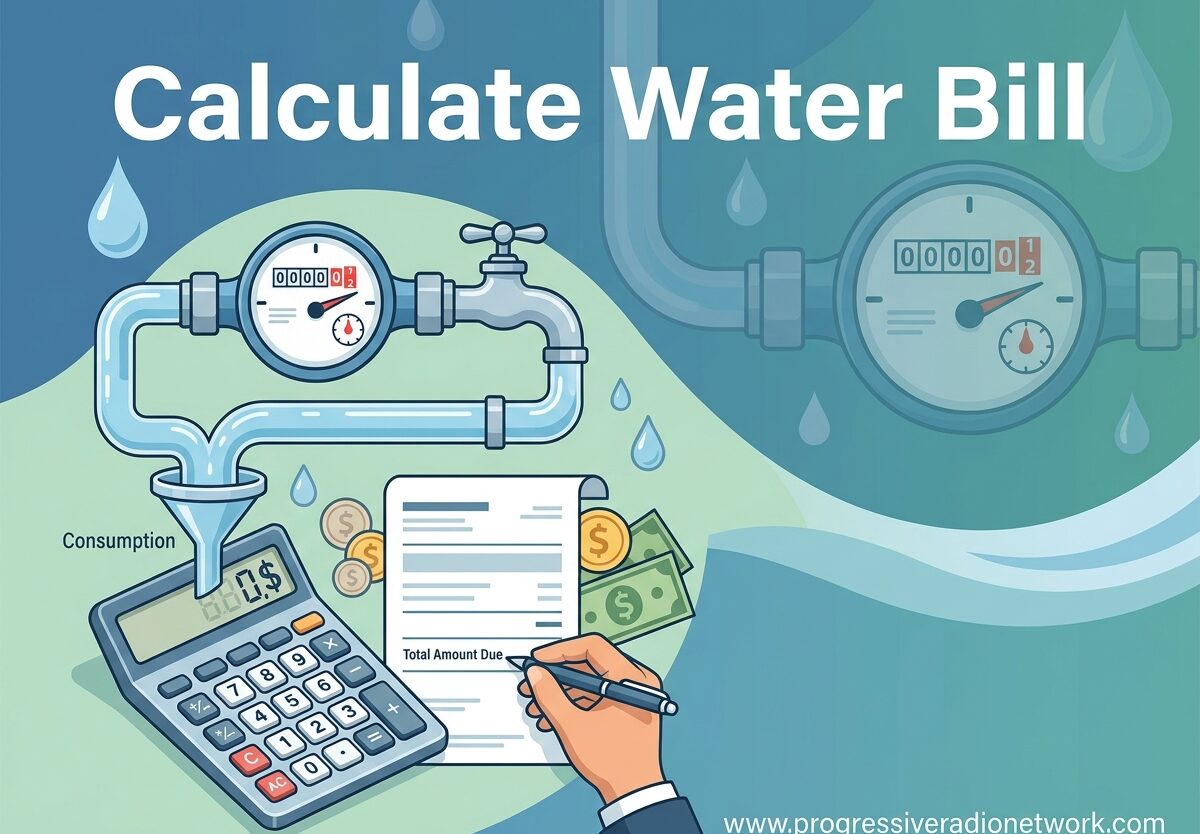
Understanding how to calculate water bill charges can save you money and help you catch costly mistakes before they become problems. I’ve spent years helping homeowners decode their utility statements, and I’m amazed by how many people overpay simply because they don’t understand what they’re being charged for.
Your water bill isn’t just a random number pulled from thin air. It’s a calculation based on specific measurements, rates, and fees that vary by location and usage patterns. When you learn how water billing works, you gain control over your monthly expenses and can spot errors that might otherwise go unnoticed.
This guide will walk you through everything you need to know about water bill calculation, from reading your meter to understanding complex rate structures. I’ll break down the formulas, provide real examples, and share insights from utility billing experts to help you master your water costs in 2026.
How Do They Calculate Your Water Bill?
Water utilities use two primary methods to calculate water bills: metered billing and unmetered billing. Most modern homes use metered billing, which charges based on actual water usage measured through a meter. Unmetered billing, less common today, calculates bills based on property characteristics like rateable value or flat fees.
For metered customers, the basic water bill calculation follows this formula: Minimum Bill + Volume Charge = Total Water Bill. The minimum bill (also called base rate) covers fixed costs like meter maintenance, customer service, and infrastructure. The volume charge depends on how much water you actually use, measured in Ccf (hundred cubic feet) or gallons.
Most residential water meters measure usage in Ccf, where one Ccf equals 748 gallons. Your utility reads your meter periodically, calculates the difference between readings, and multiplies by your applicable rate tier. Higher usage typically triggers higher per-unit rates through tiered pricing structures designed to encourage conservation.
Understanding your specific billing method is crucial because metered customers can directly reduce bills by using less water, while unmetered customers have less control over their charges. Check your bill statement or contact your utility provider to confirm which method applies to your property.
Understanding Water Measurement Units
Water utilities use confusing measurement units that trip up many customers. The most common unit is Ccf (centum cubic feet), which represents 100 cubic feet of water. Since one cubic foot equals 7.48 gallons, one Ccf equals 748 gallons. This unit appears on most residential water bills across the United States.
Some utilities bill in gallons directly, while others use cubic feet or thousand-gallon units. Knowing your utility’s measurement unit is essential for accurate water bill calculation. You can usually find this information on your bill statement or by calling customer service.
Conversion examples help clarify these units: 1 Ccf = 748 gallons, 10 Ccf = 7,480 gallons, and 20 Ccf = 14,960 gallons. The average single-family home uses approximately 5-15 Ccf per month depending on household size, irrigation habits, and appliance efficiency.
Your water meter displays usage in these same units, typically with a straightforward dial or digital readout. Meters measure total consumption since installation, so your bill reflects the difference between consecutive readings rather than the absolute number shown on your meter.
Calculate Water Bill: Step-by-Step Guide
Now I’ll show you exactly how to calculate water bill amounts using your specific usage and rate structure. This process works for any metered residential account, though exact rates vary by utility provider.
Step 1: Find Your Water Usage
Locate your current and previous meter readings on your bill statement. Subtract the previous reading from the current reading to determine your usage in the billing period. For example, if your current reading shows 1,250 Ccf and your previous reading was 1,235 Ccf, you used 15 Ccf during this billing cycle.
Step 2: Convert to Gallons (Optional)
If you want to understand your usage in more familiar terms, multiply Ccf by 748. Using our example: 15 Ccf × 748 = 11,220 gallons. This conversion helps you gauge whether your consumption is typical for your household size.
Step 3: Identify Your Rate Structure
Check your bill or utility website for your current rate schedule. Most residential customers have tiered rates where the first 2-3 Ccf cost less per unit than additional consumption. Your bill should show different rate tiers or “blocks” with corresponding prices per Ccf.
Step 4: Calculate Base Rate Charges
Every customer pays a minimum bill regardless of usage. This base rate covers fixed costs and typically includes a small allowance of water (often 2-3 Ccf). If you use less than this included amount, you still pay the full minimum bill.
Step 5: Calculate Volume Charges
Multiply usage above your minimum allowance by the applicable volume rate. For example, if your minimum bill includes 2 Ccf and you used 15 Ccf total, you pay volume charges on 13 Ccf. Apply the appropriate rate tier based on your total consumption.
Step 6: Add Additional Fees
Most bills include sewer charges, stormwater fees, and administrative costs. Sewer is typically calculated as a percentage of water usage or a fixed monthly fee. These additional charges often double the total bill amount.
Example Calculation: Let’s say you used 15 Ccf this month. Your minimum bill is $25 (includes 2 Ccf). The next 8 Ccf cost $3.50 per Ccf ($28). Usage above 10 Ccf costs $5.00 per Ccf, so your remaining 5 Ccf cost $25. Water charges total: $25 + $28 + $25 = $78. With sewer at 80% of water charges ($62.40) and a $15 stormwater fee, your final bill totals $155.40.
How to Read Your Water Meter
Reading your own water meter between billing periods helps you track usage and detect leaks early. Most water meters are located near the street in a concrete box labeled “water” or near your property line. Some buildings have indoor meters in basements or utility closets.
For analog dial meters, read the large sweep hand like a clock noting the number it has just passed. The rotating red triangle or small dial detects even small flows. If everything is off, this indicator should be completely still. Any movement indicates water is flowing somewhere on your property.
Digital meters display usage as a simple number, often with a flow indicator that flashes when water is running. Some advanced models show multiple screens cycling through total usage, flow rate, and error codes. Check your meter’s documentation or contact your utility for specific reading instructions.
To verify no hidden leaks exist, turn off all water fixtures and appliances. Watch your meter for 15-30 minutes. If the dial continues moving or numbers increase, you have a leak that needs attention. Even small leaks can waste thousands of gallons monthly, dramatically increasing your water bill calculation.
Factors That Affect Your Water Bill
Several variables impact your monthly water charges beyond basic consumption. Understanding these factors helps you predict bills and identify unusual charges.
Connection Size: Your water meter size (typically 5/8 inch for residential) affects base rates. Larger connections for commercial properties or irrigation systems incur higher minimum bills regardless of usage.
Rate Tiers: Most utilities use increasing block rates where higher consumption triggers higher per-unit prices. This tiered structure encourages conservation but can cause bill shock when usage jumps between tiers.
Seasonal Patterns: Summer water use typically doubles or triples due to irrigation. Winter bills reflect indoor use only. Understanding these seasonal variations prevents surprise when calculating water bills throughout the year.
Inside vs. Outside City Limits: Many utilities charge higher rates for customers outside city limits or service areas. These differential rates can add 20-50% to your bill depending on your location.
Sewer Billing Method: Sewer charges often equal or exceed water charges. Some utilities bill sewer as a flat percentage of water usage, while others use winter averaging to calculate summer sewer charges based on lower indoor consumption.
Irrigation Meters: Properties with separate irrigation meters receive credits on sewer charges since outdoor water doesn’t enter the sewer system. Without this separate metering, you pay sewer charges on water that never reaches the treatment plant.
Common Causes of High Water Bills
Sudden bill increases frustrate customers who understand how to calculate water charges but can’t explain dramatic spikes. Based on forum discussions and utility data, these causes account for most unexpected high bills:
Running Toilets: The most common culprit, a silently leaking toilet can waste 200-500 gallons daily. Test by putting food coloring in the tank; color appearing in the bowl within 15 minutes indicates a leak.
Irrigation Leaks: Underground sprinkler line breaks often go undetected for months. Compare your water usage during irrigation season to winter months to identify potential outdoor leaks.
Faucet Drips: A faucet dripping once per second wastes over 3,000 gallons annually. Fix even minor drips promptly to keep water bill calculations manageable.
Water Softener Malfunction: Regeneration stuck in continuous cycle can waste hundreds of gallons daily. Check your softener during periods of unusually high usage.
Changes in Household: Guests, new appliances, or behavior changes significantly impact consumption. Adding a family member typically increases usage by 2,000-3,000 gallons monthly.
Estimated vs. Actual Readings: Utilities sometimes estimate bills between actual readings. When the real meter reading occurs, corrections can cause unusually high or low bills as the estimate is adjusted.
Tips to Reduce Your Water Bill
Now that you understand water bill calculations, here are proven strategies to lower your monthly charges:
Fix Leaks Immediately: Address running toilets, dripping faucets, and visible leaks within days. Small leaks waste thousands of gallons and significantly increase your water bill calculation.
Install Efficient Fixtures: EPA WaterSense labeled toilets, showerheads, and faucets reduce consumption by 20-30% without sacrificing performance. These upgrades pay for themselves through lower water bills.
Adjust Irrigation: Water landscapes during cooler morning hours to minimize evaporation. Install rain sensors that prevent sprinklers from running during wet weather. Consider drought-tolerant plants to reduce irrigation needs.
Run Full Loads: Only run dishwashers and washing machines with full loads. Modern appliances use similar water amounts regardless of load size, so maximize efficiency by filling them completely.
Monitor Your Meter: Read your meter weekly to track usage patterns and catch problems early. Sudden unexplained increases typically indicate leaks that need immediate attention.
Consider an Irrigation Meter: If you water extensively outdoors, a separate irrigation meter eliminates sewer charges on water used for landscaping. This modification can reduce summer bills by 30-40%.
FAQs
How do they calculate your water bill?
Water utilities calculate your bill using the formula: Minimum Bill + Volume Charge = Total Water Bill. The minimum bill covers fixed costs regardless of usage. The volume charge depends on consumption measured by your meter in Ccf (hundred cubic feet) or gallons. Most residential customers have tiered rates where higher usage triggers higher per-unit prices. Additional charges for sewer, stormwater, and administrative fees are then added to determine your final bill amount.
How do I calculate how much my water bill will be?
To estimate your water bill, first determine your usage in Ccf by subtracting your previous meter reading from the current reading. Multiply usage above your minimum allowance by your applicable rate tier. Add your base rate or minimum bill. Include sewer charges (typically 70-90% of water charges) and any fixed fees. For example, 15 Ccf usage might result in $78 water charges, $62 sewer charges, and $15 in fees for a total bill of approximately $155.
What runs your water bill up the most?
Leaking toilets cause the highest unexpected water bills, often wasting 200-500 gallons daily. Outdoor irrigation leaks rank second, frequently going undetected for months. Other major factors include continuously running faucets, water softener malfunctions, and significant increases in household size. Seasonal irrigation can double or triple summer water consumption compared to winter usage. Understanding these causes helps you monitor for issues and keep your water bill calculation accurate.
Is 2000 gallons of water a month a lot?
No, 2000 gallons per month is relatively low for most households. The average person uses approximately 3,000 gallons monthly for indoor activities alone. A typical family of four uses 10,000-15,000 gallons per month without outdoor irrigation. Single individuals in apartments might use 2,000-3,000 gallons monthly. However, if you’re using 2000 gallons with irrigation or multiple residents, this could indicate underbilling or a meter issue rather than low consumption.
What is the average water bill for a family of 4?
The average water bill for a family of four ranges from $80-150 monthly depending on location and rates. Indoor consumption typically totals 10,000-12,000 gallons monthly. With moderate outdoor irrigation, usage can reach 15,000-20,000 gallons during peak months. Families in areas with tiered rate structures pay significantly more than those in flat-rate regions. Sewer charges can equal 70-90% of water charges, dramatically affecting the total bill amount for families of four.
Conclusion
Learning how to calculate water bill charges gives you control over your utility expenses and helps you spot errors or leaks before they cost hundreds of dollars. By understanding the relationship between your meter readings, rate structure, and consumption patterns, you can predict monthly bills and identify unusual charges immediately.
Remember that your water bill combines fixed base charges with variable volume charges, plus additional fees for sewer and stormwater services. Small changes in consumption can have significant impacts on your total bill, especially in tiered rate structures where higher usage triggers progressively higher rates.
Monitor your meter regularly, address leaks promptly, and consider efficiency upgrades to reduce your water consumption. When you understand how to calculate water bill amounts and what affects your charges, you’re better equipped to manage this essential household expense effectively in 2026.



Leave a Comment