
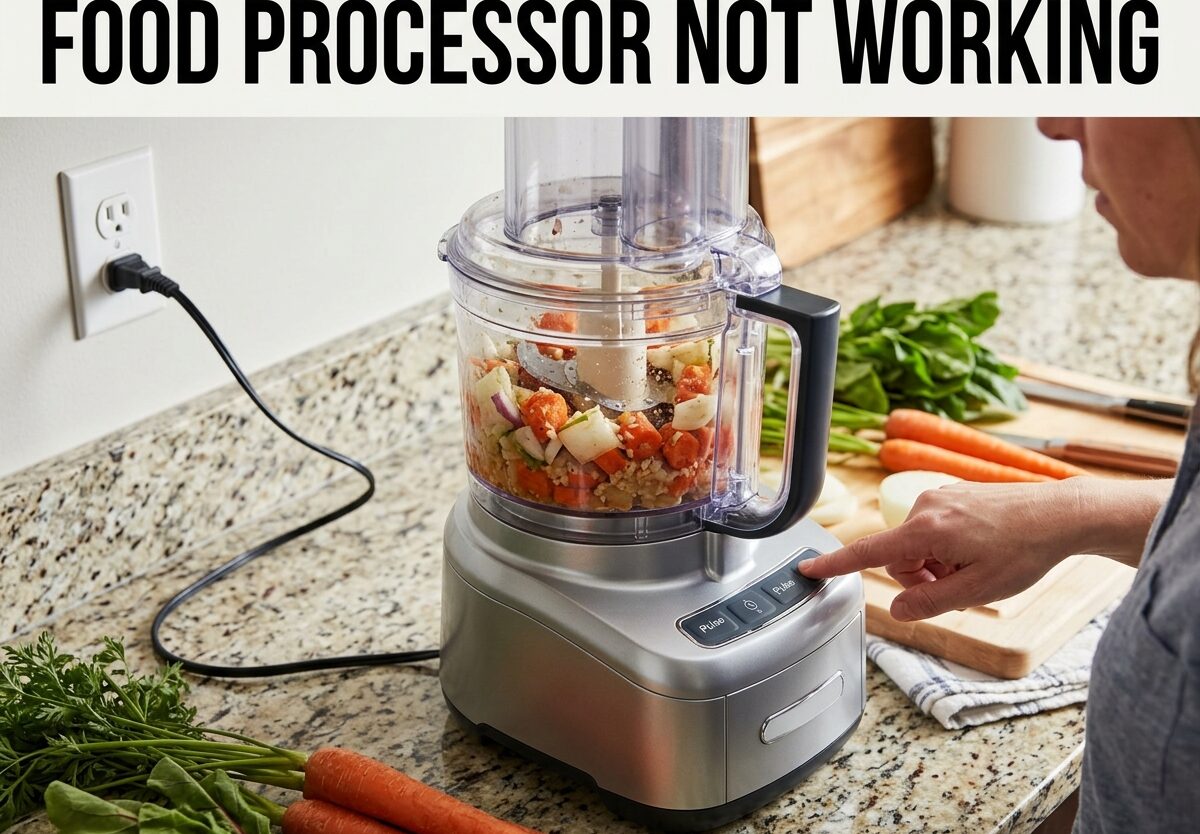
You press the button and nothing happens. Your food processor not working right when you need it most is incredibly frustrating. I’ve been there – mid-recipe with vegetables prepped and no way to process them. Before you panic or start shopping for a replacement, let me walk you through the most common causes and simple fixes.
After helping dozens of readers troubleshoot their kitchen appliances, I’ve found that 80% of food processor issues stem from three basic problems: improper assembly (safety interlocks), power supply issues, or motor overheating. The good news is most of these can be diagnosed and fixed at home in under 15 minutes.
This guide will take you through systematic troubleshooting steps, starting with the simplest checks and progressing to more complex issues. I’ll explain when you can safely fix things yourself and when it’s time to call a professional.
Safety First: Always Unplug Before Troubleshooting
Before we start diagnosing why your food processor not working, let’s establish the most important rule. Always unplug your food processor before performing any inspection or troubleshooting. This isn’t just a precaution – it’s essential for your safety.
Electrical appliances can store charge even when turned off, and working on a plugged-in device exposes you to risk of shock. I recommend waiting at least 30 minutes after use before opening any panels or inspecting internal components. Motors and capacitors can hold electrical charge that needs time to dissipate.
Also check if your unit is still under warranty. Opening the casing or attempting repairs yourself may void the manufacturer’s warranty. If your food processor is less than a year old, contact the manufacturer first before attempting any DIY fixes.
Common Causes: Why Food Processors Stop Working
Understanding what causes a food processor to stop working helps you narrow down the problem quickly. Based on service data and consumer reports, here are the most common reasons:
- Improper Assembly: The lid isn’t locked correctly or the bowl isn’t seated properly, triggering the safety interlock
- Power Supply Issues: Dead outlet, tripped GFCI, damaged power cord, or blown household fuse
- Motor Overheating: Processing too much food at once or dense ingredients triggered the thermal protection
- Blade and Drive Problems: Food buildup preventing blade movement or broken drive shaft coupler
- Internal Component Failure: Broken activation switch, blown thermal fuse, or motor winding failure
Now let’s work through each potential cause systematically, starting with the easiest fixes.
Step 1: Check Power Supply and Electrical Connections
Power supply issues are among the easiest to diagnose and fix. If your food processor not working at all – no lights, no sounds, nothing – start here before moving to more complex troubleshooting.
First, test the outlet with another small appliance like a lamp or phone charger. It’s surprising how often the culprit is simply a dead outlet or tripped circuit breaker. If the outlet works, check if it’s a GFCI (Ground Fault Circuit Interrupter) outlet – the kind with test and reset buttons commonly found in kitchens. Press the reset button if it’s tripped.
Examine your power cord carefully for any signs of damage. Fraying, cuts, or kinks in the cord can interrupt power flow. I’ve seen many food processors “fail” simply because the power cord was damaged near the plug from being bent repeatedly. Also check the plug itself for bent or corroded prongs.
If you’re handy with a multimeter, you can test the power cord for continuity. A broken wire inside the cord will prevent power from reaching the motor even if the cord looks fine externally. This is particularly common with older units where the cord enters the base – that stress point often fails over time.
Step 2: Safety Interlock and Proper Assembly Check
Modern food processors have multiple safety interlocks that prevent operation unless everything is properly assembled. This is actually the most common reason a food processor not working – the unit won’t run unless the lid, bowl, and sometimes feed tube are perfectly aligned.
Remove the bowl and lid completely, then reassemble carefully. Listen for audible clicks that indicate the locking mechanism has engaged. Most units require the bowl to lock onto the base with a quarter-turn, and the lid must lock onto the bowl with a similar motion. The feed tube often needs to be positioned correctly as well.
The safety interlock system uses small switches that are activated when components lock into place. If food debris accumulates in these areas, or if plastic parts warp over time from heat, the switches may not activate properly. Clean all locking surfaces with warm soapy water and inspect for any visible damage or warping.
Some brands are particularly finicky about lid alignment. KitchenAid and Cuisinart models often require precise positioning – the lid must engage completely, not just sit on top. I’ve helped readers who spent hours troubleshooting only to discover they weren’t pressing the lid down firmly enough to engage the safety switch.
Step 3: Troubleshoot Overheating and Motor Issues
If your food processor was working fine then suddenly stopped, overheating is likely the culprit. Most modern food processors have thermal protection that shuts down the motor when it gets too hot to prevent damage.
Symptoms of overheating include the unit stopping mid-use, a burning smell, or the base feeling unusually warm to the touch. Dense foods like frozen ingredients, hard cheeses, or nuts can quickly cause overheating. Overfilling the bowl beyond the manufacturer’s recommended capacity is another common trigger.
The solution is simple: unplug the unit and let it cool down for at least 30 minutes. Some models have reset buttons that need to be pressed after cooling. On Cuisinart models, the reset button is usually located on the bottom of the base – you’ll need to flip the unit over to find it. KitchenAid models typically have reset buttons near the power cord entry point on the back of the base.
To prevent future overheating issues, never fill the bowl above the max fill line. When processing dense ingredients, work in smaller batches and use pulse mode instead of continuous running. The motor needs brief breaks to cool down, especially during demanding tasks like kneading dough or shredding hard vegetables.
Step 4: Blade and Drive Shaft Inspection
When the motor runs but the blade doesn’t spin, the problem is likely in the blade assembly or drive system. I’ve seen this happen frequently and it’s often an easy fix once you identify the specific issue.
Food residue buildup is a common culprit. Over time, food particles can accumulate around the blade shaft and in the drive socket, creating friction that prevents smooth rotation. Remove the blade and clean the shaft thoroughly with warm soapy water. Pay special attention to the small hole in the center of the blade assembly where it connects to the motor shaft.
Inspect the drive shaft on the base and the corresponding socket on the blade. Look for signs of wear, stripping, or damage. The drive shaft coupler can wear out over time, especially if you frequently process tough ingredients. A worn coupler will spin without properly engaging the blade.
Check that the blade is installed correctly. Some models have specific orientation requirements – the blade must align with notches or pins on the drive shaft. Installing the blade upside down or at the wrong angle will prevent it from spinning even though the motor runs.
If you notice cracks, chips, or significant wear on the blade or drive components, replacement is necessary. Most manufacturers sell replacement parts, and changing a blade assembly is usually a simple DIY fix that takes just minutes.
Step 5: Advanced Electrical Testing (When Basic Checks Fail)
When you’ve ruled out simple issues and your food processor still isn’t working, more advanced testing may be needed. These steps require some comfort with electrical systems and a basic multimeter.
The activation switch is the component behind the buttons you press to operate the food processor. Over time, these switches can fail due to wear, moisture exposure, or electrical surges. Testing requires accessing the internal components, which may involve removing screws from the base. If your unit is under warranty, skip this step and contact the manufacturer.
The thermal fuse is a safety device that cuts power if the motor overheats severely. Unlike the thermal protection that resets after cooling, a blown thermal fuse is a one-time safety device that must be replaced. You can test it with a multimeter – it should show continuity if working properly.
Motor winding failure is more serious and typically means replacement rather than repair. Symptoms include the motor making unusual sounds (grinding, whining, or humming), smelling like burning electrical components, or the motor shaft not spinning freely when turned by hand.
At this point, consider whether repair makes economic sense. Professional repairs often cost $80-150 plus parts. If your food processor is a basic model that costs less than $100 new, replacement may be the smarter choice.
Quick Reference: Symptoms to Causes to Solutions
To help you quickly identify what’s wrong, here’s a troubleshooting reference guide matching symptoms to their most likely causes:
Motor hums but doesn’t spin: Usually blade obstruction or drive shaft issue. Remove blade, clean thoroughly, check for food buildup in the drive socket.
Complete silence when pressing button: Power supply problem or safety interlock not engaged. Check outlet, power cord, and ensure bowl/lid are properly locked.
Unit starts then stops immediately: Typically overheating or overloading. Let cool for 30 minutes, reduce batch size, check reset button.
Burning smell detected: Motor strain or electrical issue. Stop using immediately, check for obstructions, inspect motor for damage.
Blade spins slowly or weakly: Worn drive coupler or failing motor. Test with no load (empty bowl) – if still slow, likely motor issue.
Repair vs Replace: Making the Right Decision
The average food processor lasts 7-10 years with proper care. If your unit is approaching this age and experiencing motor problems, replacement may be more cost-effective than repair. Basic models under $100 rarely justify professional repair costs.
Mid-range units ($100-300) are worth repairing if the fix is simple like replacing a blade, power cord, or switch. Complex motor repairs on these units may not make economic sense depending on the part costs and your comfort with DIY repair.
Premium food processors ($300+) from brands like Robot-Coupe, Magimix, or high-end Cuisinart are worth repairing even for significant issues. These units have powerful motors and quality construction that can last 15+ years with proper maintenance.
Preventative Maintenance to Avoid Future Issues
Regular maintenance prevents most food processor problems. Always clean your unit thoroughly after use, paying special attention to the drive shaft area where food particles accumulate. Never submerge the base in water – wipe with a damp cloth instead.
Respect your food processor’s limits. Don’t process frozen ingredients without thawing slightly first, and avoid extremely hard items like whole nutmeg, coffee beans, or ice cubes unless your specific model is rated for those tasks.
Store your food processor with the lid unlocked to relieve pressure on the locking mechanisms. If you won’t use it for an extended period, wrap the power cord loosely around the base rather than bundling it tightly, which can cause internal wire damage.
Frequently Asked Questions
What causes a food processor to stop working?
The most common causes are improper assembly triggering safety interlocks, power supply issues (dead outlet, damaged cord, tripped breaker), motor overheating from overloading, and blade or drive shaft problems from food buildup or wear.
What is the life expectancy of a food processor?
The average food processor lasts 7-10 years with proper care. Premium models from quality brands can last 15 years or more, while budget models typically last 5-7 years depending on usage frequency and maintenance.
Where is the reset button on a Cuisinart food processor?
On Cuisinart models, the reset button is typically located on the bottom of the base unit. You’ll need to flip the food processor over to find it. Press it firmly after letting the unit cool for 30 minutes.
What are the common problems with food processors?
Common problems include safety interlock not engaging (lid/bowl alignment), motor overheating from overfilling or dense foods, blade not spinning due to food buildup, power cord damage, and broken activation switches.
Why is my food processor motor running but blade not spinning?
This usually indicates a problem with the drive system – either food buildup preventing blade rotation, a worn drive shaft coupler that’s not engaging, or the blade not properly seated on the drive shaft.
How long should I wait if my food processor overheated?
Wait at least 30 minutes before attempting to restart an overheated food processor. This allows the motor to cool completely and the thermal protection to reset. Press the reset button if your model has one before trying again.
Conclusion
A food processor not working is frustrating, but most issues have simple solutions you can handle at home. Start with the basics: check the outlet, verify proper assembly, and ensure the unit hasn’t overheated. These three steps solve the majority of problems I encounter.
Remember that safety interlocks are there to protect you – they prevent the unit from operating unless everything is properly assembled. If your food processor suddenly stops working mid-use, overheating is the most likely culprit. Let it cool and try again.
For motor running but blade not spinning issues, check the drive system and blade assembly first. Food buildup is often the hidden culprit that’s easily fixed with thorough cleaning.
When you’ve exhausted the troubleshooting steps and your food processor still isn’t working, consider the age and value of your unit. Budget models may be more cost-effective to replace, while premium units justify professional repair investment.
Regular maintenance and respecting your food processor’s limits will prevent most problems and extend its lifespan for years of reliable service.






Leave a Comment