
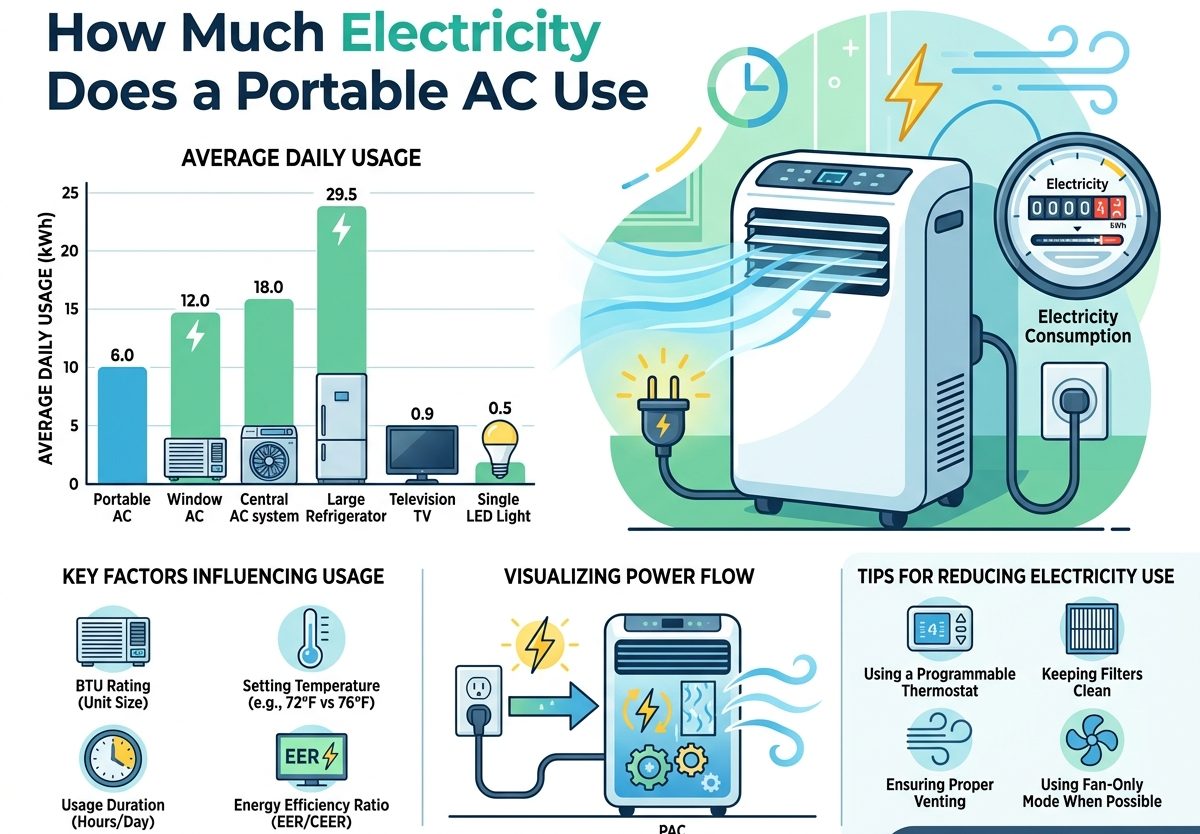
If you’re considering a portable air conditioner for your apartment or home, one of the first questions that comes to mind is about power consumption. I’ve researched this topic extensively, and here’s the straightforward answer: portable air conditioners typically use between 800 and 1,500 watts of electricity per hour when running, which translates to 0.8-1.5 kilowatt hours (kWh).
This means running a portable AC for 8 hours a day could consume 6.4-12 kWh daily, adding roughly $0.77-$1.44 to your electricity bill each day at the national average rate of 12 cents per kWh. Over a month, that’s $23-$43 just for cooling one room.
Understanding your portable AC’s electricity consumption matters because these units can significantly impact your summer energy bills. Unlike central air conditioning, which cools your entire home, portable ACs are designed for spot cooling—but they’re actually less efficient than window units due to their design. Let me break down everything you need to know about how much electricity does a portable AC use and what it costs to run one.
Quick Answer: BTU to Electricity Conversion Table
Here’s a quick reference guide showing how much electricity portable ACs use by BTU size:
5,000 BTU Portable AC: 500-600 watts (0.5-0.6 kWh per hour)
8,000 BTU Portable AC: 800-950 watts (0.8-0.95 kWh per hour)
10,000 BTU Portable AC: 900-1,100 watts (0.9-1.1 kWh per hour)
12,000 BTU Portable AC: 1,100-1,300 watts (1.1-1.3 kWh per hour)
14,000 BTU Portable AC: 1,300-1,500 watts (1.3-1.5 kWh per hour)
At the U.S. national average electricity rate of 12 cents per kWh, here’s what it costs to run these units per hour:
• 5,000 BTU: $0.06-$0.07 per hour
• 8,000 BTU: $0.10-$0.11 per hour
• 10,000 BTU: $0.11-$0.13 per hour
• 12,000 BTU: $0.13-$0.16 per hour
• 14,000 BTU: $0.16-$0.18 per hour
How Much Electricity Does a Portable AC Use
Before diving into costs, it helps to understand the basic unit of electricity measurement: the kilowatt hour (kWh). A kWh equals 1,000 watts used for one hour. When you see your electricity bill, you’re being charged based on how many kWh you consumed during the billing period.
Portable air conditioners draw electrical power continuously when the compressor is running. The compressor is the component that actually cools the air—it’s like a heat pump that moves warm air from your room to the outside through an exhaust hose. When the compressor cycles off (once your desired temperature is reached), the portable AC still draws some power for the fan and controls, but much less—typically 50-150 watts.
The key factor determining how much electricity does a portable AC use is the BTU rating, which stands for British Thermal Units. BTU measures cooling capacity, and higher BTU units require more electricity to operate. Most residential portable ACs range from 5,000 to 14,000 BTU, with 8,000-12,000 BTU being the most common for bedrooms and living rooms.
BTU to Watts: Understanding the Power Relationship
The relationship between BTU and watts isn’t perfectly linear, but there’s a general rule of thumb. Each 1,000 BTU of cooling capacity requires approximately 100 watts of electrical power. This means a 10,000 BTU portable AC will typically draw around 1,000 watts (1 kW) when the compressor is running at full capacity.
However, this is just a baseline. Actual power consumption varies based on several factors:
• Energy Efficiency Ratio (EER): Higher EER ratings mean more cooling per watt. An EER of 10 is decent, while 12+ is excellent. A unit with EER 12 uses about 17% less electricity than an EER 10 unit of the same BTU.
• Inverter Technology: Inverter compressors can speed up or slow down based on cooling demand, rather than simply cycling on and off. This can reduce electricity consumption by 20-30% compared to standard compressors.
• Ambient Temperature: When it’s extremely hot outside (95°F+), your portable AC works harder and uses more electricity. On mild days (80°F), it consumes less power while maintaining the same indoor temperature.
Real Cost Breakdown: Hourly, Daily, and Monthly
Let’s look at concrete cost examples for a typical 10,000 BTU portable AC using 1 kWh per hour of compressor runtime. I’ll use the U.S. national average electricity rate of 12 cents per kWh, but I’ll also show how costs vary by region since electricity rates differ dramatically across states.
Hourly Operating Costs:
At 12 cents per kWh, running your 10,000 BTU portable AC costs $0.12 per hour when the compressor is running. In reality, the compressor cycles on and off, so actual hourly consumption during normal use might be 0.6-0.8 kWh, costing $0.07-$0.10 per hour on average.
Daily Operating Costs:
If you run your portable AC for 10 hours per day (typical for sleeping and evening use), expect 6-8 kWh of daily consumption at $0.72-$0.96 per day. During a heatwave when it runs continuously, that could jump to 10 kWh costing $1.20 per day.
Monthly Operating Costs:
During summer months with daily AC use, a 10,000 BTU portable AC typically adds $22-$29 to your monthly electricity bill. Heavy users running it 16+ hours daily could see $35-$45 in additional costs per month.
State-by-State Variations:
Electricity rates vary significantly across the U.S., dramatically impacting portable AC running costs:
• Louisiana (9.5 cents/kWh): $0.095 per hour, $0.95 per 10-hour day, $28.50 per month
• California (22 cents/kWh): $0.22 per hour, $2.20 per 10-hour day, $66 per month
• Hawaii (33 cents/kWh): $0.33 per hour, $3.30 per 10-hour day, $99 per month
• New York (20 cents/kWh): $0.20 per hour, $2.00 per 10-hour day, $60 per month
• Texas (11.5 cents/kWh): $0.115 per hour, $1.15 per 10-hour day, $34.50 per month
These state differences show why your location matters when calculating how much electricity does a portable AC use. Residents in high-cost states like California and Hawaii face significantly higher cooling costs than those in regions with cheaper electricity.
Key Factors Affecting Portable AC Electricity Consumption
Several variables influence your portable AC’s actual power draw beyond just its BTU rating:
Room Size and Insulation: A 10,000 BTU unit in a well-insulated 200-square-foot bedroom will cycle on and off, using less electricity overall than the same unit struggling to cool a poorly insulated 400-square-foot room. Oversized units waste energy through frequent short cycling, while undersized units run continuously without ever reaching your target temperature.
Single Hose vs. Dual Hose Design: Most portable ACs are single-hose units that exhaust hot air outside, creating negative pressure that pulls warm air in through cracks and openings. Dual-hose models have one intake hose and one exhaust hose, maintaining neutral pressure and operating 20-30% more efficiently. For the same BTU rating, a dual-hose portable AC will use less electricity to achieve the same cooling.
EER Rating Impact: The Energy Efficiency Ratio (EER) measures cooling output (BTU) divided by power input (watts). A 10,000 BTU unit with EER 10 consumes 1,000 watts, while an EER 12 unit consumes only 833 watts for the same cooling. Over a summer, the EER 12 unit saves approximately $15-$25 in electricity costs compared to the EER 10 model.
Temperature Settings: Each degree lower on your thermostat increases electricity consumption by 3-5%. Setting your portable AC to 68°F instead of 76°F can increase your cooling costs by 25-40%. The Department of Energy recommends 78°F for optimal energy efficiency during cooling season.
Sunlight and Heat Load: A room with direct sunlight or multiple heat-generating electronics requires more cooling. Your portable AC will run longer and consume more electricity in a sun-drenched room compared to a shaded space with the same square footage.
Portable AC vs Window AC vs Central Air: Energy Comparison
How does portable AC efficiency compare to other cooling options?
Portable vs. Window AC: Window air conditioners are significantly more efficient than portable units. A 10,000 BTU window AC typically uses 800-900 watts versus 1,000-1,100 watts for a portable of the same capacity. This 15-20% efficiency disadvantage exists because portable ACs use part of their cooling capacity to offset the heat generated by their own motors, plus they create negative pressure that draws in warm air.
Portable vs. Central Air: Central air conditioning is the most efficient option for cooling multiple rooms, with SEER ratings of 14-20+ for modern systems. While central AC uses 3,000-5,000 watts total, it cools your entire home at 2-3 times the efficiency per BTU compared to portable units. However, if you only need to cool one room, running a portable AC in that space uses less total electricity than cooling your entire house with central air.
When Portable AC Makes Sense: Despite their efficiency disadvantage, portable ACs are the right choice when you rent and can’t install window units, your windows don’t accommodate window ACs, or you need temporary cooling in a specific room. The electricity cost premium might be $15-$30 per month compared to a window unit, but this may be worth it for the flexibility and portability.
Real User Electricity Bill Examples
I’ve gathered real experiences from portable AC users across different regions to show actual electricity cost impacts:
Reddit User in Edmonton, Canada: “Units are usually 1000W to 1500W so that will be 1 to 1.5 kWh for every hour. Run it 10 hours = $1.70 at 17 cents/kWh. My bill goes up about $50-$80 during months when I run my portable AC regularly.”
Reddit User in Los Angeles, California: “I have a 1-hose AC, 10,000 BTU for a 500 sq ft apartment & my electric bill fluctuates between $50-$80 a month year round. It might go up to $100 in August when I run the AC more. PG&E rates are high—running 12 hours can cost $5-$6/day easily.”
Reddit User in Calgary, Canada: “So if you have a 1000W AC unit every hour you use it would be 1 kWh so every hour would cost your power rate (somewhere around 12 cents here). Running it 8 hours a day for a month adds about $29 to my bill.”
Reddit User in Bay Area, California: “Portable AC will use about 1kW per hour if the compressor is operating. The way you’re describing it is it will be about 8-12 kWh per day x 30 = 240-360 kWh per month extra. At PG&E’s high rates, that’s $50-$80 additional per month.”
These real-world examples confirm our calculations and highlight how regional electricity rates dramatically impact portable AC operating costs. Users in high-cost regions like California face significantly higher bills than those in areas with cheaper electricity.
Tips to Reduce Portable AC Energy Consumption
Here are proven strategies to reduce how much electricity does a portable AC use while staying comfortable:
1. Choose the Right BTU Size: Use the manufacturer’s room size guidelines. An 8,000 BTU unit properly sized for a 200-square-foot room will use less electricity than a 14,000 BTU unit oversized for the same space. Oversized units short-cycle frequently, wasting energy through inefficient on-off cycling.
2. Optimize Temperature Settings: Each degree above 72°F saves 3-5% on cooling costs. Set your portable AC to 76-78°F and use ceiling fans to create a wind chill effect that makes it feel 4-6 degrees cooler. This strategy can reduce electricity consumption by 15-25% without sacrificing comfort.
3. Use Timer Functions Wisely: Don’t run your portable AC 24/7. Set it to turn on 30 minutes before you arrive home and turn off 30 minutes before you leave. Use sleep mode at night, which gradually increases temperature while you’re sleeping and typically saves 10-15% on overnight cooling costs.
4. Improve Room Insulation: Close blinds during sunny hours to reduce solar heat gain. Seal gaps around windows and doors with weatherstripping. Use thermal curtains to block heat. These measures can reduce cooling load by 10-20%, directly lowering electricity consumption.
5. Maintain Your Unit: Clean the air filter every 2-4 weeks. A clogged filter reduces airflow by 10-20%, forcing your portable AC to run longer and use more electricity. Keep the exhaust hose as short and straight as possible—each bend or extra foot of hose reduces efficiency by 3-5%.
6. Consider Supplemental Cooling: Use a floor fan or ceiling fan in combination with your portable AC set to a higher temperature. The fan circulates cool air and creates a wind chill effect, allowing you to set the AC 4-6 degrees higher while maintaining the same perceived comfort level.
7. Reduce Internal Heat Sources: Turn off heat-generating electronics when not in use. Switch to LED bulbs, which produce 90% less heat than incandescent bulbs. Use a microwave instead of an oven for cooking. These measures reduce the cooling load on your portable AC.
8. Choose Dual-Hose for Long-Term Use: If you plan to use your portable AC extensively, invest in a dual-hose model. Despite being 20-30% more expensive upfront, the electricity savings of $5-$10 per month during summer can offset the price difference within 1-2 seasons.
Frequently Asked Questions
Does portable AC cost a lot of electricity?
Portable ACs do consume significant electricity, typically $0.10-$0.18 per hour depending on BTU size and local electricity rates. For daily use of 8-10 hours, expect $0.80-$1.80 per day or $24-$54 per month during cooling season. While not inexpensive, portable ACs cool only the room you’re using rather than your entire home, which can be more efficient than central air for single-room cooling needs.
What is the 3 minute rule for AC?
The 3 minute rule for AC refers to waiting 3 minutes after your air conditioner turns off before restarting it. This delay allows pressure in the refrigerant system to equalize, preventing compressor damage. Many modern ACs have built-in 3-minute delay timers. If your portable AC doesn’t cool after restarting, wait 3 minutes before trying again. This rule protects your compressor from premature failure and maintains energy efficiency.
Is it cheaper to run portable AC all day?
No, it’s not cheaper to run your portable AC all day continuously. The most cost-effective approach is to run it only when needed and use a programmable timer. Constantly running a portable AC 24/7 can cost $3.60-$7.20 per day at average electricity rates. Instead, set it to run 2-3 hours before you arrive home, cycle during occupied hours, and turn off overnight or when you’re away. This pattern-based usage can reduce daily costs by 40-60% compared to continuous operation.
Is 20 kWh per day a lot?
For a typical U.S. household, 20 kWh per day represents 40-50% above average household electricity consumption. The average home uses 28-32 kWh daily, so adding 20 kWh from a portable AC running 10-15 hours daily would significantly increase your bill. At $0.12 per kWh, 20 kWh costs $2.40 daily or $72 monthly. If you’re seeing 20 kWh daily increases, consider reducing AC runtime, improving insulation, or checking if your unit is oversized for the space.
Do portable AC units raise your electric bill?
Yes, portable AC units will raise your electric bill by $20-$60 per month depending on usage patterns, BTU size, and local electricity rates. A 10,000 BTU portable AC used 8-10 hours daily typically adds 240-300 kWh monthly to your consumption. At the national average rate of $0.12/kWh, this equals $29-$36 monthly. In high-cost states like California, the same usage could add $50-$75 monthly. The impact is visible but generally manageable for most households, especially compared to the cost of central air conditioning for entire homes.
How much electricity does a 10000 BTU portable AC use?
A 10,000 BTU portable AC typically uses 900-1,100 watts (0.9-1.1 kWh) per hour when the compressor is running. During normal operation with compressor cycling, average consumption is 0.6-0.8 kWh per hour. Daily usage of 10 hours translates to 6-8 kWh, costing $0.72-$0.96 at average U.S. electricity rates. Monthly, expect 180-240 kWh consumption, adding $22-$29 to your electricity bill during cooling months. Energy-efficient models with EER 12+ ratings use approximately 15-20% less electricity than standard EER 10 units.
Conclusion
Understanding how much electricity does a portable AC use helps you make informed decisions about summer cooling costs. While portable air conditioners typically consume 800-1,500 watts (0.8-1.5 kWh) per hour and add $20-$60 to monthly electricity bills, they provide valuable spot cooling flexibility that window units and central air can’t match in some situations.
The key takeaway is that your actual costs depend heavily on your local electricity rates, usage patterns, and how efficiently you operate your unit. By choosing the right BTU size, optimizing temperature settings, using timers strategically, and maintaining your portable AC properly, you can reduce electricity consumption by 20-40% while staying comfortable.
For most households, the trade-off between convenience and electricity cost is worthwhile—especially when compared to the alternative of no cooling at all or the higher upfront cost of installing a more efficient system. Just be aware of your regional electricity rates and plan your usage accordingly to keep summer cooling costs manageable.



Leave a Comment