
Winter brings dry air to millions of homes, causing scratchy throats, static electricity, and uncomfortable sleeping conditions. When shopping for relief, you’ll quickly discover two main technologies dominating the market. Understanding the difference between ultrasonic vs evaporative humidifier options will help you choose the right solution for your home.
Both types add moisture to the air, but they work in completely different ways. The choice you make affects everything from noise levels to maintenance routines and even indoor air quality. I’ve tested both technologies extensively and consulted with respiratory therapists to bring you this comprehensive comparison.
Ultrasonic vs Evaporative Humidifier: The Main Differences
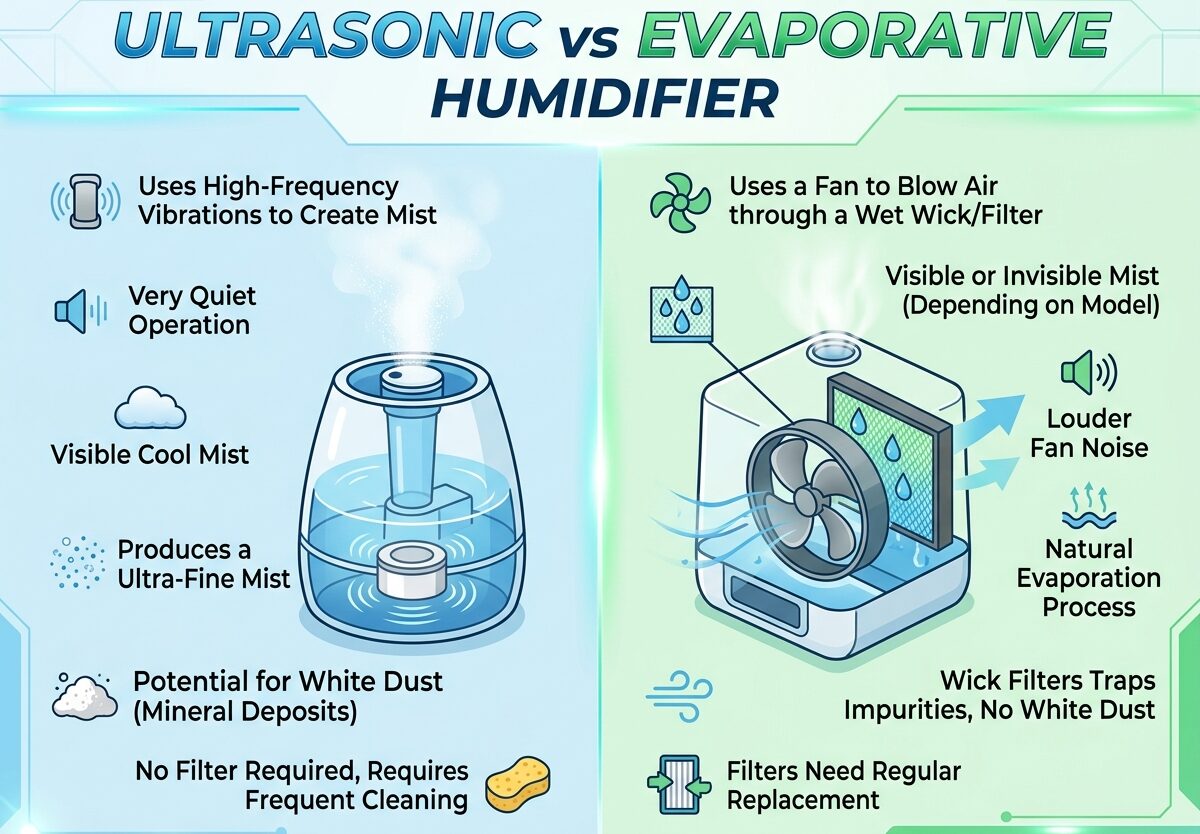
Before diving into details, here’s the fundamental difference: ultrasonic humidifiers use high-frequency vibrations to create mist, while evaporative models rely on natural evaporation using a fan and wet filter. This single difference cascades into every aspect of ownership, from noise output to cleaning requirements.
Ultrasonic models excel at quiet operation and require no replacement filters. Evaporative units self-regulate humidity levels and trap impurities before they enter your air. Neither is universally better—each shines in specific situations.
What is an Ultrasonic Humidifier?
An ultrasonic humidifier uses a small metal diaphragm vibrating at ultrasonic frequencies—typically beyond human hearing—to create water droplets so fine they appear as mist. Think of it as a miniature fog machine for your room.
Here’s how it works: water from the tank sits above a ceramic plate or metal diaphragm. When powered on, this plate vibrates at ultrasonic speeds (typically 20,000 to 100,000 times per second), breaking water into microscopic particles. A small fan then pushes these droplets out as a cool, visible mist.
Key characteristics:
- Near-silent operation (usually under 25-30 decibels)
- No filters required (no ongoing replacement costs)
- Energy efficient (uses about the same power as a nightlight)
- Produces visible cool mist only
- Can disperse minerals into air as white dust
- Requires frequent cleaning to prevent bacterial growth
Ultrasonic humidifiers are popular for bedrooms and nurseries because they’re virtually silent. The technology is simple, reliable, and inexpensive to operate since there are no filters to replace.
What is an Evaporative Humidifier?
An evaporative humidifier works through natural evaporation, just like a wet towel dries on a clothesline. A fan pulls air through a water-saturated wick filter, where moisture evaporates into the air stream and circulates throughout your room.
The process is surprisingly elegant: the wick filter (usually made of paper, cloth, or foam) sits partially submerged in the water tank. As the fan operates, air passes through the wet filter, picking up water vapor along the way. This creates invisible humidity rather than visible mist.
Key characteristics:
- Self-regulating humidity (naturally slows as room reaches desired humidity)
- Traps impurities in the filter before they enter your air
- Uses tap water safely (filter traps minerals)
- Operates at 40-50 decibels (similar to a quiet refrigerator)
- Requires filter replacements every 1-3 months ($15-40 each)
- Uses more electricity (fan runs continuously)
- Cannot over-humidify your space
Evaporative models excel at maintaining consistent humidity levels without complicated sensors. The filter acts as a first line of defense against airborne particles and minerals, making them a favorite for health-conscious users.
Quick Comparison: Ultrasonic vs Evaporative Humidifier
| Feature | Ultrasonic | Evaporative |
|---|---|---|
| Noise Level | Near-silent (25-30 dB) | Fan noise (40-50 dB) |
| Maintenance | Clean 2-3x per week | Replace filter every 1-3 months |
| Water Type | Distilled recommended | Tap water acceptable |
| Operating Cost | Very low electricity | Higher electricity + filters |
| White Dust | Yes (with tap water) | No |
| Self-Regulating | No (can over-humidify) | Yes |
| Air Filtration | No | Yes (filter traps particles) |
| Initial Cost | $30-150 | $40-200 |
Noise Level Comparison
Ultrasonic humidifiers are the undisputed champions of quiet operation. Operating at just 25-30 decibels, they’re quieter than a whisper (30 dB) and barely audible even in dead silence. The only sound is a gentle bubbling as water feeds into the vibration chamber.
Evaporative models produce fan noise ranging from 40-50 decibels—about the level of a quiet refrigerator or library conversation. While not loud by any means, this steady hum can disturb light sleepers. Many users report getting used to the white noise, but sensitive sleepers may find it disruptive.
Winner: Ultrasonic for bedrooms and nurseries. Evaporative is acceptable for living areas and offices where background noise is less critical.
Maintenance Requirements
This is where ultrasonic humidifiers demand more effort. Without a filter to trap contaminants, bacteria and mold can grow in the water tank and then be dispersed into your air. Users on forums universally report needing to clean ultrasonic models 2-3 times per week to prevent this issue.
Cleaning involves scrubbing the tank, vibration plate, and any accessible components with vinegar or hydrogen peroxide to kill microorganisms. It’s not difficult, but it is time-consuming and easy to forget until problems develop.
Evaporative humidifiers simplify maintenance through filter replacement. The wick filter naturally traps bacteria, mold, and minerals, preventing them from entering your air. When the filter becomes clogged (usually every 1-3 months depending on water hardness and usage), you simply replace it.
However, you still need to rinse the tank periodically and check for mold growth in hard-to-reach areas. Overall, evaporative models require less frequent attention, though ongoing filter costs add up.
Winner: Evaporative for convenience, though ultrasonic wins on ongoing costs if you’re diligent about cleaning.
Water Quality Needs
The water you use matters significantly, especially for ultrasonic humidifiers. Tap water contains dissolved minerals like calcium and magnesium. When ultrasonic vibrations break this water into mist, those minerals become fine airborne particles that settle as white dust on furniture, floors, and even in your lungs.
White dust isn’t just messy—it contains mineral particles you’re breathing into your respiratory system. While not typically toxic, it can aggravate asthma and allergies. The only reliable prevention is using distilled or demineralized water, which adds ongoing cost and inconvenience.
Evaporative humidifiers handle tap water beautifully. The wick filter traps minerals before they can become airborne, preventing white dust entirely. You’ll see mineral deposits build up on the filter over time, but those stay put until you replace the filter. This makes evaporative models far more convenient for households relying on tap water.
Winner: Evaporative for tap water users. Ultrasonic requires distilled water investment for optimal performance.
Energy Consumption
Ultrasonic humidifiers sip electricity. Without fans or heating elements, most models consume just 15-35 watts—similar to a lightbulb. Running one continuously for a month typically costs under $3 in electricity.
Evaporative models require a fan to operate continuously, consuming 50-100 watts depending on size. This translates to $5-10 monthly in electricity—not a huge difference, but 2-3x higher than ultrasonic models.
Winner: Ultrasonic by a small margin, though the difference is minimal compared to filter replacement costs for evaporative models.
The White Dust Problem Explained
White dust is the single biggest complaint about ultrasonic humidifiers. Here’s exactly what happens: tap water contains dissolved minerals (calcium, magnesium, iron). When ultrasonic vibrations vaporize this water, those minerals become airborne particles too small to see individually but noticeable as they accumulate.
This dust settles everywhere—furniture, electronics, bedding, and floors. More concerning, you’re breathing these mineral particles into your lungs. While not immediately harmful, long-term exposure to mineral dust can aggravate respiratory conditions.
Reddit users frequently report this issue, with many discovering the problem only after noticing white powder covering their belongings. The solution is simple but costly: use only distilled or demineralized water, or install a demineralization cartridge (if your model supports it).
Evaporative humidifiers completely avoid this issue because minerals remain trapped in the wick filter. This makes them superior for anyone using tap water or concerned about airborne mineral particles.
Health Considerations
Both humidifier types can improve respiratory health by maintaining optimal humidity (30-50%). However, improper maintenance can make either type harmful by dispersing bacteria, mold, or minerals into your air.
COPD and Asthma: Evaporative humidifiers generally edge out ultrasonic models for respiratory conditions. The filter provides an extra layer of protection against airborne particles, and there’s no risk of dispersing white dust that could irritate sensitive lungs. However, both types can help when properly maintained.
Baby Nurseries: Pediatricians often recommend evaporative models for babies because the filter traps impurities. However, the noise factor pushes many parents toward ultrasonic models. If choosing ultrasonic for a nursery, use only distilled water and maintain a strict cleaning schedule.
Allergy Sufferers: Evaporative humidifiers have the advantage here. The wick filter traps allergens before they can circulate, essentially acting as a bonus air purifier. Just remember that filters can become breeding grounds for mold if not replaced regularly.
Bacterial Safety: Both types can harbor bacteria if not properly maintained. Ultrasonic models require more frequent cleaning but allow complete access to all water-contacting parts. Evaporative filters can trap bacteria but may develop mold if not replaced on schedule. Neither has a clear safety advantage when maintained properly.
Cost of Ownership Breakdown
Looking beyond the purchase price reveals interesting differences over time. Let’s compare two-year ownership costs for typical mid-sized models:
Ultrasonic ($80 initial):
- Electricity: $3/month x 24 months = $72
- Distilled water: $15/month x 24 months = $360
- Cleaning supplies: $20
- Total: ~$532 over two years
Evaporative ($100 initial):
- Electricity: $7/month x 24 months = $168
- Filter replacements: $25 every 2 months x 12 = $300
- Total: ~$568 over two years
The difference is surprisingly small when using distilled water with ultrasonic models. If you use tap water with ultrasonic (accepting white dust), costs drop dramatically. However, many users find distilled water worth the investment to avoid white dust and potential respiratory irritation.
Winner: Roughly equivalent, though ultrasonic wins if you accept tap water and white dust, or if you’re willing to clean diligently.
Which Type is Right for You?
Choosing between ultrasonic vs evaporative humidifier comes down to your specific needs and priorities. Here are clear recommendations for common situations:
Choose Ultrasonic If:
- You need a quiet humidifier for your bedroom
- You’re willing to clean the unit 2-3 times per week
- You’re comfortable using distilled water
- You want to avoid ongoing filter replacement costs
- You live in a small apartment or single room
- You have light sleep who can tolerate minimal noise
Choose Evaporative If:
- You want set-it-and-forget convenience
- You prefer using tap water
- You’re concerned about white dust and airborne minerals
- You have respiratory issues like asthma or COPD
- You’re humidifying a baby’s nursery
- You want natural humidity regulation without risking over-humidification
- You don’t mind moderate fan noise
FAQs
Both technologies effectively add moisture to dry air. Neither is universally superior—the right choice depends entirely on your priorities around noise, maintenance, water quality, and health considerations.
Which is better, an ultrasonic or evaporative humidifier?
Neither is universally better—ultrasonic humidifiers are quieter and cheaper to operate, while evaporative models are more convenient and don’t produce white dust. Choose ultrasonic for silent bedrooms and evaporative for whole-house convenience and cleaner air.
What type of humidifier is the healthiest?
Evaporative humidifiers are generally considered healthier because the wick filter traps minerals, bacteria, and allergens before they can enter your air. They also don’t disperse white dust. However, both types are healthy when properly maintained and cleaned regularly.
What are the disadvantages of ultrasonic humidifiers?
The main disadvantages are: 1) They produce white dust when using tap water, 2) They require frequent cleaning (2-3 times per week) to prevent bacterial growth, 3) They can over-humidify your space since they lack self-regulation, and 4) The mist can deposit minerals on surfaces throughout your home.
Should I use a humidifier if I have COPD?
Yes, humidifiers can help COPD sufferers by maintaining optimal humidity (30-50%) that soothes irritated airways. Evaporative humidifiers are generally recommended for COPD patients because they don’t disperse white dust and the filter traps airborne irritants. Always consult your doctor and maintain strict cleaning routines regardless of type.
Do ultrasonic humidifiers cause white dust?
Yes, ultrasonic humidifiers cause white dust when using tap water. The high-frequency vibrations vaporize dissolved minerals in the water, creating fine particles that settle as white powder on furniture and floors. This dust contains calcium, magnesium, and other minerals from your water. The only prevention is using distilled or demineralized water.
Can I use tap water in my humidifier?
Evaporative humidifiers handle tap water well because the filter traps minerals. Ultrasonic humidifiers require distilled water to prevent white dust. If you use tap water in an ultrasonic model, you’ll see white powder throughout your home and breathe in mineral particles. Distilled water costs $1-2 per gallon and is worth the investment for ultrasonic users.
Conclusion
When choosing between ultrasonic vs evaporative humidifier options, focus on what matters most for your situation. Need near-silent operation for your bedroom? Ultrasonic is the clear winner. Want set-it-and-forget convenience with tap water? Evaporative makes more sense.
Remember that proper maintenance matters more than the technology you choose. Clean your humidifier regularly regardless of type, and monitor humidity levels to stay in the healthy 30-50% range. Both technologies can significantly improve your comfort during dry winter months when used correctly.
For most households, the decision comes down to a simple trade-off: ultrasonic offers quiet operation and lower operating costs in exchange for more maintenance, while evaporative provides convenience and cleaner air with slightly higher ongoing expenses. Choose based on your priorities and you’ll be breathing easier all winter long.



Leave a Comment