
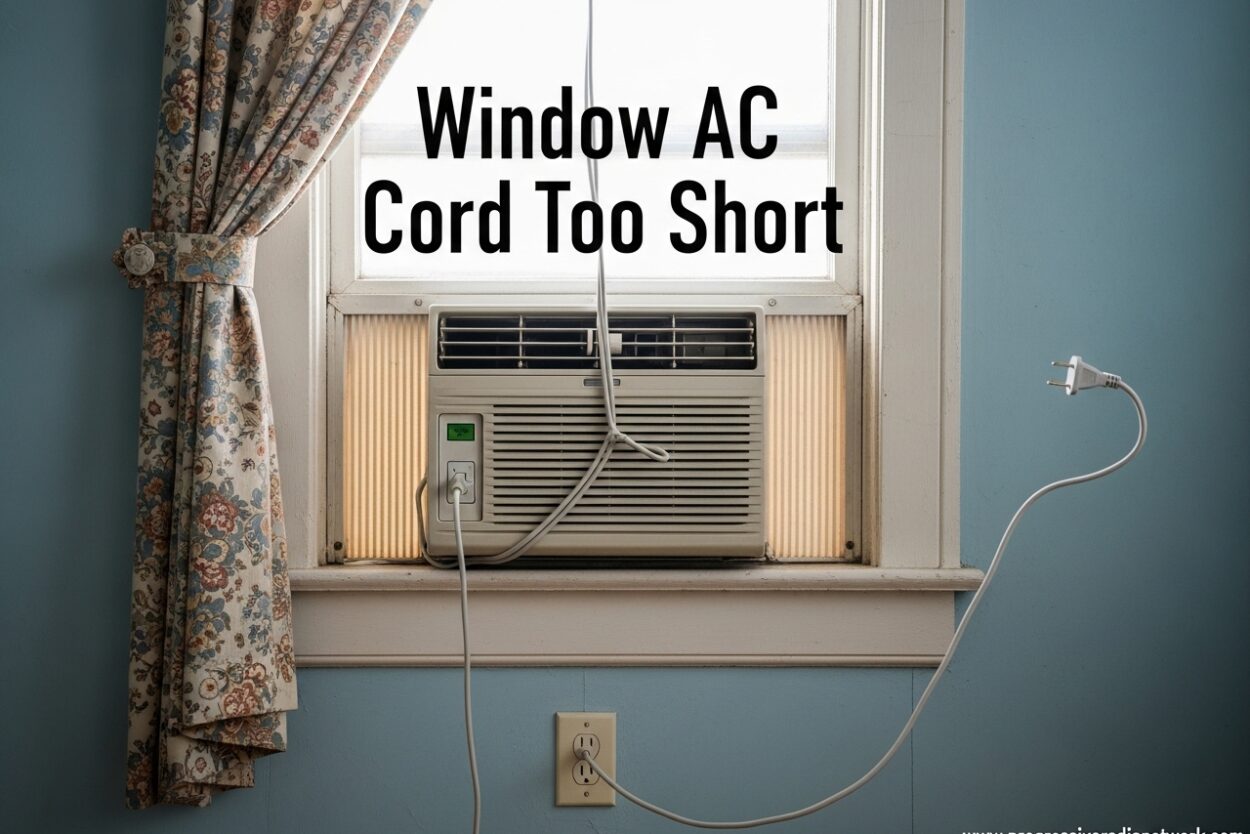
You’ve finally positioned your window air conditioner in the perfect spot, only to discover the power cord falls inches short of the nearest outlet. This frustrating scenario happens countless times each cooling season, leaving homeowners searching for safe solutions rather than resorting to dangerous workarounds.
The Window AC Cord Too Short problem isn’t just inconvenient—it’s a genuine safety concern that requires proper understanding of electrical requirements, plug types, and code-compliant solutions. Using the wrong extension cord or attempting unsafe modifications can create fire hazards, damage your AC unit, or void your warranty.
This guide covers everything you need to know about safely extending your window AC’s reach, from understanding why cords are intentionally short to choosing the right heavy-duty extension cord or replacing the power cord entirely.
Why Are Window AC Cords So Short?
Window air conditioner cords aren’t short by accident—manufacturers design them that purposefully to comply with National Electrical Code (NEC) requirements and safety standards. Shorter cords reduce tripping hazards, minimize voltage drop, and limit the risk of cords becoming damaged or pinched in window mechanisms.
Most window AC units come with power cords ranging from 4 to 6 feet in length. This minimum length is calculated based on typical installation scenarios where an outlet exists within reasonable proximity of the window. When manufacturers design these units, they assume installation will follow recommended guidelines with proper outlet placement.
While this design makes sense from a safety perspective, it doesn’t help when your room’s layout doesn’t match these assumptions. Older homes often have outlets placed in inconvenient locations, and apartment dwellers may have zero control over electrical placement. That’s when you need a safe, code-compliant solution to bridge the gap between your AC and the power source.
Safety Warning: Understanding the Risks
Before exploring solutions, it’s crucial to understand what’s at stake. Window air conditioners draw significant power—typically 5 to 15 amps depending on BTU capacity. This high current draw creates real risks when using improper extension methods.
Using a standard household extension cord (typically 16-gauge or thinner) with a window AC can cause the cord to overheat, potentially leading to melted insulation, electrical fires, or damage to your AC unit’s compressor. The voltage drop from an undersized cord can also cause your AC to work harder, draw more amps, and trip breakers.
Never splice cords, use damaged cords, or attempt to modify your AC’s electrical system unless you’re qualified to do so. These shortcuts create serious hazards that aren’t worth the risk. The solutions outlined in this guide prioritize safety first.
Identifying Your AC Plug Type (NEMA Configurations)
Before buying any extension solution, you must identify your AC unit’s plug type. Window air conditioners use various NEMA (National Electrical Manufacturers Association) configurations depending on voltage and amperage requirements.
The most common window AC plug types include:
NEMA 5-15P — Standard 125V, 15-amp plug with two flat blades and a ground pin. Found on smaller window AC units (5,000-8,000 BTU) and most common in residential settings.
NEMA 6-15P — 250V, 15-amp plug with two horizontal blades and a ground pin. Used on mid-sized units that require higher voltage operation.
NEMA 6-20P — 250V, 20-amp plug with one horizontal and one vertical blade plus ground pin. Found on larger window AC units (12,000+ BTU) and requires matching 20-amp receptacle.
Check your AC unit’s specification plate or manual to confirm plug type and electrical requirements. Using an adapter to fit a different receptacle type is generally not recommended and may violate electrical codes.
Window AC Cord Too Short: Solution 1: Using a Heavy-Duty Extension Cord
For most homeowners facing the Window AC Cord Too Short problem, a properly rated heavy-duty extension cord provides the simplest solution. However, not just any extension cord will do—you need one specifically designed for high-amperage appliances.
For window air conditioners, you need a minimum 14-gauge extension cord for units drawing up to 12 amps, and 12-gauge for larger units drawing 12-15 amps. The lower the gauge number, the thicker the wire and the more current it can safely carry. A 14-gauge cord rated for 15 amps (1,875 watts) will handle most residential window AC units safely.
Keep your extension cord as short as possible—ideally 6 feet or less. Longer cords increase resistance and voltage drop, which can cause performance issues and potential overheating. Every extra foot of cord adds resistance to the circuit.
Look for extension cords specifically labeled as “appliance rated” or “heavy-duty” with UL or ETL certification. These cords use thicker wire, better insulation, and proper grounding designed for continuous high-current applications. Avoid light-duty household cords, which are typically 16-gauge and not rated for AC use.
Wire Gauge Guide: 12-Gauge vs 14-Gauge
Choosing the right wire gauge is critical for safe operation. Here’s a quick comparison to help you decide:
14-Gauge Extension Cord — Rated for up to 15 amps (1,875 watts). Suitable for most window AC units under 12,000 BTU. More flexible and easier to find in retail stores. Adequate for runs up to 25 feet when carrying near-maximum load.
12-Gauge Extension Cord — Rated for up to 20 amps (2,500 watts). Required for larger window AC units (12,000+ BTU) or any unit drawing close to 15 amps. Better choice for longer runs (25-50 feet) as it minimizes voltage drop. Slightly thicker and less flexible but offers more headroom for safety.
When in doubt, choose the heavier 12-gauge cord. The extra capacity provides safety margin and ensures your AC receives full voltage for optimal performance and efficiency.
Window AC Cord Too Short: Solution 2: Replacing the Power Cord
For a more permanent solution, you can replace your AC unit’s entire power cord with a longer one. This approach eliminates the extension cord connection point and provides a clean, professional installation.
Replacement power cords for window AC units are available from appliance parts suppliers and online retailers. You’ll need to match your unit’s plug type (NEMA configuration), voltage rating, and amperage capacity. Most window ACs use standard three-prong configurations that are readily available.
Replacing the cord requires opening the AC unit’s cabinet, disconnecting the internal wiring, and installing the new cord with proper connections. This involves working with electrical components and should only be attempted if you’re comfortable with basic electrical work. Always disconnect power completely before beginning any repair.
If you’re uncertain about any aspect of cord replacement, this is the time to call a professional. The cost of hiring an electrician is far less than the potential cost of an electrical fire or damaged equipment.
When NOT to Use an Extension Cord
While extension cords can solve the Window AC Cord Too Short problem, there are situations where they should never be used:
Never use an extension cord with a window AC if the cord shows any signs of damage, fraying, or overheating. Damaged cords are fire hazards and should be replaced immediately.
Avoid running extension cords under carpets, rugs, or through doorways where they can be pinched or damaged. Hidden cords can overheat without ventilation and create tripping hazards.
Don’t daisy-chain multiple extension cords together. Each connection point increases resistance and potential failure points. Use a single cord of adequate length instead.
Never plug your window AC into a power strip, surge protector, or multi-outlet adapter. These devices aren’t designed for the continuous high-current draw of air conditioners and can overheat or fail catastrophically.
Cost Comparison: Extension Cord vs Cord Replacement
When deciding how to solve your Window AC Cord Too Short issue, cost is often a factor. A quality heavy-duty extension cord typically costs between $20-50 depending on length and gauge. This is the quickest solution and requires no installation.
Replacement power cords range from $30-80 depending on length and plug type. If you’re comfortable doing the work yourself, this provides a more permanent solution. However, hiring an electrician for cord replacement typically costs $100-200 including labor and parts.
For most homeowners, a quality extension cord offers the best balance of safety, convenience, and cost. Reserve cord replacement for permanent installations or when extension cord use isn’t practical for your space.
When to Call an Electrician
Sometimes the Window AC Cord Too Short problem reveals bigger electrical issues. Consider calling a licensed electrician if:
Your AC requires a 240V outlet but you only have standard 120V outlets available. Installing the proper circuit requires professional electrical work.
The nearest outlet is on a different circuit that can’t handle the additional load. An electrician can evaluate your electrical panel and recommend solutions.
You’re uncomfortable performing any electrical work yourself. Safety should always come first, and professional installation provides peace of mind.
An electrician can also evaluate whether a new outlet closer to your AC installation location would be a better long-term solution than using extension cords or replacement cords.
Frequently Asked Questions
Why are AC cords so short?
AC cords are kept short by design to comply with National Electrical Code safety requirements. Shorter cords reduce tripping hazards, minimize voltage drop, and prevent cord damage from window mechanisms. They’re designed for installations where outlets are within reasonable proximity of the unit.
Can you run a window AC off an extension cord?
Yes, but only with a properly rated heavy-duty extension cord. Use minimum 14-gauge for units under 12 amps and 12-gauge for larger units. Keep the cord as short as possible (6 feet or less), avoid light-duty household cords, and never use power strips or surge protectors with window AC units.
What gauge extension cord do I need for a window AC?
For most window AC units under 12,000 BTU, use a 14-gauge extension cord rated for 15 amps. For larger units (12,000+ BTU) or any unit drawing 12-15 amps, use a 12-gauge cord rated for 20 amps. Lower gauge numbers indicate thicker wire that can safely carry more current.
Is it safe to use a 100 foot extension cord?
No, a 100-foot extension cord is not safe for window AC use regardless of wire gauge. Excessive length causes significant voltage drop that can damage your AC compressor and create overheating risks. Keep extension cords as short as possible—ideally 6 feet or less, and never exceed 25 feet for high-amperage appliances.
What is the 3 minute rule for air conditioners?
The 3-minute rule refers to waiting 3-5 minutes after turning off your AC before restarting it. This allows pressure in the refrigerant system to equalize, preventing compressor damage. Many modern ACs have built-in delay timers, but manually waiting protects your unit if it doesn’t have this feature.
Conclusion
Dealing with a Window AC Cord Too Short doesn’t have to mean risking safety with improper electrical connections. Whether you choose a heavy-duty extension cord or opt for professional cord replacement, the key is prioritizing proper wire gauge, adequate amperage rating, and code-compliant installation.
By understanding your AC’s electrical requirements and choosing the right solution for your situation, you can enjoy cool, comfortable temperatures without the worry of electrical hazards. When in doubt, consult a licensed electrician—safety always comes first when working with high-draw appliances like air conditioners.


Leave a Comment