
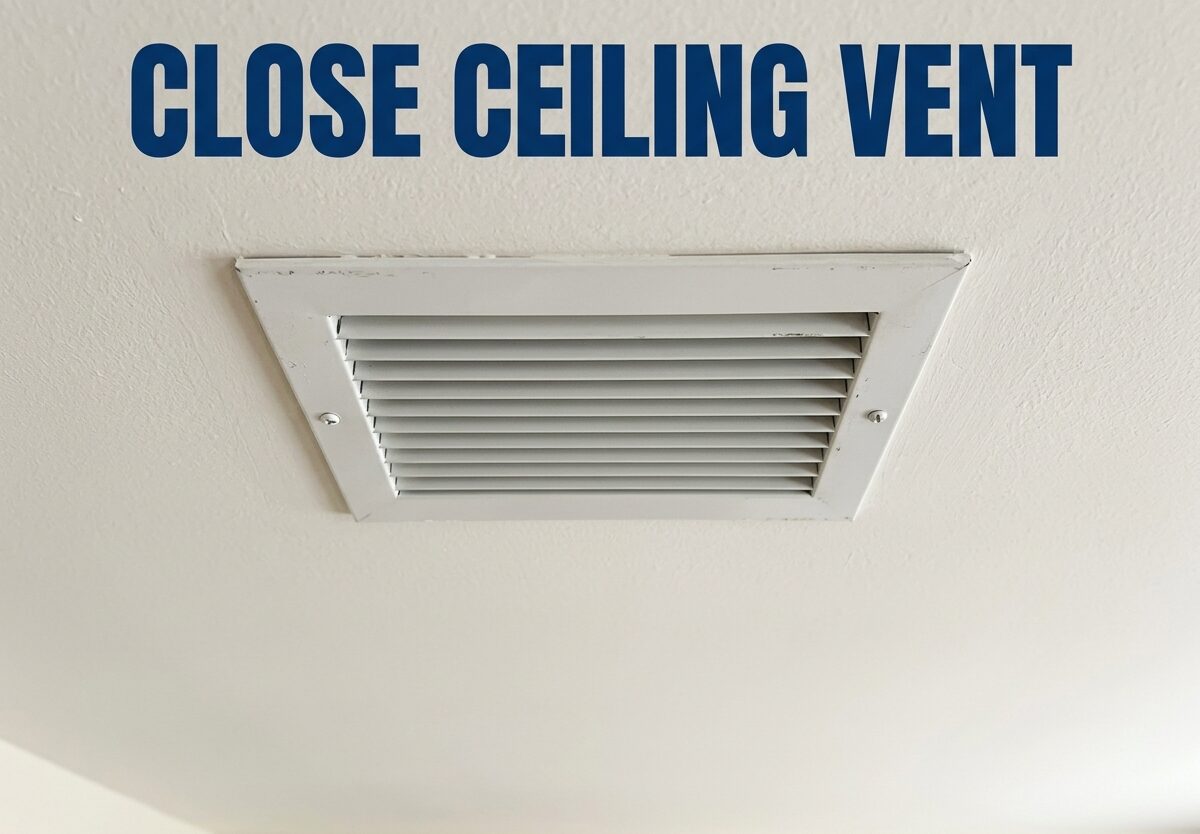
Learning how to properly close a ceiling vent gives you control over room temperature and HVAC system efficiency. Ceiling vents contain adjustable dampers that regulate airflow, but many homeowners don’t understand the correct way to operate them. I’ve spent years researching HVAC best practices, and I’m sharing what you need to know about ceiling vent operation to avoid damaging your system.
What Is a Ceiling Vent and How Does It Work?
A ceiling vent, also called a ceiling register or air diffuser, is the metal or plastic grate through which conditioned air enters your room from the HVAC ductwork. Inside the vent housing sits a damper mechanism – either a butterfly damper (metal plates that rotate) or adjustable fins – that controls airflow volume.
The damper connects to a lever, dial, or slider on the vent’s face. When you adjust this control, you’re changing the angle of the internal damper plates. Fully open allows maximum airflow, while fully closed blocks air completely. Most ceiling vents are supply vents delivering heated or cooled air, but some homes also have ceiling return vents that pull air back into the system.
Understanding your vent type matters because each operates differently. Rectangular vents typically use lever or dial controls, while round vents often have butterfly dampers that require a special tool or removal of the vent cover to adjust.
How to Tell if Your Ceiling Vent Is Open or Closed
Visual inspection is the easiest way to check vent position. Look at the vent’s lever or dial control – most have indicators showing open/closed positions. A lever perpendicular to the vent opening typically means closed, while parallel indicates open. Dial controls usually rotate fully counterclockwise for closed and clockwise for open.
If no visible controls exist, hold a tissue or thin paper near the vent while your HVAC runs. Air movement will disturb the paper if the vent is open. No movement suggests either a closed damper or blocked ductwork. For round ceiling vents, you may need to remove the cover to see the butterfly damper position inside the duct.
Some homes have vents painted shut during renovations, which makes manual inspection impossible. In these cases, the airflow test with a tissue paper is your best option.
How to Close a Ceiling Vent
Closing a ceiling vent properly depends on your vent type. Follow these steps for the most common ceiling vent designs:
For Lever-Operated Vents:
1. Locate the metal lever on the vent’s side or face
2. Slide or flip the lever until it’s perpendicular to the vent opening
3. Verify by placing your hand over the vent – you should feel minimal airflow
4. If the lever is stiff, use gentle pressure to avoid breaking it
For Dial-Control Vents:
1. Find the round dial mechanism, usually in the vent’s center
2. Rotate the dial fully counterclockwise until it stops
3. Listen for the damper plates closing inside the vent
4. Test airflow with your hand to confirm reduced output
For Round Ceiling Vents with Butterfly Dampers:
1. Turn off your HVAC system for safety
2. Use a step ladder to reach the vent safely
3. Grasp the vent edges and pull downward to remove the cover
4. Locate the butterfly damper inside the duct opening
5. Rotate the damper wing nut or use a vent adjustment tool to close the plates
6. Replace the vent cover by pressing it back into place
For ceiling vents without visible controls, the damper may be accessible only after removing the vent cover. Most vent covers either unscrew (you’ll see visible screws) or pull down with gentle pressure after releasing spring clips.
Tools for Reaching High Ceiling Vents
High ceilings make vent adjustment challenging without proper equipment. A sturdy step ladder rated for your weight is essential for safely reaching vents above eight feet. For vaulted ceilings or second-story foyers, consider an extension ladder with a stabilizer.
I’ve seen homeowners use creative DIY solutions like broom handles with hooks bent into the end to manipulate vent levers from the ground. While this works in a pinch, it risks damaging the vent mechanism. A better investment is a vent adjustment tool – a long pole designed specifically for reaching high ceiling vents with lever or dial controls.
For magnetic vent covers, a telescoping pole with a magnetic tip lets you install or remove covers without climbing. Always prioritize safety over convenience when working at heights.
How to Handle Stuck or Broken Vent Levers
Stuck vent levers usually result from paint buildup, rust, or debris in the damper mechanism. Start by cleaning around the lever with a damp cloth to remove paint or grime. For stubborn cases, apply a penetrating lubricant like WD-40 and work the lever gently back and forth until it loosens.
If the lever breaks off completely, you’ll need to remove the vent cover to access the damper directly. Most dampers can be operated manually by reaching into the duct with needle-nose pliers or a screwdriver. Turn the damper to your desired position, then consider replacing the entire vent assembly for future convenience.
Rounded vent covers with rusted screws present another challenge. Spray the screws with penetrating oil and let it sit for 15 minutes before attempting removal. Use the correct screwdriver size to avoid stripping the screw head. If screws are stripped, drilling them out may be necessary – but consider calling a professional at this point to avoid damaging the ceiling.
Warning: Why You Should Not Close Too Many Vents
Closing more than 20-25% of your home’s supply vents creates serious problems for your HVAC system. Your furnace or air conditioner is designed for a specific airflow volume based on your home’s ductwork size. Closing vents increases air pressure inside the ducts, forcing conditioned air to escape through leaks in unconditioned spaces like attics or crawlspaces.
This pressure also strains your blower motor, potentially shortening its lifespan. In extreme cases, closed vents cause the heat exchanger to overheat and crack, creating a carbon monoxide risk. The energy savings you hope to achieve are largely illusory – your system works harder and longer to compensate for reduced airflow.
Instead of closing vents in unused rooms, consider zoning systems, smart vents that automatically balance airflow, or simply adjusting the thermostat. If you must close a vent, never close more than one or two in a single heating or cooling zone.
Alternative Methods for Airflow Control
Magnetic vent covers offer a reversible solution without permanently altering your vents. These thin magnetic sheets attach over the vent face and can be removed seasonally. They’re especially useful for rooms you rarely use but don’t want to seal permanently.
For homes with forced air systems, redirecting airflow is often better than blocking it entirely. Adjust the fins on your vents to aim air toward the center of the room rather than directly at windows or exterior walls. This improves comfort without creating the pressure problems associated with closed vents.
FAQs
Is there a way to close ceiling vents?
Yes, ceiling vents can be closed using the built-in damper mechanism. Most vents have a lever, dial, or slider control that adjusts the internal damper plates. For vents without visible controls, remove the vent cover to access the butterfly damper inside the duct and rotate it to the closed position.
How do I know if my ceiling vent is open or closed?
Check the vent’s control mechanism – levers perpendicular to the opening usually indicate closed position, while parallel means open. For dial controls, fully counterclockwise is typically closed. You can also test airflow by holding tissue paper near the vent while the HVAC runs – movement indicates an open vent.
Can you block a ceiling vent?
You can block ceiling vents with magnetic vent covers or by closing the built-in damper, but never block more than 20-25% of your home’s total supply vents. Blocking too many vents increases duct pressure, strains your HVAC system, and can cause heat exchanger damage or carbon monoxide risks.
Is it bad to close ceiling vents in unused rooms?
Closing a few vents in unused rooms is generally acceptable, but avoid closing more than one or two vents per HVAC zone. Closing too many vents increases air pressure in your ductwork, forces conditioned air to escape through leaks, overworks your blower motor, and can lead to expensive heat exchanger damage.
What should I do if my ceiling vent is stuck?
Start by cleaning around the stuck lever or dial with a damp cloth to remove paint or debris. Apply penetrating lubricant and work the mechanism gently. If the lever breaks, remove the vent cover and operate the damper directly with pliers. For rusted or severely stuck vents, consider replacing the entire vent assembly.
Conclusion
Learning how to close ceiling vent assemblies properly gives you better control over your home’s comfort while protecting your HVAC investment. The key is identifying your vent type – lever, dial, or butterfly damper – and using the appropriate adjustment method. Always remember the 20-25% rule for closed vents to avoid damaging your system.
When vent levers are stuck, start with cleaning and lubrication before attempting more forceful measures. For high or vaulted ceilings, invest in proper equipment rather than risking injury with makeshift tools. If you’re unsure about any aspect of ceiling vent operation, consulting an HVAC professional is always safer than experimenting with your system.
Proper ceiling vent management is about balance – directing conditioned air where you need it without compromising your HVAC system’s efficiency or longevity.




Leave a Comment