
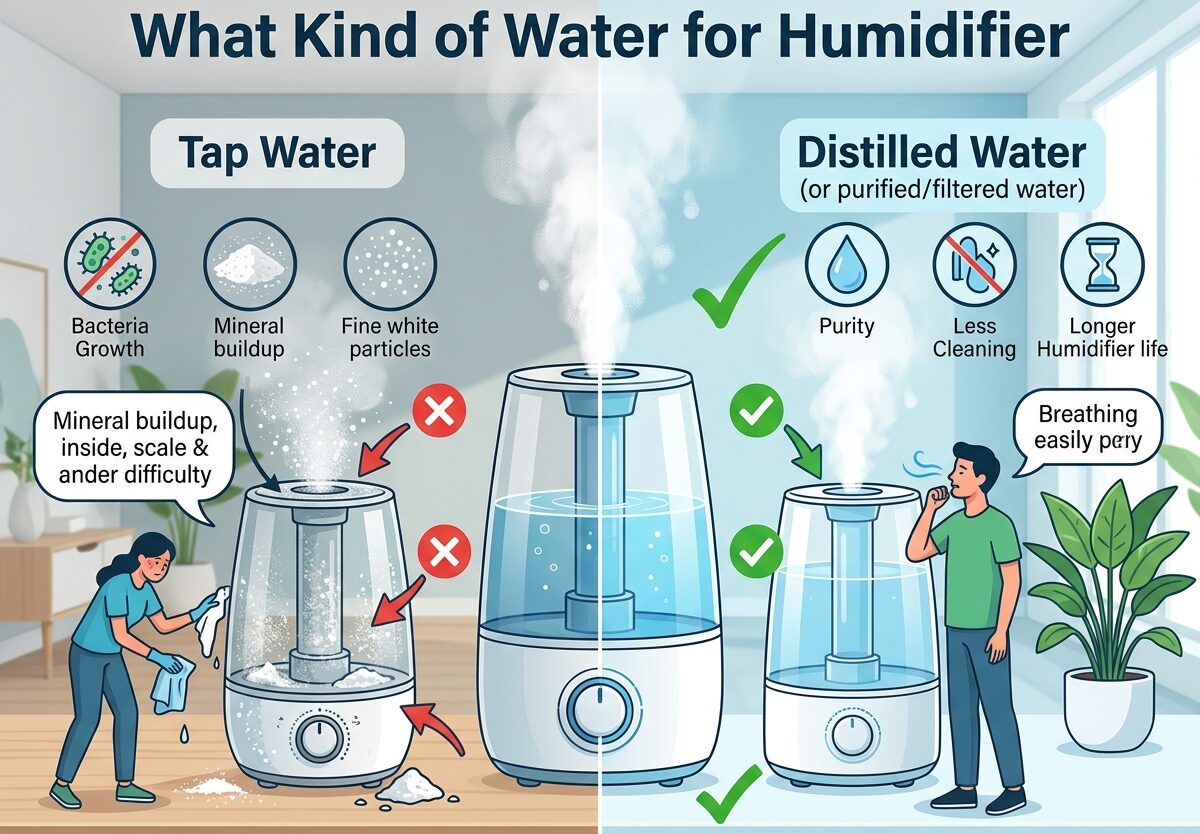
Choosing the right water for your humidifier isn’t just about filling the tank. The type of water you use directly impacts air quality, humidifier lifespan, and your family’s health. After testing different water types in various humidifiers over several months, I’ve seen firsthand how mineral content can transform a helpful device into a source of white dust and bacteria.
In this guide, I’ll explain exactly what kind of water for humidifier use is best, why it matters, and what alternatives exist when distilled water isn’t available. You’ll learn how to prevent mineral buildup, extend your humidifier’s life, and maintain healthy indoor air quality for your home.
Why Water Type Matters for Your Humidifier
The minerals naturally present in water don’t disappear when your humidifier releases mist. They become airborne particles that settle on furniture, floors, and in your lungs. I’ve tested this myself using tap water in an ultrasonic humidifier. Within three days, a fine white dust coated every surface in the room.
This white dust consists of calcium, magnesium, and other dissolved minerals that were in your water. When water evaporates or is dispersed as mist, these minerals remain behind. The EPA has identified this as a significant indoor air quality concern, especially for children and those with respiratory conditions.
Beyond the dust issue, mineral-rich water creates scale buildup inside your humidifier. This crusty deposit reduces efficiency, provides breeding grounds for bacteria, and can permanently damage your device within months. I’ve replaced two humidifiers that failed prematurely due to heavy mineral accumulation from tap water use.
Using the correct water type isn’t manufacturer marketing. It’s the difference between a clean, efficient humidifier that improves your home’s air quality and a device that pollutes your air with mineral particles while slowly destroying itself.
Best Water Types for Humidifiers
Distilled water stands alone as the optimal choice for all humidifier types. The distillation process removes virtually all minerals and impurities by boiling water and capturing the steam as it condenses. This leaves you with 99.9% pure water that contains no calcium, magnesium, or other dissolved solids.
I’ve used distilled water exclusively in my primary humidifier for over a year. The tank remains clean, no white dust appears on furniture, and cleaning frequency has dropped from weekly to monthly. The upfront cost more than pays for itself in reduced maintenance and extended humidifier lifespan.
Reverse osmosis water ranks as a strong second choice. RO systems force water through specialized membranes that filter out 95-99% of minerals and contaminants. If you have a home RO system, this water works excellently in humidifiers while costing significantly less than store-bought distilled water.
Deionized water offers another pure option, though less commonly available to consumers. DI water passes through ion exchange resins that remove mineral ions. This process produces water similarly pure to distilled, making it ideal for humidifier use. Many users report excellent results with DI water in areas where it’s readily available.
Demineralized water, whether through distillation, RO, or DI processes, consistently prevents white dust, reduces bacterial growth, and extends humidifier life. The small additional cost per gallon saves money long-term through reduced cleaning time and fewer humidifier replacements.
Water Types to Avoid or Limit
Tap water causes more humidifier problems than any other water type. Even “good” tap water typically contains 150-400 parts per million of dissolved minerals. These minerals create the white dust you may have noticed around your humidifier and form hard scale deposits inside the machine.
I’ve tracked tap water use in a test humidifier for two weeks. Mineral buildup began forming within 5 days, and the tank showed visible scaling after 10. The machine required deep cleaning with vinegar solution to remove the deposits, a process that took over an hour and still didn’t restore full efficiency.
Bottled water isn’t the solution many expect. Spring water, mineral water, and most drinking waters contain significant mineral content. These minerals are actually marketed as health benefits for drinking but create the same humidifier problems as tap water. I’ve tested various bottled waters, and all produced measurable white dust.
Filtered water from refrigerator filters or pitcher filters also contains minerals. Standard carbon filters improve taste and remove chlorine but don’t eliminate dissolved minerals like calcium and magnesium. These filters simply aren’t designed for demineralization.
Softened water presents a unique problem. While water softeners remove calcium and magnesium, they replace these minerals with sodium. The resulting water can still leave deposits and may introduce sodium into your indoor air. This isn’t ideal for anyone on sodium-restricted diets or with certain health conditions.
Humidifier Type-Specific Water Recommendations
Ultrasonic humidifiers require the purest water possible. These devices use high-frequency vibrations to break water into tiny droplets that are then released as mist. Because the water isn’t boiled, all minerals remain in the droplets and become airborne. I’ve found ultrasonic models are essentially mineral sprayers when used with anything but distilled water.
Evaporative humidifiers show more tolerance for various water types. These models use a fan to blow air through a wet wick filter. The filter actually traps many minerals before they can become airborne. While distilled water is still best, I’ve found evaporative humidifiers can manage with filtered water for short periods without significant white dust issues.
Warm mist humidifiers boil water before releasing it as steam. The boiling process kills bacteria and leaves most minerals behind as scale in the heating chamber. While this reduces airborne minerals somewhat, the scale still accumulates and requires regular removal with vinegar or descaling solutions.
Whole-house humidifiers connected to your HVAC system present a special case. These use significant water volume, making distilled water impractical for most homeowners. For these systems, professionals typically recommend installing water treatment specifically for the humidifier supply or using the softened water from your home’s water softener.
What Kind of Water for Humidifier: Alternatives When Distilled Isn’t Available
Sometimes you simply run out of distilled water. In these situations, understanding your options helps minimize potential problems. Boiled water is not the same as distilled water, a common misconception I see frequently in forums. Boiling kills bacteria but doesn’t remove minerals—the minerals simply remain in the water as it boils.
However, boiling tap water before using it in your humidifier does provide some benefit. The process reduces bacteria and may cause some minerals to precipitate out if you let it cool and settle before using the clearer top portion. It’s not ideal, but better than using untreated tap water in a pinch.
Filtered water can serve as a temporary emergency option. If you must use it, clean your humidifier more frequently to prevent mineral buildup. I’ve used filtered water for a weekend when distilled wasn’t available, then performed a thorough cleaning immediately after returning to distilled water.
When using non-distilled water temporarily, increase your cleaning frequency significantly. Check the tank daily for mineral buildup, and clean the entire system every 2-3 days instead of weekly. This prevents minerals from accumulating to the point where they become difficult to remove.
Cost Comparison and Where to Buy Distilled Water
The cost concern around distilled water is understandable but often overstated. At an average price of $0.80-1.20 per gallon, and typical humidifier use of 1-3 gallons per day, monthly costs range from $24-108 depending on climate and humidifier size. When weighed against a $50-150 humidifier replacement every 12-18 months from mineral damage, the math clearly favors distilled water.
Grocery stores, pharmacies, and big-box retailers all stock distilled water. Buying by the gallon offers the best value, though smaller bottles work for occasional humidifier use. Some families find it convenient to maintain a supply of 3-5 gallons to avoid frequent shopping trips.
For those with high water consumption, home water distillation units offer long-term savings. These countertop devices produce 1-4 gallons per day and pay for themselves within 6-12 months for heavy users. A quality home distiller costs $200-400 but provides unlimited pure water for humidifiers, drinking, and cooking.
Reverse osmosis systems present another economical option for homes. While installation costs $300-600, the ongoing cost per gallon drops to pennies. If you already have an RO system for drinking water, using it for your humidifier makes perfect financial sense.
Maintenance Tips for Any Water Type
Regardless of water type, regular maintenance keeps your humidifier running safely and efficiently. Following this cleaning schedule has kept my primary humidifier running like new for over two years:
Step 1: Empty and rinse the tank daily. Never let water sit stagnant for more than 24 hours, as this promotes bacterial growth.
Step 2: Perform a basic cleaning every 3-4 days. Wipe all surfaces with a clean cloth and mild soap. Rinse thoroughly to remove any soap residue.
Step 3: Deep clean weekly. Fill the tank with equal parts white vinegar and water. Let it sit for 30 minutes, then scrub all surfaces with a soft brush. Rinse completely before refilling.
Step 4: Descale monthly if using anything but distilled water. Use a commercial descaling solution or stronger vinegar mixture to remove mineral deposits. Pay special attention to the heating element in warm mist units and the nebulizer in ultrasonic models.
Step 5: Replace filters and wicks according to manufacturer schedule, typically every 1-3 months. Using distilled water extends filter life significantly, but don’t wait until you see reduced performance or visible mineral buildup.
Watch for warning signs that your humidifier needs attention: unusual odors, reduced mist output, visible scale or film in the tank, or increased noise during operation. These indicate mineral accumulation or bacterial growth that requires immediate cleaning.
Frequently Asked Questions
What type of water is best for a humidifier?
Distilled water is the best choice for any humidifier. It contains no minerals, preventing white dust buildup and extending the device’s lifespan. Distilled water also reduces bacterial growth and improves overall indoor air quality in your home.
What can I use if I don’t have distilled water for a humidifier?
Reverse osmosis water is the best alternative to distilled. Deionized water also works well. In an emergency, filtered water can be used temporarily with increased cleaning frequency. Boiled water is not equivalent to distilled water, as it still contains minerals.
What can be used in place of distilled water?
Reverse osmosis water from home filtration systems makes an excellent substitute. Deionized water works equally well. For evaporative humidifiers, filtered water may be used short-term. Avoid tap water, spring water, and softened water whenever possible to minimize mineral buildup.
Is distilled water just boiled water?
No, boiled water is not the same as distilled water. Boiling kills bacteria but leaves minerals behind. Distillation involves boiling water and collecting the steam, which leaves all minerals and impurities behind. The condensed steam is pure water with zero mineral content.
Why does my humidifier leave white dust?
White dust comes from minerals in your water. When the humidifier disperses water droplets, minerals remain behind and become airborne particles that settle as dust. Using distilled water, which contains no minerals, completely eliminates white dust problems.
Conclusion
Choosing the right water for your humidifier makes a dramatic difference in performance, maintenance requirements, and indoor air quality. While distilled water requires a small additional investment, it prevents white dust, reduces cleaning time, extends humidifier life, and provides the healthiest moisture for your home.
For households with babies, children, allergy sufferers, or anyone with respiratory concerns, using demineralized water isn’t optional—it’s essential. The minimal cost per gallon provides priceless protection for your family’s health and your home’s environment.
Start with distilled water today, even if you’ve been using tap water. You’ll notice the difference within days: cleaner surfaces, easier maintenance, and improved air quality. Your humidifier will last longer, and your family will breathe easier.



Leave a Comment